House of Cards

Most of us don’t choose to be caregivers. Then next thing you know, you find yourself standing on a house of cards.

Last night a friend was at a neighboring table for dinner with her husband and another couple. After they had eaten dinner, the other couple left. As our friend tried to leave, her husband refused. As he’s endured multiple severe health issues, life circumstances now have our friend in the dual role of wife and caregiver. He wouldn’t leave because he’d forgotten he’d eaten dinner, and thought his wife was trying to make him leave before eating. Try as she might to convince him he’d already eaten, he sat steadfast.

Though the differences are many, I saw many parallels in Wil’s determination not to be swayed and our friend’s husband’s determination. I intimately knew the tears in her eyes. I felt her frustration not of just that moment, but of all the moments built as carefully, patiently, diligently and lovingly as a teetering stack of cards; that in just one moment, comes falling down.

After the cards collapse a number of times, you just feel so tired of it all. All of those cards, all over the floor, and one by one you must build them back again. Sometimes, it goes smoothly, and sometimes that one card keeps falling so as it’s impossible to build on it.

I knew this cycle with Wil. The only two solutions our friend had at this point were to wait him out until he decided for himself it was time to go (which could be hours) or a fresh voice to break the spell (as the caregiver’s voice is heard so many times, pleas can fall on deaf ears). It is a new face, or a new voice, that often breaks the spell.

My dad was the one who stepped in, and I looked at our friend, our eyes connecting in a knowingness. It’s hard, and no one asked this kind of hard, but there is so much love here, so much that we’d do for our loved ones, that makes the hard parts both more challenging, and yet strengthens us at the same time. And when friends step in to help, the wobbly card steadies and we can start building again.

Just before the holidays, a member at work shared with me that she was bringing her mother, who has dementia and lives in Florida, back to Michigan for a visit. She said, “Though Wil and my mom have many differences, I now know how you feel when you fly with him. You just don’t know if they will cooperate or not, so you prepare the best you can. Then you find out there is always something you didn’t think of, and things fall apart. And other times things go so smoothly that you wondered how you worried at all. You just don’t know.”

While visiting my parents in Florida, Katherine, Elizabeth, Wil and I went to the Naples Zoo. Wil gets hot easily, so we went on the coolest day. When he grew tired and too hot, I found an area by the zebras which was shady and he really enjoyed. Though Wil is very capable of walking the zoo for the day, its his building overstimulation with the heat, with the crowds and with the animal noises that eventually get to him.

Every year I find ways to keep him at the zoo longer. Every year I learn from the previous year. But I never let him sit it out. Because every year Wil learns how much more he can do. I’m fortunate that the twins can walk off to enjoy the zoo on their own, and circle back to Wil and me, instead of stopping every time Wil and I do. They know how this works. We build the house of cards together.

When Wil finally hits a wall after stops and starts, he still has to make his way back to the zoo entrance. As this zoo is near my parents’ home, they are fortunately available to pick Wil up when that “wall” is hit. I sit with Wil as long as he needs me to, as his will to walk to the entrance is his only way out.

We don’t choose our situations; they choose us. But we do choose how to utilize the time within our situation. We do choose whether to keep building, even after the cards have fallen. When times get hard, locking tearing eyes of understanding mean more than words could ever convey. They give us strength to build again and again; as many times as it takes.

Internal victories are what carry you and lift you through the hard times. Even 30 more minutes at the zoo on this visit delivered an internal joy with iron-clad strength—a strength and joy that will not fade with time or circumstances. I can build a million cards with the super-sonic strength of 30 extra zoo minutes many take for granted.

Caretaking is unpredictable and challenging, yet it brings out our best, and brings us all together if we allow it to. It’s what humanity is all about. (But if you challenge a caretaker to a house of card building game, they will mercilessly kick your ass.)

Processing Time

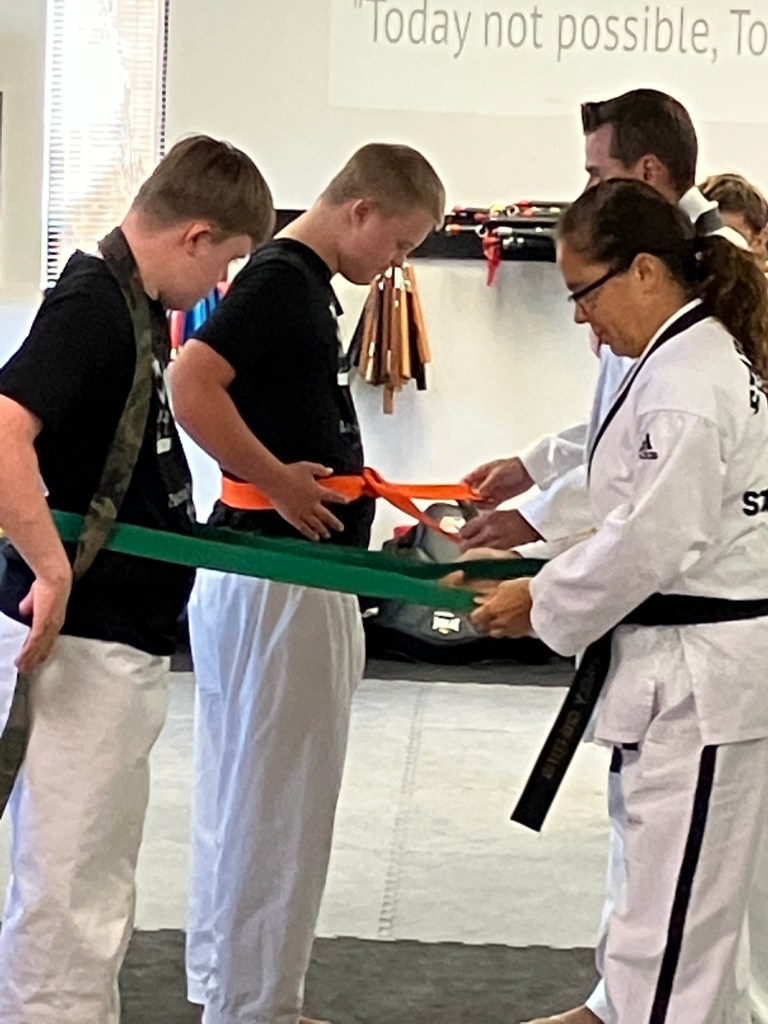
Wil attended his first taekwondo tournament last Saturday. The environment had the potential of causing sensory distress within Wil. I had been to many taekwondo tournaments in the past with Katherine, as she worked her way up to a blackbelt. There would be many people moving around on the gym floor, and spontaneous announcements over the loud speaker —both high sensory triggers for Wil. (Though we have a large dog, Wil is leery of other dogs because of spontaneous barking. The same goes for babies crying, sports announcers over a microphone, and events like pep rallies where crowds and loud noises erupt without notice).

Wil, however, has grown in his ability to manage sensory distress. He’s become more self-aware and only wears his noise-cancelling headphones when he feels it’s an absolute necessity (he still won’t walk into a movie theater without them). He also loves taekwondo. He thrives on his independence in the taekwondo classroom, and also being with his friends, Alex and Nick, who have been practicing taekwondo for years. He looks up to both of them, and works hard to achieve their level of mastery.

When Senior Master practices form with Wil, Wil pays close attention. With his desire to do well, mixed with his growth in sensory rich environments, I knew the tournament would be a challenge for him, but a challenge he would deeply want to rise to.

When we arrived at Saline High School where the tournament was being held, there was a long line out the door. Wil held his excitement throughout the wait for the tournament ahead. The line moved quickly and one of the Masters at the front desk welcomed Wil by name and gave him a high-five. Wil gave him a hearty high-five in return. We were off to a great start!

We made our way down to the high school gym. Wil paused at the entry taking in the crowds. The set-up was the same as Katherine’s past tournaments. There were multiple squares of black mats, parallel to one another, with narrow walk ways in-between. Each square had a pole with a number attached to the top. As Wil’s “Special Abilities” hadn’t been called yet, I suggested we wait by a mat with fewer crowds. I took Wil’s big gear bag from him, so he could more easily maneuver his way, and we walked to the far side of the room where it was less populated. Wil stood against the wall, and I could feel him stiffen by the look on his face. But I also knew he was determined to be brave.

I attempted to break his tension with discussion about Alex and Nick. He nodded but became increasingly quiet. Even if I couldn’t see it, I knew perceptively that the tension within him was rising above his ability to manage it. I suggested we walk over to the bleachers but he shook his head. I pointed to open seats at the very first row of bleachers; I said we wouldn’t even have to climb the stairs. We could just sit and relax for a moment. He started taking little steps away, and I knew it wasn’t to sit on the bleachers. He was plotting his escape. When he took a forward step, I took one with him. I took his hand but he shook it off.

To any outsider watching, when he decided to bolt out of the gym, it would have seemed sudden. I dropped his gear bag on the spot. With the narrow walkways and crowds, I would have knocked someone over with it chasing Wil. I had no idea where Wil was going, and I didn’t want to lose him in the high school, or worse, the parking lot.

He exited the gym and took a sharp left down a long hallway. Closed double doors blocked further progress, so he took a seat in the corner between the double doors and the wall. He curled his knees up to his chest and wrapped his arms around them.

I crouched down to his eye level and talked quietly to him. He dropped his head to his knees. I knew he wanted to be in the tournament. I knew he was disappointed in running away. But he didn’t know how to get out of his emotions.

I reminded him that Master would be excited to see him. I reminded him that once he got on the mat he would be having so much fun, he’d forget everything else. Then I sat down and stayed quiet. I knew he also needed time to process everything. As hard as I tried, right now the moment was up to him.

And inside of me, I had reached my limit too. In efforts to keep Wil calm back in the gym, tension built within me. Would he run? Where would he run? Was I saying the right words or was I making it worse? Do I make him stay? Do I let him go? Do I just kept my mouth shut? Time always gives us the answer, but in situations like this time wasn’t on our side. Wil’s “Special Abilities” division would be called when it was, whether Wil was ready or not.

I was growing increasingly frustrated with myself, mixed with a sadness for him. Here we were, Wil 15 years old, and I’m sitting in a hallway with him. Will this ever get easier? Will things always be this struggle of wondering what will happen? Will I always need this patience and forethought with everything we do?

I know from experience that each tournament will be better. That Wil will know what to expect from his own experience, and we can talk about it with growing effectiveness. He can tell me if he wants to go, or not go, fully understanding the environment he’s walking into. When Wil feels ready to compete in a tournament, it will be the best day ever as we’ll both have grown from this very experience.

But that’s for another day and another time. Right there and then in the hallway, there is no sugar-coating it. It was just plain hard.

I asked Wil if he wanted to go home. He said yes. I told him I couldn’t go get his gear bag without him. That he would have to walk back through the crowds with me to get it, but that we would go right back out to the car.

So we walked back through the gym and grabbed his gear bag. I gave him credit for being so brave to walk back in, and I meant it. I knew that would build strength in him for next time. On our walk back out of the gym I heard my name called. I looked up into the bleachers and saw it was Eleanor, Alex’s mom. She was sitting with Alex, Nick, and Nick’s dad, Jeff. They waved for us to come up and sit with them. I felt envious that Alex and Nick were sitting up there, but we were about to leave. I swiped my hand across my neck symbolizing it was over for us. Eleanor’s nod back to me was like a big hug. She understood exactly what we were going through even though words were not exchanged between us.

Wil and I made it back to the car. I let the tears go silently, so as not to upset Wil, and started the car. As per usual, Wil took my phone out of my purse and clicked on the Amazon Music app, found a Luke Bryan song (right now he’s into the Spring Break album) and started singing with Luke.

It was hard to imagine Wil shrunken in hallway corner moments before as he belted out the lyrics to “Spring Break-Up.” It wasn’t that he’d already forgotten — he’d remember every detail. But to him that moment was over, and a new moment had begun.

I had more tears to let go first, and then I’d be able to move on. I guess we all have our own processing time.

A Good Morning!

Wil set the alarm on his iPad last night for school (I showed him how after asking the twins if they had an old alarm clock Wil could use. Elizabeth said, “Mom, just use his iPad” 🙄).

On mornings I work, Katherine or Elizabeth typically wake Wil. He is very independent now, and it’s getting rarer for him to have sluggish mornings. Even if he does get stuck at times, he recovers much quicker.

As getting Wil out of bed does not require the patient encouragement it used to, I suggested he try getting himself up. He was all about it.

Just last year, setting his own alarm would not have been an option. He would have felt abandoned. He required our encouragement and our consistency to start his day right. If there was even one chink in the chain, it could throw the whole day off.

Many of Wil’s behaviors have been associated with challenges in communication. But with his desire for independence, his communication skills continue to expand.

He has the maturity now to see how communication gets him where he wants to go. His ability to ask for help when he needs it, and to more clearly identify and express his emotions, has helped him make forward strides. He still runs off when he is overwhelmed or frustrated, and likely will for some time. But again, he recovers more quickly than in times past. The more exposure he has with these situations, such as his recent choir experience I wrote about, the more confidence he’ll build.

This morning Wil woke to his alarm, dressed in the outfit he picked out the night before, ate breakfast, filled his water bottle and put it in his backpack. When I got home from work, he was rocking in the rocking chair watching Wild Kratts.

“Mom! I’m all dressed!” He said as he popped out of the rocking chair with both arms raised.

Whenever Wil hits a growth spurt like this my head spins in wonder. Only a year ago, this leap wasn’t possible. Whenever I force time on Wil, he forces back. But when the foundation is laid, and we progress the best way we know how, the time reveals itself.

Proudly Hail’d

At last Friday’s homecoming game, Wil and five choir companions formed a half circle in front of a microphone. The spectators, packing the stands, rose with hats and hands placed over hearts. The perfectly uniformed Manchester marching band spanned the field behind the semi-circle of singers and began their patriotic play. I held my breath.

The stands full of spectators would not challenge Wil’s nerve (he likes to be on stage!) It would be the volume of the band; he becomes un-nerved with loud, unpredictable noises such as the cymbals. During practice rounds, when the cymbals were up, Wil was out.

Kristi Campbell called me to form a plan (thank God for amazing paraprofessionals!). Though Wil has made vast progress in his tolerance for loud noises, the chance of him fleeing the situation still wasn’t 0%. We both wanted Wil to shine; of his own will. So Kristi said she’d stand nearby, but unobtrusively. I said I’d take a spot in the front row of the stands (I wanted a front seat anyway!).

When the band played and the choir sang, it was flawless. Jacob Mann conducted the band forward — as he did a conductor’s walk backward. Mr. Throneberry conducted the semi-cirlce of singers. Wil smiled and seriously recalled his lyrics — I even detected some of his high notes over the microphone.

It was beautiful, inspiring and right on note (Wil may have been a few beats behind in places, but that’s right on note too). I’m so very proud of Wil, and I couldn’t more proudly have hail’d the way our town comes together!

Heavy and Light

Wil loves riding his recumbent bike around our property. The challenge is I can’t fully trust he won’t go out to the road. And it’s a busy road.

I was talking to fellow mother yesterday. Her 16-year-old son, who also has Ds, is in summer speech and occupational therapy with Wil. As much as her son loves swimming, she will never have a pool. For the same reason I need to check in on Wil on his bike. She can’t fully trust he won’t go in the pool unsupervised.

Our children are teenagers. They know they are teenagers, their bodies tell them they are teenagers, and they desire the independence of teenagers. And as a parent that has raised 3 babies to teenage-hood, I enjoy a certain measure of independence too.

Last night, Matt and I were enjoying relaxing together after dinner. Wil wanted nothing to do with relaxing. He went outside to ride, and sure enough when I went to check on him he was getting close to the road. He was likely trying to make the biggest circle around our yard that he could, but again, I can’t be fully sure.

Even at 15 years old, he requires an extra level of supervision. And possibly, or possibly not, for many more years to come. With Wil one thing is certain — I won’t know until I know. (If you are a neurotic planner like me, a child w Ds is your best cure! 😂)

Many of my friends are becoming empty nesters. Matt and I may or may not be. I knew this uncertainty would be a reality when Wil was born, but now that the reality is closer, its an interesting feeling of limbo to be in.

I love my life with Wil. He is so fun to be with. We sing in our off-key voices at the top of our lungs. He still surprises me with new milestones, and huge bear-hugs that now knock me over as he’s grown. I’m thankful to fully share in his youthful exuberance.

But I also have a child that may never fully grasp the risks of certain fundamental independences into adulthood. The fullness of that can feel very heavy at times.

And yet, when life feels heavy, it’s being in Wil’s presence that purely and fully lightens the load.

You Go Girl!

At the airport yesterday, Wil was struggling a bit with some young children crying.

As a Starbucks was nearby, I asked Elizabeth to walk him over there while I stayed with our carry-on luggage (as Katherine was in another shop).

Wil was reluctant at Starbucks too, so Elizabeth walked him back to sit with me. She then walked back to Starbucks to get herself something to drink. A woman walked up to Elizabeth while she waited in line for her drink. The woman said she observed Elizabeth with her brother, and expressed her admiration at Elizabeth’s mature patience and how she talked to Wil. Then the woman said, God Bless, and walked away.

Elizabeth was surprised, yet pleased, by this. She was just being a sister to Wil as she always is (and Katherine has this same mature patience with Wil, as well), and didn’t see her actions as anything different than normal behavior.

In Elizabeth’s everyday life, she lifted the spirits of another, and she was uplifted in return.

I’m proud of Elizabeth (always), and also proud of the woman who had the courage to step up and acknowledge Elizabeth.

Katherine, Elizabeth, Wil

Open Book Ice Cream

My high school science teacher was amazing. And I had very little interest in science. He practically leapt off the floor explaining the periodic table. It was like someone just put this amazing hot fudge sundae in front of him and he couldn’t wait to dig in.

What amazed me the most was that he taught this same lesson again and again, year after year. Yet every single day, he brought the excitement. To that same old periodic table. Everything fit in this nice, little box. The combinations, even if dynamic, were predictable. No surprises. I was bored out of my mind. But I loved my teacher. He almost made me want to love science, just because I loved his enthusiasm for the subject. 

Then, in college I discovered blue book tests. I could scrawl my thoughts, in glorious freehand, across the blissfully empty white pages with pale blue lines. An empty white page to me is one of the most beautiful sights there is. And to take your own pen and feel the flow under your own hand, now we are talking digging into rich, luscious hot fudge sundaes!

And I could make it a different sundae every day! Carmel on smooth, groovy days. Strawberry on fresh, sticky, summer days. Pineapple when I was feeling prickly and tart. Blue books were so beautifully, uniquely open-ended — there were no predictable combinations when interpreting a book or poem, even if the character’s names never changed. Every person is full of surprises!

When Wil went from preschool to kindergarten, he was able to string beads — big beads with big strings. But he had to take a test to evaluate his skills. In the test, he was to string a small bead with a small string. He couldn’t do it. There were only two boxes to check. A yes box and a no box. 

As a result, Wil entered kindergarten testing at a 6 month old fine motor skill level. He was well beyond that. The test failed, Wil didn’t. The same thing happened when Wil went to his 1st endocrinologist. Wil didn’t fit in the predictable boxes. As soon as I checked the “no box” that he hadn’t achieved a certain skill, I was told to skip to the next page. “But, wait, he can do some of the other skills on this page.” “No, he can’t.” Was the answer I received. Where was the blue book for me to fill out about my unpredictable son?

Upon the news of Wil’s kindergarten testing results, his speech therapist spoke up and said that there will be very open communication between Wil’s preschool teachers and Kindergarten teachers. That though the test measured certain skills, it will be the open communication that determines where Wil will start with his ability level. I felt the beautiful, crisp new pages open upon her words. 

I also found a new endocrinologist. I knew she was the one because when I told her of our experience, she handed me a blank sheet of paper along with the test. She said to write down all the skills the test does not cover and we’d go from there. Hot fudge sundae, anyone?

On February 5th, 2007, I learned first-hand that you can change just like that. That the person you were one second can change in the next. I couldn’t force Wil to be a typical boy. My choice was to learn what all of this meant and to write our own pages with it. That is why I’m deeply offended by any claims to “cure” Down syndrome. He is a beautifully, varied and valuable human being and his story is just beginning to be written. Why burn the pages when being part of the story is so much more meaningful?

I loved my science teacher even though I never grew a love for science. What I learned most from him is we all have our different passions. And not a single one of us fits in a perfect, little box. That may be why he felt the love for his periodic table. How everything had an answer when life didn’t. And for that, I love my blue book pages. Where I can scrawl out, in long free-hand, the ever changing and evolving interpretation of what’s around me. As long as we can make our life new every day, be it by the periodic table or a blue book, then it will be a place we can’t wait to dig into…and we get to choose the topping! 

Timberlake vs. Timbuktu

Wil had a quiz to study for last night. We decided together that he would study while Katherine was at CrossFit. If Wil comes along to CrossFit for a task such as studying, we typically go to Bigby Coffee and he gets a hot chocolate with sprinkles. After a few sips, some silliness and conversation, we get down to the business at hand. Last night he said no to Bigby.

“Where do you want to go?”

“Hmmm, don’t know.”

“How about McDonalds. You can get a chocolate shake, then we’ll study for your quiz.”

“Ok.”

When we arrived at McDonalds, we had an hour until we needed to be back to pick up Katherine. Wil made a quick scan of the play area. It was empty.

He tugged on my arm. “Mom, in there.”

“Ok, let’s order your shake first.” We walked up to the kiosk. He squinted.

“Put on your glasses, Wil.”

“No.”

“Here, just try.” I handed his glasses to him.

“Hey, I can see it.”

“Um, yeah silly. That’s why we like you to wear your glasses. You can see so much better.” He wears glasses for reading and occupational therapy, other than that he has no interest in them.

Wil made his chocolate shake order through the kiosk, reading every word on the kiosk proudly out loud.

“Great job, Bud.”

After the order was complete, he pulled off his glasses, and headed toward the play structure, his arm extended back to me with the glasses.

After playing in the play structure with lots of “look at me’s!” two other young boys entered. The increased noise level was enough for Wil. He made a quick exit. I followed him with his shake. He picked a table in the main area and we took a seat.

“Here are your glassesWil. Let’s do a little studying now.”

The subject of the quiz was the Empire of Ghana. His teacher condensed the lesson for him. After we got through the definition of Mali, the Niger River and Mansa Musa, I asked him, “What was the major trading city when Mali was at the height of it’s power?”

“Timberlake!”

“Wil, Justin Timberlake is a singer. He’s the voice of Branch in Trolls.”

“I see your true colors shining through, I see your true colors and that’s why I love you…”

“You love Trolls.”

“You?”

“Yes, I love Trolls too, Wil. And Justin Timberlake is a really good singer, and dancer. But the answer isn’t Timberlake. Let’s try again. What’s the major trading city?”

“Timberlake!”

“Wil.”

“Timberlake!”

“Dude, come on.”

“Timberlake!”

“Ok, it’s Timbuktu. Can you at least say Timbuktu for me?”

“Timberlake!”

“You are so silly. Do you want to watch a Timberlake video?”

“Yes, Can’t Stop the Feeling.”

We watched Can’t Stop the Feeling and True Colors. Then we got back to the quiz. I jumped ahead to the next definitions, we got through those fairly smoothly with the exception of mosque. He looked hard at the word and came out with “message.”

“Wil, good try, it’s mosque.”

“MosKE.”

“That’s right, say it again.”

“Message.”

“Honey, you just had it right. Mosque. Say it again. Mosque.”

“MosKE.”

“Good, again.”

“MosKE.”

“Good, ten times fast.”

“MosKE, MosKE, MosKE, MosKE, Ugh, ok Mom.”

“You got it.”

Then circled back to Timbuktu.

“Ok, Wil, what was the major trading city?”

“Timberlake!”

“Can you at least tell me you will answer Timbuktu on the quiz?”

“Timberlake!”

Special Needs, Peers & Boundaries

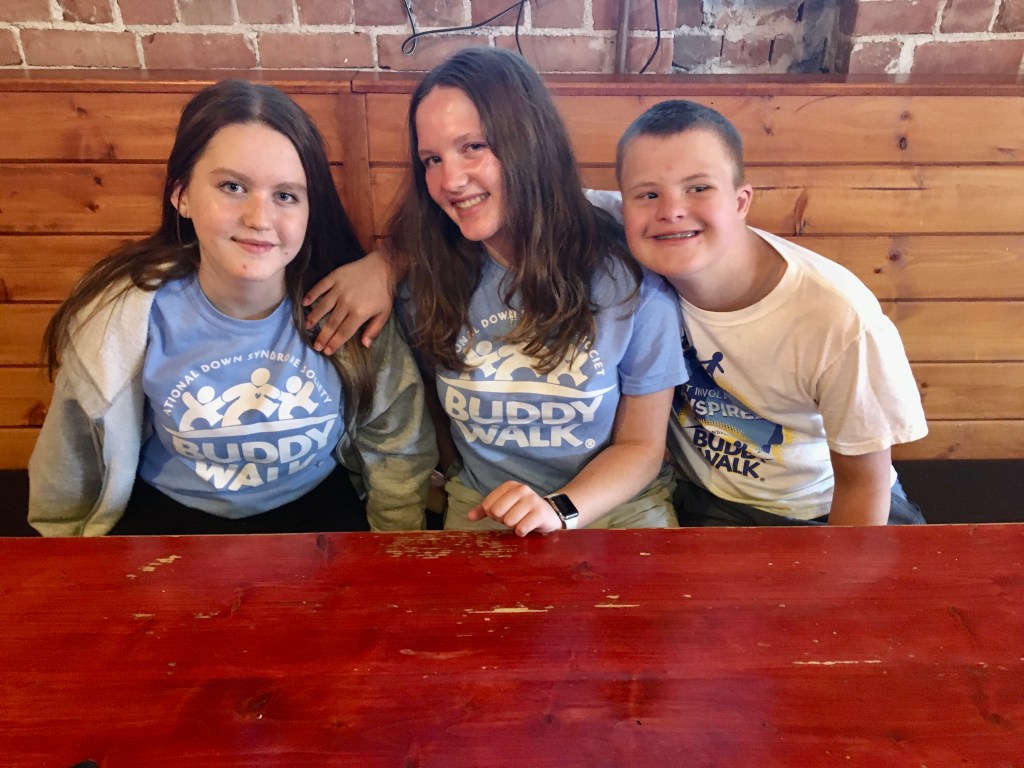
Many schools have a peer-to-peer program in the middle and/or high schools. These peer-to-peer programs are where a typically developing student is linked with a student with special needs. At our school this program is called Connect. Wil, who is in 7th grade, has been linked with two high school students, a male and a female.

Wil adores his Connect friends. They visit him during his Independent Life Skills time in the resource room. They work with him on projects, crafts and cooking. He most especially enjoys cooking with his Connect friends. It’s been an enriching experience for Wil to work with his Connect friends, and I believe for his Connect friends to work with him. On days when Wil is feeling unmotivated, his teachers will remind him he is seeing his Connect friends, and that will–on most days–perk him up.

Being in 7th grade is an interesting time for most students. Their bodies are changing, their hormones are firing, and their independence is sought. Wil is no different. His assertion for independence has him taking a few liberties with his Connect friends. He may pick up one of their spoons and throw it on the floor. Or give them a hug then mess up their hair. He’s pushing the boundaries, and also looking for attention. If he were a typical student throwing a friend’s spoon on the floor, or messing their hair, he’d get a “Hey, what did you do that for?” However, kids with special needs tend to get some extra latitude. Wil may get a laugh, rather than a reprimand. Or his behavior will go ignored as the kids simply do not know what to say. His typical peers want to be kind, and fear upsetting him.

I completely understand this, it can be complicated with the communication differences. Wil is not in elementary school anymore. Kids talk a lot faster, there is lightening back and forth processing, and Wil can feel lost in the sea of back and forth communication. A toss of a spoon, or a mess of the hair takes all of that back-and-forth and draws it to a halt. He gets the reaction he was looking for, everyone is kind and thinks, “Oh that’s just Wil,” and moves on.

If you decide to have a dialogue with Wil about why this is wrong and not respectful to friends, you will see his attention wander and probably before you are done talking, he’ll have tossed your spoon again. If you get upset with Wil, he may cry or shut down. He hears and feels the anger and takes this as an attack on his person rather than a correction of the act. A straightforward and firm, “Please do not do that. That’s my spoon, I was eating with it.” Or “Please do not mess my hair. I don’t like it.” He’ll understand that you don’t like it and why in just a few short words. I can’t promise he won’t do it again, but it will come to a halt the more that is said with each instance. And most importantly, he is being treated and respected like a peer.

This is why Wil’s relationship with his sisters is very beneficial. Basically, they don’t put up with his crap. If he does something like talking with his mouth full, Katherine will say, “Wil, that is gross. Babies do that.”

“I’m not a baby!” He will yell back. And that’s the end of that.

Or if he is badgering his sisters for attention, they will change gears with the power of distraction. “Hey Wil, let’s go walk Woody.” They will remind him to get his boots on, that it’s muddy. On the walk, Wil will find every big stick he can and show it to them. His sisters will ooooh and ahhhh at first, then growing tired of it, they will tell him that’s enough.

In that way, he learns boundaries just as naturally as anyone else does.

In many ways Wil is like any typical peer. When he is misbehaving, that misbehavior should be commented on and corrected. When he’s getting annoying by repeating an action over and over, he should be told, ok, dude, that was cool at first but now that’s enough.

Sounds simple, right? So why doesn’t it happen? Wil acts younger in many ways, so it’s easy to treat him younger. Wil is very sweet, he loves unconditionally, so his friends don’t want to hurt his feelings. All of those reasons are completely understandable. Back when I was that age, I would have done the same thing. That is also what makes these situations excellent learning opportunities. Just this morning Wil gave me a hug and started messing with my hair. I pulled out of his hug, looked at him and said, “Wil, I love your hugs. But please do not mess with my hair, or anyone’s hair. People don’t like that.”

“Ok, Mom.” He stopped messing with my hair and gave me another hug. He will likely mess with my hair again on another occasion, when he is feeling feisty. I will again say the same thing in the same way. Eventually he will stop doing it. It can take multiple reminders before he decides to respect those boundaries. Sometimes it takes just one. But the important point is the boundaries need to be set.

Wil’s Connect friends are learning how to set boundaries with Wil and Wil is learning how to respect their boundaries. What it comes down to is mutual respect amongst peers, no matter what the similarities or differences are among them. This Connect program carries with it the essential life skills of working with varying abilities and personalities with care, firmness, kindness and respect. And this crew is proving what a great time you can have doing just that.

79864123_2542951742595152_8994715820626018304_n.jpg