To “Be” or not to “Be”

At 53 years old I am a student. At 89 years old I will be a student. When I say goodbye to this world, I will be a student.

Yesterday, I was trying to help a student who has autism. I was kind. I gave this student squeezes, I spoke calmly; soothingly. This student’s aggravation grew.

I see a lot of “Be Kind” bumper stickers. “Be Understanding,” in my opinion, is where we need to “Be,” but that’s too substantial for a bumper sticker.

I looked to the teacher for advice with this student. The teacher explained that this student was working through inner thoughts; likely about an event that happened earlier at home that we knew nothing about. This student needed space to verbally work through those emotions.

This explanation clicked immediately in my mind. It made sense in the way some times physical touch and calming words are needed; while others space is required. But without that explanation, I don’t believe I would have seen this difference on my own. But now that I did, it was set in place in my mind and I will now be better equipped to help this student when another such happening occurs.

Every day, in this way, I gain new understanding. I gain new confidence and strength in helping give these students what they need to move forward.

One of my friends, whose son has autism, said she wishes, just for a moment, she had a special key to unlock his brain, walk in, take a look around, say, “uh huh,” then close his brain back up and move on with life.

Full understanding is an unattainable goal, but when we shoot for the moon, we can reach the stars; even if it’s one star at a time.

I’ve been asked more times than I can count stars, “How do you have such patience?”

I’ve used the word “patience” regarding Wil in my stories about helping him through “stuck” patches. But now, after having the few months of experience in this work that I’ve had, my perspective on “patience” has shifted.

Now, when I consider that word, “patience” is exercised when I don’t want to take the time to understand. When time is urgent, and Wil won’t go. When I want Wil to cooperate and he won’t. So I wait him out. But when I truly learn to read his cues; when I anticipate what may happen, when I try to take the “key” so to speak and unlock what is happening in his mind, that’s not patience. That’s being a student; that is cultivating an understanding. And when you unlock even a piece of understanding, the elation is beyond words.

To truly fill up the well inside of you, don’t just “Be kind.” Be desirous to learn. Be desirous to understand. Be desirous to be a perpetual student. Reach for the moon, and even if you grab one star, you’ll “Be” substantiality beyond what any bumper sticker can preach.

The Cure

My son will not play in the NBA; my son will not invent a new vaccine. My son will not design a software program nor manage your finances. My son will not drive a car nor drive a recycling truck.

But my son sang for nearly 4 hours on our drive up north without any music playing other than what was in his head. My son can put an impromptu Luke Bryan medley together faster and more expertly than Luke himself. My son knows the lyrics to well over 100 country songs. My son still jumps in puddles at age 16, finds reasons to laugh over things we’ve long forgotten, and has a joie de vivre that is enigmatically contagious.

My son is also frustratingly slow when he doesn’t want to do something, often coming to an abrupt halt. He will not be bullied, pushed or cajoled. He will do things in his own time; not mine and not yours. My son is hurt deeply when others try to force their timeline or opinions on him; yet he doesn’t hold a grudge against others. He quickly forgives, but he never forgets.

My son has his own opinions, idiosyncrasies, habits and preferences. My son, just like you and me, is fully human in beautifully challengingly ways. That is where we all can meet.

Wil does not have to win a pulitzer prize to prove his worth to this world. In fact, his having a disability gives us the opportunity to be better humans than we are. Wil, in his own way, is a pearl.

Wil was always a pearl; it was my heart that was the sand that needed to be molded and shaped.

Many do not take the time to look within their own hearts to see the sand; and this is required to take the time to understand my son. To understand Down syndrome. Our closed minds are the sand that we must mold over time and experience, and in that we find the pearl of his existence. And the beauty of that journey is we come to value what human life is about. It’s more than achievement. It’s more than habits. It’s about remembering the songs in our hearts before the sand gritted and obscured them.

I don’t want a cure for Down syndrome; I want a cure for a belief system. I want to turn sand into pearls within us. If we can create vaccines and information systems and recycling systems, can we not do this?

I Feel Good!

I remember, when Wil was a brand new baby, I walked into my first Down Syndrome Support Team (DSST) meeting. Young kids with Down syndrome were running around playing like young kids do. Everything was so normal, and yet it wasn’t to me, because all these kids had Down syndrome. I went home, though very supported by the parents, crying my eyes out. My mother-in-law, who was at our house watching the twins (who were not even 2 years old yet), asked how it went. I broke down crying again. My emotions felt too big to process.

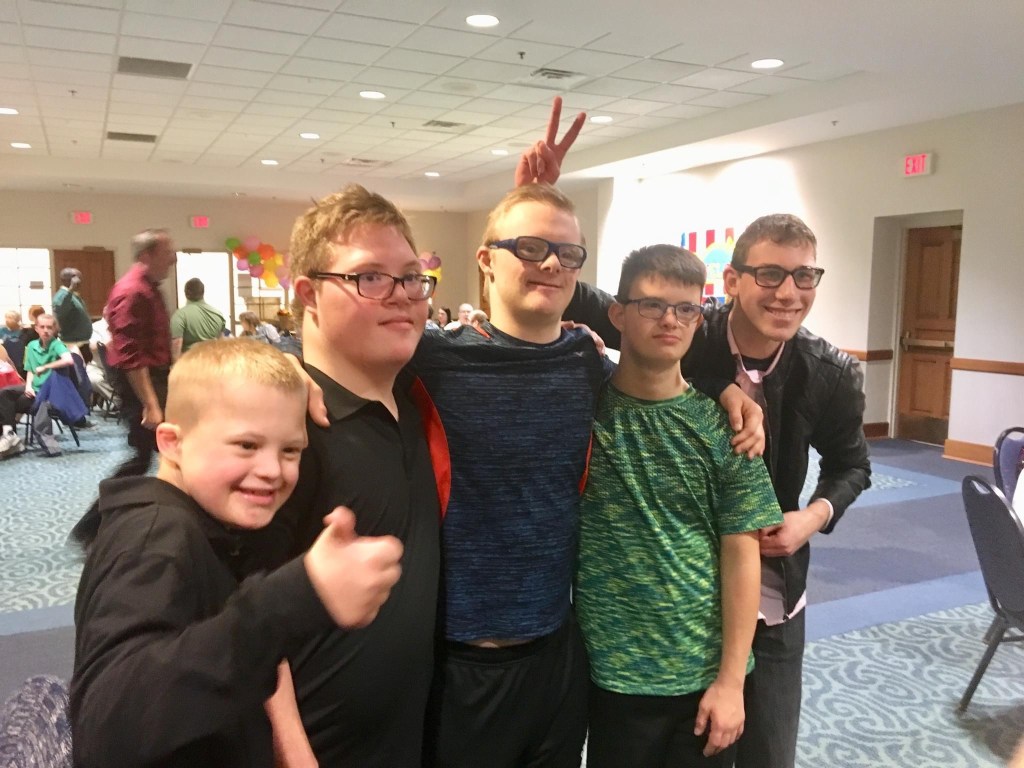
Yeaterday, at a DSST teen event, our kids acted like…you guessed it, total teenagers. They went between competitive games of pool, foosball, and Apples to Apples, to being cool and aloof. We finished the event with a dance party, and our teens got down like James Brown! I went home floating on a cloud.

What was the difference between then and now, other than age? Its the same, but also not. And in the process of learning the “not” I fell in love with the whole.

And when you can embrace the whole, there is an elation with a depth to it. Kind of like a James Brown charasmatic scream 🙂

I feel good!! Oww!!

Centurion, Collaboration & Education

“I don’t want to live until I’m 100.” One said.

“Oh, me either.” Replied another. Both shared their own beliefs for saying so.

I found myself bristling. Actually jealous. And how silly of me. Who gets to choose how long they live? But what I found myself upset about was how they could take this longevity for granted. I have a child, that even as independent as he becomes, will always be vulnerable. Always.

Who will look after him when I’m gone? Katherine and Elizabeth have already volunteered, but I’d like them to have their own independent lives as long as possible. To grow into their own adult lives without the concern of caring for their brother until they are much older.

I thought deeper on my internal reaction. If I had said something out loud, they would have apologized profusely. It would have turned the light-hearted conversation into something deeper. They would have been “educated” but would have felt “bad.” These were not people who needed to be educated. They understand Wil and love him. But they aren’t living this daily life like I am. There is a time for educating, and there is a time for not educating.

There is absolutely a lack of awareness in what we do as parents of our kids. All of the extra work involved, the daily aspects of life we must consider, and the future aspects of life. Sometimes we just get tired. Tired of explaining; tired of people not understanding. Not because they are bad people, they simply don’t know. With all of this within us, it’s easy to get angry when people simply don’t know.

I have worked with many “new” people who don’t have the knowledge I do, but they put themselves in the crosshairs of tired parents to learn. Rather than beating them down for not knowing, I am grateful they chose a profession of helping.

When Wil was in preschool, his speech therapist didn’t have much experience with Down syndrome as just previous to Wil entering school the kids with special needs went to Chelsea as they had a developed program. I could have gotten frustrated with their lack of knowledge, but instead we watched the videos together, and learned together, and I’m very grateful to say this speech therapist and I have a very strong bond, and she works with Wil in high school now. The colloaboration and learning together, has been a huge asset in Wil’s life and in his success to this point.

Even when you are challenging a boundary, have respect where another person’s ideas are coming from; ask questions rather push your agenda. Find ways to collaborate. Certainly there are those out there that don’t care. Or even worse, those that pretend to care, say what you want to hear, then go do their own thing. It makes my stomach drop.

But as Mr. Rogers said, look for the helpers. I could have wasted my time beating this person down, and those fights are necessary, but I have found focusing on the helpers is what gets Wil what he needs. I put my focus on collaborating with them. Growing my relationships with them. Showing my gratitude for them. And through all the bumps, the helpers have stuck by Wil and my sides.

We all have things we fight for. But some fights aren’t worth the energy. I’d rather choose my moments to decide when bringing up certain things are just for a fight, or are they truly worth making the change.

No one knows enough to know everything. You or anyone else. I have just as much a duty of being open as anyone else. I’m not more “right” because Wil has Ds. And just as much of a duty to listen and understand where others are coming from instead of always pushing my agenda. But I do have a duty, like any other mom, to raise Wil the best I can. And I would love for him to be a helper, by being a collaborator and realizing he doesn’t stand on a special pedastal just because he has Ds. He stands there because he was a good person.

I hope to live to 100 to see it.

Proudly Hail’d

At last Friday’s homecoming game, Wil and five choir companions formed a half circle in front of a microphone. The spectators, packing the stands, rose with hats and hands placed over hearts. The perfectly uniformed Manchester marching band spanned the field behind the semi-circle of singers and began their patriotic play. I held my breath.

The stands full of spectators would not challenge Wil’s nerve (he likes to be on stage!) It would be the volume of the band; he becomes un-nerved with loud, unpredictable noises such as the cymbals. During practice rounds, when the cymbals were up, Wil was out.

Kristi Campbell called me to form a plan (thank God for amazing paraprofessionals!). Though Wil has made vast progress in his tolerance for loud noises, the chance of him fleeing the situation still wasn’t 0%. We both wanted Wil to shine; of his own will. So Kristi said she’d stand nearby, but unobtrusively. I said I’d take a spot in the front row of the stands (I wanted a front seat anyway!).

When the band played and the choir sang, it was flawless. Jacob Mann conducted the band forward — as he did a conductor’s walk backward. Mr. Throneberry conducted the semi-cirlce of singers. Wil smiled and seriously recalled his lyrics — I even detected some of his high notes over the microphone.

It was beautiful, inspiring and right on note (Wil may have been a few beats behind in places, but that’s right on note too). I’m so very proud of Wil, and I couldn’t more proudly have hail’d the way our town comes together!

Word Up!

When Wil tries to figure something out, he has a back-and-forth conversation with himself: “Wear the grey shirt? Yes, yes, the grey shirt.” This will go on for his hat and shorts, too; and with most any task that requires decision-making.

He’s been having these conversations for about 5 years now. At first, I was concerned. He didn’t talk to himself, then all of a sudden he did — all the time. I worried these conversations developed because his peer group didn’t speak at his speed, and this was a coping mechanism to keep himself company. I did, however, enjoy hearing his thoughts, as he wasn’t always able to communicate them to me. And when he got stuck on something, I knew why.

Raising a child with a disability, you grow accustomed to digging into behaviors. Behavior is communication, but when your child isn’t capable of communicating, you put on your Sherlock cap and get to work. At first it’s something you figure out, then it becomes part of your everyday lifestyle. You don’t even realize you are doing it.

If Katherine or Elizabeth started talking to themselves, I wouldn’t think anything of it. I talk to myself out loud sometimes. It helps to clarify thoughts. And come to find out, that’s exactly what Wil was doing. But I didn’t see it because I’m always looking deeper than surface level, and not even realizing it. Wil doesn’t have the social filter that Katherine Elizabeth and I do in this area. To him, he’s simply making decisions out loud with no concern about who is listening.

Looking further into this behavior, I discovered it’s very common in people with Down syndrome, and can carry into adulthood. Now that Wil has been doing it for some time, I don’t even notice it as different anymore — because it’s not.

Today was a fun leap in Wil’s personal conversation. When he has his hands full getting out of the car, he’ll say, “Mom, I can’t do it, I don’t have enough hands!” (Don’t I know the feeling!). I’ll reply: “Sure you can!” And give him a few tips, such as tucking things under his arms, or making two trips — but who does that? Then I leave him to it. Some days he gets frustrated and sits in the car, and some days he takes my suggestions right away. Either way, he figures it out.

Today, Wil tried to get out of the car with a stack of CDs and his water bottle. Rather than addressing me this time, he said to himself: “I can’t do it, I don’t have enough hands!” Then he replied to himself, “Sure you can!”

He grabbed his CDs in a stack, opened the car door with his other hand, then got his water bottle, and bumped the door shut with his hip.

Now you’re talking, Wil! 😀

Yesterday Was a When

Yesterday, Wil and I had lunch and a conversation on the back porch.

One night, I sat on the edge of Wil’s bed. It was the school year of 2016. In the quiet before sleep, Wil was most apt to share his day. I always started with questions about his friends and lunch; they were (and still are) his favorite topics. I also knew the answers, so could prompt him if he got stuck.

“Who did you sit with at lunch today?”

“Ashley.”

“And…”

“Lila.”

“And…”

“Sarah.”

“Did you play on the playground?”

Wil nodded.

“What did you play?”

“Hmpf.”

“Did you play with a ball?”

“Hmpf.”

“The swings?”

As I prompted him, word-by-word, Wil shared pieces of his school day.

Then the tears came. They seemed out of nowhere, but I knew they came from somewhere.

“Wil, what is wrong honey? Why are you crying?” No answer.

This is where it got tricky. Did I continue to ask questions? Questions could further frustrate Wil, causing him to clam up. Or questions could do the opposite; open Wil up and help him feel understood. I’d ask leading questions, as he wouldn’t be able to offer what happened. But even the leading questions had consequences.
On another occasion, when Wil was unexplicably upset, I asked: “Was someone mean to you?” He looked up at me like “Why would anyone be mean to me?” And there I did it, his very own mother, who most wanted to protect him from mean people, put the very idea of mean people in his head.

“Wil, do you feel sad?” He nodded.

“Wil, do you feel mad?” He nodded.

“Can you tell me one thing that upset you?” He nodded.

“Would you like a hug?” He nodded and we hugged for a long time. My tears started too. I needed to understand his emotions, and he needed me to understand them, too.

Communication barriers are very sturdy. They take extreme patience and diligence to break through. I never know what question will lead to a hairline crack. Or what question will seal it shut.

What I do know is the answer to most things with Wil is time.

Given enough time, the words would come. I just didn’t know when.

I’ll never know what happened that day. It may have simply been overwhelm from everyday life. Wil’s teacher and paraprofessional were a dream team that year. If anything had happened to Wil at school on their watch, I’d know about it.

There are so many painful memories; days I wished I could even make a hairline fracture in the communication barrier. But Wil couldn’t meet me where I was, and I didn’t know how to meet him where he was.

Over time, we made progress. Like Thor’s mighty hammer, we made big, clunky breaks. Some on purpose and some by trial and error.

But when you make a break, you can’t miss it.

It flows — like a lunchtime conversation carried away on a summer breeze.

Yesterday was a when

A Little Can Mean a Lot

Yesterday I went to Wolf’s Westside Automotive Service for an oil change. I had been there the previous day to have my tire patched. When I came in for my tire, the front door was propped open, the garage bay doors rolled up, and a refreshing breeze flowed through the lobby.

Yesterday was just that much warmer, so the bay and front doors were closed; a unit air conditioner cooled the lobby.

The owner, Pete, came into the lobby from the garage, sat down across from me, and delivered an update on my car’s service. Our conversation transitioned from the car to fitness and then into a story about his friend who has an adult daughter with Down syndrome. Though I don’t know Pete beyond the walls of his garage, in his storytelling, I heard true understanding. To attain that, without a child of his own with Ds, requires an openness to understand.

His shared story, and openness, were especially timely and meaningful to me as I’ve recently experienced the challenge of closed minds at a new level. I admit I’m somewhat naive in this area; thankfully. My fighting skills are weak; again thankfully. This town has always embraced Wil. I’ve needed to advocate, yes, but advocation is a conversation when you advocate with open minds.

With Wil getting older and other certain circumstances, I have now experienced lack of understanding, and the unwillingness to understand, on a broader level.

It’s hard to explain this life because a little means a lot. How do I explain, that every time I drive in the car with Wil, and he belts out Luke Bryan lyrics with complete accuracy, the elation I feel? That every word he forms beams me back to stretched-out years patiently waiting and diligently working on forming his first words? I have a million such stories.

All I need is a little crack in the door of a mind to get through. And yet, I physically feel the air fall dead between myself and a mind that is closed. I find this disconnection rarely intentional, and not meant to be hurtful. It’s not lack of experience with a disability that is the issue, it’s the unwillingness to open a door to understanding. Even the slightest creak of a hinge is all I ask. But for reasons of their own, deep within, they don’t want to know. The door remains closed. I find ways to keep knocking.

But not yesterday. There I sat, in our small town, for an oil change of all things, and with the natural flow of conversation a story was shared with full understanding. There was no knocking, no prying, no trying. The air conditioning was working, but all I felt was a needed breath of fresh air.

A little can mean a lot.

Wil and his friend, Manny

Heavy and Light

Wil loves riding his recumbent bike around our property. The challenge is I can’t fully trust he won’t go out to the road. And it’s a busy road.

I was talking to fellow mother yesterday. Her 16-year-old son, who also has Ds, is in summer speech and occupational therapy with Wil. As much as her son loves swimming, she will never have a pool. For the same reason I need to check in on Wil on his bike. She can’t fully trust he won’t go in the pool unsupervised.

Our children are teenagers. They know they are teenagers, their bodies tell them they are teenagers, and they desire the independence of teenagers. And as a parent that has raised 3 babies to teenage-hood, I enjoy a certain measure of independence too.

Last night, Matt and I were enjoying relaxing together after dinner. Wil wanted nothing to do with relaxing. He went outside to ride, and sure enough when I went to check on him he was getting close to the road. He was likely trying to make the biggest circle around our yard that he could, but again, I can’t be fully sure.

Even at 15 years old, he requires an extra level of supervision. And possibly, or possibly not, for many more years to come. With Wil one thing is certain — I won’t know until I know. (If you are a neurotic planner like me, a child w Ds is your best cure! 😂)

Many of my friends are becoming empty nesters. Matt and I may or may not be. I knew this uncertainty would be a reality when Wil was born, but now that the reality is closer, its an interesting feeling of limbo to be in.

I love my life with Wil. He is so fun to be with. We sing in our off-key voices at the top of our lungs. He still surprises me with new milestones, and huge bear-hugs that now knock me over as he’s grown. I’m thankful to fully share in his youthful exuberance.

But I also have a child that may never fully grasp the risks of certain fundamental independences into adulthood. The fullness of that can feel very heavy at times.

And yet, when life feels heavy, it’s being in Wil’s presence that purely and fully lightens the load.

Just Make Him Do It

One of the most common things I hear (and what many of my friends who have children w disabilities hear) is, “well, just make him do it.”

I literally feel a huge distance grow between us with this seeming logic. And yet, it’s a very difficult distance to close as there is no logical explanation. It’s a “living it” thing.

We parents, special education teachers, para educators, and caregivers are constantly on the alert for “triggers” that cause our kids to dig in their heels.

Some of these triggers are constant, and we have created ways to work with them.

Some of these triggers are only known to our kids and appear spontaneously to us. And when triggered, there is no “make him do it.”

When Wil refused to get on a connecting flight, how I wish I could give the “make him do it-ers” a chance to use their logic on Wil that day. That would have been a helluva education.

Heck, I don’t know even know it all and I’ve been raising Wil for over 15 years, not to mention knowing many other children with Down syndrome quite well. And each and every kid defies this logic.

So next time you want to think it’s logical, and fits some kind of mold, I challenge you to spend a day with Wil, his friends, or in a life skills room, and let me know how that logic goes for you.