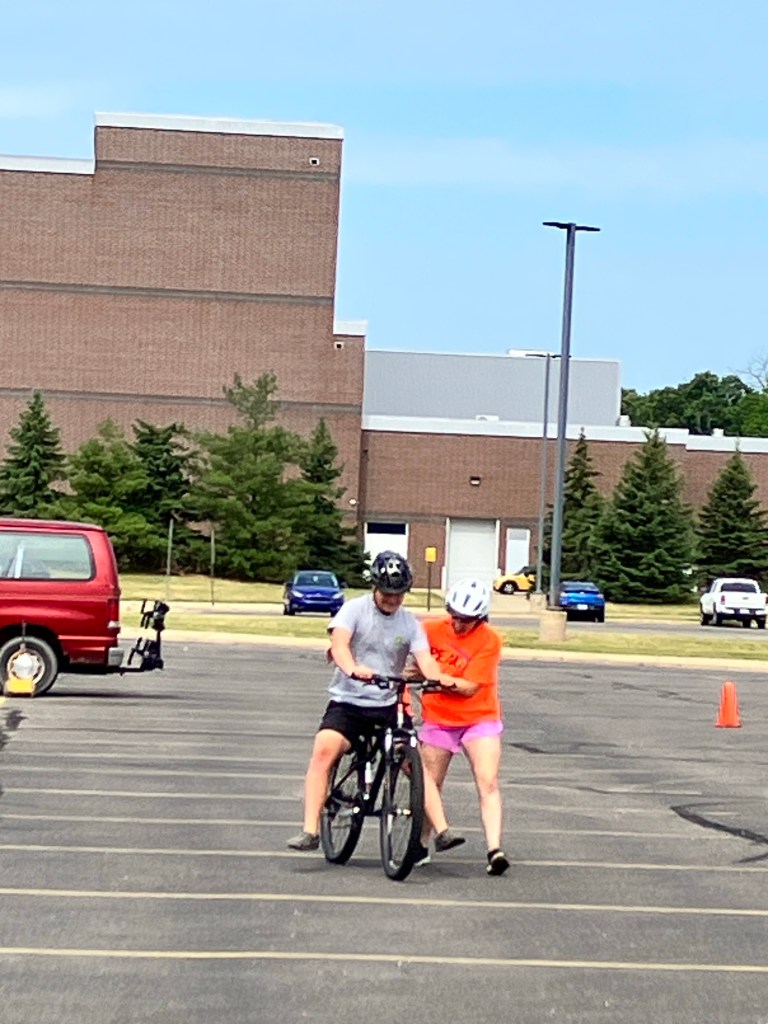
I walked into the parking lot area where Wil was to take his PEAC bike camp. I was overcome with a positive, uplifting feeling — thankfully this type of feeling is not unfamiliar. I’ve grown accustomed to this shift from breathing dense air into a higher atmosphere in only one step.
This atmosphere is one of people helping people. It is beyond a good deed. It is true unity. We innately know the difference as it’s the way we are supposed to be — together.
This is one of the many gifts individuals with special needs offer us. We only need to rise beyond ourselves to accept this handed gift.
“The first problem for all of us, men and women, is not to learn, but to unlearn. We are filled with popular wisdom of several centuries just past, and we are terrified to give it up.”
Gloria Steinem may have had women’s rights on her mind with this quote, but it rings very true for our friends with Down syndrome. I was so scared when I received Wil’s diagnosis. Why? Because of an outdated belief system handed down to me from centuries just past. I had no other frame of reference; it was what I knew and the unknown is a scary place.
When I opened my mind; when I truly looked at Wil and accepted anything and everything to come — all the knowns and most importantly the unknowns — is when my world first cracked open, then burst open, and love flowed in place of the fear.
Wil’s paraprofessional, Kristi, told me how Wil — of his own will — went to the closet in gym class, pulled out two baskets and two balls. He proceeded to toss the balls in the baskets. His peers joined in his created game by cheering him on.
Today I picked up Elizabeth, Wil and their friend Kimmy from school today. Elizabeth had an NHS meeting, so Wil, Kimmy and I sat in the car waiting for her with the windows down. As kids poured out of the school, Wil yelled out his hellos, and peers called out and waved to Wil. One friend, Trent, walked up to our car and chatted w Wil. Trent has about every sport there is on his letter jacket. After their chat he fist bumped Wil and walked away.
Wil takes this all in stride, having no idea how this type of interaction is not commonplace. To him, it’s just another day at school with friends.
Kimmy, whose aunt and sister have special needs, said how embracing of Wil the students are at school. I responded that it fills my heart; its what inclusion is meant to be. Wil’s experience is as it should be but isn’t how it always is.
Kimmy agreed, saying she sometimes forgets how people don’t grow up under the same circumstances as she does, and don’t always understand certain reactions and behaviors of individuals with special needs.
I’m so thankful for this Community School experience. It’s enriched my life as much as Wil’s. It’s what inclusion is meant to be — a benefit for all. It’s about friends being friends; of all abilities.
Today Wil and Manny went bowling. Both are teens with Down syndrome. Manny’s mom, Laura, and I share frequently about our plans, thoughts and concerns for the future. Thoughts about our boys as they age out of the school system; after friends have moved on to college, to jobs, to get married. How will our boys adapt to the change? What programs are available now and in the works for the future? And of the programs available, are they a good fit for our boys?
Last night my friend, Cheri, who’s son CJ (who you may know from his weather reports—WCJR weather) called me. CJ is graduating high school this year and also has Ds. Cheri and I shared our thoughts and plans for our boys’ futures. Cheri is always a step ahead of me in raising CJ, and I learn greatly from her experiences.
Not everyone has a teen child with Ds. We must actively seek one another out, actively seek out programs, and discern if what’s available is the appropriate fit for our soon-to-be adults. In fact, just today, Wil had an interview with a summer camp I’ve tried for years to get him into. Wil is ready for an overnight camp, but not without an aide. Just going to a typical summer camp is not an option for him. And that is the case for many people with disabilities; thus the long waiting list. The interviewer said Wil’s a really good fit, but spaces are very limited. She was wonderful, we connected immediately, and said she’d do what she can for him to get in.
Recently talking with my friend, Vanessa, who has a teen daughter w Ds said to me, “You bend for the ones you love.” That statement delivered great clarity to me. It makes sense of what connects me to a camp counselor I just met on a 30 minute Zoom meeting, but knew her innate understanding immediately; and also what connects me, on a deeper level, with my friends. We bend to create understanding and opportunities for people with disabilities. We bend together for the ones we love.
As Vanessa spoke those words, I visualized trees that stay closed in, protecting the roots they know, refusing to bend. Then I visualized trees firmly rooted in love, but with branches reaching, stretching, bending, some almost impossibly yet never breaking, open to receive the sun along with the rain — both of which serve to strengthen them.
If you were a tree, what kind of tree would you be? 😉
Wil attended his first taekwondo tournament last Saturday. The environment had the potential of causing sensory distress within Wil. I had been to many taekwondo tournaments in the past with Katherine, as she worked her way up to a blackbelt. There would be many people moving around on the gym floor, and spontaneous announcements over the loud speaker —both high sensory triggers for Wil. (Though we have a large dog, Wil is leery of other dogs because of spontaneous barking. The same goes for babies crying, sports announcers over a microphone, and events like pep rallies where crowds and loud noises erupt without notice).
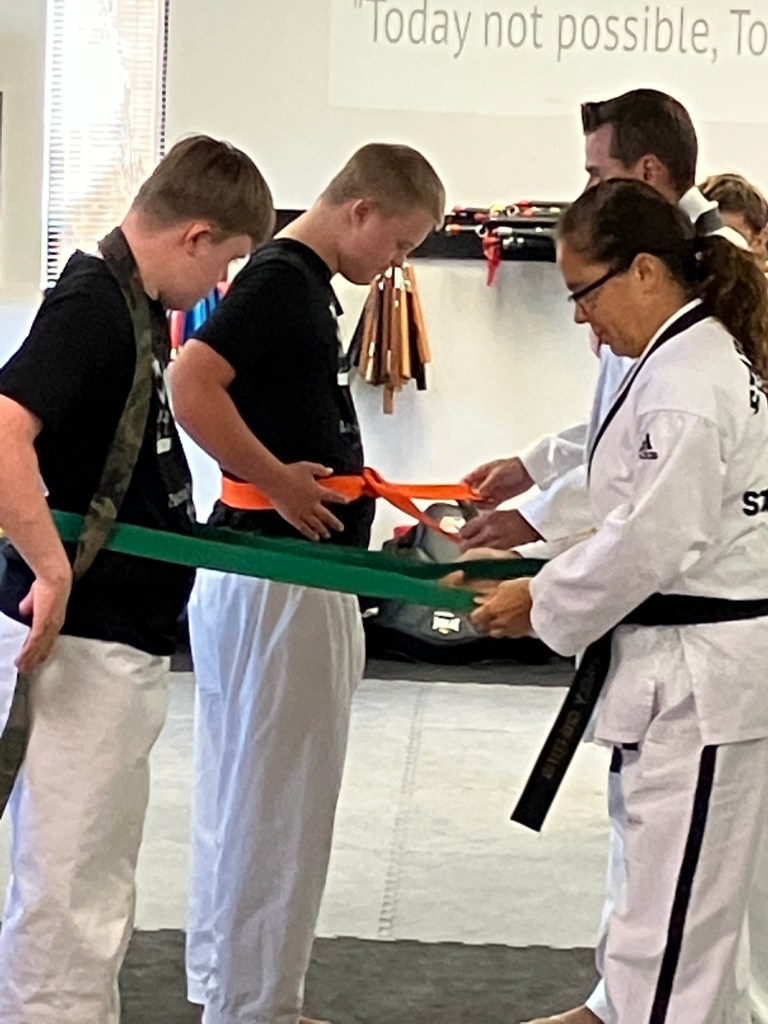
Wil, however, has grown in his ability to manage sensory distress. He’s become more self-aware and only wears his noise-cancelling headphones when he feels it’s an absolute necessity (he still won’t walk into a movie theater without them). He also loves taekwondo. He thrives on his independence in the taekwondo classroom, and also being with his friends, Alex and Nick, who have been practicing taekwondo for years. He looks up to both of them, and works hard to achieve their level of mastery.
When Senior Master practices form with Wil, Wil pays close attention. With his desire to do well, mixed with his growth in sensory rich environments, I knew the tournament would be a challenge for him, but a challenge he would deeply want to rise to.
When we arrived at Saline High School where the tournament was being held, there was a long line out the door. Wil held his excitement throughout the wait for the tournament ahead. The line moved quickly and one of the Masters at the front desk welcomed Wil by name and gave him a high-five. Wil gave him a hearty high-five in return. We were off to a great start!
We made our way down to the high school gym. Wil paused at the entry taking in the crowds. The set-up was the same as Katherine’s past tournaments. There were multiple squares of black mats, parallel to one another, with narrow walk ways in-between. Each square had a pole with a number attached to the top. As Wil’s “Special Abilities” hadn’t been called yet, I suggested we wait by a mat with fewer crowds. I took Wil’s big gear bag from him, so he could more easily maneuver his way, and we walked to the far side of the room where it was less populated. Wil stood against the wall, and I could feel him stiffen by the look on his face. But I also knew he was determined to be brave.
I attempted to break his tension with discussion about Alex and Nick. He nodded but became increasingly quiet. Even if I couldn’t see it, I knew perceptively that the tension within him was rising above his ability to manage it. I suggested we walk over to the bleachers but he shook his head. I pointed to open seats at the very first row of bleachers; I said we wouldn’t even have to climb the stairs. We could just sit and relax for a moment. He started taking little steps away, and I knew it wasn’t to sit on the bleachers. He was plotting his escape. When he took a forward step, I took one with him. I took his hand but he shook it off.
To any outsider watching, when he decided to bolt out of the gym, it would have seemed sudden. I dropped his gear bag on the spot. With the narrow walkways and crowds, I would have knocked someone over with it chasing Wil. I had no idea where Wil was going, and I didn’t want to lose him in the high school, or worse, the parking lot.
He exited the gym and took a sharp left down a long hallway. Closed double doors blocked further progress, so he took a seat in the corner between the double doors and the wall. He curled his knees up to his chest and wrapped his arms around them.
I crouched down to his eye level and talked quietly to him. He dropped his head to his knees. I knew he wanted to be in the tournament. I knew he was disappointed in running away. But he didn’t know how to get out of his emotions.
I reminded him that Master would be excited to see him. I reminded him that once he got on the mat he would be having so much fun, he’d forget everything else. Then I sat down and stayed quiet. I knew he also needed time to process everything. As hard as I tried, right now the moment was up to him.
And inside of me, I had reached my limit too. In efforts to keep Wil calm back in the gym, tension built within me. Would he run? Where would he run? Was I saying the right words or was I making it worse? Do I make him stay? Do I let him go? Do I just kept my mouth shut? Time always gives us the answer, but in situations like this time wasn’t on our side. Wil’s “Special Abilities” division would be called when it was, whether Wil was ready or not.
I was growing increasingly frustrated with myself, mixed with a sadness for him. Here we were, Wil 15 years old, and I’m sitting in a hallway with him. Will this ever get easier? Will things always be this struggle of wondering what will happen? Will I always need this patience and forethought with everything we do?
I know from experience that each tournament will be better. That Wil will know what to expect from his own experience, and we can talk about it with growing effectiveness. He can tell me if he wants to go, or not go, fully understanding the environment he’s walking into. When Wil feels ready to compete in a tournament, it will be the best day ever as we’ll both have grown from this very experience.
But that’s for another day and another time. Right there and then in the hallway, there is no sugar-coating it. It was just plain hard.
I asked Wil if he wanted to go home. He said yes. I told him I couldn’t go get his gear bag without him. That he would have to walk back through the crowds with me to get it, but that we would go right back out to the car.
So we walked back through the gym and grabbed his gear bag. I gave him credit for being so brave to walk back in, and I meant it. I knew that would build strength in him for next time. On our walk back out of the gym I heard my name called. I looked up into the bleachers and saw it was Eleanor, Alex’s mom. She was sitting with Alex, Nick, and Nick’s dad, Jeff. They waved for us to come up and sit with them. I felt envious that Alex and Nick were sitting up there, but we were about to leave. I swiped my hand across my neck symbolizing it was over for us. Eleanor’s nod back to me was like a big hug. She understood exactly what we were going through even though words were not exchanged between us.
Wil and I made it back to the car. I let the tears go silently, so as not to upset Wil, and started the car. As per usual, Wil took my phone out of my purse and clicked on the Amazon Music app, found a Luke Bryan song (right now he’s into the Spring Break album) and started singing with Luke.
It was hard to imagine Wil shrunken in hallway corner moments before as he belted out the lyrics to “Spring Break-Up.” It wasn’t that he’d already forgotten — he’d remember every detail. But to him that moment was over, and a new moment had begun.
I had more tears to let go first, and then I’d be able to move on. I guess we all have our own processing time.
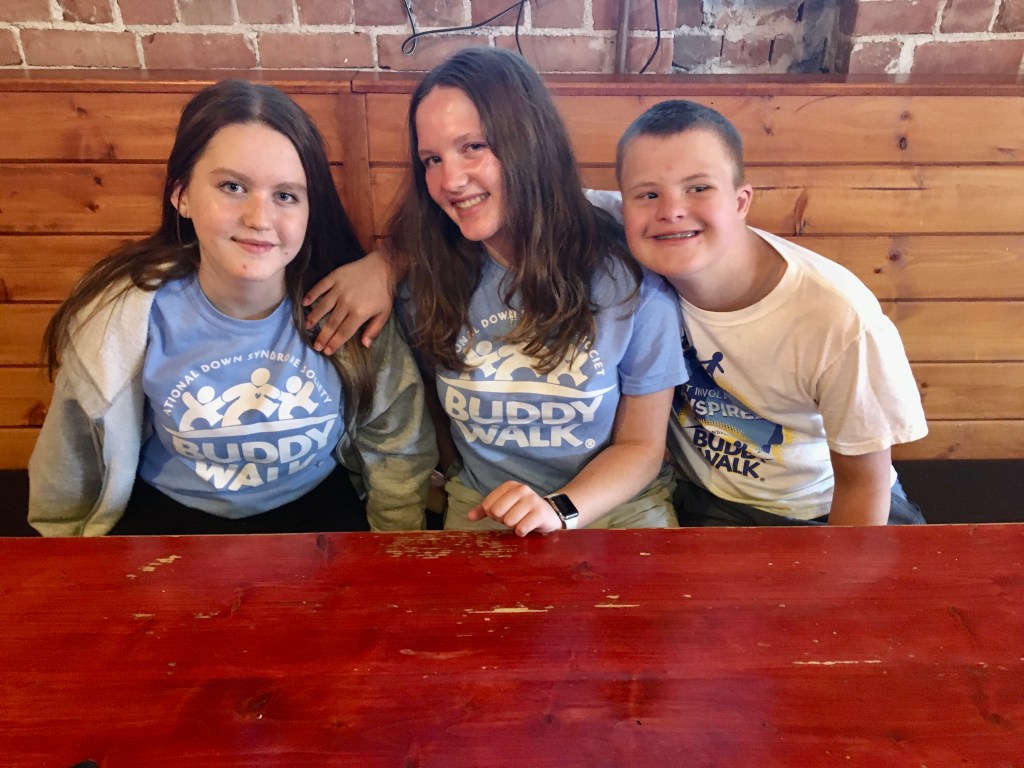
“The Buddy Walk is only one mile walk. I think you can handle it,” I joked. “And really, with so many people with Down syndrome, we don’t move fast!”
When The Peanut Butter Falcon was available for streaming, I didn’t want to watch it on my own. The viewing experience would be fuller with friends who knew Down syndrome. Whether the movie was good, bad or otherwise, we’d share in that knowing together.
A group of us moms got together at my house. The majority of us were raising teens, or kids that teetered on the edge of teenage-hood. We poured generous glasses of wine, loaded tiny decorative paper plates with dense dips, sturdy crackers and crunchy veggies, squished together on the couch, pulled up spare chairs, and settled in.
We erupted in laughter in the same scenes together, we shared audible silences in the same scenes together, tears leaked from the corners of our eyes in the same scenes together, and we enjoyed scenes of pure entertainment in the same scenes together. And we all wondered together, over the rolling closing credits, why Zak’s (the main character with Down syndrome) duration in underwear was deemed necessary.
Then in our post-movie review, we all first recalled the same scene together: Tyler’s adamant assertion to Zak that he stop asking him questions; there was a slight pause then Zak picked right back up with more questions. We broke out in laughter again and remarked on how our kids would do the same.
Our review continued along the same vein; how relatable Zak’s behaviors were to our own kids’. And where there were varied differences, we could still fully relate.
If you are a parent, it’s highly likely you have your own friend group of parents who have children in a similar age group.
Though your kids are fully their own individuals, you easily laugh together over shared traits; you easily share audible, thoughtful silences over certain situations, and likely enjoy the pure entertainment in others. Though each child has their own unique differences, a group of friends raising children of a certain age group can fully appreciate and relate to another’s experiences through their own.
There is running joke at our annual Buddy Walk: “Who is going to win the Buddy Walk this year?”
I’ve been to 15 annual Buddy Walks (since Wil was 7 months old). I can guarantee about 70% of the kids will either decide at some point to sit it out (more than once), run to a play structure, or take some sort of tangent. Our kids can be very quick, and cunning in their moments of escape, but typically in any other direction than the paved walk. (Some may argue my statistic is on the low side).
Laughing about our kids taking their time to get to the finish line is not a slight against them. Its relating a typical scene in our lives that we share together. Any one of us parents would say our lives are fuller for it.
So sometimes I forget when I make “off the cuff” comments like that. It’s not a familiar scene to everyone yet — it wasn’t one to me once — and we are both watching a movie of our own. When those scenes find a way to merge, I have no doubt we’ll share in that laughter together.
Yesterday, Wil and I had lunch and a conversation on the back porch.
One night, I sat on the edge of Wil’s bed. It was the school year of 2016. In the quiet before sleep, Wil was most apt to share his day. I always started with questions about his friends and lunch; they were (and still are) his favorite topics. I also knew the answers, so could prompt him if he got stuck.
“Who did you sit with at lunch today?”
“Ashley.”
“And…”
“Lila.”
“And…”
“Sarah.”
“Did you play on the playground?”
Wil nodded.
“What did you play?”
“Hmpf.”
“Did you play with a ball?”
“Hmpf.”
“The swings?”
As I prompted him, word-by-word, Wil shared pieces of his school day.
Then the tears came. They seemed out of nowhere, but I knew they came from somewhere.
“Wil, what is wrong honey? Why are you crying?” No answer.
This is where it got tricky. Did I continue to ask questions? Questions could further frustrate Wil, causing him to clam up. Or questions could do the opposite; open Wil up and help him feel understood. I’d ask leading questions, as he wouldn’t be able to offer what happened. But even the leading questions had consequences. On another occasion, when Wil was unexplicably upset, I asked: “Was someone mean to you?” He looked up at me like “Why would anyone be mean to me?” And there I did it, his very own mother, who most wanted to protect him from mean people, put the very idea of mean people in his head.
“Wil, do you feel sad?” He nodded.
“Wil, do you feel mad?” He nodded.
“Can you tell me one thing that upset you?” He nodded.
“Would you like a hug?” He nodded and we hugged for a long time. My tears started too. I needed to understand his emotions, and he needed me to understand them, too.
Communication barriers are very sturdy. They take extreme patience and diligence to break through. I never know what question will lead to a hairline crack. Or what question will seal it shut.
What I do know is the answer to most things with Wil is time.
Given enough time, the words would come. I just didn’t know when.
I’ll never know what happened that day. It may have simply been overwhelm from everyday life. Wil’s teacher and paraprofessional were a dream team that year. If anything had happened to Wil at school on their watch, I’d know about it.
There are so many painful memories; days I wished I could even make a hairline fracture in the communication barrier. But Wil couldn’t meet me where I was, and I didn’t know how to meet him where he was.
Over time, we made progress. Like Thor’s mighty hammer, we made big, clunky breaks. Some on purpose and some by trial and error.
But when you make a break, you can’t miss it.
It flows — like a lunchtime conversation carried away on a summer breeze.
At the airport yesterday, Wil was struggling a bit with some young children crying.
As a Starbucks was nearby, I asked Elizabeth to walk him over there while I stayed with our carry-on luggage (as Katherine was in another shop).
Wil was reluctant at Starbucks too, so Elizabeth walked him back to sit with me. She then walked back to Starbucks to get herself something to drink. A woman walked up to Elizabeth while she waited in line for her drink. The woman said she observed Elizabeth with her brother, and expressed her admiration at Elizabeth’s mature patience and how she talked to Wil. Then the woman said, God Bless, and walked away.
Elizabeth was surprised, yet pleased, by this. She was just being a sister to Wil as she always is (and Katherine has this same mature patience with Wil, as well), and didn’t see her actions as anything different than normal behavior.
In Elizabeth’s everyday life, she lifted the spirits of another, and she was uplifted in return.
I’m proud of Elizabeth (always), and also proud of the woman who had the courage to step up and acknowledge Elizabeth.
Kristi, Wil’s paraprofessional, sent me this photo of Wil cooking at school with his Connect mentor, Victoria. It was Cinco de Mayo and they were making tacos. Kristi told me he ended up eating 3!
It’s awe-striking to me, still, even though Wil is a teenager, how powerful the simplest joys with him are. I mean, they were making tacos on Cinco de Mayo. How simple is that? But look at their faces. I think of the support he is encompassed with. Simple never is with Wil.
When Wil was born, I knew so little about Down syndrome. I didn’t know how powerful the simplest actions could be.
Though there was a high learning curve in early therapies and doctor’s appointments with Wil, my deepest learning came from knowing him. Knowing Wil’s smile. Knowing Wil’s hugs. Knowing Wil’s first words. Knowing a community that embraced him.
When I reached out to Victoria, she shared, “it’s kids like him who have really made me want to go into the profession. He is so caring.”
Victoria is way ahead of where I was. Her knowing will change lives. Not only for her chosen profession in the future, but also right now. The way she interacts with Wil, simply by being who she is, sets an example that shatters stereotypes and alleviates fears. It is not scary to know Wil. It is not hard to know Wil. In fact, it’s really darn cool to know Wil.
Whenever I hear words like Victoria’s, I’m always drawn to thoughts of my mom’s close friend, Martha. Martha has three sons. Her oldest, Paul, is my age and has Down syndrome. Paul did not have friends like Victoria. In fact, for Paul, general classroom opportunities were scarce to non-existent. Early therapy was not available or encouraged. And a Connect mentor program would have been a far off dream. Martha navigated this life with a tiny fraction of the awareness and advocacy Wil is surrounded with.
Wil and Victoria’s experiences are not just for Wil and Victoria. They are for the families who navigated this life before us, and for the families Wil and Victoria will open doors for. The power of advocacy is not always found in picket lines. Advocacy is also spread by our daily actions in simple, yet powerful, ways. Simple never is with Wil.
“Give me a hug.” Those were Laura’s first words when she came over for a visit.
A slanderous word had been directed at Wil that he thankfully didn’t hear (when I learned about it, this careless use of a word hurt me more than him). Even as Wil grows in maturity and in self-advocacy, he will always have a level of vulnerability that is indefensible, which is why it is key that we as parents and friends rise up to advocate for our loved ones with Down syndrome. And that is exactly what Wil’s friends did; they spoke up and their words righted a wrong.
Words have the power to educate, to elevate, and to tear down. As powerful as words are, words can also fall short; notably in experiences when the day-to-day minutia of our lives vary enough from the norm to be easily misunderstood, or carelessly undervalued. One favorite example is from a school psychologist who was told in his early days of training that individuals with Down syndrome can be stubborn. “Well, ok, stubborn is stubborn,” he thought. After his experience working with individuals with Down syndrome he said, “I learned there was a whole new level of stubborn!”
Laura’s hug articulated a level of understanding words never could. Laura’s son, Manny, who is almost 16 years old, also has Down syndrome.
A podcaster who has a daughter with severe disabilities recently said that when raising a child with disabilities, you need friends who are doing the same. That these friends innately understand the specifics of your life because they live it too. She added that if at all possible, these friends would be your friends anyway.
On St. Patrick’s Day, Laura and I were at a coffee house. We chose an outside table as it was unseasonably warm. Laura’s attention turned over my shoulder. I followed her gaze and saw a group of four young men walking in our direction. All of the men were dressed for the holiday; including the group leader with them. The men stopped by our table, and flipped the sheets of paper they held, conferred with each other, then looked down at flower pots, and up at signs.
“Are you on a scavenger hunt?” I asked the young man closest to me. He had a slight speech delay and was not the least bit shy. He showed me his sheets of paper, and told me what they found already, and what they were now looking for. He was clearly enjoying this activity with his friends. Laura and I exchanged a warmhearted smile. An entire conversation passed between us without a single word.
Like most mothers, Laura and I want our children to be happy. Laura’s two other children will soon be leaving home for college and careers of their own. I’ll be in the same position just over two years from now. Many of our friends are either experiencing, or soon to be experiencing, an empty nest. Our nests will look different; Laura and I are on the cusp of navigating what that will look like. Having a friend who understands the entirety of this upcoming new adventure, without explanation, lifts me beyond words.
Though Laura and I connected through our boys, somehow I know we’d be friends anyway. There are some things you just know.








 'WIL'ingness = Willing to Embrace Extra in Life