Wil Rode the School Bus Today!

Wil rode the school bus today.

In this house we take no such statements for granted.

In middle school, Wil riding the bus proved unsuccessful. He was already having a hard time transitioning to a new school with new educators and hormones were in full effect. The middle school years are challenging; then add in communication barriers and cognitive delays that a body’s progression into puberty does not wait for, and you’ve got behaviors. Every day was a new experience, and we were rewriting the plan over and again. Finally, I called “Uncle” on the bus riding as it was adding stress to Wil amongst all the other areas we were navigating at the time. It’s challenging to do that, as you never know if you are giving up at the right time, or too soon. But what I have learned is no matter what the success — or lack there of — looks like from the outside, there is groundwork being laid on the inside.

Wil is now in 11th grade. He loves being 16 years old. And he is fond of reminding me he will be 17 years old on his birthday. He wants to go to college like his sisters. We will cross that bridge — in this house we are very used to crossing bridges as they come. As he is growing into his indepedence and his maturity has blossomed, he told me he wants to ride the bus home. I joyously concurred.

Last spring, he did ride the transfer bus from his high school to the elementary school where I work. This was very successful, so I think it was the perfect nudge to riding the bus the full way home.

All was going smoothly until 2 weeks ago. Wil walked to the bus like he always did, but then just kept on a-walking. His teacher ran after him and walked him back to the bus. Wil refused to get on. So Wil and his teacher walked to the office. His teacher called me and I picked him up. This happened every day for a week.

All I could get out of Wil was that the bus was too crowded. He refused to sit up front where it was quieter. But he is in 11th grade, so why would he want to do that? I suggested his noise-cancelling headphones. Wil is very aware of his looks, and doesn’t want to look different. I want to make clear that he is in no way ashamed of his disabilty, nor should he be. And noise sensitivity is part of his disability. But Wil puts great importance on his appearance, and you know by now his deep affection for baseball hats, so noise-cancelling headphones would throw off his style; and his hat. (Wil only wears his headphones now if he is at the movies or a concert, but he’ll only go to these loud places if he really wants to be there.)

So, here we were. Wil refused to ride up front where it was quieter. He wanted to sit in the back with his friends. But it was too crowded. So it makes total sense that he would attempt to walk up to the bus, get nervous and keep going.

Just being able to make sense of things is HUGE!! When Wil was in middle school, he was not able to express to me his reasons for being nervous on the bus. His educators and I had to do our best detective work, but with so many factors at play, our best guesses were only that — guesses.

As Wil could now tell me the reason for not riding the bus, we could have a discussion about it. Now Wil had true ownership in his decision as we could have a conversation about his options as I knew what the struggle was.

Whether what we come up with works for the long-term or not is to be seen. But what is most important is that Wil has a voice in this, and that is something he’s always deserved to have, and we’ve worked hard for him to share it.

With this knowledge, Wil’s teacher created a chart to hang in the classroom. Each day Wil rides the bus he will get a sticker. Wil thrives on recognition so was immediately into this idea. Every 3 stickers, I will take Wil to the market to pick out a handmade sandwich of his choice and a drink. He also loves this type of adventure.

Today is day one of this plan. I went up to the school and parked in the lot just in case Wil refused (I parked out of Wil’s sight so he wouldn’t backtrack.)

Wil’s teacher walked with him, and he successfully made it on the bus!

In this house, we celebrate successes!

Today is one day, tomorrow will be another. And so will the next. Every day we cross a new bridge. Every day I will feel a tightening in my stomach at 2:45 with one eye on my phone. And every day it doesn’t ring I’ll release the butterflies in my stomach to fly in celebration.

In this house, every day is a new day. We never take such things for granted.

On Teenage Terms

Wil was being a full-on teenager and I was being a full-on frustrated parent of a teenager.

I had prepared him for this orthodontist appointment for over a week. And he likes the orthodontist. He likes the orthodontic hygienists. He likes picking out new colored bands for his braces.

The issue was not the orthodontist. The issue is transitioning from one thing to the next. It always has been.

Wil’s appointment was at 11:15. We needed to leave at 10:55 at the very latest. I gave him countdowns all morning. We need to leave in 2 hours. We need to leave in one hour. Almost a half hour, let’s start wrapping up what you are doing. At 10:30 I asked him to get his hat and crocs. He replied “Ok, Mom” without resistance or complaint to my reminders. When it was time to go he dug in his barefooted heels into the grey plush carpet.

“Wil, it’s time to go. I gave you plenty of time to prepare. And you like the orthodontist. You get new colored bands today.”

He was watching a show on his iPad. He was comfortable seated on the plush carpet. Why would he want to leave? He knew I couldn’t do anything about it.

Fortunately I had 2 aces in my back pocket.

“If you don’t go to the orthodontist, that means you won’t be able to go bowling with Kristi Campbell (his paraprofessional we all adore) and you won’t be able to go to Special Olympics softball tonight. You’ll just have to stay home and be bored all day.” (I hung on to the last “L” of all for a few seconds.)

Though Wil was comfortable in his current spot, the thought of being bored is very uncomfortable. Adding in the discomfort of missing bowling with Kristi and softball would be powerful motivators. But even with those 2 added aces, I had to play my cards right. The more I talked, the more noise I’d put in his head. So I shut up and let him mull this over.

While Wil pondered and processed, my internal frustration grew. The clock was ticking. He’d refused a previous orthodontist appointment, and they’d been very understanding and not charged us the missed appointment fee. But I didn’t want to take advantage of that. And most importantly, I didn’t want to send Wil the message that he could miss his appointments. I had a fighting chance to send Wil the message I wanted to. I just needed him to get up off the floor first.

Spontaneity isn’t Wil’s friend, unless it’s on his terms.

When Wil was 13 years old, his refusal to move would have been a full stop sign. There would be no reasoning with him. This world moves fast for all of us, and for Wil even faster. He needs time to feel in control of his situation and emotions as we all do. Rarely do we fully achieve this level of control, but all of us need some semblance of this to move forward.

But Wil is not 13 years old anymore; and age is quite relative anyway. I know my son, and he was being more of a teenager asserting his independence than needing extra processing time. After a period of silence to allow Wil to think over his options, I reminded him that he was 16 years old and a Junior in high school. I asked him if 16-year-old Juniors sat on the floor when they didn’t feel like doing something. I asked him if he ever saw his sisters sit on the floor and refuse to go somewhere. No, when you are 16, you do what you need to do.

Wil honors his independence. He’s always trying to catch up to his sisters in age. In the window that they are one year apart, he believes that he’s almost gained on them.

Wil won’t even step foot in the elementary school where I work. He believes that will set him back in age. Even if I have to run into the school for a short while, he waits outside or in the car.

Still seated on the grey carpet, Wil talked to himself. About being 16 years old. About bowling with Kristi. About softball. This was a good sign. I watched as he worked through his emotions.

My tension built with each passing minute. Finally, I burst.

“Wil, enough. You know what you need to do. It is time to go. Get your hat and crocs.”

He pondered this for a minute then looked at me. “Hot chocolate at Biggby ?”

“It’s a deal. Let’s go.”

Once he was in the car we talked it over. About his independence, about honoring his commitments. I’m not sure if he fully wraps his mind around commitments. But it’s time to start talking about it with him. Anything that relates to independence has meaning to him.

I don’t know the level of independence Wil will reach. I don’t know if he will ever stop having stuck moments. But I do know how much he’s grown through the years. I keep growing and navigating it with him.

But I do get frustrated. Yesterday, when Wil was stuck, it wasn’t just yesterday. It was all the yesterdays I’ve been through with him. Some days I have the patience of Job, but yesterday I was done with it. When it’s time to go, I just want to go. I thought, how many years do I have to prepare him for days? How many years do I have to wonder if he will get up and go, or get stuck? It gets really old sometimes. Sometimes, I just don’t wanna, just like Wil just doesn’t wanna.

I suppose I’m a lot like Wil — spontaneity isn’t my friend either, unless it’s on my terms.

(Photo: Wil and Kristi Campbell bowling)

HOW WE BEND

Today Wil and Manny went bowling. Both are teens with Down syndrome. Manny’s mom, Laura, and I share frequently about our plans, thoughts and concerns for the future. Thoughts about our boys as they age out of the school system; after friends have moved on to college, to jobs, to get married. How will our boys adapt to the change? What programs are available now and in the works for the future? And of the programs available, are they a good fit for our boys?

Last night my friend, Cheri, who’s son CJ (who you may know from his weather reports—WCJR weather) called me. CJ is graduating high school this year and also has Ds. Cheri and I shared our thoughts and plans for our boys’ futures. Cheri is always a step ahead of me in raising CJ, and I learn greatly from her experiences.

Not everyone has a teen child with Ds. We must actively seek one another out, actively seek out programs, and discern if what’s available is the appropriate fit for our soon-to-be adults. In fact, just today, Wil had an interview with a summer camp I’ve tried for years to get him into. Wil is ready for an overnight camp, but not without an aide. Just going to a typical summer camp is not an option for him. And that is the case for many people with disabilities; thus the long waiting list. The interviewer said Wil’s a really good fit, but spaces are very limited. She was wonderful, we connected immediately, and said she’d do what she can for him to get in.

Recently talking with my friend, Vanessa, who has a teen daughter w Ds said to me, “You bend for the ones you love.” That statement delivered great clarity to me. It makes sense of what connects me to a camp counselor I just met on a 30 minute Zoom meeting, but knew her innate understanding immediately; and also what connects me, on a deeper level, with my friends. We bend to create understanding and opportunities for people with disabilities. We bend together for the ones we love.

As Vanessa spoke those words, I visualized trees that stay closed in, protecting the roots they know, refusing to bend. Then I visualized trees firmly rooted in love, but with branches reaching, stretching, bending, some almost impossibly yet never breaking, open to receive the sun along with the rain — both of which serve to strengthen them.

If you were a tree, what kind of tree would you be? 😉

Proudly Hail’d

At last Friday’s homecoming game, Wil and five choir companions formed a half circle in front of a microphone. The spectators, packing the stands, rose with hats and hands placed over hearts. The perfectly uniformed Manchester marching band spanned the field behind the semi-circle of singers and began their patriotic play. I held my breath.

The stands full of spectators would not challenge Wil’s nerve (he likes to be on stage!) It would be the volume of the band; he becomes un-nerved with loud, unpredictable noises such as the cymbals. During practice rounds, when the cymbals were up, Wil was out.

Kristi Campbell called me to form a plan (thank God for amazing paraprofessionals!). Though Wil has made vast progress in his tolerance for loud noises, the chance of him fleeing the situation still wasn’t 0%. We both wanted Wil to shine; of his own will. So Kristi said she’d stand nearby, but unobtrusively. I said I’d take a spot in the front row of the stands (I wanted a front seat anyway!).

When the band played and the choir sang, it was flawless. Jacob Mann conducted the band forward — as he did a conductor’s walk backward. Mr. Throneberry conducted the semi-cirlce of singers. Wil smiled and seriously recalled his lyrics — I even detected some of his high notes over the microphone.

It was beautiful, inspiring and right on note (Wil may have been a few beats behind in places, but that’s right on note too). I’m so very proud of Wil, and I couldn’t more proudly have hail’d the way our town comes together!

Heavy and Light

Wil loves riding his recumbent bike around our property. The challenge is I can’t fully trust he won’t go out to the road. And it’s a busy road.

I was talking to fellow mother yesterday. Her 16-year-old son, who also has Ds, is in summer speech and occupational therapy with Wil. As much as her son loves swimming, she will never have a pool. For the same reason I need to check in on Wil on his bike. She can’t fully trust he won’t go in the pool unsupervised.

Our children are teenagers. They know they are teenagers, their bodies tell them they are teenagers, and they desire the independence of teenagers. And as a parent that has raised 3 babies to teenage-hood, I enjoy a certain measure of independence too.

Last night, Matt and I were enjoying relaxing together after dinner. Wil wanted nothing to do with relaxing. He went outside to ride, and sure enough when I went to check on him he was getting close to the road. He was likely trying to make the biggest circle around our yard that he could, but again, I can’t be fully sure.

Even at 15 years old, he requires an extra level of supervision. And possibly, or possibly not, for many more years to come. With Wil one thing is certain — I won’t know until I know. (If you are a neurotic planner like me, a child w Ds is your best cure! 😂)

Many of my friends are becoming empty nesters. Matt and I may or may not be. I knew this uncertainty would be a reality when Wil was born, but now that the reality is closer, its an interesting feeling of limbo to be in.

I love my life with Wil. He is so fun to be with. We sing in our off-key voices at the top of our lungs. He still surprises me with new milestones, and huge bear-hugs that now knock me over as he’s grown. I’m thankful to fully share in his youthful exuberance.

But I also have a child that may never fully grasp the risks of certain fundamental independences into adulthood. The fullness of that can feel very heavy at times.

And yet, when life feels heavy, it’s being in Wil’s presence that purely and fully lightens the load.

Blame Overboard!


I was once asked if I felt to blame for Wil having Down syndrome. Rude, yes. But when something happens unexpectedly, we all look for reasons. This person just happened to ask their reason out loud. Asking why something happened is survival. However, our asking usually points to something outside of ourselves. We can dust our hands of it and say, welp, it’s just the way it is; it was the way I was made; it was because of; it’s their problem now.

There is no known reason for why that 3rd copy attaches itself to the 21st chromosome. I might be to blame, I might not. Thankfully, I don’t have the answer to that question. And I love that so much. Because it is initiative in it’s purest form. There are no fingers to point except to myself. Not in blame, but to wrap around myself in this great big hug that says, “I’m not sure what’s ahead, but let’s jump in with both feet and see where this journey leads us.”

Turn it Up, Down

Wil and I left the store and walked through the parking lot to our car. Wil stopped just short of our car, and kicked his legs out in front of him in quick succession. He began humming a tune, then planted his legs and wiggled his hips. His hum broke way to song and he pumped his arms in the air. 

“Mom, dance with me!” He yelled.

“How could I not?” I replied and jumped in with him. 

Wil is rarely without a song. If you utter a word, he’s got a song for it. If I say, “I think it’s going to rain,” he’ll reply with,  “Rain is a good thang!” (A Luke Bryan favorite.) 

Wil walks around our house singing songs. It’s not uncommon for Wil to break out in song at the dinner table. He may have halts in his speech, but his singing words flow. Wil plays and lives by the beat of his own music every day. You don’t have to know music to know Wil –he brings you along for the ride. 

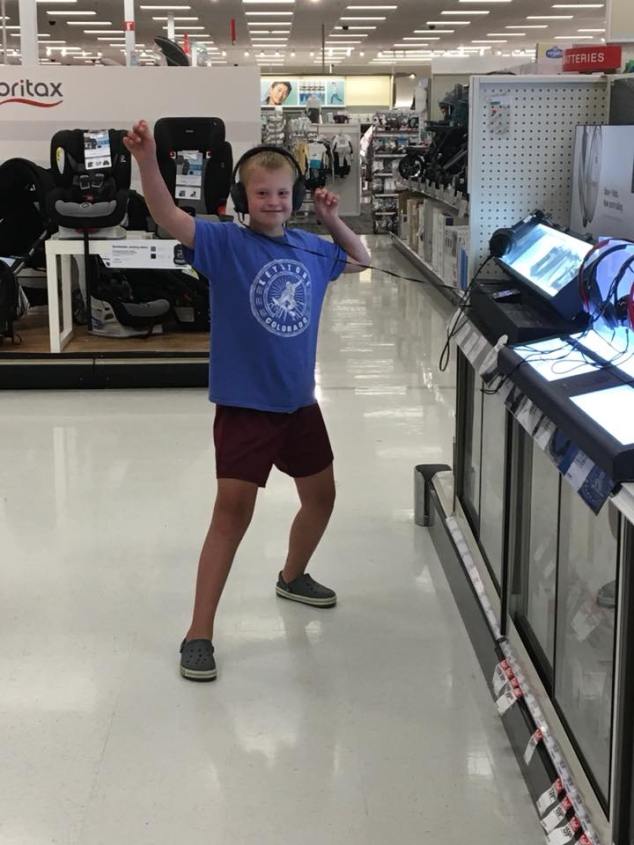
One day while walking the aisles at Target, Wil spied sample headphones sitting on a counter. He put them on and started jumping, twisting and waving his arms. The wire cord attaching the headphones to the counter were his only hinderance. He danced to a beat streamed into the headphones only he could hear, and yet it was quite amazing to watch the effect of his song reach every person passing by. There was not a person who didn’t visibly relax their shoulders, smile and walk taller after passing Wil’s space. You don’t have to hear his music to feel the beat.

Ironically, when I think back to the day I received Wil’s diagnosis, my memoires are devoid of song. There was no dancing, not even to a silent beat. Even Wil barely let out a whimper. 

I learned lots of words and terms in those early days, but none had a note of song. In fact, Wil’s diagnosis had a name that was quite melancholy. The name “Down” was attached to Wil’s syndrome, after Dr. Langdon Down. Though Dr. Langdon Down seemed to be a good man, whose intentions were to make a better life for people with Down syndrome, a name like “Down” is hardly joy invoking. But leave it to Wil to change that.

Wil may have been a quiet baby, but he could soon sing “You Are My Sunshine,” word-for-word (a song my dad always sang to him) before he was able to speak. He rocked to the beat months before he could walk.

As Wil “gets down” to his music every day, I looked up that very term in the dictionary: “to enjoy oneself by being uninhibited, especially with friends in a social setting.” 

I’d say that’s a down-right accurate description. 

To which Wil would likely sing in reply:  “I turn it up, down, up, down, up, down…”

Person First

Person-first language. That was one of the first terms I learned. Wil is not a Down syndrome boy. Wil is a boy with Down syndrome. 

I also learned where the word Down came from: Dr. John Langdon Down. Dr. Down wasn’t the first person to discover Down syndrome, but he was the first person to fully describe the characteristics of Down syndrome. “Down” is thus capitalized for Dr. Down’s name, while syndrome remains in lower case. I heard from many different sources that Dr. Down’s name was unfortunate and that our kids really have “Up” syndrome (be sure to only capitalize the “Up”). 

Terms also got Down-right (or should that really be Up-right?) clinical. Hypotonia, hypothyroidism and epicanthal fold to name a few of the most common first terms I heard repeatedly. Except for one genetics class in college, I’d never been presented with so many photos of chromosomes in my life; and not just any chromosome. The very specific 21st chromosome pictured with 3 copies rather than the typical pair. Thus the name, Trisomy 21, the most common form of Down syndrome. 

Looking back on this early learning curve full of facts and definitions, I have a visual of a news broadcaster (if you can picture a hybrid of Tom Brokaw and Ron Burgandy) sitting behind a desk. His face is very serious as he taps his important stack of papers on the desk in front of him. He looks straight into the camera, ready to deliver his very important speech. Over his left shoulder is a screen, and on it appears the cherubic face of an infant. 

 “Good evening, folks.” He says in a professional deep baritone voice. “What you are seeing now is a baby with Down syndrome.” He pauses for effect. “Not a Down syndrome baby. Be sure to use your person-first language only, folks.” “Note the baby’s epicanthal fold, giving the appearance of almond shaped eyes…”

The photo of the cherubic baby is replaced with 3 squiggly lines.  “What you are looking at now are chromosomes. Specifically 3 copies of the 21st chromosome…”

“And remember folks,” he says in closing as the screen changes to a stock photo of laughing toddler (who has Down syndrome) with his cheerful mother,” there is nothing Down about it!” Cut to commercial. 

It’s easy to poke fun now because I’ve lived this life. In the beginning, the diagnosis of Down syndrome scared the heck out of me. Mostly because I knew so little about it. An education in terms was important to me. But there is a vast difference between living a life and learning about that same life. Learning about a life relies on definitions to develop understanding. But when you live that life, everything you need to know is learned by first-hand experience, and most importantly, feeling the emotions that accompany those experiences. 

Today, those stock photos of the 3 copies of the 21st chromosomes are squiggly, little lines that I just want to hug. They are part of my son. And speaking of hugs, have you ever had a Wil hug? Thanks to hypotonia, he just melts right into you. Don’t get me started on those little folds above his eyes. Talk about melting. 

As for Wil’s diagnosis? The coining of Dr. Down’s name is unfortunate,  who wants to be defined as Down all the time? But who is Up all the time, either?  Wil is Wil. We are totally down with Wil’s syndrome (be sure to capitalize the W). 

I would love to see my hybrid newscaster take on the task of presenting our potty-training adventures. The word poop was a common word in my vocabulary as both a noun and a verb. One well-meaning family member convinced my parents that the only reason Wil wasn’t potty-trained was because I was too busy. As my parents would have Wil to themselves for a weekend, this family member mentioned it would be the perfect opportunity for my parents to potty-train Wil. I said have at it! That very first night, my mom called me saying she gave up. We both had a really, good laugh over that. My parents are totally down with Wil syndrome, too. 

Having low muscle tone (aka hypotonia) didn’t help the potty-training process move smoothly, so to speak. Discussions within our Down syndrome support group revolved around this subject on most occasions. We were each other’s best resource, as we had very little other resources to pull from. Typical potty-training books were soon flushed down the toilet in frustration as our kids pulled up their pull-ups and got on with another day, oblivious to our concerns we’d be buying pull-ups through their teen years.

Wil is now a teenager, and thankfully the pull-ups days are long behind us. Poop, however, has not vanished as a common word in this household. He’s a teenage boy after all. Potty talk is considered hilarious in both noun and verb form. As for me, I continue to flush typical how-to books down the toilet and find my friends within our Down syndrome support group to be my most helpful and greatest resource (with a few laughs along the way to get us through our challenges). 

When you know the person first, you wouldn’t live, learn, speak or see things any other way. 

Playing Catch-Up

Wil is an expert at the game of catch-up. It’s a game he plays every day.

Wil has low muscle tone, which adds to the game. In fact, I’ve been told having low muscle tone feels like wearing a backpack all day long. It’s no surprise, then, that Wil’s favorite place to play is in the buoyant water.

Last week while on vacation, Wil was playing in the outdoor pool. Wil recently learned how to do a handstand in the water. So he practiced his handstand over and over.

A brother and sister, about Wil’s age, were the only others in the pool. They were tossing a football back and forth. Observing Wil do handstands, the brother set aside the football and said, “Zoe, let’s do handstands.” Zoe, smaller than Zander, made an attempt and soon toppled over. “Watch this,” he said, confident to top his sister. His handstand was nearly the same as Wil’s – his legs went up in the air, and as soon as he straightened them, he toppled over. Zoe and her brother continued their practice of handstands.

Tired of handstands, Wil pulled himself out of the pool. With a quick walk/run (the kind that kids do when they know they have to walk but really want to run) Wil hustled to the deep end of the pool. Then Wil stepped back and, with a running start, leapt into the pool.

The brother and sister stopped their handstands and watched. Wil repeated the process (with a side eye on the brother and sister).

The brother swam over to Wil. “Do you want to be our friend?” the brother asked.

“Yes.” Wil said.

“Hey Buddy, introduce yourself.” I called out from the pool deck.

“Hi, I’m Wil.”

“Tell them your names,” their father called out from the pool deck. The brother and sister then introduced themselves as Zander and Zoe.

“What do you want to do?” Zander asked. “Do you want to throw the football?”

Wil said yes, but then he swam off. Zander and Zoe, confused, swam after Wil. Wil pulled himself out at the shallow end, then did his walk/run to the deep end. He stopped and waited for Zander and Zoe to catch up. Then he stepped back, took his running start and leapt into the pool.

Zander ran and leapt in after Wil. Zoe ran to the edge of the pool, stopped, then hopped in. They all bobbed and swam to the shallow end, looking at each other as they came up for air, smiling. A game was afoot. Round and round they went.

Each round, Zoe’s fears subsided and her leaps began to catch-up to the length of Wil’s. Zander, who started out as a ball of fire, began to lag behind, catching his breath.

“Getting worn out, Zander?” Zander’s dad asked and smiled. Not to be outdone, Zander gathered back his energy and ran to keep up with his new friend, Wil.

Wil is an expert at the game of catch-up.

Thank you for sharing Manchester Mirror: http://themanchestermirror.com/2020/08/31/stories-of-wil-playing-catch-up/