He’s a 16-year-old kid. He wants to be a 16-year-old kid the way he is, just like any 16-year-old kid wants to do things the way they do.
Why should a kid with prosthetic legs be an inspiration when he plays baseball? He just wants to play baseball, and that’s the way he does it. Yes, it’s more challenging than if he had two flesh and bone legs that ran when he told them to. But the way he plays is normal for him.
When I narrowly viewed how things should be, I unintentionally one-dimensionalized people. Then when I had reason to truly care, my heart cracked open to multiple ways of being. That is true joy once experienced; it’s very freeing. Challenges don’t disappear but my mind is no longer caught in what should be, because Wil is exactly as he should be. Boys playing baseball, no matter how they get to the bases, are how they should be.
Whenever I define what should be, the deep value of the many ways things can be is lost in my angst. The value of a multitude of joys is equal to the value of true inclusion. But a change in thinking doesn’t happen until we have a reason to care.
Should people without disabilties play parts in film of people with disabilties?
There have been some impressive performances of such cases. But then I thought, if Wil were an actor, would he be hired to play any part but of the person with Down syndrome? That would be summed up in two letters: NO. And if he were an actor, how would I feel about a person without Down syndrome playing his part? How would he feel? I would be appalled on many levels. No matter how much that actor studied, how would they really know? Who better to play the part, to raise true awareness, and to give a paying job to, than someone who lives it.
In today’s age, what does disability representation in film look like? There is definitely what coined by Stella Young as “inspiration porn.” As a society, are we as progressive as we claim to be? It’s definitely something to give thought to. So I did some research. Then I wrote about (see below) for my Special Education class (please feel free to comment, I’d love to hear thoughts):
Time to Share the Mic: Authenticating the Voice of Disability in Film Turner Classic Movies (TCM) played a double feature every Sunday this past July – a total of 10 movies for the month – showcasing people’s experiences with disabilities. The series, which coincided with Disability Pride Month, went as far back as the silent film Deliverance (1919) about Helen Keller and her teacher, Anne Sullivan. This early 20th-century film’s symbolism of ignorance and knowledge – one wore a white robe, the other black, and both urged Helen to follow them – was ahead of the times. The real Helen Keller and Anne Sullivan made an appearance in the film. The TCM series starter was The Best Years of Our Lives (1946), wherein three war veterans returned to their hometown “who are all in different states of physical and mental distress after the war” (Fields, 2023). One of the veterans is played by a real-life war veteran, Harold Russell. Russell lost both of his hands in a wartime incident, and having the choice between plastic prosthetic hands and steel hooks, he chose steel hooks. Russell became quite adept at using the steel hooks and eventually made a training film for soldiers who had lost both hands (Sevaro, 2002). Director William Wyler, a veteran himself with severe hearing loss due to his service, saw Russell’s training film and advocated hiring Russell. Russell had never had acting lessons, and Wyler stopped producer Samuel Goldwyn from arranging them. “This was a rare case of a person with an actual disability playing a character with a disability” (Fields, 2023).
Fast-forward the film reels of time to the present day and we will find that “significant depictions of disability on film and television shows have nearly tripled over the past decade compared with the previous 10 years”(Bahr, 2021). Per a Nielson study of among 3000 titles (from television and movies) from 1920 to 2021 nearly 70% of the content inclusive of disability was in film (Nielson, 2021).
So that is great news for the authentic voice of actors with disabilities to be heard, right? In film-speak, that would be called a long shot. Only 1.9% of all speaking characters in the top films of 2022 had a disability, according to an August 2023 report published by the University of Southern California (USC) Annenberg Inclusion Initiative (Heasley, 2023). The report states that “there has been no change in the representation of characters with disabilities since this community was included in our reporting across top films from 2015. Characters with disabilities are consistently missing in film.”(Smith, et al., 2023).
With an increase of disability portrayed in film, but with less than 2 percent of speaking characters with disabilities in recent top films, who is the voice of the disabled? Have we reverted back to the silent film days of Deliverance? The answer is, non-disabled actors are speaking for the disabled. Nearly 70 Academy Award nominations and 27 wins were given to non-disabled actors for playing disabled roles. Yet, only three actors with disabilities have won Oscars: The aforementioned Harold Russell, as Best Supporting Actor in 1947 for The Best Years of Our Lives, Marlee Matlin, who is deaf, as Best Actress in 1987 for Children of a Lesser God and most recently Troy Kotsur, as Best Supporting Actor in 2022 for CODA (Brownworth, 2023).
Non-disabled actors are clearly lauded, and applauded, for their portrayals of persons with an actual disability as is evidenced by the overwhelming number of nominations and Academy Awards given to non-disabled actors in relation to disabled actors. “Even though the number of disabled characters continues to increase, approximately 95 percent of those roles are still portrayed by actors who do not have disabilities,” said Lauren Applebaum, Senior Vice President of Communications at RespectAbility (Bahr, 2021).
And what of the content of the increased portrayals in film of people with disabilities? Consider what Stella Young, who spends her day in a wheelchair, coined as “inspiration porn” in her 2014 Tedx Talk:
The little girl with no hands drawing a picture with a pencil held in her mouth. You might have seen a child running on carbon fiber prosthetic legs. And these images, there are lots of them out there, they are what we call inspiration porn. (Laughter) And I use the term porn deliberately, because they objectify one group of people for the benefit of another group of people. So in this case, we’re objectifying disabled people for the benefit of nondisabled people. The purpose of these images is to inspire you, to motivate you, so that we can look at them and think, ‘Well, however bad my life is, it could be worse. I could be that person.’ But what if you are that person? I’ve lost count of the number of times that I’ve been approached by strangers wanting to tell me that they think I’m brave or inspirational, and this was long before my work had any kind of public profile. They were just kind of congratulating me for managing to get up in the morning and remember my own name. (Laughter) And it is objectifying. These images, those images objectify disabled people for the benefit of nondisabled people. They are there so that you can look at them and think that things aren’t so bad for you, to put your worries into perspective (Young, 2014).
If such inauthentic portrayals of disability have the power to shift human emotions, imagine how hard it is to unravel decades of film that have trained us to think about how disability should be portrayed. “When disability is a part of a character’s story, too often content can position people with disabilities as someone to pity or someone to cure, instead of portraying disabled individuals as full members of our society,” said Applebaum. (Bahr, 2021).
Rather than placing a non-disabled person’s bias on such portrayals, or portray people with disabilities as flawed or inspirations, a boost to authentic inclusion and diversity could be made by taking actions like Wyler in The BestYears of Our Lives; advocating for a person with an actual disability playing a character with a disability. Moreso, creating space for writers and directors behind the camera who have first-hand experience living with a disability. “The inclusion of disabled talent does not happen by accident. It is critical to have representation behind the scenes to ensure better and more authentic representation on screen,” said Appelbaum. “We need people with disabilities in a position to influence storylines and narratives, help make decisions about casting and talent, and represent the disability community throughout the creative process” (Nielson, 2022).
That’s exactly why some filmmakers and actors with disabilities are taking matters into their own hands by creating films such as CripCamp and Peanut Butter Falcon. Crip Camp is a “groundbreaking summer camp for teens with disabilities. Crip Camp is the story of one group of people and captures one moment in time. There are hundreds, if not thousands, of other equally important stories from the Disability Rights Movement that have not yet received adequate attention.” Crip Camp’s release in 2020 marked the start of a campaign “whose goal was to use the film as leverage to create change for people with disabilities.” Crip Camp stands “by the creed of nothing about us, without us. For too long, too many were excluded, and it is time to broaden the number of voices and share the mic”(CripCamp.com, 2020). The idea for PeanutButter Falcon began with a conversation between Zack Gottsagen, an actor who has Down syndrome, and his friends and screenwriters, Tyler Nilson and Michael Schwartz. Nilson shared with Gottsagen “that even though he was talented and had been studying acting for years, there just weren’t many roles written in Hollywood for actors with Down syndrome (or any disability) and that there was a very small chance that he’d ever get an opportunity to play a major role.” Gottsagen replied, “Well … you guys make movies, why don’t you write one and I can be in it?! We can do it together!” (Schwartz & Nilson, 2019).
There is reason to be hopeful that, as Gottsagen so aptly stated, “we can do it together!” More films with authentic disability representation have recently been released such as A Quiet Place, All the Beauty and The Bloodshed, CODA, Creed 111, and Netflix’s Rising Phoenix, Sex Education, and Special (Fraser, 2023).
Just maybe, we are realizing that “we need more relatable, middle ground, diverse disabled characters” (MediaTrust, 2019). Bobby Farrelly, director of Champions, a 2023 movie with a predominate cast of actors with disabilities, said, “We’ve become aware of how hard it is for disabled actors to get parts in movies because they don’t read for parts that aren’t disabled, so when the character is disabled, it should go to a disabled actor” (Heasley, 2023).
When non-disabled actors are applauded and awarded for their roles as the disabled, and when audiences applaud themselves with feel-good cheers of inspiration porn, or when the emotional wheels of pity are churned in scenes of people with disabilities marginalized as flawed, broken, or lesser versions of themselves – these are the reels of superficial progress. “We’re so busy believing we are being progressive…that we’re stuck in a rut, having lost sight of the fact that to progress means to move forward” (Zacharek, 2023). It’s time to shine a light on where the cast, crew, and audience have long followed a dark cloak of ignorance and celebrated it as knowledge. It’s time to shed light on the bigger picture. It’s time to share the mic.
This blog isn’t about Wil, it’s about me in relation to Wil.
And I guess all my blogs are really about that. Because I had no clue how to raise a child with Down syndrome. And I don’t think many of us do. There are parenting books, but how many of your typically-developing kids fit those molds? Throw in an extra chromosome, with inclusion being a relatively new concept, and any road map you think you have dissipates into a mirage.
Most of my learning, rather than from books, can be likened to sitting around a campfire passing the peace pipe, except we parents are sitting in lobbies of therapy centers, or school hallways sharing stories of how to navigate governmental services, available therapies, what worked for our kids, what didn’t, and most commonly what worked for our kids one day but then didn’t the next. We all laugh at that last fact, as any sure plans have the staying power of a puff on the peace pipe.
But what’s solid is the connections I have made with those who support me on this path. What’s solid is the work I have put in to the best of my ability. What’s solid are the tear stains on my cheeks from so many hard, frustrating times when nothing seemed to work and days that never seemed would end; what’s solid are triumphs that emerged. By triumph I don’t mean always grand — though they felt that way. A triumph during one period was that Wil actually climbed out from under the table for a few minutes. When you feel directionless, and have no idea which way is up, you are willing to grab on to any sliver of light and expand it any way you can. A silver lining, no matter how slim, is always celebrated when it appears.
When I brought Wil to summer camp it was like standing at the top of a mountain and sticking a flag firmly in the ground. I looked around, and though there were more mountains around us, we had summited this one. It was not just about the day, it was a pinnacle moment; a symbol of the journey thus far.
I know my part in that, I know Wil’s part in that, and I know the friends’ I leaned on part of that. I know, deep down in my heart the worth of that.
And in one shared sentence to me about Wil going to camp the flag was lowered; the worth diminished. Of everything I did to get Wil there, of everything Wil did, of the friends and connections that were part of that journey, the sentence ignored that. The sentence was also more than just words, just like Wil going to camp was more than just camp. The sentence was a pinnacle; a symbol of the journey thus far. Like if Wil was treated as a typical kid, he would have been at that spot anyway. Not one mention of the journey. Not one word of respect for the journey. Not one word of honor for what it took to get there.
Wil is not a typically-developing kid nor will he ever be. Wil has Down syndrome. He has 47 chromosomes, we have 46. That’s not going to change. It is not a negative thing, it is not to be ignored like it doesnt exist. It’s not to be fixed, it’s not to be cured. Wil needs extra help, he needs extra time, and he needs more than I was educated to give him which is why I’ve surrounded myself with very proactive parents.
We are all truly better for knowing, understanding and honoring our friends with disabilities. I know that deep in my heart. I stand firmly on that, and I honor that. One sentence can not change that, but as I said it was a pinnacle sentence so it gave me loads of clarity.
I’ve been carrying the extra baggage of the flag-lowering type of thinking for much too long. Believing time will change it. But you can’t change what you don’t want to, and the only person you can change is you.
I’m handing the baggage back. I’m grateful for the strength of carrying it gave me. It pushed me deeper into what I respect and honor. But it’s not mine to carry.
At this realization I was hard on myself for taking that long to realize how heavy the baggage of another’s is that was not mine to carry. I mean, I could have set it down at any time.
But if raising Wil has taught me anything (and this journey has taught me a lot!), I’ve learned that it doesn’t matter how long it takes to reach certain destinations; what matters is that you do the best you know now, and keep doing that until you get where you want to go. And that extra baggage — that’s up to the owner. It always was.
Now excuse me while I step out much more lightly and enjoy the view from this incredible journey I never knew I wanted, and now can’t imagine life without!
There is no magic formula to acceptance of our friends with disabilities.
Acceptance, in its essence, is very simple.
You don’t need to be a special person. You don’t need to be born kind or compassionate or patient. You don’t need to be energetic or inspirational.
You don’t need to be anything other than willing to open your mind to acceptance.
That’s it. You don’t need anything else. It’s simply to be or not to be.
Once you truly open your mind to acceptance, the rest will come. The new ways of thought. The adventures you never considered. The new friends you wouldn’t have known otherwise. It’s the experience, once accepted, that delivers the specialness, the kindness, the compassion, the inspiration, the energy and the patience.
But if you keep your mind closed, then you’ll never know the amazing you are missing.
Acceptance is not a natural-born talent or a skill; it’s a choice. And that choice is up to you.
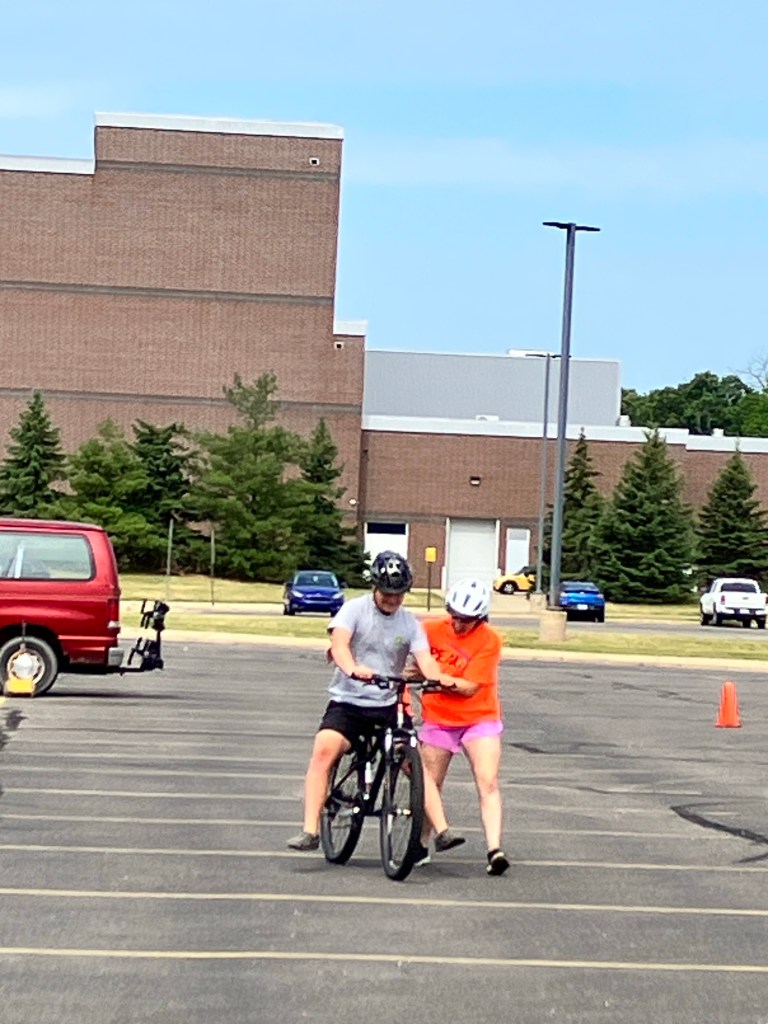
I walked into the parking lot area where Wil was to take his PEAC bike camp. I was overcome with a positive, uplifting feeling — thankfully this type of feeling is not unfamiliar. I’ve grown accustomed to this shift from breathing dense air into a higher atmosphere in only one step.
This atmosphere is one of people helping people. It is beyond a good deed. It is true unity. We innately know the difference as it’s the way we are supposed to be — together.
This is one of the many gifts individuals with special needs offer us. We only need to rise beyond ourselves to accept this handed gift.
“The first problem for all of us, men and women, is not to learn, but to unlearn. We are filled with popular wisdom of several centuries just past, and we are terrified to give it up.”
Gloria Steinem may have had women’s rights on her mind with this quote, but it rings very true for our friends with Down syndrome. I was so scared when I received Wil’s diagnosis. Why? Because of an outdated belief system handed down to me from centuries just past. I had no other frame of reference; it was what I knew and the unknown is a scary place.
When I opened my mind; when I truly looked at Wil and accepted anything and everything to come — all the knowns and most importantly the unknowns — is when my world first cracked open, then burst open, and love flowed in place of the fear.
Most of us don’t choose to be caregivers. Then next thing you know, you find yourself standing on a house of cards.
Last night a friend was at a neighboring table for dinner with her husband and another couple. After they had eaten dinner, the other couple left. As our friend tried to leave, her husband refused. As he’s endured multiple severe health issues, life circumstances now have our friend in the dual role of wife and caregiver. He wouldn’t leave because he’d forgotten he’d eaten dinner, and thought his wife was trying to make him leave before eating. Try as she might to convince him he’d already eaten, he sat steadfast.
Though the differences are many, I saw many parallels in Wil’s determination not to be swayed and our friend’s husband’s determination. I intimately knew the tears in her eyes. I felt her frustration not of just that moment, but of all the moments built as carefully, patiently, diligently and lovingly as a teetering stack of cards; that in just one moment, comes falling down.
After the cards collapse a number of times, you just feel so tired of it all. All of those cards, all over the floor, and one by one you must build them back again. Sometimes, it goes smoothly, and sometimes that one card keeps falling so as it’s impossible to build on it.
I knew this cycle with Wil. The only two solutions our friend had at this point were to wait him out until he decided for himself it was time to go (which could be hours) or a fresh voice to break the spell (as the caregiver’s voice is heard so many times, pleas can fall on deaf ears). It is a new face, or a new voice, that often breaks the spell.
My dad was the one who stepped in, and I looked at our friend, our eyes connecting in a knowingness. It’s hard, and no one asked this kind of hard, but there is so much love here, so much that we’d do for our loved ones, that makes the hard parts both more challenging, and yet strengthens us at the same time. And when friends step in to help, the wobbly card steadies and we can start building again.
Just before the holidays, a member at work shared with me that she was bringing her mother, who has dementia and lives in Florida, back to Michigan for a visit. She said, “Though Wil and my mom have many differences, I now know how you feel when you fly with him. You just don’t know if they will cooperate or not, so you prepare the best you can. Then you find out there is always something you didn’t think of, and things fall apart. And other times things go so smoothly that you wondered how you worried at all. You just don’t know.”
While visiting my parents in Florida, Katherine, Elizabeth, Wil and I went to the Naples Zoo. Wil gets hot easily, so we went on the coolest day. When he grew tired and too hot, I found an area by the zebras which was shady and he really enjoyed. Though Wil is very capable of walking the zoo for the day, its his building overstimulation with the heat, with the crowds and with the animal noises that eventually get to him.
Every year I find ways to keep him at the zoo longer. Every year I learn from the previous year. But I never let him sit it out. Because every year Wil learns how much more he can do. I’m fortunate that the twins can walk off to enjoy the zoo on their own, and circle back to Wil and me, instead of stopping every time Wil and I do. They know how this works. We build the house of cards together.
When Wil finally hits a wall after stops and starts, he still has to make his way back to the zoo entrance. As this zoo is near my parents’ home, they are fortunately available to pick Wil up when that “wall” is hit. I sit with Wil as long as he needs me to, as his will to walk to the entrance is his only way out.
We don’t choose our situations; they choose us. But we do choose how to utilize the time within our situation. We do choose whether to keep building, even after the cards have fallen. When times get hard, locking tearing eyes of understanding mean more than words could ever convey. They give us strength to build again and again; as many times as it takes.
Internal victories are what carry you and lift you through the hard times. Even 30 more minutes at the zoo on this visit delivered an internal joy with iron-clad strength—a strength and joy that will not fade with time or circumstances. I can build a million cards with the super-sonic strength of 30 extra zoo minutes many take for granted.
Caretaking is unpredictable and challenging, yet it brings out our best, and brings us all together if we allow it to. It’s what humanity is all about. (But if you challenge a caretaker to a house of card building game, they will mercilessly kick your ass.)
“Oh, me either.” Replied another. Both shared their own beliefs for saying so.
I found myself bristling. Actually jealous. And how silly of me. Who gets to choose how long they live? But what I found myself upset about was how they could take this longevity for granted. I have a child, that even as independent as he becomes, will always be vulnerable. Always.
Who will look after him when I’m gone? Katherine and Elizabeth have already volunteered, but I’d like them to have their own independent lives as long as possible. To grow into their own adult lives without the concern of caring for their brother until they are much older.
I thought deeper on my internal reaction. If I had said something out loud, they would have apologized profusely. It would have turned the light-hearted conversation into something deeper. They would have been “educated” but would have felt “bad.” These were not people who needed to be educated. They understand Wil and love him. But they aren’t living this daily life like I am. There is a time for educating, and there is a time for not educating.
There is absolutely a lack of awareness in what we do as parents of our kids. All of the extra work involved, the daily aspects of life we must consider, and the future aspects of life. Sometimes we just get tired. Tired of explaining; tired of people not understanding. Not because they are bad people, they simply don’t know. With all of this within us, it’s easy to get angry when people simply don’t know.
I have worked with many “new” people who don’t have the knowledge I do, but they put themselves in the crosshairs of tired parents to learn. Rather than beating them down for not knowing, I am grateful they chose a profession of helping.
When Wil was in preschool, his speech therapist didn’t have much experience with Down syndrome as just previous to Wil entering school the kids with special needs went to Chelsea as they had a developed program. I could have gotten frustrated with their lack of knowledge, but instead we watched the videos together, and learned together, and I’m very grateful to say this speech therapist and I have a very strong bond, and she works with Wil in high school now. The colloaboration and learning together, has been a huge asset in Wil’s life and in his success to this point.
Even when you are challenging a boundary, have respect where another person’s ideas are coming from; ask questions rather push your agenda. Find ways to collaborate. Certainly there are those out there that don’t care. Or even worse, those that pretend to care, say what you want to hear, then go do their own thing. It makes my stomach drop.
But as Mr. Rogers said, look for the helpers. I could have wasted my time beating this person down, and those fights are necessary, but I have found focusing on the helpers is what gets Wil what he needs. I put my focus on collaborating with them. Growing my relationships with them. Showing my gratitude for them. And through all the bumps, the helpers have stuck by Wil and my sides.
We all have things we fight for. But some fights aren’t worth the energy. I’d rather choose my moments to decide when bringing up certain things are just for a fight, or are they truly worth making the change.
No one knows enough to know everything. You or anyone else. I have just as much a duty of being open as anyone else. I’m not more “right” because Wil has Ds. And just as much of a duty to listen and understand where others are coming from instead of always pushing my agenda. But I do have a duty, like any other mom, to raise Wil the best I can. And I would love for him to be a helper, by being a collaborator and realizing he doesn’t stand on a special pedastal just because he has Ds. He stands there because he was a good person.
Over the summer, Wil greatly anticipated celebrating at his Connect friends’ senior grad parties. However, once at the event, he’d soon become overwhelmed with the activity and number of people and flee.
As many of the grads live in the country, I’d turn my back in conversation, only to find Wil already deep in a field (we live on acreage so he’s very familiar with going on what he calls “adventures”). I’ve chased him through a few fields over the years. Fortunately at one city home, he only rounded the backyard to the front porch. The two of us hung out there, Wil refusing to move, for about an hour.
Matt and I had talks with Wil before and after each grad party: It’s okay to feel overwhelmed. You just need to tell us. Just say you feel overwhelmed and want to go.
Wil nodded in agreement, but the next grad party he’d flee again. So we’d again reinforce Wil using his words. But again he’d flee.
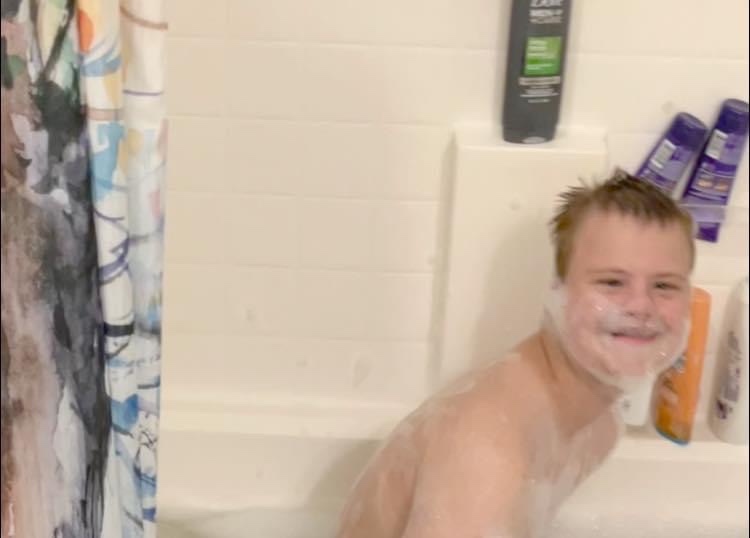
So fast-forward from the summer to last night. Wil did not want to shower but he needed one. I prepared everything for him to reduce any further obstacles; I turned on the water, got his towel, pulled back the shower curtain, then left him to it.
Less than 5 minutes later he came marching up the stairs in his towel, but with hair completely dry.
“Wil,” I asked, “why didn’t you finish your shower?”
“I was overwhelmed.”
“Nice try,” I said stifling a laugh. “Now back downstairs and finish your shower.”
He went back downstairs but switched the shower to a bath. Oh the teenage rebellion 🙄😂






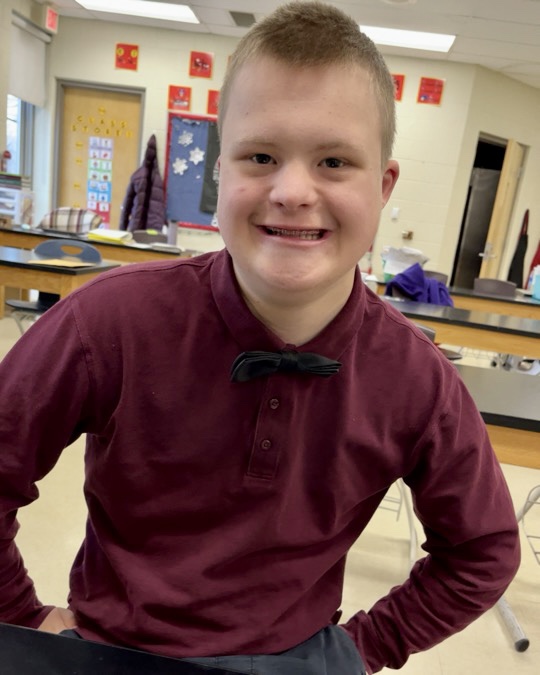



 'WIL'ingness = Willing to Embrace Extra in Life