Wil and I decorated the Christmas tree. It’s the first time we’ve done it just the two of us.
Usually the twins are here so he’ll hang a few ornaments, but then move on to singing or other activities around us.
As Wil was home sick, and we needed low-key activities to stave off boredom, I suggested we decorate the tree. The tree was up, we were just waiting for the twins to come home this weekend. But I said let’s do it.
That’s all I needed to say. Wil got the box of ornaments from the basement and we got to work.
As it was just the two of us decorating, he put up more ornaments than usual. He picked one area of the tree and put all the ornaments there. Fine motor skills are hard for him (such as pinching his fingers together), so when he got frustrated putting the ornament loops over branches, he just shoved the ornaments into the tree.
“Wil, take a break when you need to. I know this gets tiring for you. But watch this, if you hold it like this it’s easier. And feel free to spread out.”
He did take a brief break. Then he tried looping a few more ornaments but stuck to the same spot.
All of his ornaments in one spot, many shoved in, was so darn cute — like a younger child would do. But also mixed with the teenage defiance of “you can tell me what to do but I’ll do it my way.”
Tree decorated, we cleaned up pieces of sparkle and felt that had fallen off of older handmade ornaments.
Wil picked up a red piece of felt, held it under his nose and said, “Look Mom, a mustache!”
Wil is an expert at spontaneous joy. As frustrated as he gets at things that are hard for him, he always has a silly something up his sleeve. It’s these moments that have changed my life. How otherwise mundane tasks can be incredibly joyful in the simplest of ways.
Which is one of the many reasons I don’t like the question: “What mental age is he?”
Ummm, he’s 5, 10, 17, 25 all in one moment. What mental age are you?
Some of us, like Wil, have all our ages all bunched up together in one spot.
Sometimes we need some guidance to spread out, and other times we know exactly how to make the best of right where we are. ❤️
Wil’s paraprofessional, Kristi, told me how Wil — of his own will — went to the closet in gym class, pulled out two baskets and two balls. He proceeded to toss the balls in the baskets. His peers joined in his created game by cheering him on.
Today I picked up Elizabeth, Wil and their friend Kimmy from school today. Elizabeth had an NHS meeting, so Wil, Kimmy and I sat in the car waiting for her with the windows down. As kids poured out of the school, Wil yelled out his hellos, and peers called out and waved to Wil. One friend, Trent, walked up to our car and chatted w Wil. Trent has about every sport there is on his letter jacket. After their chat he fist bumped Wil and walked away.
Wil takes this all in stride, having no idea how this type of interaction is not commonplace. To him, it’s just another day at school with friends.
Kimmy, whose aunt and sister have special needs, said how embracing of Wil the students are at school. I responded that it fills my heart; its what inclusion is meant to be. Wil’s experience is as it should be but isn’t how it always is.
Kimmy agreed, saying she sometimes forgets how people don’t grow up under the same circumstances as she does, and don’t always understand certain reactions and behaviors of individuals with special needs.
I’m so thankful for this Community School experience. It’s enriched my life as much as Wil’s. It’s what inclusion is meant to be — a benefit for all. It’s about friends being friends; of all abilities.
Today Wil and Manny went bowling. Both are teens with Down syndrome. Manny’s mom, Laura, and I share frequently about our plans, thoughts and concerns for the future. Thoughts about our boys as they age out of the school system; after friends have moved on to college, to jobs, to get married. How will our boys adapt to the change? What programs are available now and in the works for the future? And of the programs available, are they a good fit for our boys?
Last night my friend, Cheri, who’s son CJ (who you may know from his weather reports—WCJR weather) called me. CJ is graduating high school this year and also has Ds. Cheri and I shared our thoughts and plans for our boys’ futures. Cheri is always a step ahead of me in raising CJ, and I learn greatly from her experiences.
Not everyone has a teen child with Ds. We must actively seek one another out, actively seek out programs, and discern if what’s available is the appropriate fit for our soon-to-be adults. In fact, just today, Wil had an interview with a summer camp I’ve tried for years to get him into. Wil is ready for an overnight camp, but not without an aide. Just going to a typical summer camp is not an option for him. And that is the case for many people with disabilities; thus the long waiting list. The interviewer said Wil’s a really good fit, but spaces are very limited. She was wonderful, we connected immediately, and said she’d do what she can for him to get in.
Recently talking with my friend, Vanessa, who has a teen daughter w Ds said to me, “You bend for the ones you love.” That statement delivered great clarity to me. It makes sense of what connects me to a camp counselor I just met on a 30 minute Zoom meeting, but knew her innate understanding immediately; and also what connects me, on a deeper level, with my friends. We bend to create understanding and opportunities for people with disabilities. We bend together for the ones we love.
As Vanessa spoke those words, I visualized trees that stay closed in, protecting the roots they know, refusing to bend. Then I visualized trees firmly rooted in love, but with branches reaching, stretching, bending, some almost impossibly yet never breaking, open to receive the sun along with the rain — both of which serve to strengthen them.
If you were a tree, what kind of tree would you be? 😉
“Oh, me either.” Replied another. Both shared their own beliefs for saying so.
I found myself bristling. Actually jealous. And how silly of me. Who gets to choose how long they live? But what I found myself upset about was how they could take this longevity for granted. I have a child, that even as independent as he becomes, will always be vulnerable. Always.
Who will look after him when I’m gone? Katherine and Elizabeth have already volunteered, but I’d like them to have their own independent lives as long as possible. To grow into their own adult lives without the concern of caring for their brother until they are much older.
I thought deeper on my internal reaction. If I had said something out loud, they would have apologized profusely. It would have turned the light-hearted conversation into something deeper. They would have been “educated” but would have felt “bad.” These were not people who needed to be educated. They understand Wil and love him. But they aren’t living this daily life like I am. There is a time for educating, and there is a time for not educating.
There is absolutely a lack of awareness in what we do as parents of our kids. All of the extra work involved, the daily aspects of life we must consider, and the future aspects of life. Sometimes we just get tired. Tired of explaining; tired of people not understanding. Not because they are bad people, they simply don’t know. With all of this within us, it’s easy to get angry when people simply don’t know.
I have worked with many “new” people who don’t have the knowledge I do, but they put themselves in the crosshairs of tired parents to learn. Rather than beating them down for not knowing, I am grateful they chose a profession of helping.
When Wil was in preschool, his speech therapist didn’t have much experience with Down syndrome as just previous to Wil entering school the kids with special needs went to Chelsea as they had a developed program. I could have gotten frustrated with their lack of knowledge, but instead we watched the videos together, and learned together, and I’m very grateful to say this speech therapist and I have a very strong bond, and she works with Wil in high school now. The colloaboration and learning together, has been a huge asset in Wil’s life and in his success to this point.
Even when you are challenging a boundary, have respect where another person’s ideas are coming from; ask questions rather push your agenda. Find ways to collaborate. Certainly there are those out there that don’t care. Or even worse, those that pretend to care, say what you want to hear, then go do their own thing. It makes my stomach drop.
But as Mr. Rogers said, look for the helpers. I could have wasted my time beating this person down, and those fights are necessary, but I have found focusing on the helpers is what gets Wil what he needs. I put my focus on collaborating with them. Growing my relationships with them. Showing my gratitude for them. And through all the bumps, the helpers have stuck by Wil and my sides.
We all have things we fight for. But some fights aren’t worth the energy. I’d rather choose my moments to decide when bringing up certain things are just for a fight, or are they truly worth making the change.
No one knows enough to know everything. You or anyone else. I have just as much a duty of being open as anyone else. I’m not more “right” because Wil has Ds. And just as much of a duty to listen and understand where others are coming from instead of always pushing my agenda. But I do have a duty, like any other mom, to raise Wil the best I can. And I would love for him to be a helper, by being a collaborator and realizing he doesn’t stand on a special pedastal just because he has Ds. He stands there because he was a good person.
At the airport yesterday, Wil was struggling a bit with some young children crying.
As a Starbucks was nearby, I asked Elizabeth to walk him over there while I stayed with our carry-on luggage (as Katherine was in another shop).
Wil was reluctant at Starbucks too, so Elizabeth walked him back to sit with me. She then walked back to Starbucks to get herself something to drink. A woman walked up to Elizabeth while she waited in line for her drink. The woman said she observed Elizabeth with her brother, and expressed her admiration at Elizabeth’s mature patience and how she talked to Wil. Then the woman said, God Bless, and walked away.
Elizabeth was surprised, yet pleased, by this. She was just being a sister to Wil as she always is (and Katherine has this same mature patience with Wil, as well), and didn’t see her actions as anything different than normal behavior.
In Elizabeth’s everyday life, she lifted the spirits of another, and she was uplifted in return.
I’m proud of Elizabeth (always), and also proud of the woman who had the courage to step up and acknowledge Elizabeth.
Kristi, Wil’s paraprofessional, sent me this photo of Wil cooking at school with his Connect mentor, Victoria. It was Cinco de Mayo and they were making tacos. Kristi told me he ended up eating 3!
It’s awe-striking to me, still, even though Wil is a teenager, how powerful the simplest joys with him are. I mean, they were making tacos on Cinco de Mayo. How simple is that? But look at their faces. I think of the support he is encompassed with. Simple never is with Wil.
When Wil was born, I knew so little about Down syndrome. I didn’t know how powerful the simplest actions could be.
Though there was a high learning curve in early therapies and doctor’s appointments with Wil, my deepest learning came from knowing him. Knowing Wil’s smile. Knowing Wil’s hugs. Knowing Wil’s first words. Knowing a community that embraced him.
When I reached out to Victoria, she shared, “it’s kids like him who have really made me want to go into the profession. He is so caring.”
Victoria is way ahead of where I was. Her knowing will change lives. Not only for her chosen profession in the future, but also right now. The way she interacts with Wil, simply by being who she is, sets an example that shatters stereotypes and alleviates fears. It is not scary to know Wil. It is not hard to know Wil. In fact, it’s really darn cool to know Wil.
Whenever I hear words like Victoria’s, I’m always drawn to thoughts of my mom’s close friend, Martha. Martha has three sons. Her oldest, Paul, is my age and has Down syndrome. Paul did not have friends like Victoria. In fact, for Paul, general classroom opportunities were scarce to non-existent. Early therapy was not available or encouraged. And a Connect mentor program would have been a far off dream. Martha navigated this life with a tiny fraction of the awareness and advocacy Wil is surrounded with.
Wil and Victoria’s experiences are not just for Wil and Victoria. They are for the families who navigated this life before us, and for the families Wil and Victoria will open doors for. The power of advocacy is not always found in picket lines. Advocacy is also spread by our daily actions in simple, yet powerful, ways. Simple never is with Wil.
Wil sat down on the bench. I sat next to him and watched a droplet of sweat slip down the side of his forehead. It was 88 degrees and he’d already been walking for 90 minutes. Katherine was to our left crouched in front of a hyena. She snapped a few close-up photos. The hyena was belly up, legs splayed, mouth open in what I swear was a smile, pink tongue hanging to the side, with the cool earth on his back and the hint of a breeze ruffling his coat; just like our pet Labrador on a hot summer day. Elizabeth and my dad were to our right watching an anteater splash himself in a pond.
I knew there would be a point when Wil abruptly declared himself done with the zoo. I was impressed, though, that he’d made it this far. Earlier that morning, Wil jumped out of bed, stripped off his pajamas, took his still damp swimsuit off the dry rack, and pulled it on as fast as you can pull on a damp swimsuit. He jumped in my parent’s pool and played for 2 hours forgetting all about breakfast, until I reminded him it was time to eat and head to the zoo.
Wil and I sat together on the bench talking; I knew the only place he’d go from there was the exit door. After about 10 minutes, Katherine, Elizabeth and my dad joined us at the bench. Katherine and Elizabeth wanted to stay for the safari show which was in 2 hours. We came up with a plan: my dad would take Wil out to eat while Katherine, Elizabeth and I completed a tour of the zoo and watched the safari show. After that, we’d meet my dad and Wil in the parking lot and head back to my parent’s condo.
It’s a balance raising typically-developing children and a child with Down syndrome, but not an equal one. If my dad wasn’t at the zoo that day, then Katherine, Elizabeth and I would have left after we coaxed Wil up from the bench. Or, I would have sat with Wil while Katherine and Elizabeth continued the zoo tour on their own, because when Wil is ready to go, there is little chance of convincing him otherwise. Katherine and Elizabeth are deeply patient, compassionate and understanding individuals for that fact. They haven’t been outwardly taught to be that way; it’s part of their daily lives and ingrained in who they are.
After my dad and Wil headed off to the car, Katherine, Elizabeth and I visited more animals, took pictures, browsed the gift shop, and watched the safari show — all on our own time, at our own pace, in our own way, just us girls. As we sat at a picnic table and sipped $4.00 lemonade under the shade of the Naples Zoo banyan tree, I took notice of the way the roots, stump and branches articulately wove together over time to create this magnificent tree.
I sent a silent nod of reverence to the banyan tree, as we share the knowledge that balance is not always created in symmetry; that intertwining segments woven together over time form a foundation well-grounded. I looked my girls, and thought of sharing this, but they are teenagers and would have rolled their eyes. Instead I told them how proud I was of them, how thankful I was for this time together, and that one day they would also know their deep magnificence.
“Give me a hug.” Those were Laura’s first words when she came over for a visit.
A slanderous word had been directed at Wil that he thankfully didn’t hear (when I learned about it, this careless use of a word hurt me more than him). Even as Wil grows in maturity and in self-advocacy, he will always have a level of vulnerability that is indefensible, which is why it is key that we as parents and friends rise up to advocate for our loved ones with Down syndrome. And that is exactly what Wil’s friends did; they spoke up and their words righted a wrong.
Words have the power to educate, to elevate, and to tear down. As powerful as words are, words can also fall short; notably in experiences when the day-to-day minutia of our lives vary enough from the norm to be easily misunderstood, or carelessly undervalued. One favorite example is from a school psychologist who was told in his early days of training that individuals with Down syndrome can be stubborn. “Well, ok, stubborn is stubborn,” he thought. After his experience working with individuals with Down syndrome he said, “I learned there was a whole new level of stubborn!”
Laura’s hug articulated a level of understanding words never could. Laura’s son, Manny, who is almost 16 years old, also has Down syndrome.
A podcaster who has a daughter with severe disabilities recently said that when raising a child with disabilities, you need friends who are doing the same. That these friends innately understand the specifics of your life because they live it too. She added that if at all possible, these friends would be your friends anyway.
On St. Patrick’s Day, Laura and I were at a coffee house. We chose an outside table as it was unseasonably warm. Laura’s attention turned over my shoulder. I followed her gaze and saw a group of four young men walking in our direction. All of the men were dressed for the holiday; including the group leader with them. The men stopped by our table, and flipped the sheets of paper they held, conferred with each other, then looked down at flower pots, and up at signs.
“Are you on a scavenger hunt?” I asked the young man closest to me. He had a slight speech delay and was not the least bit shy. He showed me his sheets of paper, and told me what they found already, and what they were now looking for. He was clearly enjoying this activity with his friends. Laura and I exchanged a warmhearted smile. An entire conversation passed between us without a single word.
Like most mothers, Laura and I want our children to be happy. Laura’s two other children will soon be leaving home for college and careers of their own. I’ll be in the same position just over two years from now. Many of our friends are either experiencing, or soon to be experiencing, an empty nest. Our nests will look different; Laura and I are on the cusp of navigating what that will look like. Having a friend who understands the entirety of this upcoming new adventure, without explanation, lifts me beyond words.
Though Laura and I connected through our boys, somehow I know we’d be friends anyway. There are some things you just know.
Over the years, I have found it less important how people approach Wil than how they have left an experience with Wil. Wil demands a shift of heart without demanding it at all.
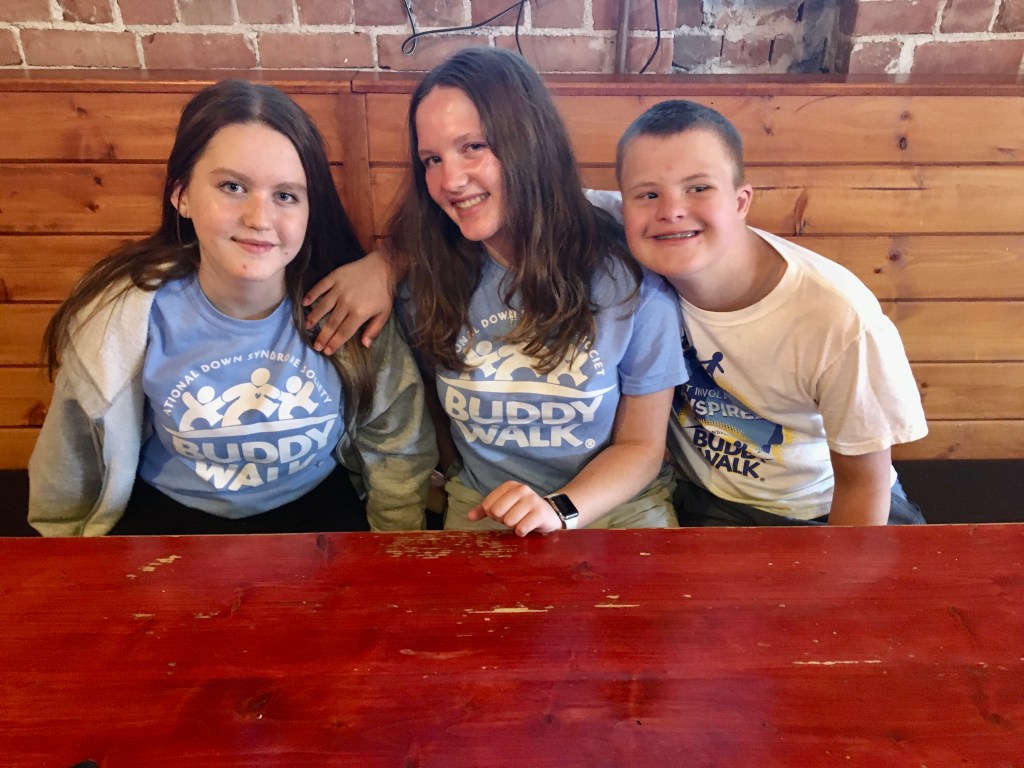
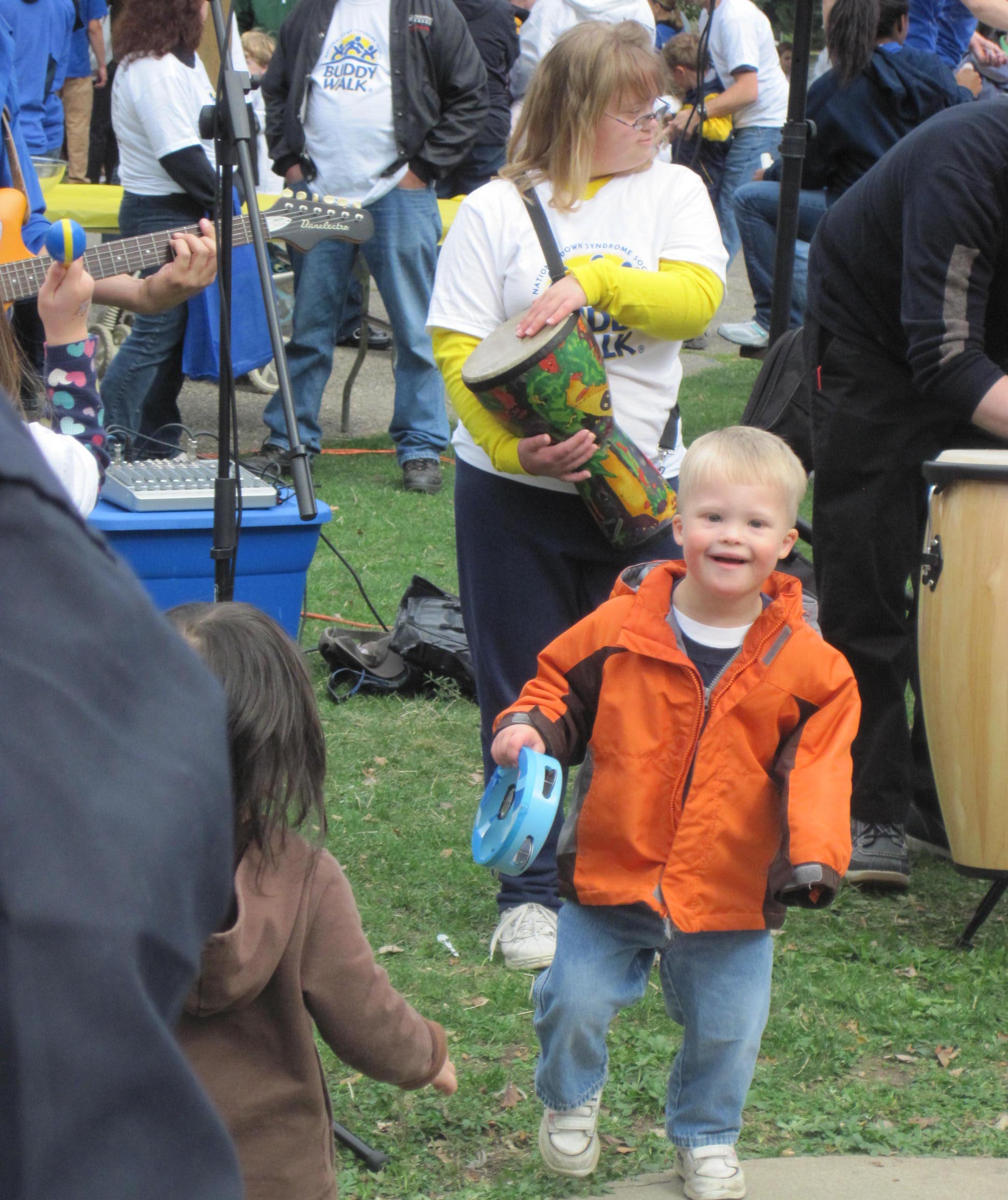
I’ve been involved in our Down Syndrome Support Team’s annual Buddy Walk since Wil was 7 months old. Many walkers who attend this event are long-time attendees such as myself. And it is no surprise why. When new friends attend, a look of awe crosses their faces at the sheer uplifting feeling of it all. You may say it’s the music from the band, mixed with excitement from the silent auction, heightened with a sugar-high from the cotton candy. But I know it’s something far less tangible than that.
I do not know with what expectations or intentions people walk into our event, but I do know the feeling with which they walk out. And that they will come back again. There are no strangers at the Buddy Walk. Each and every participant is folded in like family no matter where they have come from or why they chose to attend. Come as you are and you are accepted as you are, no matter your level of acceptance. Though a welcome banner announces the entry, it is the atmosphere that invites you in. You may have no musical talent but pick up a guitar, the bongo drums or a tambourine and you are part of the band. You may have two left feet, but you will meet a favorite dance partner as soon as you step foot on the dance floor if you aren’t pulled onto it first. You may have been part of the Buddy Walk for years or just walked onto the scene, but you will be received with open arms and a mighty hug just the same. It’s just how our loved ones with Down syndrome roll.
The Buddy Walk lives on in whoever has attended the event. But you needn’t have attended the Buddy Walk to know of the atmosphere with which I speak. It is our loved ones with Down syndrome who create this atmosphere and live their lives in it. And like any atmosphere, it knows no boundaries.
I’ve seen kindnesses emerge from a multitude of strangers upon entering the atmosphere Wil lives in. I have literally felt the shift in people. Not once or twice, but on a daily basis. Tight-lipped strangers visibly loosen – their eyes become softer, their shoulders relax and my personal favorite is seeing an unconscious smile spread across their faces. As they walk past us their smile holds on. You can’t smile on the outside without feeling it on the inside.
I can try to teach a belief system about acceptance of our loved ones with Down syndrome until I’m blue in the face. But the atmosphere created by our loved ones with Down syndrome meets everyone exactly where they are, accepts them as they are, and gives rise to a new level of understanding without a single teacher at the lector. Our loved ones with Down syndrome demand nothing less of us without demanding it at all.
I walked Wil into his first day of camp, then I walked back to my car. I shut the car door and cried for 5 minutes straight.
I couldn’t stop seeing Wil’s face in my mind. His big, wide eyes looking up at me above his mask. I knew that look. He was trying to be brave. He was trying to do what I wanted him to do. He was trying to do what he wanted to do. To do camp by himself. But he was scared. The innocence and trust in his eyes is so pure. It’s beautiful and terrifying at the same time.
Wil was all a bundle of joy on the drive to camp. Country music a-blaring, he was bouncing in his seat and yelling his songs out the window. No matter it was 19 degrees, the music in him was too big to be contained within the walls of the car. It needed to be released into the winter air.
He was most excited about his lunch. We stopped on the way to camp to pick up a Lunchable to pack along with the carrots, cheese, crackers and water bottle I packed at home. The Lunchable was a special treat – he chose the ham & cheese sub with the little Pringles packet and 2 Oreo cookies.
With weeks of virtual school, and now Christmas break, Wil’s mojo has slowly been declining. Wil is an energetic kid by nature, and I am very mindful of nurturing that energy. Wil has low thyroid, so it would not be hard for him to fall into sluggishness. For both physical and mental health reasons, it’s key to keep his energy high. And I know, personally, how physical and mental health go hand-in-hand.
For Christmas, Wil received a mini-trampoline and Luke Bryan CDs. I knew he’d love jumping around to his favorite country singer. I also bought one Luke Combs CD, because I knew Wil would want me to take turns with him jumping to music, and Wil has me about burned out on Luke Bryan! (Wil is agreeable to adding Luke Combs, Alan Jackson, Blake Shelton, Johnny Cash, Zac Brown and Kenny Chesney to his music selection on occasion).
When I came across an email that the Saline Rec Center was having a winter camp, I read into it further. Then my heart sank when I read the age group was for kids ages 5 through 12. I knew Wil would not want to be with the 5-7 year old children, as he’s very much a teenager, but I also knew he’d enjoy the activities the 10-12 year old’s would be doing. As Wil is 13, I thought the camp director may make an exception. No hurt in asking, so I did.
When I called the camp director and mentioned that I had a 13-year-old son with Down syndrome I’d be interested in signing up for the winter camp, her first questions surrounded Wil’s interests. This may sound routine, but whenever I mention Wil has Down syndrome, the first questions typically surround what his limitations are. Let that sink in a minute…when you are asked about your child, are the first questions about what they can’t do?
Raising Wil, there are multiple micro intricacies like this that pop out in our daily lives. Many times, people are not being unkind, it’s truly a matter of not knowing. And you don’t know until you do know. I just happen to live in the know in this particular category. So when you meet people who are in this type of know, you don’t miss the cues, no matter how small. And the cues usually are small –which is what makes them so big.
The topic of Wil’s limitations never came up directly. In discussing who Wil was as a person, the conversation naturally unfolded into what his triggers were for certain behaviors and what extra help in certain areas he may need. The camp director determined that how the camp was structured would be a good fit for Wil, and described the group she would place him in (with 10-12 year olds). It also so happened that the staff member leading that group has an adult sister with autism. Though Down syndrome and autism are very different, there is a deeper understanding gained in growing up with a sibling with special needs.
When I met the staff member leading Wil’s group at the camp, I knew right away he would be a good fit for Wil. Wil had a Master’s baseball hat on, and he said to Wil, “Ahh, the Masters! I love watching the Masters. So you play golf, Wil?”
“Uh huh,” Wil said. Wil looked around at the other kids that were playing ball. His eyes were wide and nervous, but he also wanted to join in the fun. The staff member got Wil settled and I asked him about his sister.
“She’s doing great. She has her own agenda, you know?” I nodded. In his words were a whole world I knew. I didn’t know him, I didn’t know his sister, but I understood what lived under those words. There are pieces of this life that are difficult to articulate. They have to be lived to be truly understood. Even though each piece has its own personality, underneath it all the emotions are the same. And that’s where we met. It’s the same place I meet my friends in our Down syndrome support group. We don’t have to explain, thank goodness. Explaining takes too much energy and the words always fall flat. It’s an enormous comfort when you meet someone underneath the words.
With the combination of the camp director and the leader of Wil’s group, I knew he was in good hands. It was time for me to go, and give Wil his first day at camp. I gave Wil a hug, said good-bye and walked back to my car.
These are my first steps in opening Wil to greater independence. It’s a feeling I’m not sure I’ll ever be able to articulate accurately with words. But if you saw Wil’s eyes, you would know exactly what I mean without my saying a word.








 'WIL'ingness = Willing to Embrace Extra in Life