House of Cards

Most of us don’t choose to be caregivers. Then next thing you know, you find yourself standing on a house of cards.

Last night a friend was at a neighboring table for dinner with her husband and another couple. After they had eaten dinner, the other couple left. As our friend tried to leave, her husband refused. As he’s endured multiple severe health issues, life circumstances now have our friend in the dual role of wife and caregiver. He wouldn’t leave because he’d forgotten he’d eaten dinner, and thought his wife was trying to make him leave before eating. Try as she might to convince him he’d already eaten, he sat steadfast.

Though the differences are many, I saw many parallels in Wil’s determination not to be swayed and our friend’s husband’s determination. I intimately knew the tears in her eyes. I felt her frustration not of just that moment, but of all the moments built as carefully, patiently, diligently and lovingly as a teetering stack of cards; that in just one moment, comes falling down.

After the cards collapse a number of times, you just feel so tired of it all. All of those cards, all over the floor, and one by one you must build them back again. Sometimes, it goes smoothly, and sometimes that one card keeps falling so as it’s impossible to build on it.

I knew this cycle with Wil. The only two solutions our friend had at this point were to wait him out until he decided for himself it was time to go (which could be hours) or a fresh voice to break the spell (as the caregiver’s voice is heard so many times, pleas can fall on deaf ears). It is a new face, or a new voice, that often breaks the spell.

My dad was the one who stepped in, and I looked at our friend, our eyes connecting in a knowingness. It’s hard, and no one asked this kind of hard, but there is so much love here, so much that we’d do for our loved ones, that makes the hard parts both more challenging, and yet strengthens us at the same time. And when friends step in to help, the wobbly card steadies and we can start building again.

Just before the holidays, a member at work shared with me that she was bringing her mother, who has dementia and lives in Florida, back to Michigan for a visit. She said, “Though Wil and my mom have many differences, I now know how you feel when you fly with him. You just don’t know if they will cooperate or not, so you prepare the best you can. Then you find out there is always something you didn’t think of, and things fall apart. And other times things go so smoothly that you wondered how you worried at all. You just don’t know.”

While visiting my parents in Florida, Katherine, Elizabeth, Wil and I went to the Naples Zoo. Wil gets hot easily, so we went on the coolest day. When he grew tired and too hot, I found an area by the zebras which was shady and he really enjoyed. Though Wil is very capable of walking the zoo for the day, its his building overstimulation with the heat, with the crowds and with the animal noises that eventually get to him.

Every year I find ways to keep him at the zoo longer. Every year I learn from the previous year. But I never let him sit it out. Because every year Wil learns how much more he can do. I’m fortunate that the twins can walk off to enjoy the zoo on their own, and circle back to Wil and me, instead of stopping every time Wil and I do. They know how this works. We build the house of cards together.

When Wil finally hits a wall after stops and starts, he still has to make his way back to the zoo entrance. As this zoo is near my parents’ home, they are fortunately available to pick Wil up when that “wall” is hit. I sit with Wil as long as he needs me to, as his will to walk to the entrance is his only way out.

We don’t choose our situations; they choose us. But we do choose how to utilize the time within our situation. We do choose whether to keep building, even after the cards have fallen. When times get hard, locking tearing eyes of understanding mean more than words could ever convey. They give us strength to build again and again; as many times as it takes.

Internal victories are what carry you and lift you through the hard times. Even 30 more minutes at the zoo on this visit delivered an internal joy with iron-clad strength—a strength and joy that will not fade with time or circumstances. I can build a million cards with the super-sonic strength of 30 extra zoo minutes many take for granted.

Caretaking is unpredictable and challenging, yet it brings out our best, and brings us all together if we allow it to. It’s what humanity is all about. (But if you challenge a caretaker to a house of card building game, they will mercilessly kick your ass.)

Processing Time

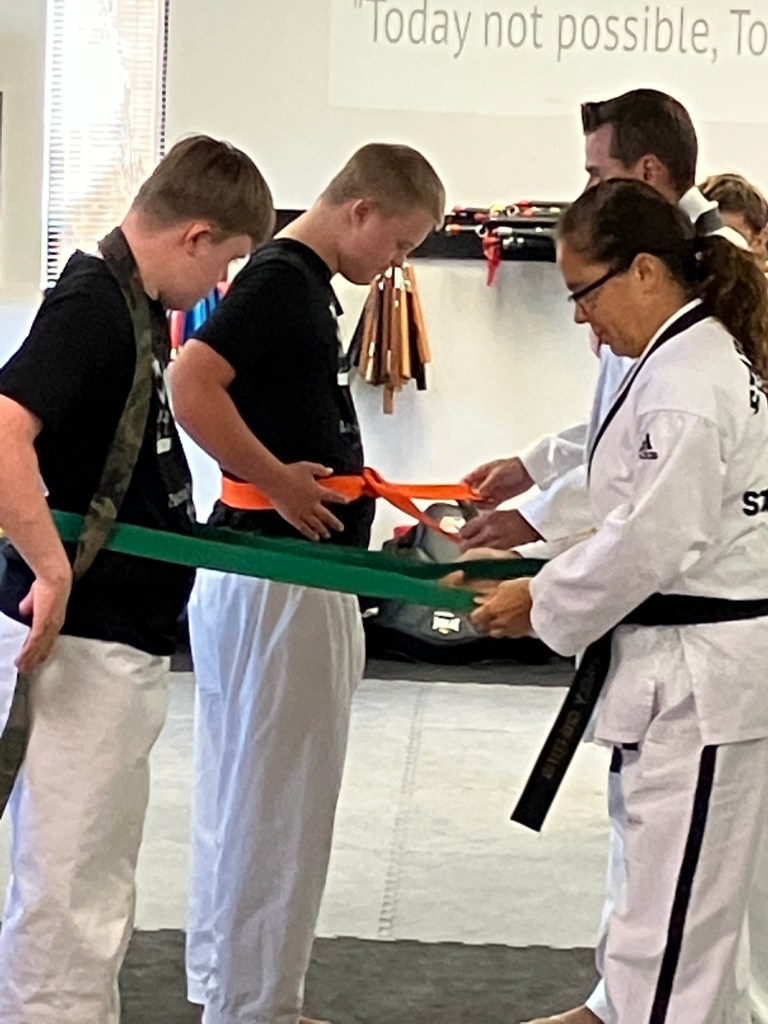
Wil attended his first taekwondo tournament last Saturday. The environment had the potential of causing sensory distress within Wil. I had been to many taekwondo tournaments in the past with Katherine, as she worked her way up to a blackbelt. There would be many people moving around on the gym floor, and spontaneous announcements over the loud speaker —both high sensory triggers for Wil. (Though we have a large dog, Wil is leery of other dogs because of spontaneous barking. The same goes for babies crying, sports announcers over a microphone, and events like pep rallies where crowds and loud noises erupt without notice).

Wil, however, has grown in his ability to manage sensory distress. He’s become more self-aware and only wears his noise-cancelling headphones when he feels it’s an absolute necessity (he still won’t walk into a movie theater without them). He also loves taekwondo. He thrives on his independence in the taekwondo classroom, and also being with his friends, Alex and Nick, who have been practicing taekwondo for years. He looks up to both of them, and works hard to achieve their level of mastery.

When Senior Master practices form with Wil, Wil pays close attention. With his desire to do well, mixed with his growth in sensory rich environments, I knew the tournament would be a challenge for him, but a challenge he would deeply want to rise to.

When we arrived at Saline High School where the tournament was being held, there was a long line out the door. Wil held his excitement throughout the wait for the tournament ahead. The line moved quickly and one of the Masters at the front desk welcomed Wil by name and gave him a high-five. Wil gave him a hearty high-five in return. We were off to a great start!

We made our way down to the high school gym. Wil paused at the entry taking in the crowds. The set-up was the same as Katherine’s past tournaments. There were multiple squares of black mats, parallel to one another, with narrow walk ways in-between. Each square had a pole with a number attached to the top. As Wil’s “Special Abilities” hadn’t been called yet, I suggested we wait by a mat with fewer crowds. I took Wil’s big gear bag from him, so he could more easily maneuver his way, and we walked to the far side of the room where it was less populated. Wil stood against the wall, and I could feel him stiffen by the look on his face. But I also knew he was determined to be brave.

I attempted to break his tension with discussion about Alex and Nick. He nodded but became increasingly quiet. Even if I couldn’t see it, I knew perceptively that the tension within him was rising above his ability to manage it. I suggested we walk over to the bleachers but he shook his head. I pointed to open seats at the very first row of bleachers; I said we wouldn’t even have to climb the stairs. We could just sit and relax for a moment. He started taking little steps away, and I knew it wasn’t to sit on the bleachers. He was plotting his escape. When he took a forward step, I took one with him. I took his hand but he shook it off.

To any outsider watching, when he decided to bolt out of the gym, it would have seemed sudden. I dropped his gear bag on the spot. With the narrow walkways and crowds, I would have knocked someone over with it chasing Wil. I had no idea where Wil was going, and I didn’t want to lose him in the high school, or worse, the parking lot.

He exited the gym and took a sharp left down a long hallway. Closed double doors blocked further progress, so he took a seat in the corner between the double doors and the wall. He curled his knees up to his chest and wrapped his arms around them.

I crouched down to his eye level and talked quietly to him. He dropped his head to his knees. I knew he wanted to be in the tournament. I knew he was disappointed in running away. But he didn’t know how to get out of his emotions.

I reminded him that Master would be excited to see him. I reminded him that once he got on the mat he would be having so much fun, he’d forget everything else. Then I sat down and stayed quiet. I knew he also needed time to process everything. As hard as I tried, right now the moment was up to him.

And inside of me, I had reached my limit too. In efforts to keep Wil calm back in the gym, tension built within me. Would he run? Where would he run? Was I saying the right words or was I making it worse? Do I make him stay? Do I let him go? Do I just kept my mouth shut? Time always gives us the answer, but in situations like this time wasn’t on our side. Wil’s “Special Abilities” division would be called when it was, whether Wil was ready or not.

I was growing increasingly frustrated with myself, mixed with a sadness for him. Here we were, Wil 15 years old, and I’m sitting in a hallway with him. Will this ever get easier? Will things always be this struggle of wondering what will happen? Will I always need this patience and forethought with everything we do?

I know from experience that each tournament will be better. That Wil will know what to expect from his own experience, and we can talk about it with growing effectiveness. He can tell me if he wants to go, or not go, fully understanding the environment he’s walking into. When Wil feels ready to compete in a tournament, it will be the best day ever as we’ll both have grown from this very experience.

But that’s for another day and another time. Right there and then in the hallway, there is no sugar-coating it. It was just plain hard.

I asked Wil if he wanted to go home. He said yes. I told him I couldn’t go get his gear bag without him. That he would have to walk back through the crowds with me to get it, but that we would go right back out to the car.

So we walked back through the gym and grabbed his gear bag. I gave him credit for being so brave to walk back in, and I meant it. I knew that would build strength in him for next time. On our walk back out of the gym I heard my name called. I looked up into the bleachers and saw it was Eleanor, Alex’s mom. She was sitting with Alex, Nick, and Nick’s dad, Jeff. They waved for us to come up and sit with them. I felt envious that Alex and Nick were sitting up there, but we were about to leave. I swiped my hand across my neck symbolizing it was over for us. Eleanor’s nod back to me was like a big hug. She understood exactly what we were going through even though words were not exchanged between us.

Wil and I made it back to the car. I let the tears go silently, so as not to upset Wil, and started the car. As per usual, Wil took my phone out of my purse and clicked on the Amazon Music app, found a Luke Bryan song (right now he’s into the Spring Break album) and started singing with Luke.

It was hard to imagine Wil shrunken in hallway corner moments before as he belted out the lyrics to “Spring Break-Up.” It wasn’t that he’d already forgotten — he’d remember every detail. But to him that moment was over, and a new moment had begun.

I had more tears to let go first, and then I’d be able to move on. I guess we all have our own processing time.

Another Gear

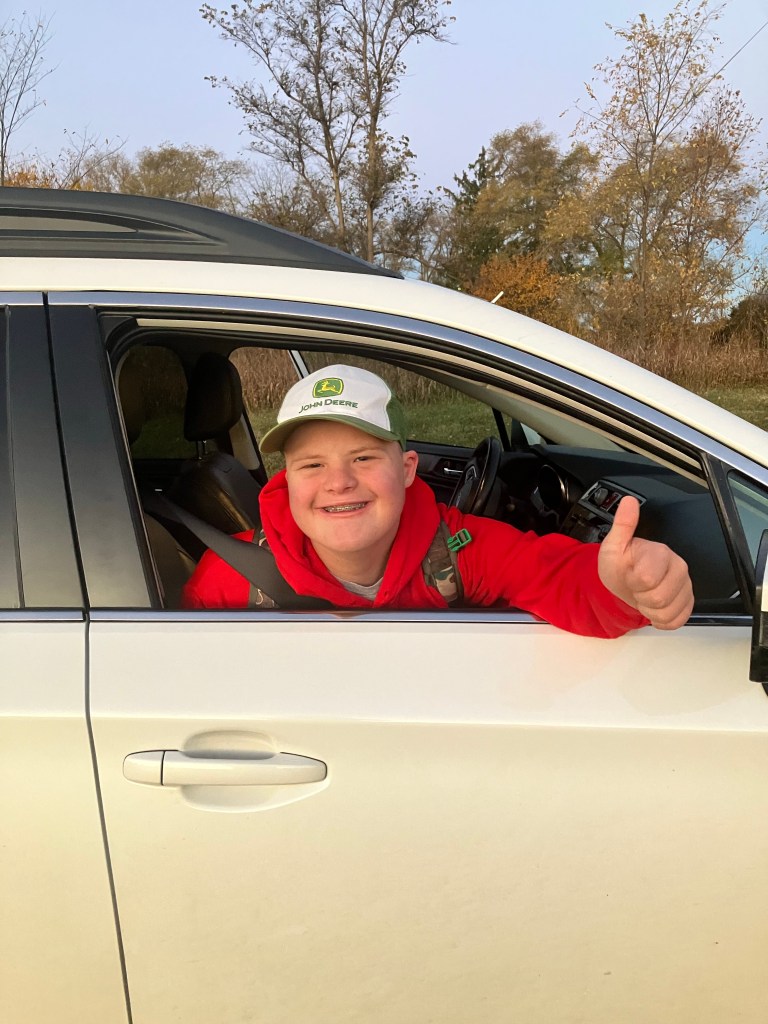
I pulled up in the driveway at 7:45AM after coaching. Just as I was about to exit my car to go inside our home and check on Wil’s readiness for school, he ran outside and into the car!

He was fully dressed, complete with his hoodie, backpack and even socks (which sometimes prove challenging for him to put on) under his Crocs.

Ever since Wil chose to set his own alarm and get up and ready for school on his own a few weeks ago, he’s been gaining momentum by the day. At first I had to nudge him with a few things. Today, Wil whittled it down to zero nudges, with a bonus of him walking outside to meet me (rather than my coming in to meet him).

Last year he simply wasn’t ready for this next step. There were too many “stuck mornings.” But in true “Wil fashion,” when he’s ready the next step turns quickly into a leap. It’s like what was once stuck is now a well-oiled locomotive that quickly gains forward momentum.

I’ve learned over the years to take Wil’s milestones a day at a time. To not look too far ahead; and yet to keep trying and never give up. Because over and again his readiness builds ever so silently under the surface, and when it emerges for us all to see, it’s like BAM! Here we go!

Proper Pacing

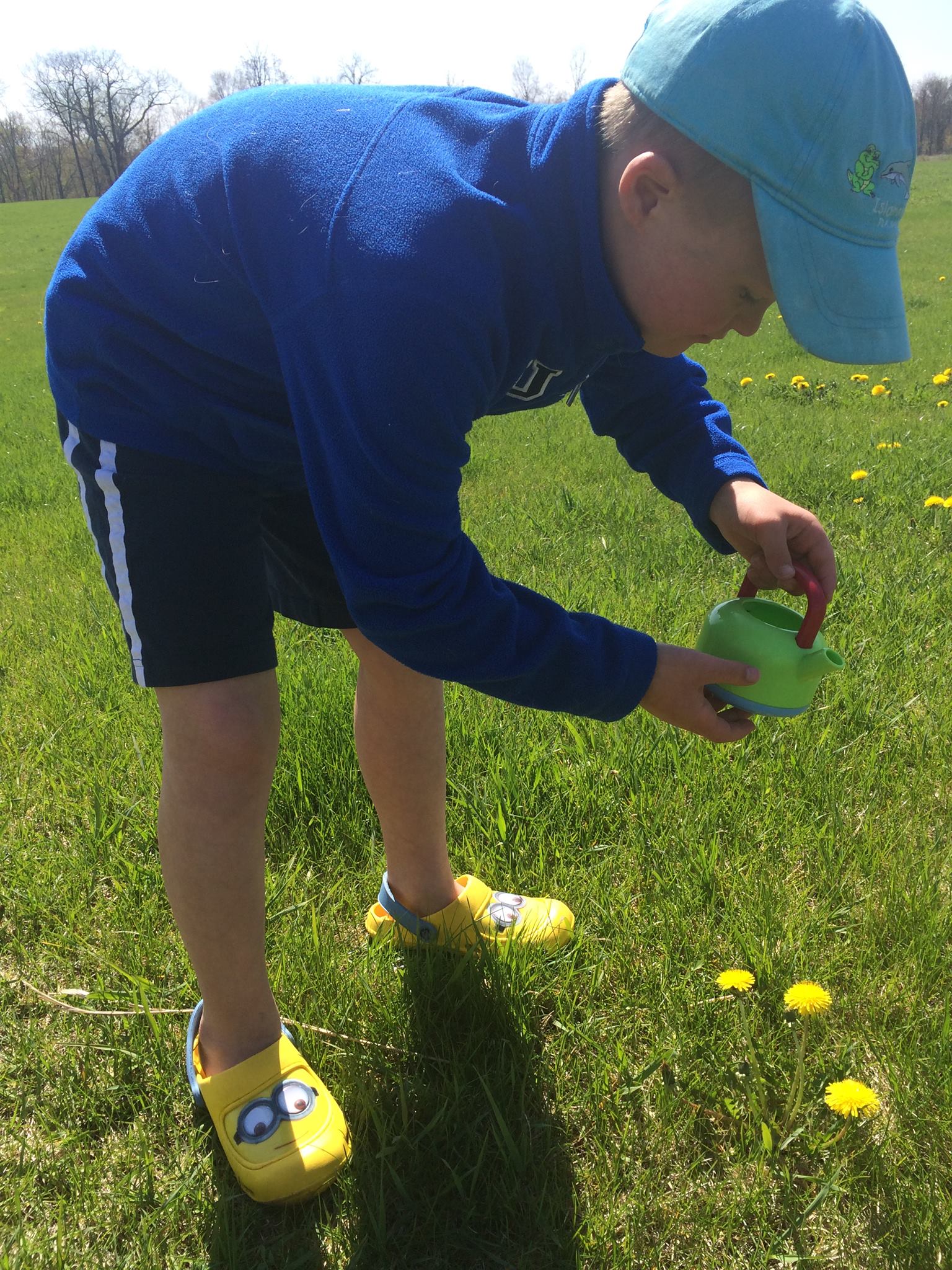
When Wil goes outside, he just goes. Once he’s out there, he figures out what he’s going to do. Sometimes, it’s picking up sticks. Piling them up, or bringing a few choice specimens home.

Other times it’s walking the lane all the way back to the woods. He may get into mischief by investigating a hunter’s deer feed pile. Or he may walk all the way back to the river. He’ll stand there for hours throwing sticks into the river. When he’s done with that, he’ll turn around and come home. No matter what, he finds his way to adventure.

On one of his river trips, I threw sticks with him. Thankfully, I forgot my phone at home. After tiring of the stick throwing, I took a look around. Then I looked up. There, poised on a tall dead tree was a woodpecker. He started his pecking. I watched him for a time, then just listened. Listened to the river, the sway of the trees. And lots of silence.

Wil enjoys the silence. The world is fast for him. Here, in the woods, nature is his pace. It’s funny how hard I try to get him to “keep up.” Come on, Wil, zip up your coat. Come on, Wil, get your shoes. Come on, Wil, it’s time to go.

How often do I go his pace? How often do I go the pace of nature? To listen to the woodpecker. To feel the flow of the river. To feel the silence?It’s amazing how scared of challenges we are, and yet, standing in silence may be our biggest challenge yet.

How silly of me to rush Wil, when instead, he’s the one drawing me forward.

The Same, but a Little Brighter

You know that “brillance” enhancement on your iPhone photos? How your picture is the same, but a little brighter? That’s how it is raising a child with Ds. There is a lot that is the same. So much that is the same. Then there are the experiences that take longer to emerge; I like to call it active patience. You try and wait, you try and wait, you try another tactic and wait. You continue on with active patience. Then it happens. It all comes together. Even though you’ve been trying and waiting, it feels like this big, magical surprise gift. That’s what makes it the same, but a little brighter.

3CCBE976-974C-40AD-A270-15DB79A7306C

Play, Pray and Don’t Say Beer at School

I ran into Wil’s room and started cheering, “It’s Friday, it’s Friday, it’s Friday!”

He rolled over, giggled, and pulled the covers over his head. I put my hands on his back, and pushed down, then released, pushed down, released, over and again, bouncing him on his bed, singing, “It’s Friday, it’s Friday, it’s Friday!”

He laughed, craned his head up to look at me and said, “Ok, ok, ok, Mom, just calm down.”

“I will if you get out of bed.”

Still laying on his stomach, he scrunched his body up, his tushy sticking up in the air. I gave it a swat and said, “Get your little booty out of bed.”

“Look Mom, I’m an inch worm” and he wiggled on the bed.

“You are a very cute inch worm. And you are going to be a late inch worm if you don’t get dressed soon.”

“Ok, Mom, hugs.” He sat up and reached out for a hug. As I leaned in to give him a hug, he bear hugged me. I lifted him up and out of bed. He curled up his legs, so his feet wouldn’t touch the floor. I felt my neck and back sinch up, and leaned him back over the bed.

“Dude, you are not little anymore. You can hurt Mommy doing that. Ok, up and at ’em!”

“Huuuuugs.” I hugged him again, then he laid back down in bed.

“Wil, up, up, up!”

“Oh, Mom, too much energy. Hugs.” I hugged him again, and pulled him up.

“Ok, Mom, go.”

“You promise to get dressed if I go?”

“Ugh, yes, mooooom.” From a playful inchworm into an irritated teenager in seconds.

We decided what he wanted for breakfast– “Mac n cheese?” “No.” “Sandwich?” “No.” “Eggs?” “No.” “Oatmeal?” “Yuck, Moooom.” “Ok, hot sandwich?” <pause> “Yes, and tomato soup.”

As I left his room to make his breakfast, I pulled the door almost shut, so I could peek through the crack to make sure he was getting dressed. After putting the sandwiches on the stove, I quietly walked up to his room and peeked in the crack of his door. He was talking to himself about his outfit. He always puts his pants on first, then his shirt. If I’m ever helping him get dressed after his swim lesson, and I forget this rule, he looks at me like I’m a crazy person, then says in a very matter of fact way, “Pants first, mom, then shirt.”

Wil always has a theme in mind when he gets dressed. On Monday, he emerged from his room, threw his hands up in the air and proclaimed, “Grey Power!” He, of course, had on a grey hooded sweatshirt with grey pants. He also happened to match the winter sky that day. I thought, that’s one way to make the most out of a grey day. Especially on a Monday. Unfortunately, even though that day started on a high, it ended on a low. His team and I weren’t sure of the triggers, but he refused to work in his afternoon classes and I picked him up after school rather then him taking the bus.

Today he walked out of his room with a Luke Bryan concert t-shirt his Aunt Carrie bought him. “Look at me, Mom!” (Last night watching Jeopardy, I said to Wil, “if they had Luke Bryan as a category, you would win.”

“Really, what?” He ran up to the television, mistaking my
comment for Jeopardy having a real time Luke Bryan category.

He yelled out, “Kill the Lights!” “Here’s to the Farmer!” “Strip it Down!” “M-O-V-E!” “Drink a Beer” then, under his breath, “No, don’t say that at school. Don’t say beer at school.”)

Wil sat down to eat the breakfast I made him–two warm ham, cheese and spinach sandwiches on whole wheat buns and bowl of tomato soup heated to a lukewarm temperature–he doesn’t like anything hot.

“Which shoes do you want today, black or brown?” This is always a consideration each morning and he enjoys making this choice. The black shoes are his tennis shoes, the brown are a little dressier. Today he chose brown, even though he wore sweatpants. His Luke Bryan shirt must have had him feeling fancy.

When it was time to go, he still had half of one of the sandwiches left and some soup. Occasionally this happens, I believe on purpose, because he wants to bring some of his breakfast to school. I put his sandwich in a baggie with a plastic spoon, and poured the remainder of the soup into a thermos.

He pulled on his backpack, grabbed his baggie and thermos and we were off. He sang Luke Bryan songs the entire way to school. (When I’m driving by myself, I can’t listen to a Luke Bryan song. It’s lackluster without Wil’s backup.)

When I brought the car to a stop in front of the school, Wil bolted out with a quick, “Bye, Mom” and in his low muscle tone way, he ran without much bend in his knees, moving slightly side to side, his backpack bouncing on his back, baggie and thermos in hand. I sent up a prayer for his good spirits to continue.

Every day is a process, with or without a playful start. It’s fun when kids are younger, but now Wil is 13 years old. In many ways I’m thankful for his continued youthful spirit, and in other ways the process gets tiring after so many years. His independence is growing in leaps and bounds, yet still, he requires lots of encouragement to get on with his day and with extracurricular activities. I’ve tried to rush him, and it backfires each time. In fact, a little reverse psychology can go a long way. I used to say, “Quick like a bunny!” but now I say, “Slow as a tortoise.” He’ll start slow, find it to be funny, then get on to the activity.

While a playful start doesn’t guarantee a good day, my own personal calculations show a sharp rise in success with a playful start. So I play the numbers, inch by inch, each and every day. Once he bolts out the car door, in the mix with many other kids and experiences, it’s anyone’s guess as to what may trigger him to turn the day upside down or flip it back around and land right side up. That’s when a good team at school and prayers come in handy.

Give us this day our daily hot sandwich and tomato soup, as we start our day in play, may we keep our day right side up, and remember not to say “beer” at school. Amen.

image


Twist, turn, kick. Sputter. Smile.

His swim instructor was showing him how to roll over from his stomach to his back in the water. He’d start, face down, floating, then twist himself around. As he made the twist, he’d flail slightly, body twisting hard, with a little kicking to get himself all the way around.

He’d pop his head to the surface, his clear-lensed wide-eyed goggles—he affectionately calls “Frog power” when he puts them on—showing wide eyes underneath. His breath sputtering, spitting out water. Then catching his breath, laying on his back, realizing he succeeded, a huge smile spread across his face.

Again, he’d twist, kick, turn his body around. Low muscle tone making the task challenging, his observing mom thankful for the important core strengthening that was happening. Again he surfaced, sputtering, eyes wide, spitting out water, catching his breath. Then the smile. Big. Proud.

Again, he’d twist, turn, kick. Sputter. Smile.

Again, again, again.

Each time, the twist would come a little quicker. The sputtering less. Soon, the smile was already there, shining underwater, revealed as he completed the turn and lay on his back. Floating.

And his observing mom found herself smiling too, thinking isn’t life just like that?

FAF48D2A-4E41-42C8-941D-0DCD3D837A92

Special Needs, Peers & Boundaries

Many schools have a peer-to-peer program in the middle and/or high schools. These peer-to-peer programs are where a typically developing student is linked with a student with special needs. At our school this program is called Connect. Wil, who is in 7th grade, has been linked with two high school students, a male and a female.

Wil adores his Connect friends. They visit him during his Independent Life Skills time in the resource room. They work with him on projects, crafts and cooking. He most especially enjoys cooking with his Connect friends. It’s been an enriching experience for Wil to work with his Connect friends, and I believe for his Connect friends to work with him. On days when Wil is feeling unmotivated, his teachers will remind him he is seeing his Connect friends, and that will–on most days–perk him up.

Being in 7th grade is an interesting time for most students. Their bodies are changing, their hormones are firing, and their independence is sought. Wil is no different. His assertion for independence has him taking a few liberties with his Connect friends. He may pick up one of their spoons and throw it on the floor. Or give them a hug then mess up their hair. He’s pushing the boundaries, and also looking for attention. If he were a typical student throwing a friend’s spoon on the floor, or messing their hair, he’d get a “Hey, what did you do that for?” However, kids with special needs tend to get some extra latitude. Wil may get a laugh, rather than a reprimand. Or his behavior will go ignored as the kids simply do not know what to say. His typical peers want to be kind, and fear upsetting him.

I completely understand this, it can be complicated with the communication differences. Wil is not in elementary school anymore. Kids talk a lot faster, there is lightening back and forth processing, and Wil can feel lost in the sea of back and forth communication. A toss of a spoon, or a mess of the hair takes all of that back-and-forth and draws it to a halt. He gets the reaction he was looking for, everyone is kind and thinks, “Oh that’s just Wil,” and moves on.

If you decide to have a dialogue with Wil about why this is wrong and not respectful to friends, you will see his attention wander and probably before you are done talking, he’ll have tossed your spoon again. If you get upset with Wil, he may cry or shut down. He hears and feels the anger and takes this as an attack on his person rather than a correction of the act. A straightforward and firm, “Please do not do that. That’s my spoon, I was eating with it.” Or “Please do not mess my hair. I don’t like it.” He’ll understand that you don’t like it and why in just a few short words. I can’t promise he won’t do it again, but it will come to a halt the more that is said with each instance. And most importantly, he is being treated and respected like a peer.

This is why Wil’s relationship with his sisters is very beneficial. Basically, they don’t put up with his crap. If he does something like talking with his mouth full, Katherine will say, “Wil, that is gross. Babies do that.”

“I’m not a baby!” He will yell back. And that’s the end of that.

Or if he is badgering his sisters for attention, they will change gears with the power of distraction. “Hey Wil, let’s go walk Woody.” They will remind him to get his boots on, that it’s muddy. On the walk, Wil will find every big stick he can and show it to them. His sisters will ooooh and ahhhh at first, then growing tired of it, they will tell him that’s enough.

In that way, he learns boundaries just as naturally as anyone else does.

In many ways Wil is like any typical peer. When he is misbehaving, that misbehavior should be commented on and corrected. When he’s getting annoying by repeating an action over and over, he should be told, ok, dude, that was cool at first but now that’s enough.

Sounds simple, right? So why doesn’t it happen? Wil acts younger in many ways, so it’s easy to treat him younger. Wil is very sweet, he loves unconditionally, so his friends don’t want to hurt his feelings. All of those reasons are completely understandable. Back when I was that age, I would have done the same thing. That is also what makes these situations excellent learning opportunities. Just this morning Wil gave me a hug and started messing with my hair. I pulled out of his hug, looked at him and said, “Wil, I love your hugs. But please do not mess with my hair, or anyone’s hair. People don’t like that.”

“Ok, Mom.” He stopped messing with my hair and gave me another hug. He will likely mess with my hair again on another occasion, when he is feeling feisty. I will again say the same thing in the same way. Eventually he will stop doing it. It can take multiple reminders before he decides to respect those boundaries. Sometimes it takes just one. But the important point is the boundaries need to be set.

Wil’s Connect friends are learning how to set boundaries with Wil and Wil is learning how to respect their boundaries. What it comes down to is mutual respect amongst peers, no matter what the similarities or differences are among them. This Connect program carries with it the essential life skills of working with varying abilities and personalities with care, firmness, kindness and respect. And this crew is proving what a great time you can have doing just that.

79864123_2542951742595152_8994715820626018304_n.jpg


Today was a Tail Feather Shaker

Driving home from work this morning I received a call from Katherine.

“Mom, Wil is in the shower and he won’t get out. We have to leave in 15 minutes.”

“Ok, see if you can urge him out. If not, keep getting yourself ready and I’ll be home in 5 minutes. Has he eaten yet?”

“No.”

“Ok, what does he want for breakfast?”

“Sandwiches.”

“Ok, good, thanks. See you soon.” 

This is no new scenerio. Some mornings Wil hops out of bed ready to go, and other mornings take more time. We all have those kinds of mornings for whatever reason. The challenging part is, where we all understand the need for urgency, Wil could care less about urgency. Any rushing sets you 10 steps back. 

Not too long ago Wil would not get out of bed. Would not, no, no, no. Even with the most patience, he was stuck in a funk. He was moving so slow, that there was no way that he and his sisters wouldn’t be late for school. I convinced him to at least get in the car so I could take his sisters to school on time, it wasn’t fair for them to be late, and that the two of us would go back and finish getting ready. Even with that extra time, he still had a challenging day. Those funks can be hard to break for all of us. Consider having verbal delays where you are unable to express in words how you are feeling–this makes it all the more frustrating. 

When these halting mornings are happening, there are typically 3 key questions that need to be answered to anticipate the outcome in this situation: Is he staying in the shower out of independence? Or is it an act of defiance? Or is he simply enjoying the shower and not ready to get out?

If it’s the first one, he’s generally in good spirits and it’s simply that he wants to determine his shower time like most tweens and teens. With a little pleasant urging, he’s usually more than happy to get out and get ready for school. But if he’s rushed, this situation can easily move into key question #2. If it’s obstinance, its hands down being late to school. It means there is something bigger brewing under the surface and I need to find a way to help him get through it. This always takes time. Any amount of rushing and his heels will find a way to dig into that slippery shower floor and they won’t be coming out anytime soon. Giving him time and allowing him to regroup his emotions is the best way to get through this bump in the road. Question #3 is my favorite. Don’t we all like to linger in the shower a little longer? 

When I arrived home, sure enough, Wil was still in the shower. I pulled back the shower curtain. 

“Hi Mommy! Watch this.” He did a pantomime dive down the the base of the tub and started to pretend to swim. 

<Phew, no obstinance. Clearly he just wasn’t ready to get out of the shower>

“That’s really good you little fish! Hey, it’s time to get to school. If we move fast enough, you’ll still have time to eat one of your two sandwiches. You can take the other one with you(he loves to take his unfinished breakfast into school).” 

“Ok!” How do you spell relief? O-K! 

He stepped out of the shower, picking up his towel, held it in front of him, and shook his bare little tail feather in a dance. I wrapped the towel around him and he ran off still dripping water to his room. 

When I followed him into his room, I saw he had already picked out his clothes. His shirt, pants and underwear were all neatly stacked on his bed. Can you spell Independence with a Capital I?!!! 

We had five minutes left. I slapped together his sandwiches and he ate one while I put on and tied his shoes. I put the other in a tupperware dish to carry to school. 

“You’ll be able to eat one and take the other with you.”

“Ok!” Did I just hear the sound of music? So many ok’s at once, my heart overflows. Clearly this morning, he was ready to hustle and get off to school. 

We only left the house 3 minutes later than usual and the kids arrived to school on time. 

When halting mornings happen, I typically start them with questions. And when they don’t work out well, I ask more and more questions. When you are raising a child with communication barriers, the questions are necessary for everyone’s success. Some questions will never be answered, but many will–those answers help us take the next step forward. After many halting mornings where there were seemingly no answers, today was a resounding success. 

When I pulled back the shower curtain I did not know what I was going to get. To hear Wil’s uplifted voice say, “Hi Mommy!” was music to my ears. That swift 18 minutes this morning was a life-winning race. Today it feels like Katherine, Elizabeth, Wil and I are all wearing medals around our necks. 

Shake your tail feather to big, little victories! Onward!