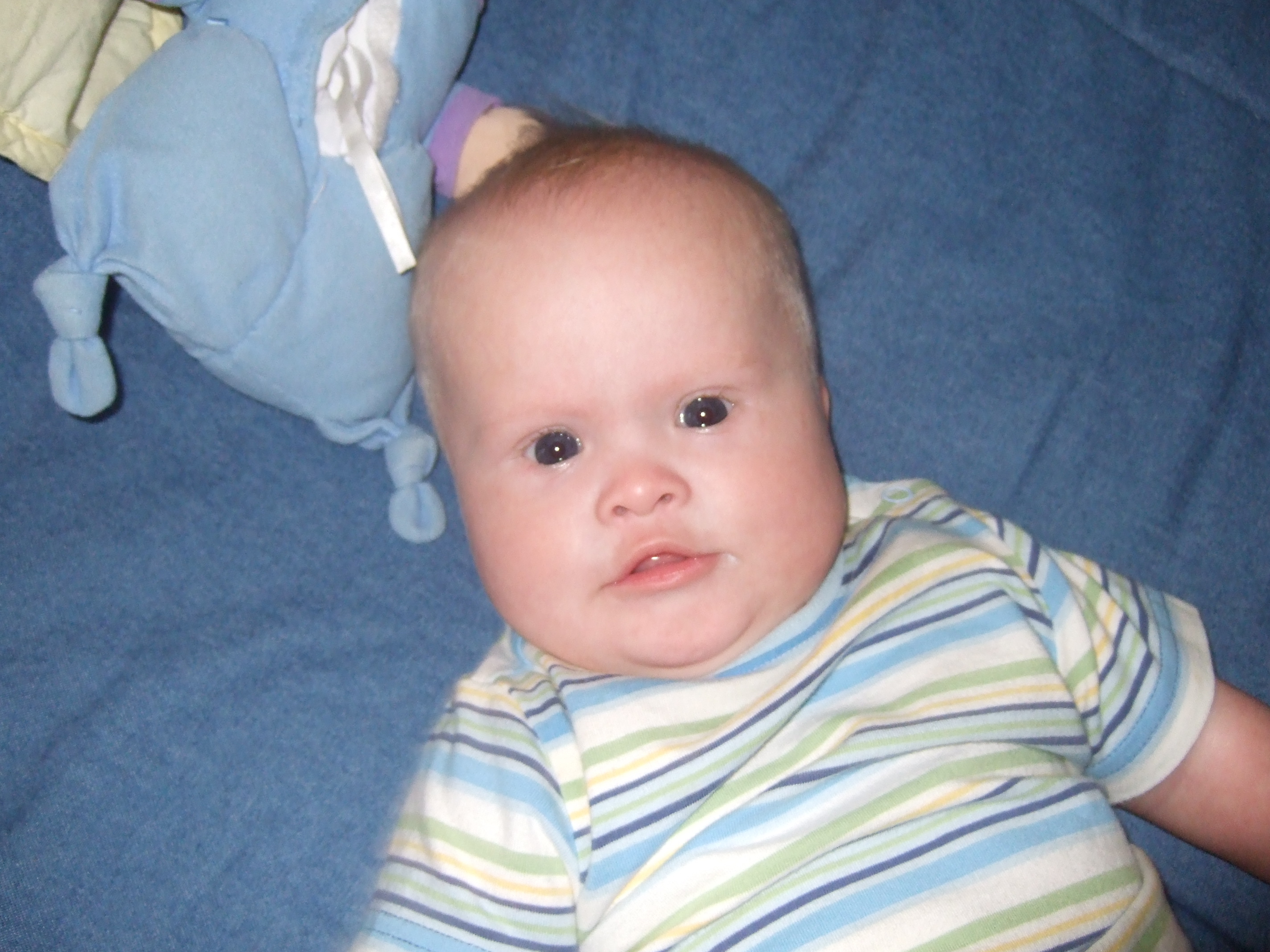
Age is Just All Numbers

Wil and I decorated the Christmas tree. It’s the first time we’ve done it just the two of us.

Usually the twins are here so he’ll hang a few ornaments, but then move on to singing or other activities around us.

As Wil was home sick, and we needed low-key activities to stave off boredom, I suggested we decorate the tree. The tree was up, we were just waiting for the twins to come home this weekend. But I said let’s do it.

That’s all I needed to say. Wil got the box of ornaments from the basement and we got to work.

As it was just the two of us decorating, he put up more ornaments than usual. He picked one area of the tree and put all the ornaments there. Fine motor skills are hard for him (such as pinching his fingers together), so when he got frustrated putting the ornament loops over branches, he just shoved the ornaments into the tree.

“Wil, take a break when you need to. I know this gets tiring for you. But watch this, if you hold it like this it’s easier. And feel free to spread out.”

He did take a brief break. Then he tried looping a few more ornaments but stuck to the same spot.

All of his ornaments in one spot, many shoved in, was so darn cute — like a younger child would do. But also mixed with the teenage defiance of “you can tell me what to do but I’ll do it my way.”

Tree decorated, we cleaned up pieces of sparkle and felt that had fallen off of older handmade ornaments.

Wil picked up a red piece of felt, held it under his nose and said, “Look Mom, a mustache!”

Wil is an expert at spontaneous joy. As frustrated as he gets at things that are hard for him, he always has a silly something up his sleeve. It’s these moments that have changed my life. How otherwise mundane tasks can be incredibly joyful in the simplest of ways.

Which is one of the many reasons I don’t like the question: “What mental age is he?”

Ummm, he’s 5, 10, 17, 25 all in one moment. What mental age are you?

Some of us, like Wil, have all our ages all bunched up together in one spot.

Sometimes we need some guidance to spread out, and other times we know exactly how to make the best of right where we are. ❤️
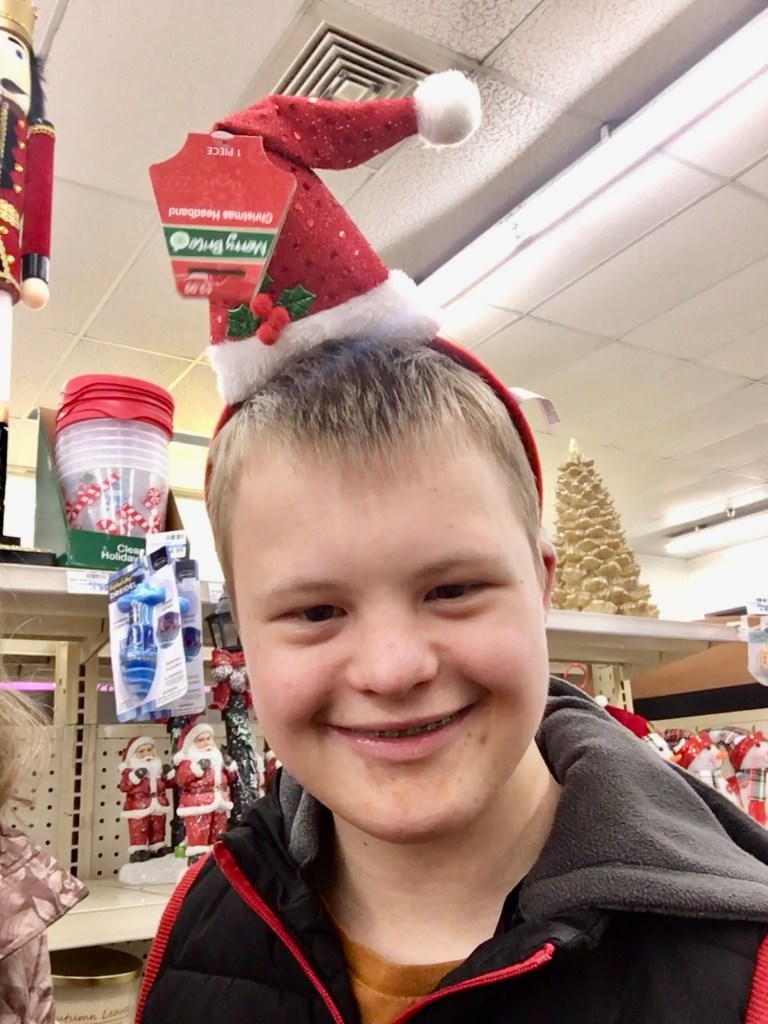
An Ornamental Moment

Wil loves putting ornaments on the Christmas tree. Using his fine motor skills has always been a challenge for him; especially pinching.

As you can imagine, placing ornaments with loops on top gets tiresome quickly for Wil — but Wil always finds a way. When his pinching fingers are worn out, he puts the ornament loop on the very edge of a branch, or just slides that ornament right into the tree and nestles it between branches. He has as much pride in this placement of ornaments as he is still participating in decorating the Christmas tree.

I’ll wake in the morning to multiple ornaments on the floor that slipped off their precarious perch over night. I then look up and browse the ornaments he’s tucked into the Christmas tree. As I stand there my entire being is consumed in a humorous joy that is from somewhere deep inside me. My joy is such it could elevate me directly to the ceiling like in a Mary Poppins floating tea party.

My deep joy is born of deep worries. Deep worries I had in Wil’s younger years when I learned of his low muscle tone. Of when I cried seeing his fine motor skills test scores report a 6-month-old’s ability level when he was 5 years old simply because he couldn’t string beads yet.

I’ve learned a lot about the values and deficiencies of tests over the years. I’ve learned what to take at face value and what to hit the delete button on. I’ve learned a lot about taking life day-by-day. I’ve found myself celebrating what I didn’t know would ever happen— I’ve found a patience in myself waiting for even a glimmer of it to happen. And I’ve found myself become someone who celebrates in vivid colors “what is,” while “what isn’t” quieted itself into a hazy, distant background I once knew.

What I once worried about does mean a lot. But not in the way I thought it would mean today.

This nestled ornament is not only made of paper, styrofoam, cotton balls and glue — it is a symbol of deeply nestled worries grown into a deep, uplifting joy.

Heavy and Light

Wil loves riding his recumbent bike around our property. The challenge is I can’t fully trust he won’t go out to the road. And it’s a busy road.

I was talking to fellow mother yesterday. Her 16-year-old son, who also has Ds, is in summer speech and occupational therapy with Wil. As much as her son loves swimming, she will never have a pool. For the same reason I need to check in on Wil on his bike. She can’t fully trust he won’t go in the pool unsupervised.

Our children are teenagers. They know they are teenagers, their bodies tell them they are teenagers, and they desire the independence of teenagers. And as a parent that has raised 3 babies to teenage-hood, I enjoy a certain measure of independence too.

Last night, Matt and I were enjoying relaxing together after dinner. Wil wanted nothing to do with relaxing. He went outside to ride, and sure enough when I went to check on him he was getting close to the road. He was likely trying to make the biggest circle around our yard that he could, but again, I can’t be fully sure.

Even at 15 years old, he requires an extra level of supervision. And possibly, or possibly not, for many more years to come. With Wil one thing is certain — I won’t know until I know. (If you are a neurotic planner like me, a child w Ds is your best cure! 😂)

Many of my friends are becoming empty nesters. Matt and I may or may not be. I knew this uncertainty would be a reality when Wil was born, but now that the reality is closer, its an interesting feeling of limbo to be in.

I love my life with Wil. He is so fun to be with. We sing in our off-key voices at the top of our lungs. He still surprises me with new milestones, and huge bear-hugs that now knock me over as he’s grown. I’m thankful to fully share in his youthful exuberance.

But I also have a child that may never fully grasp the risks of certain fundamental independences into adulthood. The fullness of that can feel very heavy at times.

And yet, when life feels heavy, it’s being in Wil’s presence that purely and fully lightens the load.

For What They Do

“Wil, I miss you,” popped up in the chat box from Sarah Stommen. Virtual school started back up again a week from last Friday. Wil kicked off his virtual schedule full of steam, but by Thursday the task of getting him in front of the computer was a feat. Sarah saw the look on Wil’s face at the beginning of their virtual social studies class and knew he needed some encouragement.

When I pointed out Sarah’s message to Wil, he quickly turned his attention to the chat box, read the message for himself and a wide smile crossed his face. He then remembered he didn’t want to be there and turned his head to the side.

“Hey Wil,” Ms. Kastel, their social studies teacher said, “where is your dog?” Sarah was holding her dog, Maizie. Wil usually loves to share his pets along with his classmates, but he shook his head. I ran to pick up Oreo, as he was sleeping in the sun near us. I placed Oreo in Wil’s lap but he refused to share our cat with his classmates, too.  Ms. Kastel then asked Wil a few questions about subjects he enjoys discussing, like country music (she’s fostered a love for Johnny Cash in him). Ms. Kastel has a knack for pulling Wil out of his stuck feelings, but on this day, he was determined to stay stuck.

That same afternoon, Wil’s friend, Lila Harvey, sent Wil a “snap” through Elizabeth’s Snapchat (Elizabeth shares her Snapchat with Wil). Lila knew he’d been having a tough time with virtual school and wanted to cheer him up.  

When Wil was a baby, and his diagnosis fresh, I reached out to support groups and read books. I was in a battle against the “wouldn’t be’s.” How could I prevent Wil from falling behind? What did I need to do? I signed him up for all the therapies. Though these therapies were places of growth and strength for Wil, they became those places for me too. When Wil was only months old, his occupational  therapist laid him on a blanket and dangled a toy above him. The goal was for Wil to develop the strength the reach across the centerline of his body. I never knew such details existed. I never knew such heights of joy as I watched every inch of progress Wil made on his way to reaching that toy. Every new reach, every new grasp, every new step, every new word, every new milestone was celebrated. I found myself celebrating not because I believed Wil wouldn’t; I celebrated because he did.  

It’s easy to say these 14 years later that Wil deserves loving friends and teachers. And he does. Yet I remember well the “wouldn’t be’s.” I remember well the process of growth, strength and joy that shifted my focus in a new direction. So when I celebrate friends like Sarah and Lila and teachers like Ms. Kastel for who they are and what they do, it’s not because I believe that they wouldn’t. I celebrate them because they do. 

A New Flight Path

On the day of Wil’s birth, the nurse said he was “floppy” which is a soft marker for Down syndrome. He melted into my chest. The soft, defined curve of his eyes warmed my heart like I’d known this love forever. At the same time, the shape of his eyes sent a hard marker of knowing deep into my gut. I wouldn’t let the knowing climb up to be processed by my rationale. I held it down like a child with hands clamped over her ears, singing, “la-la-la-la.”

We all have dreams for our children. Even if our children do not step into those dreams. Even if we don’t really expect them to. It’s natural to form a moving picture view of the future ahead. Our dreams point the way. When I could no longer hold down the knowing of Wil’s diagnosis, confirmed by a doctor’s solemn nod, I found myself staring into a blank future. In what direction do I go? It was a stand-still in time.

I stared into Wil’s eyes and wondered at the seeming randomness of it all. Though I received many words of consolation and many words of encouragement, I felt directionless. I had no reference point. I was lost even though people all around me shouted directions.  

My first step was to call a trusted friend, Beckie Brewis. She ran the First Steps Parents as Teachers program which Katherine and Elizabeth were enrolled in. She was also the Early On service coordinator (a program for children with special needs ages 0-5). She put me in touch with therapists for Wil. He soon started speech, physical and occupational therapy. Beckie and Wil’s therapists not only helped him take his first steps into speaking, walking and picking up Cheerios, they also helped me take my first steps into this life too. 

When Wil first learned to walk, his physical therapist, Shelly, helped him up onto a balance beam. Shelly held one of Wil’s hands and I held the other.  On a balance beam the only reference point is forward, or you fall off. “Look how he does that,” Shelly said as Wil advanced along the beam. “He doesn’t know how to walk on his own yet, but he is now able to place one foot in front of the other.”

Today Wil and I run like airplanes – our arms out wide, we dip, we skip, we circle, we jump, we zig, we zag, all through the landscape. Our path may seem directionless to some, but we know where we are going because our grounding is solid. Imprinted in the earth are our footprints, one in front of the other, the path of trusted friends alongside steadying our gait. 

Learning to walk through the blank space was how I learned to fly. You can’t spread your wings standing still with your hands clamped over your ears. The knowing that I once held down is now the air that lights my wings….arms out wide, ears open, eyes curved to the sky, la-la-la-la onward we go.

Photo: Beckie and Wil

No Words to Describe the Words that Do

Wil was busy packing his backpack. Then he walked up to me and told me what he was doing and walked out the door. I didn’t understand fully what he said. So I watched him walk down the lane of our back field. If he turns right, that means he’s going to the river. If he turns left, he’s collecting sticks. He turned right.
I threw on a coat and gloves, hopped on the 4-wheeler, and sped down the lane. I hopped off and started making my way from our property to the woods.

But, before I reached the woods, there sat Wil – cross legged in the grass. His backpack was open, the soccer ball he packed had rolled out. In front of him was a spiral notebook. He held a pen in his hand and had written one word: Ashley.

“Hi Wil.”

“Hi Mom.”

“Whatcha doing?”

“Mom, look.” He started writing.

“Ashley summer? Yes, we’ll see Ashley in the summer.” He nodded and continued writing.

“Swimming with Lila? Yes, you’ll have fun swimming with Lila.” He nodded then wrote again.

“Eating? I know you love to eat!” He laughed and wrote again.

“With Mom and Dad. Yes, Wil, that’s right.”

“Mom, look.” And he wrote “I love you.”

“I love you, too, Wil. Very much. I’m also very proud of you.”

He smiled at me, and signed his name.

“I’m cold, Mom.”

“I bet. I’ll give you a ride home.”

Words can’t describe. ❤️

Remembering Leading Hands on the Journey to Acceptance

Reading a passage on a special needs social media page, I came across a sentence about our kids’ first friends being their therapists. Tears immediately flowed with that sentence. Have you ever found your emotions processing words faster than your intellect? My heart felt the words before their literal meaning reached my brain.

Then when my brain kicked in, I thought, “here I am, 13 years into this journey, fully embracing this journey, and still find myself crying at the drop of a hat over an early memory.” No matter where you are in your journey of acceptance, even if you have come full circle, you never, ever forget your early days of passage into what you now embrace.

In the early days, I didn’t know many people who knew what this life was. That is likely true for many. Those around you either don’t know what to say, or try to console you. So, those first steps are full of so many questions, but you are unsure where to direct them at that point. The therapists, for many of us, are those first people to ask real questions of. The therapists, for many of us, are our first solid signs of hope. The therapists, for many of us, give us more than words. They give with their actions.

Wil’s first therapists were on the side of acceptance I valiantly wanted to find my way to. In the way they were there for Wil, they were also opening the passage to me. I could ask very real and upfront questions, and they responded with very real and upfront answers. They were people in the know. And they cared. I may not have been there of my choosing, but they were there because this was their chosen life’s work. That is some powerful stuff.

Wil’s therapists moved Wil’s limbs and motivated Wil to learn in their knowing ways. I watched the ease in which they did this. Then I would try. I immediately failed. What looked so easy for them was so very new to me. They patiently showed me again and again. And again and again. In the process, I learned the beauty of patience–that not all things come when we want them, but in their own time. As Wil was learning, though he took many trys, there would be small advances. Advances I never would have noticed if I already knew what to do. I learned there is beauty in the space between the advances. I learned there is never an ordinary moment. What we call ordinary means we are glancing over too quickly. I learned that not everything that comes to us is natural–we need to go through the process to acquire our second nature.

I learned my second nature through Wil’s therapists. I learned patience through Wil’s therapists. I learned to pay attention to the space between the advances with Wil’s therapists. I crossed the bridge to acceptance by the leading hands of the therapists.

Though I have come full circle to acceptance, within that circle there are still the broken parts I pieced together to create the whole. The emotions my heart registers before my brain, never forgot those broken parts. They are the building blocks that I ever so learningly, patiently, lovingly and dedicately worked to link together with the leading and helping hands of Wil’s first therapists, Wil’s first friends, on this journey.

Thank you, always for helping put those pieces together Wil’s very first therapists:
Theresa, Janet, Cathy & Shelly

2007_1229Fallwinter070038