At last Friday’s homecoming game, Wil and five choir companions formed a half circle in front of a microphone. The spectators, packing the stands, rose with hats and hands placed over hearts. The perfectly uniformed Manchester marching band spanned the field behind the semi-circle of singers and began their patriotic play. I held my breath.
The stands full of spectators would not challenge Wil’s nerve (he likes to be on stage!) It would be the volume of the band; he becomes un-nerved with loud, unpredictable noises such as the cymbals. During practice rounds, when the cymbals were up, Wil was out.
Kristi Campbell called me to form a plan (thank God for amazing paraprofessionals!). Though Wil has made vast progress in his tolerance for loud noises, the chance of him fleeing the situation still wasn’t 0%. We both wanted Wil to shine; of his own will. So Kristi said she’d stand nearby, but unobtrusively. I said I’d take a spot in the front row of the stands (I wanted a front seat anyway!).
When the band played and the choir sang, it was flawless. Jacob Mann conducted the band forward — as he did a conductor’s walk backward. Mr. Throneberry conducted the semi-cirlce of singers. Wil smiled and seriously recalled his lyrics — I even detected some of his high notes over the microphone.
It was beautiful, inspiring and right on note (Wil may have been a few beats behind in places, but that’s right on note too). I’m so very proud of Wil, and I couldn’t more proudly have hail’d the way our town comes together!
I saw it in his eyes. He wanted to bolt. If he found a crack in the crowd, he’d force his way through like a flower through a concrete slab. At 5’5” and 155 pounds, clad with big blue noise-cancelling headphones, people would step back startled and stare, walk around and give him space, rather than stop him.
And that’s what scared me. Where would he go? When Wil is overwhelmed in a store he bolts straight to the parking lot. He knows exactly where our car is parked. If it’s locked he’ll stand right by it. But in that state, he may not watch for passing cars.
He escaped the eyes of about 20 mothers at Crisler Arena (home of University of Michigan men’s basketball). “But he was just right here!” a startled mother said. “That’s how he does it!” I replied as we all split up to find him. A Crisler Arena employee, once I alerted her Wil was lost, spied him on the security camera. He had located the exact doors we entered, and was just about to exit the building. He was in hot pursuit of our parked car.
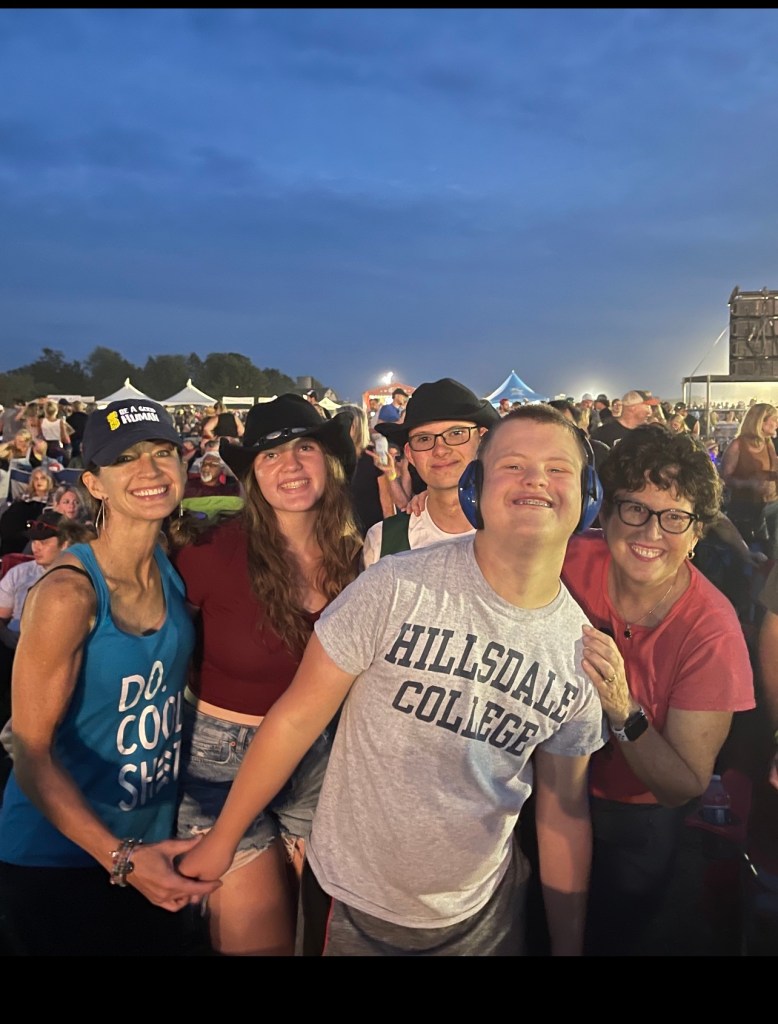
Today, though, we weren’t at a store. We weren’t at Crisler Arena. In fact, losing Wil at Crisler was child’s play compared to this venue. We stood upon hundreds of acres of farm field amongst 20,000 concert goers. Our only land markers were identical lamp posts installed for the concert with identical colored square boards tacked to the top of each lamp post. The colored square boards differed only by the number printed upon them, but it was highly unlikely Wil paid any attention to that. The gentle rise and fall of elevation erased any purposeful sense of direction I tried to hold onto. By the time we neared the ticket-taker, I knew only that our car was at least a mile away in the general vicinity of stage left.
I talked to Wil softly, reminding him how badly he wanted to see Luke Bryan. How special it was that his sister Elizabeth and friend CJ, and CJ’s mom, Cheri, were there too. That Riley Green was opening and he’d get to sing with Riley to, “I Wish Grandpas Never Died.” That we just had to get through the ticket-taker, and there would be loads of room to spread out and find the perfect spot. I knew Wil wanted to believe me, that he wanted more than anything to be with the country artist he listens to every day; is a fan club member of, has 2 pillows of and multiple t-shirts of, knows what town he lives in, the names and ages of his wife and children, including his adopted nephew and nieces, and every lyric of every song. I tease Wil that if there was a category on Jeopardy titled “Luke Bryan,” that he would take down the entire column against Luke Bryan himself.
Cheri and her son, CJ who is 2 years older than Wil and also has Down syndrome, were being pushed further ahead of us as Wil held his ground looking for an escape route. Elizabeth did her best to block any means of escape for Wil. Elizabeth and Cheri know how this goes; when our boys have their minds made up, there is little to stop them. I kept my eye on Cheri’s pink shirt and my body only inches from Wil’s. There was no cell phone reception.
“Can I help?” I turned around. He had a very light shade of red hair. I noticed his female partner had the same shade of hair color.
“Yes, please! I so appreciate you asking. It helps to break the spell when it’s anyone but mom.”
The blond-red haired man leaned forward to get Wil’s attention. His partner smiled kindly. They drew Wil in with questions. I don’t remember the questions they asked Wil, but I do remember the gentle, calming kindness with which they asked them. I could both see and feel the grip of overwhelm loosen within Wil. Not fully, but it was enough.
The crowd pushed forward and we started to separate from the couple. I knew Wil would quickly revert. But just as I was having that thought, a man directly to my left, that must have been there for some time but I was so absorbed in Wil that I didn’t notice said, “We will get you guys through tickets. I’m Paul. This is my wife Erica, and my twin boys Mark and Mitchell.” Then Paul, in a sideways comment to me said, “Hey, my cousin is missing a chromosome!” We shared a chuckle.
“Hey Wil,” Paul asked, “how old are you? These are my boys. They are fifteen.”
“Wil, they are the same age as you, how cool!” I said trying to keep Wil’s attention on anything but escape. “And Wil’s sisters are twins! This is one of Wil’s twin sisters, Elizabeth.”
Elizabeth, Paul and his wife, Erin, then struck up a conversation. I was thankful that the focus could now be on Elizabeth for a change.
Paul kept to his word and stayed with us. Wil never fully relaxed, which meant nor did I, but again it was enough to keep us moving forward. We made it through the ticket-taker (halleluiah!) and the security guard actually gave me a hard time for the bag I had (it was a big open bag with no pockets or compartments). I politely pointed to Wil and said it simply wouldn’t be safe for me to carry two lawn chairs, two jackets and keep tabs on him (most people, I’ve found, aren’t trying to be difficult, they simply don’t know). The security guard called his manager over — a huge, imposing man — who upon seeing us, gave us the hugest, heartiest smile and waved us on.
“Sorry, just doing my job,” the security guard said.
We broke way into the concert area and the crowds dispersed like a dense flock of birds exploding from a tree into the sky. Wil visibly relaxed in the open space and recognition soaked in.
Wil and I attended Luke Bryan’s very first Farm Tour in Fowlerville last year. We arrived later in the day, so didn’t have the experience of the crowd. However, we were backed up in traffic for over two hours which led to it’s own set of challenges. Armed with last year’s knowledge, and companioned with Elizabeth, Cheri and CJ, we were in a much better situation. Even so, there are some hurdles that must be crossed to get where you want to go.
Paul said that his family was meeting a large group of friends and we were welcome to plant our lawn chairs with them. He said that way I could relax as there would be many “eyeballs” as Paul put it, on Wil. I smiled, thanked him, and chose not to share the Crisler Arena incident.
We did in fact plant our lawn chairs with Paul’s friends and I felt more of a sense of ease. Every single person in the group was friendly, welcoming and clearly there for a good time, but Cheri and I always had one eye on CJ and Wil. CJ made a few attempts to make his way, on his own, up to the stage. He was unconvinced as to why he couldn’t go up there. He holds his own weather report on YouTube every day, and plays baritone with his high school marching band. He lives on the stage. In one forward attempt, he walked up to a pretty girl dancing and asked her to dance with him. She jumped at the chance, and even her boyfriend, who’d been standing still as a statue, broke a smile and busted a move.
Paul leaned over and said to me, “It’s a beautiful life, but I know you have challenges. Please know that you sharing Wil and CJ with us is a gift.”
“The Buddy Walk is only one mile walk. I think you can handle it,” I joked. “And really, with so many people with Down syndrome, we don’t move fast!”
When The Peanut Butter Falcon was available for streaming, I didn’t want to watch it on my own. The viewing experience would be fuller with friends who knew Down syndrome. Whether the movie was good, bad or otherwise, we’d share in that knowing together.
A group of us moms got together at my house. The majority of us were raising teens, or kids that teetered on the edge of teenage-hood. We poured generous glasses of wine, loaded tiny decorative paper plates with dense dips, sturdy crackers and crunchy veggies, squished together on the couch, pulled up spare chairs, and settled in.
We erupted in laughter in the same scenes together, we shared audible silences in the same scenes together, tears leaked from the corners of our eyes in the same scenes together, and we enjoyed scenes of pure entertainment in the same scenes together. And we all wondered together, over the rolling closing credits, why Zak’s (the main character with Down syndrome) duration in underwear was deemed necessary.
Then in our post-movie review, we all first recalled the same scene together: Tyler’s adamant assertion to Zak that he stop asking him questions; there was a slight pause then Zak picked right back up with more questions. We broke out in laughter again and remarked on how our kids would do the same.
Our review continued along the same vein; how relatable Zak’s behaviors were to our own kids’. And where there were varied differences, we could still fully relate.
If you are a parent, it’s highly likely you have your own friend group of parents who have children in a similar age group.
Though your kids are fully their own individuals, you easily laugh together over shared traits; you easily share audible, thoughtful silences over certain situations, and likely enjoy the pure entertainment in others. Though each child has their own unique differences, a group of friends raising children of a certain age group can fully appreciate and relate to another’s experiences through their own.
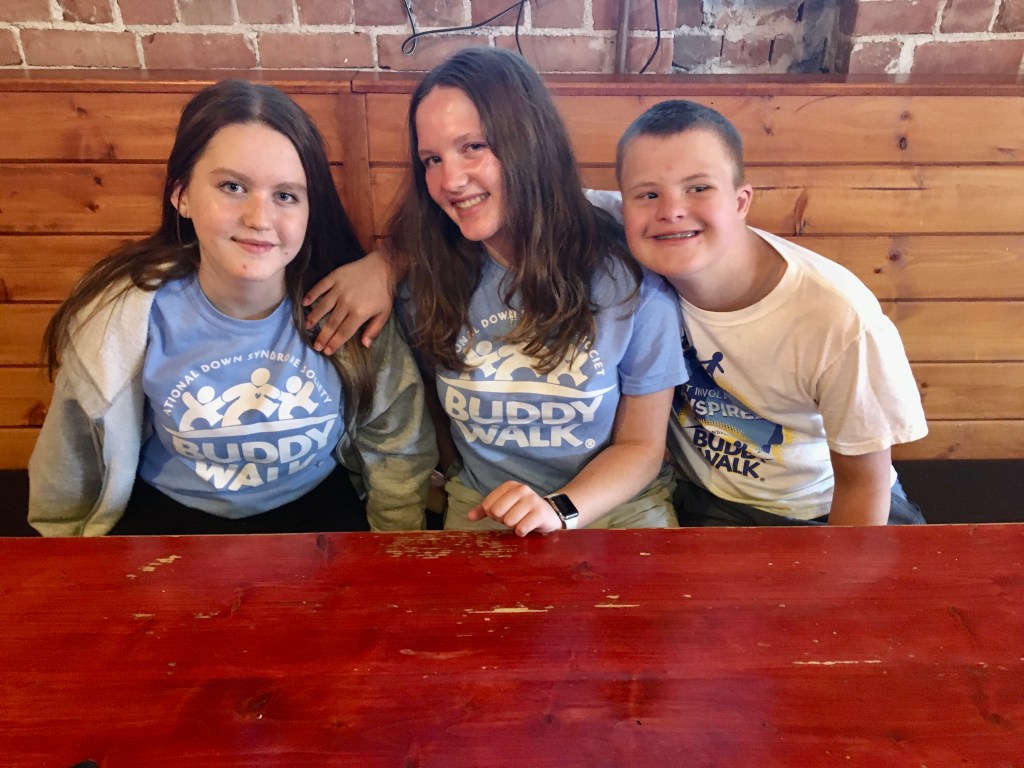
There is running joke at our annual Buddy Walk: “Who is going to win the Buddy Walk this year?”
I’ve been to 15 annual Buddy Walks (since Wil was 7 months old). I can guarantee about 70% of the kids will either decide at some point to sit it out (more than once), run to a play structure, or take some sort of tangent. Our kids can be very quick, and cunning in their moments of escape, but typically in any other direction than the paved walk. (Some may argue my statistic is on the low side).
Laughing about our kids taking their time to get to the finish line is not a slight against them. Its relating a typical scene in our lives that we share together. Any one of us parents would say our lives are fuller for it.
So sometimes I forget when I make “off the cuff” comments like that. It’s not a familiar scene to everyone yet — it wasn’t one to me once — and we are both watching a movie of our own. When those scenes find a way to merge, I have no doubt we’ll share in that laughter together.
Wil double-stepped down the broad concrete steps. He paused. Then he threw both arms back, hinged forward at the waist, and propelled himself over the last step. Mid-air he hollered, “Jump!”
He landed flat-footed and straight-legged.
Dang, when will he ever bend his knees?
“Mom, jump!” He yelled.
I exaggeratedly swung my left arm back, but kept my right elbow tucked in tight to protect a cup of lidded coffee. I jumped and landed softly with bent knees, then lifted my right arm in an effort to match the flow of my coffee. A deep brown dribble of coffee escaped the small hole in the lid and slid into the rim. I sipped it from the rim and raised my cup to Wil.
“Woohoo!” He yelled.
“Woohoo!” I yelled back.
“They are angels.” A woman said. I spun around. She sat on one of the ornate ice cream parlor chairs in front of the coffee shop. She was dressed in full-on Kelly green. I could barely discern where her shirt ended and her pants began.
“I’ve worked with many Down’s people. All angels.” She said.
I heard Elizabeth and Katherine, as clearly as if they were there, burst out in laughter. Then in my mind I heard Elizabeth say, “Does an angel throw your favorite comb down the heat vent?”
My mom-mind immediately targeted the woman’s lack of person-first language. But like Wil’s straight-legged landing, a correction would have stolen the meaning of the moment. The woman clearly cared about the person; she cared enough to reach out to a stranger and share the ultimate compliment.
So I smiled. I listened. Then Wil got antsy. I wished her a blessed day.
Still, her comment sat like a lead ball in the pit of my stomach. I needed to reach down deep, lift it up and roll it around until I could identify what the weight meant to me.
Then I saw it…she had put individuals with Down syndrome in a box. It was a beautiful white-feathered box placed on the very top shelf, with the utmost care and kindness; but it was still a box.
I realized I had put myself in a box too; labeled: to educate or not to educate. It’s a grown habit that becomes ingrained over the years of hearing stereotypes both well-meaning and not. Of watching your child reach milestones in micro-moments, so even the slightest bend in the knee does not go undetected.
But sometimes moments are meant to be moments. Moments to take a leap and land just the way you are. Moments to accept a stranger’s kindness by her intent rather than her words. Moments to unravel what sits heavy with you, unwrap it and let it go.
If there was an angel that day, it was one who whispered the vision of Katherine and Elizabeth in my mind; filled with laughter and words to match the moment and burst open the box.
The teenaged lifeguard; tall, lean and curly-haired, stood on the edge of the wave pool blowing his whistle — at me.
I saw her face in his; though she was his senior by at least 20 years, with straight brown hair and a brisk uniform. She was resolute to get Wil’s boarding pass — from him.
Though the airport incident happened over 2 years before the wave pool incident, time came together in their parallels.
When a pool or a plane is involved, Wil is the happiest guy on the planet; until he’s not. Both travel and swimming fill Wil with excitement, unless it brims over to overwhelm; rendering him stuck on the spot.
In the airport, Wil was well on his way to overwhelm. I saw it building, so did my best to keep him distracted and on-the-move. But the heaviness was taking him over. Wil has never had a problem going through security, so I didn’t anticipate an issue. But when we approached the podium, either Wil read this security guard’s demeanor, or overwhelm finally overtook him. He sat on the ground, smack dab in front of the security guard’s podium. Not the wisest choice, but there we were.
I offered to hand the security guard Wil’s boarding pass, but she refused. He had to do it. I explained he was overwhelmed and had Down syndrome. That wasn’t enough for her. A grown woman chose a stand-off with a then 13-year-old boy with Down syndrome.
Fortunately, a few podiums over, another security guard was witness to what was happening. She asked how she could help. I explained our situation. She reached her hand out to Wil, he accepted it, and she walked us down to another podium. I heard the stolid security guard, upon our leaving, say to the security guard that helped us, “I was just doing my job.”
“I understand we need to get out of the pool,” I said to the curly-haired lifeguard. “My son won’t get out on his own. Just give me a minute.” (I sent up a silent prayer that a minute was all we’d need.)
I crouched down next to Wil and explained that it was dangerous to stay in the water; that a storm was coming; that when lifeguards hear thunder we need to get out; that we need to respect the rules; that they are there for our safety.
I knew my words wouldn’t motivate Wil out of the water now, but they would have meaning later should this happen again. Wil doesn’t fully grasp danger, but he does have an ironclad memory. When I preface a pool trip with the words “we have to get out if there is thunder” these will no longer be empty words. Experience gives Wil meaning to the words, thus being the best teacher.
A pretty lifeguard with white-blond hair stood only a few feet from us. Wil, being a teenager, would certainly respond better to her than me. I walked up to her and said, “My son isn’t wanting to get out. When he’s like this, he does much better with people who are not mom. Would you mind asking him to get out. Maybe offering him your hand?”
She willingly agreed, and approached Wil with an outstretched hand. Wil lifted his head, but couldn’t quite motivate himself to fully reach back. Though he stayed in the pool, I could see she had released some of his resistance.
Two female sheriffs that were nearby approached Wil.
“Would you like a sticker?” They held golden star badges up for Wil to see. I appreciated their efforts, but there was no way a sticker was going to prompt him out of the water (but maybe a trip to the clink would!).
Then another teenaged lifeguard, with auburn hair, walked up to me and said, “Can I help?”
The clouds parted and angels sang! No, that didn’t happen. Or else we would have got back to swimming. But that’s exactly how those words felt.
Three little words; only 8 letters in their entirety. And yet, I knew they were more than words; there had to be experience behind them.
The auburn-haired lifeguard, with a calm, friendly demeanor, reached her hand out to Wil and said, “Would you like to come with me?” Wil must have read her demeanor, because he stood up without hesitation and took her hand. He then looked at the blond lifeguard and took her hand too. Wil walked out of the water hand-in-hand with the two lovely lifeguards. Then the sheriffs gave Wil his stickers. I hope curly-haired whistle-blower was watching 😉
With Wil now out of the water, my main focus was to keep him moving forward. If this were not the case, I would have circled back to ask the auburn-haired lifeguard what inspired her to ask to help (same with the helpful security guard). What experience is in their back-pocket to step in and offer help?
Could it simply be a strong desire to help? Possibly, but my guess is it goes deeper than that. Is it gained from the experience of inclusion during their school years? Is it gained from experience with a family member or friend with a disability? Is it gained from experience as first being an observer then learning from situations such as these?
What transforms a stolid whistle-blower into an asker? What opens a mind from “doing my job” to “can I help?”
These are key questions that lead to the progression of acceptance and understanding of people with disabilities.
Within each of these questions, and likely within each of the answers, lies one common theme: experience.
And that gives me hope, because we can all learn from experience, if we choose to.
Yesterday I went to Wolf’s Westside Automotive Service for an oil change. I had been there the previous day to have my tire patched. When I came in for my tire, the front door was propped open, the garage bay doors rolled up, and a refreshing breeze flowed through the lobby.
Yesterday was just that much warmer, so the bay and front doors were closed; a unit air conditioner cooled the lobby.
The owner, Pete, came into the lobby from the garage, sat down across from me, and delivered an update on my car’s service. Our conversation transitioned from the car to fitness and then into a story about his friend who has an adult daughter with Down syndrome. Though I don’t know Pete beyond the walls of his garage, in his storytelling, I heard true understanding. To attain that, without a child of his own with Ds, requires an openness to understand.
His shared story, and openness, were especially timely and meaningful to me as I’ve recently experienced the challenge of closed minds at a new level. I admit I’m somewhat naive in this area; thankfully. My fighting skills are weak; again thankfully. This town has always embraced Wil. I’ve needed to advocate, yes, but advocation is a conversation when you advocate with open minds.
With Wil getting older and other certain circumstances, I have now experienced lack of understanding, and the unwillingness to understand, on a broader level.
It’s hard to explain this life because a little means a lot. How do I explain, that every time I drive in the car with Wil, and he belts out Luke Bryan lyrics with complete accuracy, the elation I feel? That every word he forms beams me back to stretched-out years patiently waiting and diligently working on forming his first words? I have a million such stories.
All I need is a little crack in the door of a mind to get through. And yet, I physically feel the air fall dead between myself and a mind that is closed. I find this disconnection rarely intentional, and not meant to be hurtful. It’s not lack of experience with a disability that is the issue, it’s the unwillingness to open a door to understanding. Even the slightest creak of a hinge is all I ask. But for reasons of their own, deep within, they don’t want to know. The door remains closed. I find ways to keep knocking.
But not yesterday. There I sat, in our small town, for an oil change of all things, and with the natural flow of conversation a story was shared with full understanding. There was no knocking, no prying, no trying. The air conditioning was working, but all I felt was a needed breath of fresh air.
At the airport yesterday, Wil was struggling a bit with some young children crying.
As a Starbucks was nearby, I asked Elizabeth to walk him over there while I stayed with our carry-on luggage (as Katherine was in another shop).
Wil was reluctant at Starbucks too, so Elizabeth walked him back to sit with me. She then walked back to Starbucks to get herself something to drink. A woman walked up to Elizabeth while she waited in line for her drink. The woman said she observed Elizabeth with her brother, and expressed her admiration at Elizabeth’s mature patience and how she talked to Wil. Then the woman said, God Bless, and walked away.
Elizabeth was surprised, yet pleased, by this. She was just being a sister to Wil as she always is (and Katherine has this same mature patience with Wil, as well), and didn’t see her actions as anything different than normal behavior.
In Elizabeth’s everyday life, she lifted the spirits of another, and she was uplifted in return.
I’m proud of Elizabeth (always), and also proud of the woman who had the courage to step up and acknowledge Elizabeth.
It’s not that I don’t enjoy them, or learn from them, or feel a connection with them. I do. I have a few of my favorites saved in my library for quick access when I need extra help. But mostly, I enjoy the running podcast of my own life.
Like when Wil goes to Challenger baseball, I look forward to it just as much as he does. It’s as much of a supportive environment for him as it is for me.
There is both structure and freedom in the Challenger games: 3 innings, player placement in the outfield, a batting line-up, and everyone makes it to home plate. But beyond that, and sometimes within that, anything goes. It’s really the perfect parallel to raising a child with disabilities. The parents, coaches and players get it, because they live it. Every day.
Tim stepped up to bat, and Coach H. announced it was Tim’s birthday. Everyone cheered. Coach H. joked that his son, who has autism and scripts (repeats sayings), only told him 55 times that morning. After Tim hit the ball, Tim’s mom quietly told Coach H. that she’s not sure where his son heard it was Tim’s birthday; it’s really in January. But who couldn’t use an extra cheer?
Sandi was next up to bat. She hit the ball and ran to 1st base. But she didn’t stop there. Sandi ran on to join her friend on 2nd base to give him a hug. There Sandi stayed; two players on 2nd base and no one on 1st base.
James enjoys music; the same music, over and over. James’ dad’s cell phone is on a near constant repeat of animated show tunes in his pocket. But James’ dad instilled a rule: music while in the outfield, but no music while waiting to bat.
“I swear I can’t listen to that song one more time!” James’ dad said to me. James, in turn, scripted about the music the entire time he waited to bat. So, by the time James and his dad went back to the outfield, his dad was just as relieved as his son was to play music again!
I jokingly said to James’ dad, “No music on the pitching mound.” He replied, “Oh, there is going to be music on the pitching mound!”
Just before Challenger baseball, Wil, with his strong left-handed throw, tossed Elizabeth’s book into his pool. He wasn’t mad it her. Nothing precipitated his actions. He saw her book sitting on the back-porch table, and his pool was in perfect throwing distance.
He lost his iPad privileges, which means no Luke Bryan. So, he grabbed his Luke Bryan CDs, which I also said no to.
“DVD’s mom?” Wil asked.
“No,” I replied.
At the Challenger baseball game, I shared this incident with my friend, Eleanor. Her son also has Down syndrome and is Wil’s age. I knew she would understand, and sure enough, she laughed and said her son had committed similar acts with his sister’s possessions for no apparent reason. We shared other stories and how our sons always tell the truth, or remain silent, about such incidents. We’ve never heard either tell a lie. Then we watched her son crack an impressive grounder and take on the bases.
Entertainment, sports, connection, support, humor and education; no streaming required, all on a Sunday afternoon.
Wil did not share this fact after school. Nor at the dinner table.
Wil was lying on the couch, shortly before bedtime, watching a Netflix show with Elizabeth and me. He popped up in the middle of a scene— that had nothing to do with gym class, or long-time friends — and made his declaration.
When Wil was younger — and his friends, cousins and sisters were younger — the main goal was play. Though some kids ran and talked faster than Wil, the running and talking didn’t last long. They were all about the play, and that’s what they did.
But now, the play has transitioned to conversations. And these conversations move fast and take lots of tangents. And Wil, though he speaks quite well, simply can’t keep pace with most teenagers and adults when it comes to conversation. Thus activities in gym, and seeing long-time friends like Ashley, are highlights of Wil’s day.
I’ve recently noticed Wil’s increasing silence at large gatherings such as weddings and holiday dinners. Ironically, Wil’s conversational skills have increased, and yet, he still cannot keep up with the pace of group conversation. He joins in where he can; and for Wil, that is in laughter. Unless Wil is addressed or given the space to talk, he sits quietly, staring at his plate, until laughter spontaneously and contagiously catches everyone at the table, and he heartily joins in.
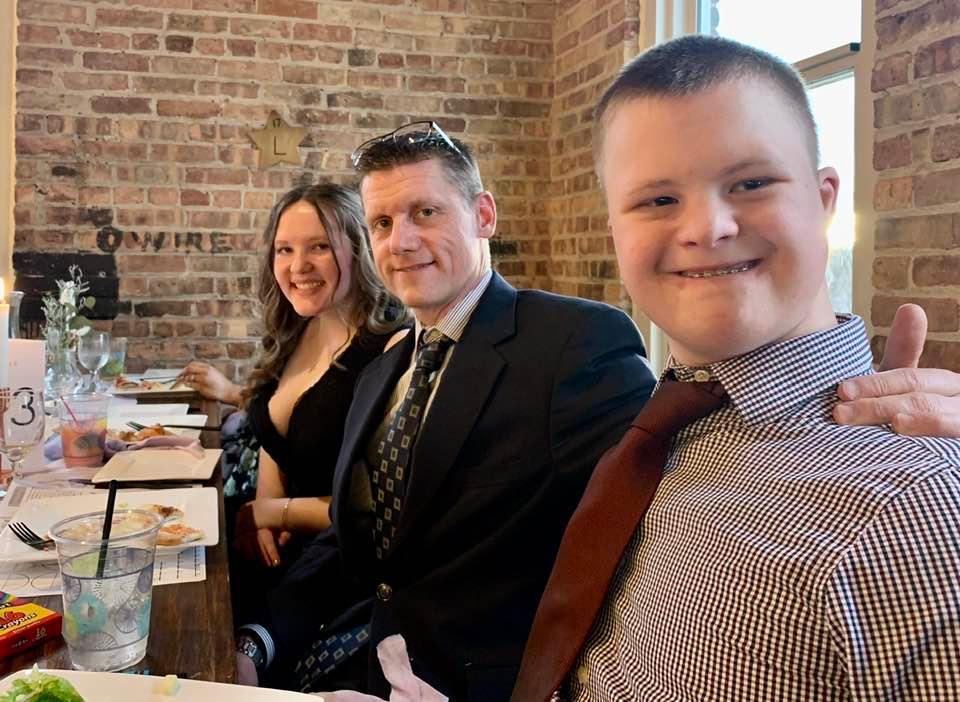
Fortunately most large events come with dancing and games, and this is where Wil knows exactly how to make space for himself. At my nephew’s wedding, he literally did just that. Wil created his own space on the dance floor, got down with his own moves, and his energy was so contagious that no other dancer could resist joining him. He was again at play, everyone around him was about the play, and that’s exactly what they did.
When space isn’t created for Wil, and he is not able to create space for himself, it is when the night grows quiet that he thinks on his day and processes events. It is his time to filter through images without all the tangents and interruptions. And though some of his declarations may seem out of the blue to us, he is creating that space for himself. And as his mom, I can’t help but cheer when he decides to take the floor!












 'WIL'ingness = Willing to Embrace Extra in Life