It’s in the Experience

The teenaged lifeguard; tall, lean and curly-haired, stood on the edge of the wave pool blowing his whistle — at me.

I saw her face in his; though she was his senior by at least 20 years, with straight brown hair and a brisk uniform. She was resolute to get Wil’s boarding pass — from him.

Though the airport incident happened over 2 years before the wave pool incident, time came together in their parallels.

When a pool or a plane is involved, Wil is the happiest guy on the planet; until he’s not. Both travel and swimming fill Wil with excitement, unless it brims over to overwhelm; rendering him stuck on the spot.

In the airport, Wil was well on his way to overwhelm. I saw it building, so did my best to keep him distracted and on-the-move. But the heaviness was taking him over. Wil has never had a problem going through security, so I didn’t anticipate an issue. But when we approached the podium, either Wil read this security guard’s demeanor, or overwhelm finally overtook him. He sat on the ground, smack dab in front of the security guard’s podium. Not the wisest choice, but there we were.

I offered to hand the security guard Wil’s boarding pass, but she refused. He had to do it. I explained he was overwhelmed and had Down syndrome. That wasn’t enough for her. A grown woman chose a stand-off with a then 13-year-old boy with Down syndrome.

Fortunately, a few podiums over, another security guard was witness to what was happening. She asked how she could help. I explained our situation. She reached her hand out to Wil, he accepted it, and she walked us down to another podium. I heard the stolid security guard, upon our leaving, say to the security guard that helped us, “I was just doing my job.”

“I understand we need to get out of the pool,” I said to the curly-haired lifeguard. “My son won’t get out on his own. Just give me a minute.” (I sent up a silent prayer that a minute was all we’d need.)

I crouched down next to Wil and explained that it was dangerous to stay in the water; that a storm was coming; that when lifeguards hear thunder we need to get out; that we need to respect the rules; that they are there for our safety.

I knew my words wouldn’t motivate Wil out of the water now, but they would have meaning later should this happen again. Wil doesn’t fully grasp danger, but he does have an ironclad memory. When I preface a pool trip with the words “we have to get out if there is thunder” these will no longer be empty words. Experience gives Wil meaning to the words, thus being the best teacher.

A pretty lifeguard with white-blond hair stood only a few feet from us. Wil, being a teenager, would certainly respond better to her than me. I walked up to her and said, “My son isn’t wanting to get out. When he’s like this, he does much better with people who are not mom. Would you mind asking him to get out. Maybe offering him your hand?”

She willingly agreed, and approached Wil with an outstretched hand. Wil lifted his head, but couldn’t quite motivate himself to fully reach back. Though he stayed in the pool, I could see she had released some of his resistance.

Two female sheriffs that were nearby approached Wil.

“Would you like a sticker?” They held golden star badges up for Wil to see. I appreciated their efforts, but there was no way a sticker was going to prompt him out of the water (but maybe a trip to the clink would!).

Then another teenaged lifeguard, with auburn hair, walked up to me and said, “Can I help?”

The clouds parted and angels sang! No, that didn’t happen. Or else we would have got back to swimming. But that’s exactly how those words felt.

Three little words; only 8 letters in their entirety. And yet, I knew they were more than words; there had to be experience behind them.

The auburn-haired lifeguard, with a calm, friendly demeanor, reached her hand out to Wil and said, “Would you like to come with me?” Wil must have read her demeanor, because he stood up without hesitation and took her hand. He then looked at the blond lifeguard and took her hand too. Wil walked out of the water hand-in-hand with the two lovely lifeguards. Then the sheriffs gave Wil his stickers. I hope curly-haired whistle-blower was watching 😉

With Wil now out of the water, my main focus was to keep him moving forward. If this were not the case, I would have circled back to ask the auburn-haired lifeguard what inspired her to ask to help (same with the helpful security guard). What experience is in their back-pocket to step in and offer help?

Could it simply be a strong desire to help? Possibly, but my guess is it goes deeper than that. Is it gained from the experience of inclusion during their school years? Is it gained from experience with a family member or friend with a disability? Is it gained from experience as first being an observer then learning from situations such as these?

What transforms a stolid whistle-blower into an asker? What opens a mind from “doing my job” to “can I help?”

These are key questions that lead to the progression of acceptance and understanding of people with disabilities.

Within each of these questions, and likely within each of the answers, lies one common theme: experience.

And that gives me hope, because we can all learn from experience, if we choose to.
Just Make Him Do It

One of the most common things I hear (and what many of my friends who have children w disabilities hear) is, “well, just make him do it.”

I literally feel a huge distance grow between us with this seeming logic. And yet, it’s a very difficult distance to close as there is no logical explanation. It’s a “living it” thing.

We parents, special education teachers, para educators, and caregivers are constantly on the alert for “triggers” that cause our kids to dig in their heels.

Some of these triggers are constant, and we have created ways to work with them.

Some of these triggers are only known to our kids and appear spontaneously to us. And when triggered, there is no “make him do it.”

When Wil refused to get on a connecting flight, how I wish I could give the “make him do it-ers” a chance to use their logic on Wil that day. That would have been a helluva education.

Heck, I don’t know even know it all and I’ve been raising Wil for over 15 years, not to mention knowing many other children with Down syndrome quite well. And each and every kid defies this logic.

So next time you want to think it’s logical, and fits some kind of mold, I challenge you to spend a day with Wil, his friends, or in a life skills room, and let me know how that logic goes for you.

A Moment in Time: Surprise gifts

Wil and I went to pick up pizza in town. As we exited the pizzeria, we saw Will D., Wil’s friend from school.

We enjoyed a quick chat, then as Wil and I headed back to our car, Wil turned around and called out to Will D., “See you tomorrow!”

I’ve never heard my Wil say that when meeting school friends in town. And yet, there it was, thrown out there just like that.

When the common never is, it’s like your life is dotted with little surprise gifts. 🎁

Vocal-Ease

It was just after 9 p.m. and I heard the back patio door click shut. I tucked Wil into bed only moments before. But I knew it was him. My alarm was set for 3:20 a.m. to rise for work, so I’d recently tucked myself into bed too. 

I got out of bed, walked to the kitchen, and opened the patio door. I saw Wil walk to the far edge of our yard. He stopped at the outcropping of alfalfa. About five deer were scattered across our back field contentedly grazing. Two of the deer lifted their heads; more in curiosity than with concern.

Woody, our yellow lab, sniffed the grass close to Wil. Woody would have created chase with the deer in his younger years. But now with arthritic hips, Woody guarded Wil in close proximity.

Wil turned around and saw me standing on the back porch. Instead of running away, he walked over to the hammock. Woody followed him then rolled in the grass. Wil attempted to open the material of the hammock wide enough to lie down. He decided that was too much work, sat down on the hammock, gripped the material on either side of him, and swung gently as if on a swing.

“Not tired yet, Wil?” I asked.

“Hmph.” With this response, I knew pressing or prying would only tighten the knot of his emotions and he’d clamp down, resisting any type of communication.

“It’s a nice night. Look at Woody roll in the grass.” Wil looked at Woody, then back at me. His open response to my comment, even if non-verbal, was a good sign. I decided to take a chance. “Are you upset because your sisters aren’t home?” 

“Yes,” he said and dipped his chin. 

“Don’t worry, they will be home soon. How about I walk you back to bed and give you extra snuggles?” I said.

“Ok, Mom. You going to work in the morning? Can you make me breakfast?”

“Sure, Wil. I’ll leave it on the island for you. I bet I’m back home before you’ve put your plate away!” 

“Thanks, Mom. Hugs!” Wil jumped off the hammock and barreled into me. Only a year ago he likely would have responded by running away from me or remained on the hammock refusing, or unable, to explain his upset. But on this night, with only minimal resistance, he shared his feelings of sadness about his sisters not being home. And as he typically makes his own breakfast, his asking me to make it revealed the extra comfort he desired in my absence.

I tucked Wil back in bed, with the extra promised snuggles, then crawled back into my bed. I’d barely pulled up my sheets when I heard Wil’s heavy footsteps move toward the kitchen (with low muscle tone, he’s not exactly light on his feet). This time it wasn’t the patio door that I heard shut. It was a kitchen cabinet. Then I heard Wil scoop up ice, pour it in a cup, turn on the faucet, and walk back to bed. 

“Ah, fresh,” Wil said (a phrase he commonly uses sipping a cold drink). With these words of satisfaction, I knew sleep would soon follow. And it did, for both of us.

A milestone in communication had been attained that night. It was mutually understood…no explanation necessary. 

Stuck On You

I didn’t know exactly where or when Wil would get stuck at the party, but I knew it was a possibility. The graduate was one of his Connect mentors that he admires greatly. As Wil is used to her individualized attention at school, I knew he would expect that level of attention at her party, too. I explained — every day for a week leading up to her party — that there would be lots of guests. That she would be very happy to see him, and that she would also have many other guests to greet. 

As Wil gets older, experiences like these are valuable life lessons for him to learn from; as his reactions are valuable life lessons for me too (and reinforce the value of our close-knit community). 

When we arrived, Wil received a very warm welcome from Victoria. He understood she couldn’t spend the entire party with him, so he did well joining me to get a plate of food and sat down with friends to eat. Then, upon his own initiative, Wil walked over to join an ongoing game of cornhole.  

Wil has matured a lot this year, and I watched him play impressed with his newfound independence and self-initiative. I didn’t relax too much, however, as I knew the situation could change at any moment. 

Whenever we enter a situation Wil has built up great anticipation for, he can get stuck. His anticipation and excitement build to a point of overwhelm. His way of coping is to sit down on the spot or flee the scene. When he becomes overwhelmed, all he really needs is time to unravel his emotions. The challenge is that we don’t always have the time (we’ve almost missed plane flights), and I can’t always see from the outside what is going on inside his mind. 

And just like that, Wil took off toward the front yard. As I had one eye on him from the table, I was hot on his trail. He found a quiet spot near the front porch.

Knowing he needed time, we sat down for a moment together. Then I tried singing a Luke Bryan song with him. He told me to stop (I’m not a good singer). I asked him to do a silly dance with me, but he didn’t move. Even a bribe of a Sprite was met with a head shake. 

I racked my brain for more motivators. Anyone at the party would have been happy to help if they knew we were in the front yard (and I’d left my car keys and phone on the table).

Then I heard voices near us. Two men were now in the front driveway. I recognized one of the voices.

“Hey Jason!” I called out.

“Hey Christie! Hey Wil!” 

I asked Jason if his wife, Melanie, was there. Melanie Woods used to babysit Wil when he was a preschooler. The two formed a strong bond and to this day Wil calls her “my Melanie” and he is her Wil. 

“Yes, Melanie is here,” Jason said. “Right around the back.”

“Wil, your Melanie is here! Let’s go see her.” To my relief, Wil took my hand and walked back to the party. When we found Melanie she immediately gave Wil a hug.  I asked Melanie if she could walk Wil to the car while I thanked Victoria, and grabbed my car keys and phone. 

Wil has many stuck moments on a day-to-day basis, which is normalcy for us, but not familiar to most. As I watched Wil and Melanie walk off easily together, and said good-bye to friends, I was flooded with gratitude for the support that surrounds us. 

When I met Wil at the car he said, “Sprite now, Mom!” 

Melanie & Wil

You Are Here

Like many mothers, I loved my son before he was born. My daughters and husband placed their hands on my belly and felt his kicks and punches. We pondered names and dreamed our dreams. The field of possibilities was laid open before us.

The golden gates to that field slammed shut seconds after Wil was born. My brain valiantly fought to pry them open, objecting to each indicator the medical staff shared with me that my son may have Down syndrome.  Look at the way his arms and legs splay out, they said, see his short stubby fingers and his low-set ears, note the thickness of his neck. Interestingly enough, they never mentioned the shape of his eyes. 

As Wil melted into my chest the day he was born, I reveled in my love for him. I was careful to keep thoughts of his expected diagnosis locked tight in a separate compartment, though it hovered perilously above me. I looked down into his eyes; their shape struck me. I was both awed by their beauty and intensely terrified. My brain, still playing defense attorney, objected strenuously. But when the heart knows, the defense must concede to rest. The compartment above me busted open and everything spilled out all over us on the hospital bed. 

Just days after Wil came home from the hospital, I stared at him in his crib. Though my brain had rested its case — we even had genetic proof by this time — it begged to object. I simply could not believe I had a child with Down syndrome. But it was true. My heart held deep love for him, yet my brain kept its distance. I had never felt so contradicted in my life. As I stood there, my stomach suddenly dropped as if I was going down a roller coaster. The ground vanished below me and I stood suspended, as if in an elevator well. I visually saw darkness under me and the four walls of Wil’s room suffocated me. I knew this experience was a figment of my imagination but my body felt every sensation as if it were real. 

When I was able to regain my balance and logically analyze what happened, I knew what it meant. I felt completely out of control. Though I had many loving people around me and a packet full of helpful information, I realized more than ever that the work of acceptance is intensely personal. I had to take the first grounding step into acceptance myself. 

Acceptance has no clear start point. I never found a big, red “you are here” circle followed by dashed lines leading the way to acceptance. Rather, acceptance is like an open field surrounded by clouded mountains. You just jump in wherever you are, firmly plant both feet in the field, and figure it out from there. 

I overstepped into territory I wasn’t ready for, like reading books about teens with Down syndrome before Wil was even a year old. Those books offer a different meaning to me now for the landscape I’ve travelled, but then it was too much knowledge too soon. I learned how to back-step and move in new directions.

Fourteen years later, I’m still back-stepping and running forward, climbing, traversing, discovering; yet I arrived to acceptance the day I jumped in and firmly planted both feet on the ground. 

I know the feeling of the gates being closed on me. And that is why at the top of every mountain we ascend, like Julie Andrews in “The Sound of Music,” I open my arms wide above the clouds, spin with the wind and soak in the spectacular view of this beautiful, vast landscape I gratefully call home.  

Simply Powerful

Kristi, Wil’s paraprofessional, sent me this photo of Wil cooking at school with his Connect mentor, Victoria. It was Cinco de Mayo and they were making tacos. Kristi told me he ended up eating 3! 

It’s awe-striking to me, still, even though Wil is a teenager, how powerful the simplest joys with him are. I mean, they were making tacos on Cinco de Mayo. How simple is that? But look at their faces. I think of the support he is encompassed with. Simple never is with Wil. 

When Wil was born, I knew so little about Down syndrome. I didn’t know how powerful the simplest actions could be. 

Though there was a high learning curve in early therapies and doctor’s appointments with Wil, my deepest learning came from knowing him. Knowing Wil’s smile. Knowing Wil’s hugs. Knowing Wil’s first words. Knowing a community that embraced him. 

When I reached out to Victoria, she shared, “it’s kids like him who have really made me want to go into the profession. He is so caring.”  

Victoria is way ahead of where I was. Her knowing will change lives. Not only for her chosen profession in the future, but also right now. The way she interacts with Wil, simply by being who she is, sets an example that shatters stereotypes and alleviates fears. It is not scary to know Wil. It is not hard to know Wil. In fact, it’s really darn cool to know Wil. 

Whenever I hear words like Victoria’s, I’m always drawn to thoughts of my mom’s close friend, Martha. Martha has three sons. Her oldest, Paul, is my age and has Down syndrome. Paul did not have friends like Victoria. In fact, for Paul, general classroom opportunities were scarce to non-existent. Early therapy was not available or encouraged. And a Connect mentor program would have been a far off dream. Martha navigated this life with a tiny fraction of the awareness and advocacy Wil is surrounded with. 

Wil and Victoria’s experiences are not just for Wil and Victoria. They are for the families who navigated this life before us, and for the families Wil and Victoria will open doors for. The power of advocacy is not always found in picket lines. Advocacy is also spread by our daily actions in simple, yet powerful, ways. Simple never is with Wil.

Unfiltered

This morning Wil sat on his bed. He wouldn’t get dressed. The frustration rose in me. The clock doesn’t stop for him. School would start ready or not. Inside I have to give my heart a deep breath. Why do the simplest things have to take such patience? Every.single.day. I ask, in my calmest voice, if he needs help. No. I say ok, and walk away. I don’t know what he’ll do. I know I can’t push it or he’ll push back. The tension rises in me. I exhale it again.

A 14-year streak of sitting on his bed, and he won’t move, and the clock is ticking, and the only way to get him to move is to be your calm damnedest self when you just want to scream for him to please just do the simplest thing in the world. Please just put your pants on.Then you hear him move. And it’s like the best thing in the world. The absolute best. And he emerges from his room victorious, with his long-sleeved T-shirt with Luke Bryan on the front, and yes, his pants on. He raises his arms, “Look Mom!”

It’s an event so much smaller than those filtered close-up selfies proclaiming “gratitude!” and “seize the day!” I mean, my selfie would be me in my pjs, holding a cup of coffee while playing air guitar in response to Wil’s clothing choice, because we just freaking seized the day.

Yes, so much smaller than those filtered, designed proclamations. And yet, so much bigger.

True Nature

When Wil said, “Walk to the river, Mom,” I left my phone on the countertop, took off my watch and grabbed our mud boots. With the constant tug of a virtually agenda-driven world, I was more than ready to leave behind the volitional tools that bound me to it. Woody, our yellow lab, perked up his ears at the word “walk” and was quickly on our heels as we hurdled out the door.

It was late April and the temps had recently warmed so the bugs were sparse. We reached the tree-cover and squished through mud over imprinted deer tracks. Deep puddles and fresh, bright green undergrowth lined the path. We could now hear the river and it sounded cold. Woody ran ahead and plunged in as if it were a hot summer day. He plodded around the shoreline looking for water bugs that weren’t yet existent, then swam out to the center of the river. He paddled against the current like he was on a treadmill; running hard but getting nowhere. He eventually grew tired of the grind and veered off to the other side of the river and played along that bank. 

Wil slid down a muddy embankment and stretched his legs into the river. His muck boots filled with water. “It’s cold, Mom!” He got his footing and waded out until the water reached the bottom edge of his shorts. Then he reached down into the river and pulled out a smooth, black rock. He held the rock up to admire its sheen, then threw it in the air. “Catch Woody!” 

Woody swam back across the river, even as the rock sank to the bottom; his loyalty to Wil’s call. Wil reached down for another rock, again admired its smooth surface, and tossed it. “Go get it, Woody!” Wil found a few more smooth rocks, taking a moment to admire each one, tossed them, and Woody swam toward each splash. Wil moved on to tossing sticks, which were retrievable for Woody, but watching the two play this game, I saw that winning was not about retrieval. The win for both was in the play.  

A red-headed woodpecker flew across the river, landed on the side of a tall tree, turned his head toward us and called out. He then silently stared at us for a moment, decided we were not a threat, hopped up the tree and went on with his business. 

I sat down on a low, flat rock and breathed in the earthy smell. Green buds popped out on branches all around me. The scene was picture-perfect; and yet I was thankful I had no means of taking a picture as it would steal the nature of the moment.  

Thank you Wil, for leading me on this winding, earthy, budding, flowing, green and boundless path, where there is always something found to admire and the win is in the play. Your true nature always circles me home to mine.

For What They Do

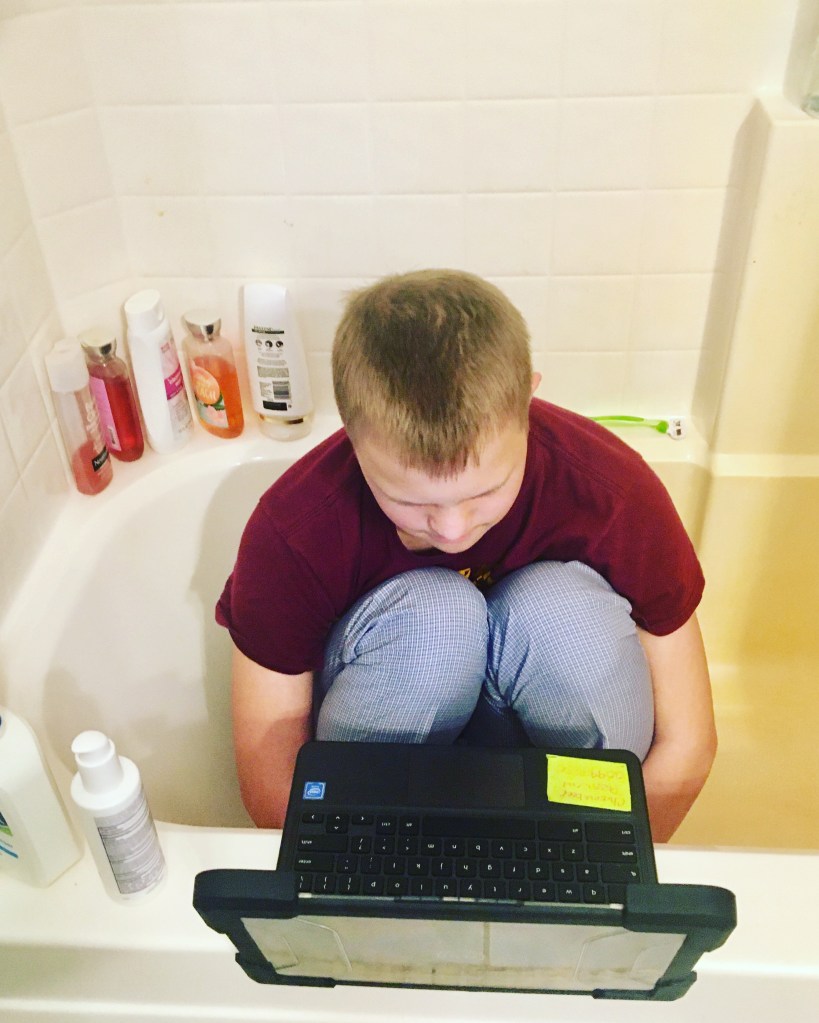
“Wil, I miss you,” popped up in the chat box from Sarah Stommen. Virtual school started back up again a week from last Friday. Wil kicked off his virtual schedule full of steam, but by Thursday the task of getting him in front of the computer was a feat. Sarah saw the look on Wil’s face at the beginning of their virtual social studies class and knew he needed some encouragement.

When I pointed out Sarah’s message to Wil, he quickly turned his attention to the chat box, read the message for himself and a wide smile crossed his face. He then remembered he didn’t want to be there and turned his head to the side.

“Hey Wil,” Ms. Kastel, their social studies teacher said, “where is your dog?” Sarah was holding her dog, Maizie. Wil usually loves to share his pets along with his classmates, but he shook his head. I ran to pick up Oreo, as he was sleeping in the sun near us. I placed Oreo in Wil’s lap but he refused to share our cat with his classmates, too.  Ms. Kastel then asked Wil a few questions about subjects he enjoys discussing, like country music (she’s fostered a love for Johnny Cash in him). Ms. Kastel has a knack for pulling Wil out of his stuck feelings, but on this day, he was determined to stay stuck.

That same afternoon, Wil’s friend, Lila Harvey, sent Wil a “snap” through Elizabeth’s Snapchat (Elizabeth shares her Snapchat with Wil). Lila knew he’d been having a tough time with virtual school and wanted to cheer him up.  

When Wil was a baby, and his diagnosis fresh, I reached out to support groups and read books. I was in a battle against the “wouldn’t be’s.” How could I prevent Wil from falling behind? What did I need to do? I signed him up for all the therapies. Though these therapies were places of growth and strength for Wil, they became those places for me too. When Wil was only months old, his occupational  therapist laid him on a blanket and dangled a toy above him. The goal was for Wil to develop the strength the reach across the centerline of his body. I never knew such details existed. I never knew such heights of joy as I watched every inch of progress Wil made on his way to reaching that toy. Every new reach, every new grasp, every new step, every new word, every new milestone was celebrated. I found myself celebrating not because I believed Wil wouldn’t; I celebrated because he did.  

It’s easy to say these 14 years later that Wil deserves loving friends and teachers. And he does. Yet I remember well the “wouldn’t be’s.” I remember well the process of growth, strength and joy that shifted my focus in a new direction. So when I celebrate friends like Sarah and Lila and teachers like Ms. Kastel for who they are and what they do, it’s not because I believe that they wouldn’t. I celebrate them because they do.