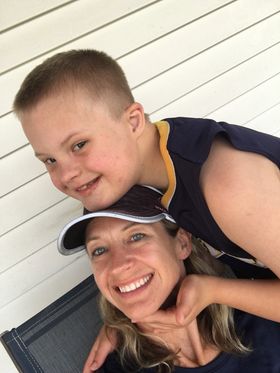
Wil ran up to me, then reached into his pajama pants pocket. He pulled out an adhesive mustache and stuck it under his nose. “Look at me, Mom!” He leaned his face so close to mine that I saw double.
“You are so close I can’t see you!” He stepped back, his mustache upside-down, the edges tickling his cheeks. He smiled at me with that upside-down mustache and I thought, this is what they can’t tell you.
The silliness started at about 7:30 that morning. Wil busted out of his bedroom, in his stripe-legged pajamas, the music from his CD player trailing behind him. He placed his hands on the living room floor and kicked his bare feet up in the air. “Look at me, Mom!”
“Look at you, Fancy Pants! Nice moves.” Though I’m a coffee drinker, there is no amount of caffeine that can lift me higher in the morning than Wil’s dance moves. It’s like being handed a fistful of balloons and feeling your feet leave the ground.
Sadly, I had to bring us back to earth. It was time to log in to school. “Wil, you look very handsome in your mustache. How about you show off your mustache in class? You are going to be late if you don’t log in now.”
“Ugh, Mom, no.” He flopped himself on the floor then laid face-down.
I dropped to the floor, laid on my belly and put my face close to his head. In a deep, sing-songy voice I said, “I see you! Time to log in to school, Wil.”
He lifted his head, leaned his forehead into mine and mimicked my deep sing-songy voice, “Ok, Mr. Mom.” Then he started laughing. When Wil laughs, he laughs with his whole body. I thought, this is what they can’t tell you.
They can’t break through your tears, into your hurt heart, after you learn your child gained one extra chromosome, and explain how a smile under an upside-down mustache, a leg-kicking pajama dance, and a body-racking belly laugh on the floor will make you feel like you hit the jackpot.
Because you did. You just have to live it to know it.
My high school science teacher was amazing. And I had very little interest in science. He practically leapt off the floor explaining the periodic table. It was like someone just put this amazing hot fudge sundae in front of him and he couldn’t wait to dig in.
What amazed me the most was that he taught this same lesson again and again, year after year. Yet every single day, he brought the excitement. To that same old periodic table. Everything fit in this nice, little box. The combinations, even if dynamic, were predictable. No surprises. I was bored out of my mind. But I loved my teacher. He almost made me want to love science, just because I loved his enthusiasm for the subject.
Then, in college I discovered blue book tests. I could scrawl my thoughts, in glorious freehand, across the blissfully empty white pages with pale blue lines. An empty white page to me is one of the most beautiful sights there is. And to take your own pen and feel the flow under your own hand, now we are talking digging into rich, luscious hot fudge sundaes!
And I could make it a different sundae every day! Carmel on smooth, groovy days. Strawberry on fresh, sticky, summer days. Pineapple when I was feeling prickly and tart. Blue books were so beautifully, uniquely open-ended — there were no predictable combinations when interpreting a book or poem, even if the character’s names never changed. Every person is full of surprises!
When Wil went from preschool to kindergarten, he was able to string beads — big beads with big strings. But he had to take a test to evaluate his skills. In the test, he was to string a small bead with a small string. He couldn’t do it. There were only two boxes to check. A yes box and a no box.
As a result, Wil entered kindergarten testing at a 6 month old fine motor skill level. He was well beyond that. The test failed, Wil didn’t. The same thing happened when Wil went to his 1st endocrinologist. Wil didn’t fit in the predictable boxes. As soon as I checked the “no box” that he hadn’t achieved a certain skill, I was told to skip to the next page. “But, wait, he can do some of the other skills on this page.” “No, he can’t.” Was the answer I received. Where was the blue book for me to fill out about my unpredictable son?
Upon the news of Wil’s kindergarten testing results, his speech therapist spoke up and said that there will be very open communication between Wil’s preschool teachers and Kindergarten teachers. That though the test measured certain skills, it will be the open communication that determines where Wil will start with his ability level. I felt the beautiful, crisp new pages open upon her words.
I also found a new endocrinologist. I knew she was the one because when I told her of our experience, she handed me a blank sheet of paper along with the test. She said to write down all the skills the test does not cover and we’d go from there. Hot fudge sundae, anyone?
On February 5th, 2007, I learned first-hand that you can change just like that. That the person you were one second can change in the next. I couldn’t force Wil to be a typical boy. My choice was to learn what all of this meant and to write our own pages with it. That is why I’m deeply offended by any claims to “cure” Down syndrome. He is a beautifully, varied and valuable human being and his story is just beginning to be written. Why burn the pages when being part of the story is so much more meaningful?
I loved my science teacher even though I never grew a love for science. What I learned most from him is we all have our different passions. And not a single one of us fits in a perfect, little box. That may be why he felt the love for his periodic table. How everything had an answer when life didn’t. And for that, I love my blue book pages. Where I can scrawl out, in long free-hand, the ever changing and evolving interpretation of what’s around me. As long as we can make our life new every day, be it by the periodic table or a blue book, then it will be a place we can’t wait to dig into…and we get to choose the topping!
Think being light-hearted doesn’t hold weight? Even in serious matters? Just ask the fly who won the vice-presidential debate.
Just ask an elementary school teacher how a whisper quiets an entire classroom.
Just ask a parent of a child with Down syndrome.
When Wil is feeling heavy, he has a hard time getting out of his own way. Even in serious matters. He’s decided, in the middle of the Saline post office parking lot, that he could not take another step. He sat down, cross-legged, half-way between our car and the post office door. Smack dab in the middle of the parking lot. Reminding him of the dangers held no weight. It was my singing to him that elevated his attention. It was Elizabeth’s offer of a piggyback ride that lifted him off the asphalt.
Wil can be equally heavy in the morning. No reminders of being late for school hold any weight. It is laughter that puts a new spin on the morning. But then there are the mornings when I’m not feeling the laughter. How do I share it if I’m not feeling it? And yet, every morning Wil demands my laughter or he falls heavier into his pillow.
After our hugs last Thursday morning, I tried a few familiar tactics to lift Wil, but nothing worked. Wil remained heavy in his bed. My reserves were empty. But I knew I had to dig deeper. I had to find something to cut through the heaviness. Somehow, from somewhere, I found myself talking to Wil in a new language: “Wharbargargrrrr, Wil! Grrrarrberrrargh!”
Wil sat up. “Wharbargargrrrr!” He replied.
“Time to – warrgarrrberrgarr – get – brrrgarrr – dressed!” I said.
“Ok – wharargrrrrrr – Mom!” he said. Yes! I thought.
I walked into the kitchen to make his breakfast and hollered back to his bedroom, “Whargarbrrrrgrrr, Wil!” He peaked his head around the edge of his doorway and yelled back “Wharbarrgrrr, Mom!” I laughed and thought to myself, I had not only busted through Wil’s heavy walls this morning; I busted through mine too.
Elizabeth was sitting at the kitchen table, eating an English muffin. “Are you talking Taz?” she asked, meaning the Tasmanian devil cartoon.
“Umm, yep!” I replied. (I guess it wasn’t my language after all. Thanks Taz!).
Though at times I wish lifting Wil were easier, I find myself thankful for the times that he’s not. It is in these times I have learned that somehow, from somewhere, even when I’m not feeling it, I can bring forth a light-heartedness. Once released, it creates a forward-moving momentum powerful enough to bust through the walls of heaviness.
Just ask Taz. He tornadoes through the boulders every day. “Whargarbrrrgrrr!”
“Mom, I worked hard today!” Wil shouted as he threw the car door open and took a seat right behind me. The school day had just ended. Elizabeth slid into the passenger seat and Katherine jumped in next to Wil.
“No way, Wil, not three days in a row.” I said.
“Yes!”
“Nope, not possible.”
“Yes!”
“Put it here, buddy. I’m proud of you.” I raised my hand over the front seat and Wil met it with a strong high-five. “Katherine, did you work hard today?”
“Hmm, sort of.” She gave Wil a sideways smile.
“What!” I rolled my eyes in mock disdain.
“Giiirl,” Wil pointed to her, “you work hard!”
“Elizabeth, did you work hard today?” I asked.
“I did, but I could have worked harder.”
“Darn straight!” Wil yelled out.
“Wil learned that from Ms. Kastel in a game they were playing.” Elizabeth said. “I think she changed one of the words.” We shared a smile.
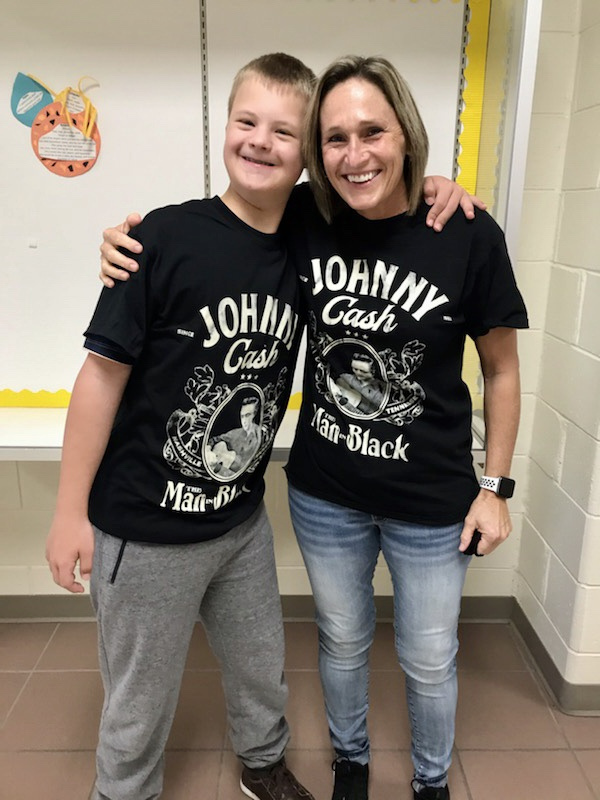
Ms. Kastel was Wil’s 7th and now 8th grade social studies teacher. 7th grade was a particularly trying time for Wil, with a change in schools and an uptick in puberty. Ms. Kastel was cognizant of this and continually worked to find ways to connect with Wil. When she discovered Wil’s love for country music, she introduced him to one of her favorites, Johnny Cash. She bought the two matching t-shirts which Wil wears proudly. Wil also loves Pringles, so he and Ms. Kastel share a Pringles cheer for a job well done in class. Not surprisingly, social studies is now one of his favorite subjects.
On our drive home, Elizabeth filled me in on her day. Katherine added commentary on their shared classes. Wil listened to both of his sisters, then hollered out, “Mac ‘n’ cheese, Mom!”
“Mac ‘n’ cheese? You had it for lunch?”
“No, made mac ‘n’ cheese.” Wil mimicked stirring a pot. “With Victoria and Anna. My Connect friends.” (Connect friends are typically-developing juniors and seniors who are paired with students who have special needs.)
Oftentimes, Wil doesn’t offer much after school. He’s generally open at bedtime, when the house is quiet and there is time and space to share his thoughts. It can be challenging to create space between his sisters’ words on the drive home. We will often ask Wil questions to create the space for him. Though we typically get a “hmph” and shrug of the shoulders in reply.
When Wil stepped into the car that day, he threw the door wide open to his school experiences. I never know when or how a breakthrough in communication will arrive, but I know it when I hear it. On this day what busted down the gates was a build-up of three straight days of working hard, making mac ‘n’ cheese with Connect friends, a darn straight awesome social studies teacher, and hard-working (even if they tease they don’t), loving sisters who naturally show Wil how to create his own space. And that’s exactly what he did.
I was once asked if I felt to blame for Wil having Down syndrome. Rude, yes. But when something happens unexpectedly, we all look for reasons. This person just happened to ask their reason out loud. Asking why something happened is survival. However, our asking usually points to something outside of ourselves. We can dust our hands of it and say, welp, it’s just the way it is; it was the way I was made; it was because of; it’s their problem now.
There is no known reason for why that 3rd copy attaches itself to the 21st chromosome. I might be to blame, I might not. Thankfully, I don’t have the answer to that question. And I love that so much. Because it is initiative in it’s purest form. There are no fingers to point except to myself. Not in blame, but to wrap around myself in this great big hug that says, “I’m not sure what’s ahead, but let’s jump in with both feet and see where this journey leads us.”
“I was just wondering if Wil wanted to be part of the 7 dwarfs. We were thinking he could be Snuggly, Giggly, Silly, or Smiley! Considering Wil has all those traits!” I received this text from Ashley about Halloween costumes. Ashley and Wil, now in 8th grade, have gone to school together and been friends since preschool.
I read Ashley’s text aloud to Wil. He jumped up and responded, “Yes!” Wil chose Smiley, then I received another text from Ashley: “Or Seeger was thinking he could be the prince if he wanted to.” (Seeger is another good friend of Wil’s from school.)
“The prince!” Wil said without an ounce of hesitation. Which is quite apt, as Wil’s friends, who are planning a Snow White-style Halloween, are all girls.
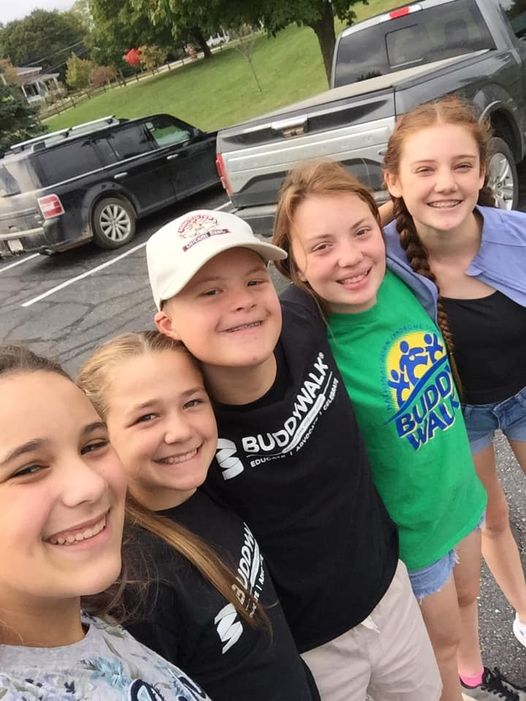
Our Down Syndrome Support Team holds an annual Buddy Walk the last Sunday of September to raise awareness and acceptance for individuals with Down syndrome. With the pandemic, the decision was to hold a virtual event. Wil and his friends were not to miss out, so we held a small, local walk to which about 30 friends participated in. Wil, of course, walked with his close buddies, Ashley, Seeger, Lila and Sarah. At one point during the walk, Wil decided he needed a break and sat down on the sidewalk. Wil’s friends stopped and cheered him on. With their encouragement, Wil jumped up and they all started running. The friends joked it was the “Buddy Run.”
Near the end of the walk, we climbed to the top of school bus loop. Once at the top, Wil’s friends ran down the steep, grassy hill along the side of the bus loop. Wil remained at the top, looking trepid. Once again, the cheering section arose. His friends’ cheers nudged Wil over the edge and he tore down the hill. Once united, the friends jumped, laughed and cheered in a circle. It’s just as rewarding to be the cheerleader as it is to be the cheered.
Last year, I was talking to Ashley after school. She told me about an activity in gym the group of friends enjoyed participating in together. Then she said Wil grew tired and laid flat out on the gym floor. She shrugged her shoulders, smiled and said, “That’s just Wil being Wil.”
When Wil doesn’t have the words, his actions are his communication. Wil’s friends understand his language. Wil doesn’t judge others or create drama; it’s simply not in his arsenal. In that way, his friends are fully free to be themselves. If you are sad, he accepts your sadness without question. If you are happy, he accepts your happiness fully. If you feel goofy, he’s more than willing to join you in the silliness. If you need a hug, he has one at the ready. If that’s your clothing style, then it’s cool. To Wil, that’s just you being you.
As a parent of a child with special needs, I know first-hand the fight for acceptance. I also know first-hand that acceptance is quite fundamental: It’s just friends being friends.
Wil and I laid on our sectional couch just before bedtime. Our heads together, we made a right angle given that we are almost the same height from top to bottom. My boy is growing up.
“Mom, we read ‘The Shoemaker.’” I smiled. It takes quiet moments like these for Wil to initiate a conversation.
“The Shoemaker? Was that in Ms. Kennedy’s class?” (Ms. Kennedy is Wil’s new resource room teacher.)
“Yes, up on the screen.”
“Did you read it with the whole class?”
“Yes. There were elves.”
“Elves? Were they helping make the shoes?”
“Yes. They are cute.” Wil tilted his head closer to mine and smiled up at me.
“You are cute too.”
“I know.”
“Tell me how the elves made the shoes.”
At quiet times like these, when Wil’s words are flowing and forthcoming, I wonder how many stories Wil keeps locked inside when the world is moving too fast for him. Wil is quick to laugh with his friends and interjects when he has something to say, but he rarely expands on his thoughts unless the time is laid out openly in front of him. When conversations are moving fast, as they typically do during the day, Wil is prone to stutter. Wil knows exactly what he wants to say but his words don’t come out fast enough and he gets stuck. “Use your soft voice, Wil,” is a cue we learned from Mrs. Charney, one of Wil’s speech therapists. Using his “soft voice” gives Wil the feeling of time and space laid out in front of him for his words to flow into.
When Wil is not forthcoming about his day (he is a teenager, after all), the topic of lunch usually gets the conversation rolling. Lunch revolves around his two favorite subjects: food and friends. Wil easily offers, in great detail, the day’s menu and the friends he sat with at the lunch table: “Seeger, Lila, Ashely, Sarah, Lilly…” This group of friends is gold, and happen to be 100% female. One of Wil’s homework assignments asked, “What do you want to do when you are an adult?” He thought about it for a moment and answered, “Football player.”
“Hmmm, that’s an interesting answer.” I said. “You don’t play football. Do you want to learn how?”
“No.”
“I’m pretty sure you have to know how to play football to be a football player. What else would you like to do?”
“Get married.”
“I’m not surprised to hear that. I hope whoever you marry loves listening to your stories as much as I do, Wil.”
Two weeks ago, I shared a story with you about our tubing adventure on Lake Lansing with friends Cheri, Randy and their son, CJ. Thanks to Cheri’s patience, Wil overcame his fears and very tentatively got on the tube with her. With much coaxing, Cheri convinced Wil to go for a very slow ride. Wil’s fear morphed into thrill that day, and he couldn’t wait to come back for another try.
Wil’s second attempt was vastly different from his first. Wil eagerly hopped on the tube with his friend CJ, who also has Down syndrome. CJ is very adept at water sports. He tubes, wakeboards, ZUPs – you name the water sport and he’s likely an expert. He’s also fun to watch as he has great enthusiasm and knows lots of tricks. CJ, thus experienced, easily got up on his hands and knees on the tube. Wil followed CJ’s lead and propped himself up on his hands and knees. We all cheered Wil on from the boat.Wil and CJ bounced over big waves and even went outside of the wake. Wil’s smile never faded. What a transformation from his first ride!
After the tubing fun, we were all hungry. We decided to make a trip to Culver’s for a bite to eat. Wil loves a cheeseburger so he was pumped up. CJ was also pumped up to eat a cheeseburger with his friend, Wil. Cheri and I exchanged stories how Wil and CJ can tend to swallow things whole, as it’s so much work to chew certain foods. (Many individuals with Down syndrome have low muscle tone, making chewing certain foods a challenge.) Cheeseburgers are one of those challenging foods for CJ. He typically removes the bun and cuts up the cheeseburger. This day, however, CJ was determined to eat a full cheeseburger complete with the bun like Wil.
CJ watched Wil (an experienced cheeseburger eater) devour his cheeseburger, then looked down at his own cheeseburger with doubt. Cheri reminded CJ he could do this and she helped him cut the cheeseburger, with the bun still on it, into quarters to make it easier to chew. CJ picked up a quarter and bit into it. He chewed it slowly and tentatively.“CJ, you are eating a cheeseburger!” Cheri cheered. CJ looked at his mom with a huge grin. It was an exciting moment and we all cheered CJ on. By the third quarter CJ was eating like a champ. In fact, Cheri had to remind him to slow down! He finished his fourth quarter and we all reveled in his accomplishment. Not a light in the room beamed brighter than CJ.With the power of friendship, that tube and cheeseburger never stood a chance. Cheers to the champs of the day: Wil and CJ!








 'WIL'ingness = Willing to Embrace Extra in Life