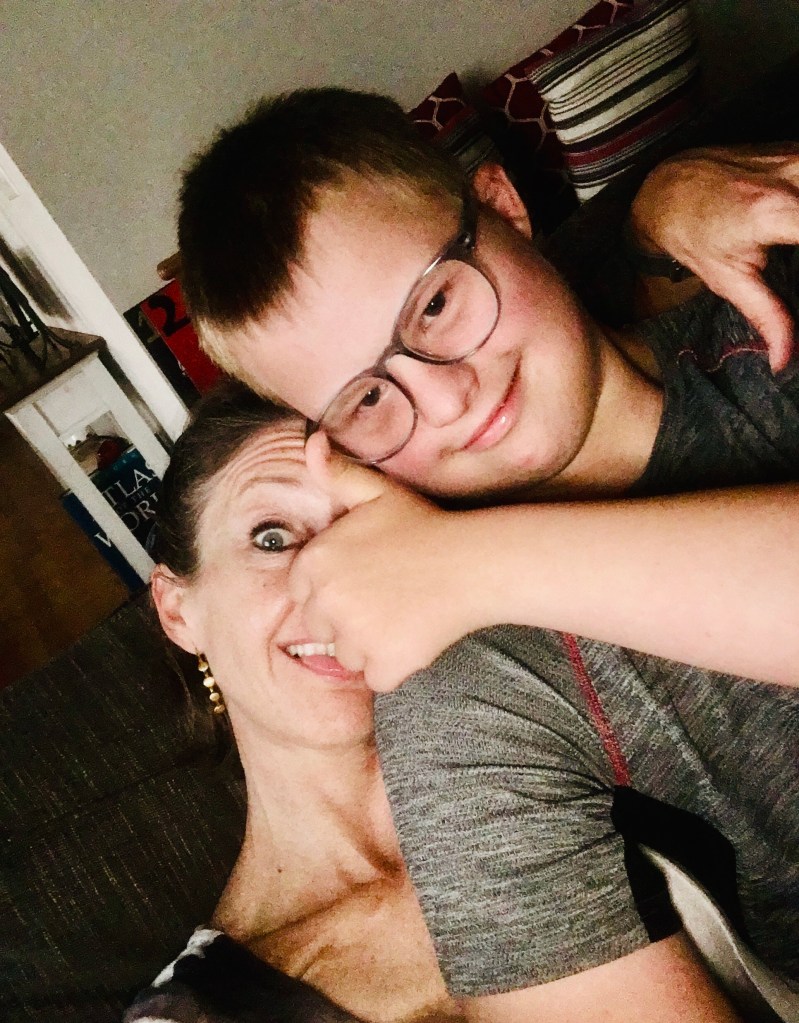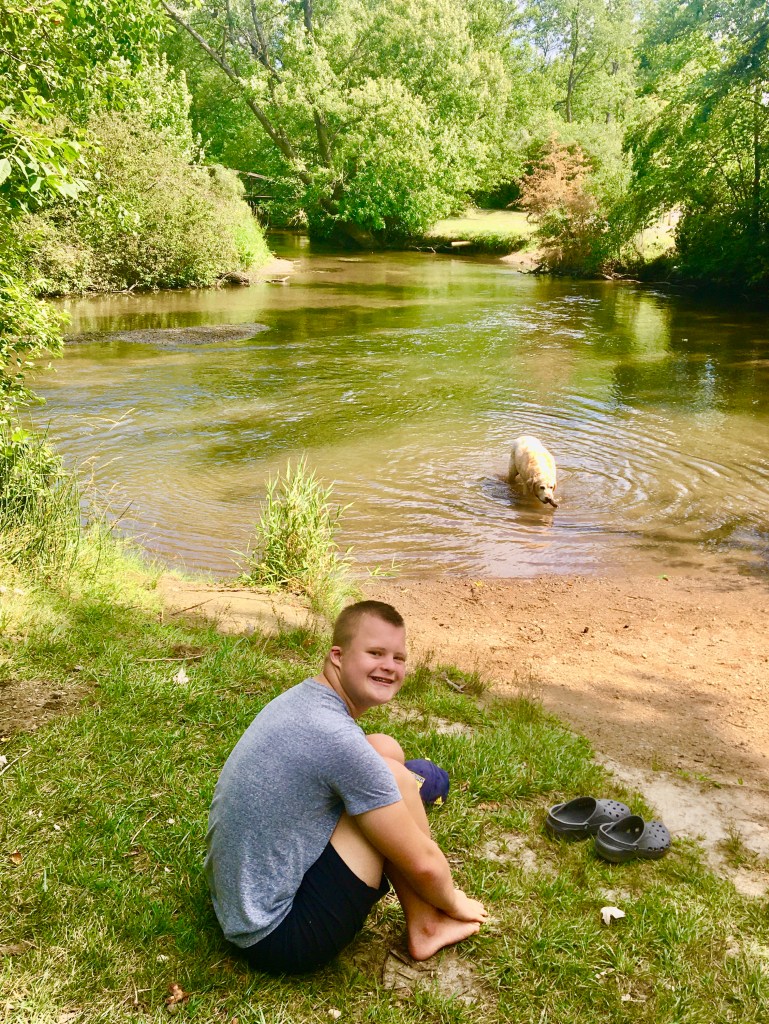
Unwrapped

Wil double-stepped down the broad concrete steps. He paused. Then he threw both arms back, hinged forward at the waist, and propelled himself over the last step. Mid-air he hollered, “Jump!”

He landed flat-footed and straight-legged.

Dang, when will he ever bend his knees?

“Mom, jump!” He yelled.

I exaggeratedly swung my left arm back, but kept my right elbow tucked in tight to protect a cup of lidded coffee. I jumped and landed softly with bent knees, then lifted my right arm in an effort to match the flow of my coffee. A deep brown dribble of coffee escaped the small hole in the lid and slid into the rim. I sipped it from the rim and raised my cup to Wil.

“Woohoo!” He yelled.

“Woohoo!” I yelled back.

“They are angels.” A woman said. I spun around. She sat on one of the ornate ice cream parlor chairs in front of the coffee shop. She was dressed in full-on Kelly green. I could barely discern where her shirt ended and her pants began.

“I’ve worked with many Down’s people. All angels.” She said.

I heard Elizabeth and Katherine, as clearly as if they were there, burst out in laughter. Then in my mind I heard Elizabeth say, “Does an angel throw your favorite comb down the heat vent?”

My mom-mind immediately targeted the woman’s lack of person-first language. But like Wil’s straight-legged landing, a correction would have stolen the meaning of the moment. The woman clearly cared about the person; she cared enough to reach out to a stranger and share the ultimate compliment.

So I smiled. I listened. Then Wil got antsy. I wished her a blessed day.

Still, her comment sat like a lead ball in the pit of my stomach. I needed to reach down deep, lift it up and roll it around until I could identify what the weight meant to me.

Then I saw it…she had put individuals with Down syndrome in a box. It was a beautiful white-feathered box placed on the very top shelf, with the utmost care and kindness; but it was still a box.

I realized I had put myself in a box too; labeled: to educate or not to educate. It’s a grown habit that becomes ingrained over the years of hearing stereotypes both well-meaning and not. Of watching your child reach milestones in micro-moments, so even the slightest bend in the knee does not go undetected.

But sometimes moments are meant to be moments. Moments to take a leap and land just the way you are. Moments to accept a stranger’s kindness by her intent rather than her words. Moments to unravel what sits heavy with you, unwrap it and let it go.

If there was an angel that day, it was one who whispered the vision of Katherine and Elizabeth in my mind; filled with laughter and words to match the moment and burst open the box.
A Dose of Happy

After coaching this AM, I pulled into our attached garage.

Wil, hearing the garage door lift, opened the side door from our house into the garage. He stood there, with his short hair a fuzzy mess, navy blue donut pj bottoms, and one of his many Buddy Walk t-shirts.

I responsively smiled at him through my car window. I shifted the car to park, lifted my hands and raised the roof. He raised the roof back. I stirred the pot, and he stirred it back. I rocked my shoulders, he rocked his and added a hip twist. I hadn’t even gotten out of my car, it was barely 7:30AM, and our day was already groovin’.


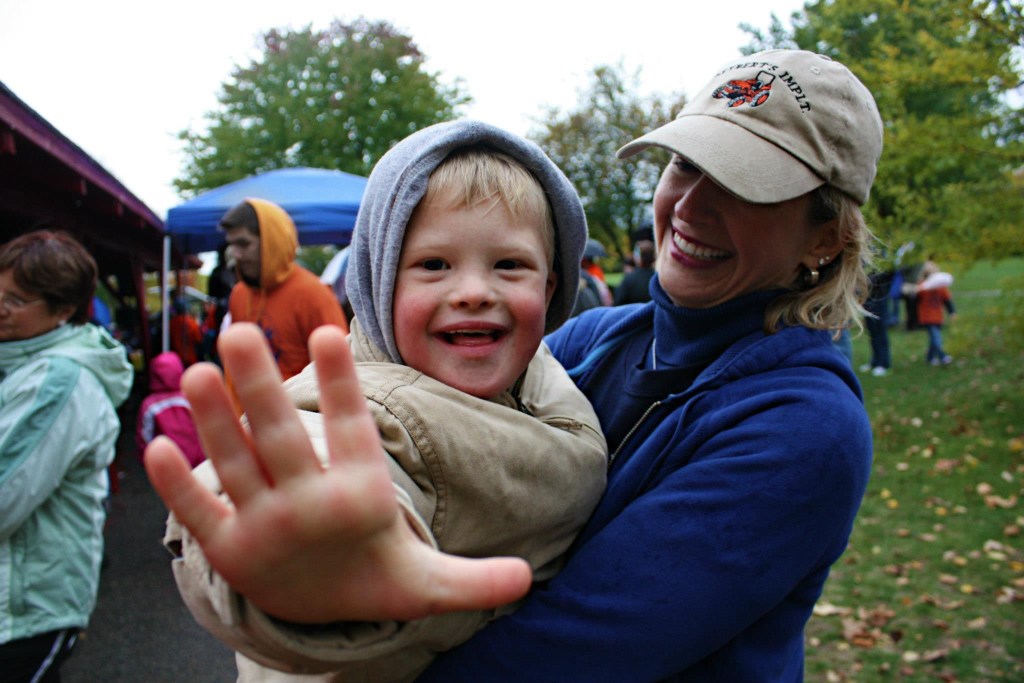
I wish I could bottle this stuff up and spread it around. Our kids w Ds bring just the right dose of joy this world so desperately needs right now.

Our kids aren’t happy all the time, but wow does Wil know how to bring out happiness in others.

Word Up!

When Wil tries to figure something out, he has a back-and-forth conversation with himself: “Wear the grey shirt? Yes, yes, the grey shirt.” This will go on for his hat and shorts, too; and with most any task that requires decision-making.

He’s been having these conversations for about 5 years now. At first, I was concerned. He didn’t talk to himself, then all of a sudden he did — all the time. I worried these conversations developed because his peer group didn’t speak at his speed, and this was a coping mechanism to keep himself company. I did, however, enjoy hearing his thoughts, as he wasn’t always able to communicate them to me. And when he got stuck on something, I knew why.

Raising a child with a disability, you grow accustomed to digging into behaviors. Behavior is communication, but when your child isn’t capable of communicating, you put on your Sherlock cap and get to work. At first it’s something you figure out, then it becomes part of your everyday lifestyle. You don’t even realize you are doing it.

If Katherine or Elizabeth started talking to themselves, I wouldn’t think anything of it. I talk to myself out loud sometimes. It helps to clarify thoughts. And come to find out, that’s exactly what Wil was doing. But I didn’t see it because I’m always looking deeper than surface level, and not even realizing it. Wil doesn’t have the social filter that Katherine Elizabeth and I do in this area. To him, he’s simply making decisions out loud with no concern about who is listening.

Looking further into this behavior, I discovered it’s very common in people with Down syndrome, and can carry into adulthood. Now that Wil has been doing it for some time, I don’t even notice it as different anymore — because it’s not.

Today was a fun leap in Wil’s personal conversation. When he has his hands full getting out of the car, he’ll say, “Mom, I can’t do it, I don’t have enough hands!” (Don’t I know the feeling!). I’ll reply: “Sure you can!” And give him a few tips, such as tucking things under his arms, or making two trips — but who does that? Then I leave him to it. Some days he gets frustrated and sits in the car, and some days he takes my suggestions right away. Either way, he figures it out.

Today, Wil tried to get out of the car with a stack of CDs and his water bottle. Rather than addressing me this time, he said to himself: “I can’t do it, I don’t have enough hands!” Then he replied to himself, “Sure you can!”

He grabbed his CDs in a stack, opened the car door with his other hand, then got his water bottle, and bumped the door shut with his hip.

Now you’re talking, Wil! 😀

Buddy Walk

As Wil gets older, fewer and fewer opportunities are available to him. The summer can be a very challenging time for our children with Down syndrome; at any age.

Few summer camps or learning opportunities are available. If our kids do qualify for extended school year, it is typically a few hours for a few weeks of the summer (thank you to all the teachers who stay for summer ESY!!!).

For this reason, our Down Syndrome Support Team decided to run a summer therapy program. Our president found 2 amazing speech therapists, 2 amazing occupational therapists, and 2 amazing special education teachers to provide tutoring over the summer. Wil and his friends thrive each summer within this program. Both for the consistency in schedule they provide, and the education with peers with Down syndrome.

But these resources come at a cost. The support of our annual Buddy Walk is what makes this essential learning possible for our kids.

It’s not so simple to sign our kids up for classes like dance, gymnastics, ice skating, taekwondo, etc. as many of our kids need extra support in this area. These venues either are not equipped, or not able, to offer support, so again our kids are lacking the social and physical opportunities they need. It is the parents within our support group that seek out places that will offer this support, or create classes on our own. Our annual Buddy Walk again is a place where we create community and grow resources for our kids.

As Wil gets older, and his needs change, I rely on the support and understanding of fellow parents in this journey as much as I did in the early days; just in a different way. I can not do this on my own. And I don’t want to do this on my own. We all lean on one another, and grow stronger with one another.

You showing up to walk one mile with us at the Buddy Walk means so much to us and our kids. Thank you to all who support us in any way you can! Your love is definitely spread in the best of ways!

To join us this year, you can pre-register online (t-shirts guaranteed to those who register by Aug 23rd), or at the event starting at 1:30PM. Hope to see you Sunday, September 25th!!! See Wil’s link below for more info, or feel free to message me with questions.

https://www.ds-stride.org/dsstbuddywalk/profiles/team/47

Thank you!!! 💙💛💙💛

Mixed Medley

I dropped Wil off on the second morning of his first all-day camp.

He talked about camp for weeks; water balloon tosses, scavenger hunts, a trip to the beach – and parent-free. There were no tears at drop-off; Wil and I were both ready for this leap in independence.

This summer has been the Mom & Wil show. As 17-year-olds, Katherine and Elizabeth have taken trips, worked, and enjoyed the freedom of driving teenagers. As such, this summer has been a sneak-peek into life with Wil when Katherine and Elizabeth are away at college. As close as Wil and I are, we both require a level of time on our own. I knew it was time to find a way to spread our wings — but how and where?

This first all-day camp experience would be an ideal situation for Wil. It is where he takes taekwondo, so he is familiar with the staff and the venue. Master and his staff are very understanding of Wil’s abilities. They know when to push him, and when to give him space. Wil would enjoy time with typically developing peers and two of his taekwondo buddies who also have Down syndrome.

Even so, it would be a long day for Wil. He was focused on the fun; I was focused on preparing him for a full day.

“Wil, you know camp is a full day; the same as a school day. You’ve got to hold it together.”

“Ok, mom.”

“You are going to have a lot of fun. But you may get tired. And that’s ok. Just tell someone. Find Master, or one of the helpers in a red shirt. Tell them you need a break. Use your words. No plopping or running off. Got it?”

“Ok, mom. Camp! Yay, woohoo!”

I played my preparatory words on repeat in the weeks leading up to camp. It may seem redundant, but I knew from experience that he’d fly in blazing, only to find that it truly was a long day. He’d then fizzle into an exhausted plop on the floor, or flee overwhelmed out the door. His words, or words by others spoken to him, would be lost. Only time and space would unravel him.

Wil is fully capable of communicating that he needs a break. He just needs to be prepared to use his words before overwhelm or exhaustion overtake him. Therefore, we play things on repeat around here.

Wil focuses much of his life on the fun side, and I’m on a joy-ride with him. The flip side of that is anticipation, preparation, and words on repeat — and I’m on a replay-loop of constant-ness with him. Sometimes I need to step out of the loop and take time for myself, while Wil needs to take a step away from me, and forward into independence.

On the drive to camp this morning, Wil sang his own impressive a cappella medley of Luke Bryan songs — I thought dang! Even Luke would be taking notes on what Wil put together. But then again, Wil knows better than most how a mixed medley works.

Yesterday Was a When

Yesterday, Wil and I had lunch and a conversation on the back porch.

One night, I sat on the edge of Wil’s bed. It was the school year of 2016. In the quiet before sleep, Wil was most apt to share his day. I always started with questions about his friends and lunch; they were (and still are) his favorite topics. I also knew the answers, so could prompt him if he got stuck.

“Who did you sit with at lunch today?”

“Ashley.”

“And…”

“Lila.”

“And…”

“Sarah.”

“Did you play on the playground?”

Wil nodded.

“What did you play?”

“Hmpf.”

“Did you play with a ball?”

“Hmpf.”

“The swings?”

As I prompted him, word-by-word, Wil shared pieces of his school day.

Then the tears came. They seemed out of nowhere, but I knew they came from somewhere.

“Wil, what is wrong honey? Why are you crying?” No answer.

This is where it got tricky. Did I continue to ask questions? Questions could further frustrate Wil, causing him to clam up. Or questions could do the opposite; open Wil up and help him feel understood. I’d ask leading questions, as he wouldn’t be able to offer what happened. But even the leading questions had consequences.
On another occasion, when Wil was unexplicably upset, I asked: “Was someone mean to you?” He looked up at me like “Why would anyone be mean to me?” And there I did it, his very own mother, who most wanted to protect him from mean people, put the very idea of mean people in his head.

“Wil, do you feel sad?” He nodded.

“Wil, do you feel mad?” He nodded.

“Can you tell me one thing that upset you?” He nodded.

“Would you like a hug?” He nodded and we hugged for a long time. My tears started too. I needed to understand his emotions, and he needed me to understand them, too.

Communication barriers are very sturdy. They take extreme patience and diligence to break through. I never know what question will lead to a hairline crack. Or what question will seal it shut.

What I do know is the answer to most things with Wil is time.

Given enough time, the words would come. I just didn’t know when.

I’ll never know what happened that day. It may have simply been overwhelm from everyday life. Wil’s teacher and paraprofessional were a dream team that year. If anything had happened to Wil at school on their watch, I’d know about it.

There are so many painful memories; days I wished I could even make a hairline fracture in the communication barrier. But Wil couldn’t meet me where I was, and I didn’t know how to meet him where he was.

Over time, we made progress. Like Thor’s mighty hammer, we made big, clunky breaks. Some on purpose and some by trial and error.

But when you make a break, you can’t miss it.

It flows — like a lunchtime conversation carried away on a summer breeze.

Yesterday was a when

It’s in the Experience

The teenaged lifeguard; tall, lean and curly-haired, stood on the edge of the wave pool blowing his whistle — at me.

I saw her face in his; though she was his senior by at least 20 years, with straight brown hair and a brisk uniform. She was resolute to get Wil’s boarding pass — from him.

Though the airport incident happened over 2 years before the wave pool incident, time came together in their parallels.

When a pool or a plane is involved, Wil is the happiest guy on the planet; until he’s not. Both travel and swimming fill Wil with excitement, unless it brims over to overwhelm; rendering him stuck on the spot.

In the airport, Wil was well on his way to overwhelm. I saw it building, so did my best to keep him distracted and on-the-move. But the heaviness was taking him over. Wil has never had a problem going through security, so I didn’t anticipate an issue. But when we approached the podium, either Wil read this security guard’s demeanor, or overwhelm finally overtook him. He sat on the ground, smack dab in front of the security guard’s podium. Not the wisest choice, but there we were.

I offered to hand the security guard Wil’s boarding pass, but she refused. He had to do it. I explained he was overwhelmed and had Down syndrome. That wasn’t enough for her. A grown woman chose a stand-off with a then 13-year-old boy with Down syndrome.

Fortunately, a few podiums over, another security guard was witness to what was happening. She asked how she could help. I explained our situation. She reached her hand out to Wil, he accepted it, and she walked us down to another podium. I heard the stolid security guard, upon our leaving, say to the security guard that helped us, “I was just doing my job.”

“I understand we need to get out of the pool,” I said to the curly-haired lifeguard. “My son won’t get out on his own. Just give me a minute.” (I sent up a silent prayer that a minute was all we’d need.)

I crouched down next to Wil and explained that it was dangerous to stay in the water; that a storm was coming; that when lifeguards hear thunder we need to get out; that we need to respect the rules; that they are there for our safety.

I knew my words wouldn’t motivate Wil out of the water now, but they would have meaning later should this happen again. Wil doesn’t fully grasp danger, but he does have an ironclad memory. When I preface a pool trip with the words “we have to get out if there is thunder” these will no longer be empty words. Experience gives Wil meaning to the words, thus being the best teacher.

A pretty lifeguard with white-blond hair stood only a few feet from us. Wil, being a teenager, would certainly respond better to her than me. I walked up to her and said, “My son isn’t wanting to get out. When he’s like this, he does much better with people who are not mom. Would you mind asking him to get out. Maybe offering him your hand?”

She willingly agreed, and approached Wil with an outstretched hand. Wil lifted his head, but couldn’t quite motivate himself to fully reach back. Though he stayed in the pool, I could see she had released some of his resistance.

Two female sheriffs that were nearby approached Wil.

“Would you like a sticker?” They held golden star badges up for Wil to see. I appreciated their efforts, but there was no way a sticker was going to prompt him out of the water (but maybe a trip to the clink would!).

Then another teenaged lifeguard, with auburn hair, walked up to me and said, “Can I help?”

The clouds parted and angels sang! No, that didn’t happen. Or else we would have got back to swimming. But that’s exactly how those words felt.

Three little words; only 8 letters in their entirety. And yet, I knew they were more than words; there had to be experience behind them.

The auburn-haired lifeguard, with a calm, friendly demeanor, reached her hand out to Wil and said, “Would you like to come with me?” Wil must have read her demeanor, because he stood up without hesitation and took her hand. He then looked at the blond lifeguard and took her hand too. Wil walked out of the water hand-in-hand with the two lovely lifeguards. Then the sheriffs gave Wil his stickers. I hope curly-haired whistle-blower was watching 😉

With Wil now out of the water, my main focus was to keep him moving forward. If this were not the case, I would have circled back to ask the auburn-haired lifeguard what inspired her to ask to help (same with the helpful security guard). What experience is in their back-pocket to step in and offer help?

Could it simply be a strong desire to help? Possibly, but my guess is it goes deeper than that. Is it gained from the experience of inclusion during their school years? Is it gained from experience with a family member or friend with a disability? Is it gained from experience as first being an observer then learning from situations such as these?

What transforms a stolid whistle-blower into an asker? What opens a mind from “doing my job” to “can I help?”

These are key questions that lead to the progression of acceptance and understanding of people with disabilities.

Within each of these questions, and likely within each of the answers, lies one common theme: experience.

And that gives me hope, because we can all learn from experience, if we choose to.

A Little Can Mean a Lot

Yesterday I went to Wolf’s Westside Automotive Service for an oil change. I had been there the previous day to have my tire patched. When I came in for my tire, the front door was propped open, the garage bay doors rolled up, and a refreshing breeze flowed through the lobby.

Yesterday was just that much warmer, so the bay and front doors were closed; a unit air conditioner cooled the lobby.

The owner, Pete, came into the lobby from the garage, sat down across from me, and delivered an update on my car’s service. Our conversation transitioned from the car to fitness and then into a story about his friend who has an adult daughter with Down syndrome. Though I don’t know Pete beyond the walls of his garage, in his storytelling, I heard true understanding. To attain that, without a child of his own with Ds, requires an openness to understand.

His shared story, and openness, were especially timely and meaningful to me as I’ve recently experienced the challenge of closed minds at a new level. I admit I’m somewhat naive in this area; thankfully. My fighting skills are weak; again thankfully. This town has always embraced Wil. I’ve needed to advocate, yes, but advocation is a conversation when you advocate with open minds.

With Wil getting older and other certain circumstances, I have now experienced lack of understanding, and the unwillingness to understand, on a broader level.

It’s hard to explain this life because a little means a lot. How do I explain, that every time I drive in the car with Wil, and he belts out Luke Bryan lyrics with complete accuracy, the elation I feel? That every word he forms beams me back to stretched-out years patiently waiting and diligently working on forming his first words? I have a million such stories.

All I need is a little crack in the door of a mind to get through. And yet, I physically feel the air fall dead between myself and a mind that is closed. I find this disconnection rarely intentional, and not meant to be hurtful. It’s not lack of experience with a disability that is the issue, it’s the unwillingness to open a door to understanding. Even the slightest creak of a hinge is all I ask. But for reasons of their own, deep within, they don’t want to know. The door remains closed. I find ways to keep knocking.

But not yesterday. There I sat, in our small town, for an oil change of all things, and with the natural flow of conversation a story was shared with full understanding. There was no knocking, no prying, no trying. The air conditioning was working, but all I felt was a needed breath of fresh air.

A little can mean a lot.

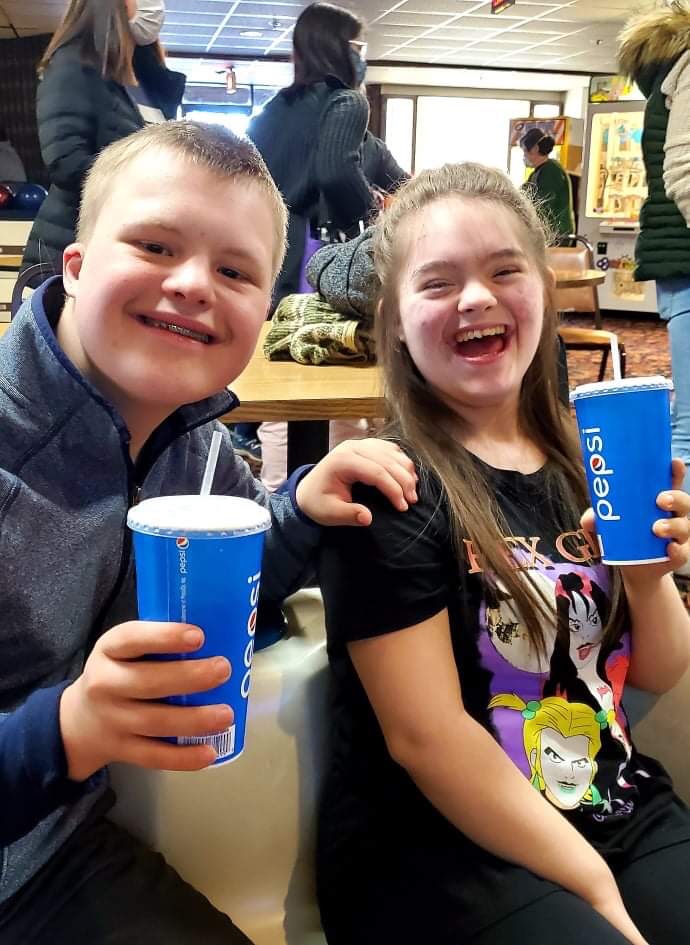
Wil and his friend, Manny

Frames of Time

I listen to empty nester friends–– or near empty nester friends–– share stories of re-visiting old independences and exploring new ones. There is talk of extended trips and couples-only vacations. Their children are nearly independent; close to graduating high school or in their college years.

Sometimes, I feel the edges of the future weighing me down. Like a framed painting, the weight of the frame tucks the canvas into place. Wil is going to require our care forever.

Though I always knew Wil would need our care forever, I didn’t really know…until I walked further down the road.

When Wil was younger I was too busy defying the odds. Forging our own path. Wil had therapy from nearly day one. I was quick to surround myself with friends on the same journey. We went through feeding strategies together. Then speech therapies. And helped our kids learn to walk with miniature treadmills. Speech and walking do not develop simultaneously. When one of our children took a first step, or said their first word, we erupted in congratulations. This meant our child who walked but didn’t talk would soon say their first word. Or after the first word came, walking would soon commence.

To the outside world these were exciting but expected milestones; to us this was everything. In this way we forged our paths together.

Then on to potty-training…oy vey! The record got stuck in the groove on that one. Wil flushed every fool-proof solution down the toilet, then went to pee in the closet. When people ask me now how we did it, I truly answer, “I have no idea.” Those early years were lived in-the-now; exactly where I needed to be. When parents spoke of their older kids with Down syndrome; of the loneliness, of the need to be ever-diligent in creating friendships, seeking out opportunities, uncovering new resources, I listened, but I didn’t fully grasp their meaning. And yet I held on to their words, like a classic book. I knew what I held had wisdom in it, even if I didn’t have the time just yet to sit down and take it all in. So, I tucked it away for another time.

Now is that time. I understand now the loneliness, the diligence in creating activities and opportunities for friendships. Life has become a more complex tapestry. The words of wisdom I heard many years before are now taking graspable shape in my own life.

Like many parents in our situation, I’ve sought out teen friends with Down syndrome. We recently had a park date. Wil became overwhelmed and took off across the field. One of the friends also felt overwhelmed so sat down next to a tree and didn’t budge, while another friend planted himself on the swings, and yet another friend continued to climb on the play structure until her mom said it was time to go for ice cream. At the ice cream shop, one of the friends dropped to his knee to propose to the female friend in our group. His mom said he needed a job before he could get married. He said he had one, he unloads the dishwasher at home.

I am so thankful for these parents and for our shared experiences together. There is never a shortage of humor, and never a need for explanation. We all understand right where we are. And we are exactly where we need to be.

There may be couples-only trips and extended vacations in our futures, but our children with Down syndrome will always be somewhere in that picture.

Though it is the heavy frame that holds the canvas, as I step back the frame fades into the background and the canvas takes over. I’m absorbed, and expanded, by the experiences of colors layered one upon another to create a powerful story. And like any great painting, I know there is never just one story. There are many more just waiting to be discovered, grasped and experienced exactly when they need to be.

Heavy and Light

Wil loves riding his recumbent bike around our property. The challenge is I can’t fully trust he won’t go out to the road. And it’s a busy road.

I was talking to fellow mother yesterday. Her 16-year-old son, who also has Ds, is in summer speech and occupational therapy with Wil. As much as her son loves swimming, she will never have a pool. For the same reason I need to check in on Wil on his bike. She can’t fully trust he won’t go in the pool unsupervised.

Our children are teenagers. They know they are teenagers, their bodies tell them they are teenagers, and they desire the independence of teenagers. And as a parent that has raised 3 babies to teenage-hood, I enjoy a certain measure of independence too.

Last night, Matt and I were enjoying relaxing together after dinner. Wil wanted nothing to do with relaxing. He went outside to ride, and sure enough when I went to check on him he was getting close to the road. He was likely trying to make the biggest circle around our yard that he could, but again, I can’t be fully sure.

Even at 15 years old, he requires an extra level of supervision. And possibly, or possibly not, for many more years to come. With Wil one thing is certain — I won’t know until I know. (If you are a neurotic planner like me, a child w Ds is your best cure! 😂)

Many of my friends are becoming empty nesters. Matt and I may or may not be. I knew this uncertainty would be a reality when Wil was born, but now that the reality is closer, its an interesting feeling of limbo to be in.

I love my life with Wil. He is so fun to be with. We sing in our off-key voices at the top of our lungs. He still surprises me with new milestones, and huge bear-hugs that now knock me over as he’s grown. I’m thankful to fully share in his youthful exuberance.

But I also have a child that may never fully grasp the risks of certain fundamental independences into adulthood. The fullness of that can feel very heavy at times.

And yet, when life feels heavy, it’s being in Wil’s presence that purely and fully lightens the load.