Complex Simplicities

She usually wears shoes to golf but in this heat, my guess is she wouldn’t leave the house without her flip-flops. She slipped off her flip-flops at the driving range and sliced the golf ball just as expertly as she did with shoes on.

She sat down to brush the dirt off her feet. Her bare feet were lifted to nearly chin level. Hypotonia (low muscle tone) allows our kids with Down syndrome great flexibility. The loose dirt fell off, but a dark stain remained on her heel. She wanted that to come off too, but wasn’t able to brush it off. She knows me as Wil’s mom, so I bent down and asked if I could help. She nodded. I poured water from my water bottle across her heel then scrubbed with my hand. She tilted her foot inward to get a better look, but never let her feet fall below chin-level. The dark stain had faded but she shook her head. Not good enough.

I poured more water on her heel and scrubbed again. She tilted her foot inward, took another look and shook her head. Another parent ran up to the golf course’s restaurant to get some napkins. But even those didn’t remove the dirt to her satisfaction. Her dad soon walked over, as he was volunteering on the putting green. By his expression I could tell he knew what was happening. He bent down and had a quiet conversation with her. She finally let her feet fall down to the ground then slid on her flip-flops. Victory! She took her dad’s hand, I waved good-bye and they headed toward the parking lot.  

The next day was equally as hot, but the evening had slightly cooled, so I sat on the back porch and Wil got his recumbent bike out. He expertly maneuvered the handles to make perfect cuts and turns across the grass. Sweat dripped down the side of his face but I don’t think he even noticed. Wil turned his head toward me and smiled every few seconds to be sure I was watching. 

When Wil was a baby he wore tiny lycra biker shorts with the inseam sown together. Otherwise his legs would flop out as Wil also has hypotonia. The idea of these shorts was to strengthen his hips and train his body to keep his legs in. Every time I watch Wil ride his bike, I’m brought back to those tiny biker shorts.  

Wil clomps heavily when he walks, and has a slight side-to-side swagger. Wil had speech therapy with his friend Teddy this summer. Teddy’s mom and I would always share a smile as Teddy and Wil clomp, clomp, clomped off to the classroom together. 

When Wil was born, I was told by parents who were ahead of me on this journey: “It may be hard to see now, but your life will be so much fuller with Wil in it.” 

That remained stuck in my head because it both struck a chord, and yet felt too abstract. I wanted more details. I wanted to know how my life would be fuller. What did that mean exactly? 

But how do you share with a new mom how endearing a flip-flop stand-off is when she is navigating the complexity of acceptance? How do you explain the depth of joy in watching your child ride his bike when she is navigating doctor appointments and therapies? How do you share the feeling of a deep-down connection in another mom’s smile when she is bewildered by a new journey full of new, unknown people. 

My answer to that now is no more detailed than the response I received over 14 years ago. I had to first embrace the complexities before I fully received the gifts of the simplicities.

Tunes of the Territory

Wil had become overwhelmed and fled the situation with little warning. I chased after him and tried to get him to open up. He never did. 

Wil has grown greatly in his communication skills, and each time we go somewhere he grows in independence too. However there are multiple stops that must break way to starts. The unexpected throws Wil off and we find ourselves at a standstill. It’s all part of the territory, but at times the repeated standstills weigh on me. 

I’ve heard you need to fight for your joy. And some days I do. It seems the only way to get through at times. But whenever I take a deep breath, step back, open my eyes (and ears), I’ve found joy has a way of letting itself in.  

Last Wednesday night McKenna Marsh, a senior at Wil’s school, came over to watch Wil while Matt and I had a date night. Though we know McKenna and her family, this was the first time she would be Wil’s caregiver. Wil was very excited about this (as was I) so when McKenna arrived he ran to the door to let her in. We walked to the kitchen and started chatting. Wil’s high energy fell to silence. 

“Wil, you are very quiet. I know you are excited to spend time with McKenna. Is something on your mind?” I asked.

He tucked his head, and with a coy sideways smile at McKenna said, “I’m feeling a little bit shy.”

Joy flooded through me! Wil hadn’t retreated into deeper silence. He hadn’t run away. I hadn’t asked multiple questions to draw out his emotions. He opened up of his own will — by being a flirt! 

The next night, driving home from Special Olympics golf, with the windows down and country music blasting, Wil and I belted out the country songs at the top of our lungs. 

“Mom look!” As I rounded a curve, off to the right, hanging low over a wide-open field, the sun was an oversized fiery pink ball. Scattered clouds absorbed its color creating a brilliant sky. We fell in silent awe. 

Wil and I looked at each other with easy smiles and synchronously resumed our loud and off-pitch tunes. I never regret the weight of this territory, otherwise I may never know such heights.

Vocal-Ease

It was just after 9 p.m. and I heard the back patio door click shut. I tucked Wil into bed only moments before. But I knew it was him. My alarm was set for 3:20 a.m. to rise for work, so I’d recently tucked myself into bed too. 

I got out of bed, walked to the kitchen, and opened the patio door. I saw Wil walk to the far edge of our yard. He stopped at the outcropping of alfalfa. About five deer were scattered across our back field contentedly grazing. Two of the deer lifted their heads; more in curiosity than with concern.

Woody, our yellow lab, sniffed the grass close to Wil. Woody would have created chase with the deer in his younger years. But now with arthritic hips, Woody guarded Wil in close proximity.

Wil turned around and saw me standing on the back porch. Instead of running away, he walked over to the hammock. Woody followed him then rolled in the grass. Wil attempted to open the material of the hammock wide enough to lie down. He decided that was too much work, sat down on the hammock, gripped the material on either side of him, and swung gently as if on a swing.

“Not tired yet, Wil?” I asked.

“Hmph.” With this response, I knew pressing or prying would only tighten the knot of his emotions and he’d clamp down, resisting any type of communication.

“It’s a nice night. Look at Woody roll in the grass.” Wil looked at Woody, then back at me. His open response to my comment, even if non-verbal, was a good sign. I decided to take a chance. “Are you upset because your sisters aren’t home?” 

“Yes,” he said and dipped his chin. 

“Don’t worry, they will be home soon. How about I walk you back to bed and give you extra snuggles?” I said.

“Ok, Mom. You going to work in the morning? Can you make me breakfast?”

“Sure, Wil. I’ll leave it on the island for you. I bet I’m back home before you’ve put your plate away!” 

“Thanks, Mom. Hugs!” Wil jumped off the hammock and barreled into me. Only a year ago he likely would have responded by running away from me or remained on the hammock refusing, or unable, to explain his upset. But on this night, with only minimal resistance, he shared his feelings of sadness about his sisters not being home. And as he typically makes his own breakfast, his asking me to make it revealed the extra comfort he desired in my absence.

I tucked Wil back in bed, with the extra promised snuggles, then crawled back into my bed. I’d barely pulled up my sheets when I heard Wil’s heavy footsteps move toward the kitchen (with low muscle tone, he’s not exactly light on his feet). This time it wasn’t the patio door that I heard shut. It was a kitchen cabinet. Then I heard Wil scoop up ice, pour it in a cup, turn on the faucet, and walk back to bed. 

“Ah, fresh,” Wil said (a phrase he commonly uses sipping a cold drink). With these words of satisfaction, I knew sleep would soon follow. And it did, for both of us.

A milestone in communication had been attained that night. It was mutually understood…no explanation necessary. 

With Chocolate chips on top

“Well, you have enough challenges raising Wil.”

I write about the challenges raising Wil, so it’s expected to frequently hear that, and I’m thankful. I used to hear, “well, he’ll always be happy.” To wrap Wil into one emotion both undermines who he is as a person, and the value of what it means to be his mother. 

There are few constants raising Wil; I live in a guessing game of interpreting his thoughts and ambitions. He very well knows, but he doesn’t always have the words to communicate his thought processes. So I am left hypothesizing, considering, deducing, reaching in and reaching out. One common saying in our Down Syndrome Support Team is: “What worked today may not work tomorrow!” To place Wil in a happy corner is laughably simplistic. He is fully, frustratingly, beautifully, imaginatively, ubiquitously challenging. Aren’t we all in our own multi-dimensional ways? 

I am in daily awe, however, of one constant in Wil’s life. That is how open and loving he lives it. His friends find a level of peace with him. He will never judge them, and that provides an internally settling feeling few other emotions can match. Wil will never grow jaded. Wil remembers slights and hurts, but he doesn’t hold on to them. He travels light. I’m ever the student when it comes to Wil.

Last Thursday night, I sat on the edge of Wil’s bed as I tucked him in and we had a conversation. His school was going virtual again and he’d just had his last day of in-person school for what we hope only lasts 2 weeks. He was feeling sad about not seeing his friends and teachers so we talked it out. Then suddenly he changed the subject. “Mom, pancakes.”

“You want pancakes for breakfast?” 

“No, made pancakes.”

“Oh, you made pancakes in school today?”

“Yes, with Kennedy.” Rachel Kennedy is Wil’s resource room teacher. Sometimes he refers to his teachers by their last names: Campbell, Kastel, Kennedy. 

Then he smiled and held up two fingers. “I made two. With chocolate chips.” 

My heart leapt with joy. That smile of his was for more than just pancakes. It was a smile of connection. A connection made through his own self-initiated words that invited me into his world.  

In Wil’s early school years, there were few words. He would get frustrated, the tears streamed, and he couldn’t tell me why. I could only ask questions, hoping I’d strike something with some accuracy that he would nod to. At times he would nod for the sake of nodding. He desperately wanted to say yes to something. To connect. So I would hug him and hide my tears, aching for the day he could express his own thoughts. You don’t know the value of a word until you know what it’s like to wait to hear just one, please just one word, that tells me what you are thinking.

I used to believe I knew what optimism meant, but I confused it with positivity. Positivity is rather one-dimensional, as is slapping someone, or something, with a happy label without care to delve deeper. Optimism lengthens with patience. Optimism holds on tight with faith. Optimism searches, reaches, climbs, knowing there is an answer, it’s simply not ready to appear yet. Optimism feels sadness but never stops believing. Optimism rejoices as optimism knows it grows through the challenges.

Yes, I have enough challenges raising Wil; as is the reason I brim with optimism. He’s grown my heart to believe with every part of my being…with chocolate chips on top.

How Big Is a Millimeter?

Early animation was created millimeter-by-millimeter. To some, this is a tedious process — much too much work. Others enjoy the sinuous flow of the completed project, unaware of or unconcerned with the process behind the scenes. To the animator, however, the diligence, patience and love poured into every intricate detail has special meaning. Each development in the process, no matter how slight, contributes to the bigger picture. 

For Wil, getting dressed is an event. He may emerge from his bedroom decked out in grey and declare the day “Grey Power!”  There was a “Red Day” when, you guessed it, he wore red from his hat down to his socks. Wil is equally excited about his blended color outfits, or his self-proclaimed “fancy” or “handsome” collared shirts — accurately meeting both descriptions.  

Wil’s dexterity has not reached the point where he can tackle buttons on his own. Wil’s button-down shirts are hung in his closet with the top three buttons undone. That way he can maintain his independence by pulling the shirt over his head, only needing my help for those last few buttons. As I fasten the very top button, I ask, “Isn’t that too tight?”

“Ugh, mom, no!” Clearly, I do not know fashion. 

Wil’s teenaged response reels me back in time, as I often am, triggered by one of his words or actions. I’m reminded of all the still-frames in time pieced together, millimeter-by-millimeter, to create the moment we are standing in now. Such a typical scene, and yet, it’s not. 

I’m brought back to a 3-year-old Wil, his hair nearly white-blond and wispy. His voice light and sweet, with an upturned, cheerful innocence. Wil sits across the table from Ms. Theresa Herron (Wil’s speech therapist since he was a baby through his grade school years). Wil points at one of the flash cards laid on the table; upon each card a picture with a word describing it. Wil is learning how to pronounce the words on the cards. He’s also learning to make associations with the pictures as they are placed into a scenario. During each session, Wil and Theresa find something to giggle about.

Theresa had an iPad set up on the table, which was an advanced concept at the time, and she videoed certain sessions. The videoed sessions, seen one at a time, may appear to be near repeats of Wil pointing at this, then Wil associating this with that. Progress made might be difficult to detect. However, if you chose to press the fast-forward button to view continuous sessions, you would enjoy a sinuous flow of Wil’s clear advances over time. 

Theresa and I were like the animators as we reviewed each session — we rejoiced in every millimeter of change. Theresa would note how Wil enunciated a word in a slightly different way, or how he made an association he hadn’t before. If he’d been experiencing a roadblock, she’d gather the information we had so far and indicate a new direction to move in. Our shared celebration of each session ran deep, as we both valued the magnitude of each millimeter.

Over 10 years later, Wil’s vocabulary has greatly expanded thanks to the strong foundation of his early speech therapy days. Wil’s ability to communicate has been vital to his flourishing independence.  Even Wil’s “Ugh, mom, no!” is so teenage-typical, and yet it’s not. We stand on a mountain of millimeters, special meaning built within every intricate layer, in this sinuous flow of life. 

A Sucker for You

Communicating with Wil is an incredible experience. Though he has been in speech therapy since he was months old, he has always been one savvy communicator.

A tilt of his head and a smile melts you into a puddle of mush on the spot. When music takes him over, his good vibes serendipitously course through your veins with no conscious thought on your part; you find yourself both curiously and delightfully boosted. When Wil walks out the door and is hit by a breeze, he opens his arms wide and spins round and round. “Fresh!” he says into the air — this one word an invitation to open yourself to the dizzying, fresh new moment with him.

To hear Wil put words to his emotions is one of my true delights. A back-and-forth conversation with Wil was once a dedicated dream, and is now our reality. Though Wil now has a full and colorful vocabulary, he continues to be the master of condensing a myriad of meaning into one word or action.

In October, I shared with you a story about Wil refusing to sleep in his own bed. He was not forthcoming about the reason for his refusal, though he has the words. I peppered him with questions and eventually drew out one key word from him: “cats.” From that one word I had my answer. The source of Wil’s bad dream was from an “Elmo Pets” DVD. There is a “Cats” segment where a puppet tiger pounces onto the scene with a roar. The puppet is soft and cuddly, but the element of surprise combined with the loud noise terrifies and mystifies Wil. Before the bad dream happened, I found him in his room playing the tiger scene over and over. Like cranking the handle of a Jack-in-the-Box, the predictable surprise continues to startle. I removed the DVD, and the DVD player, from his room.

He’ll now sleep in his own bed for short bouts, but invariably I’ll wake up to find Wil camped out in the living room in his sleeping bag. Whenever Wil spends the entire night in his room, I commend his progress: “Great job, Wil! You slept the whole night in your room. How about we go for another night?”

After a considerable moment, Wil replies, “Maybe.” Oh, the ubiquitous power of one word!

Last week at school Wil walked down the hall with his paraprofessional, Kristi Campbell. He held a fistful of Blow-pop suckers he had been given as a gift. It was nearing time to pack up his things. While many days this is not a problem for him at all, on this day the transition built up in his mind and became overwhelming. Though he has the words to express his feelings, when the overwhelm overtakes him, sitting on the floor gets the point across much more efficiently.

Many passersby offered Wil encouraging words to motivate him up off the floor. On certain days, this encouragement breaks up the overwhelm for him. But there are also days when Wil needs a total 180 in thinking to turn his thoughts around. Kristi read what Wil was communicating that day as he remained unmoving on the floor.

“Hey, Wil,” Kristi said matter-of-factly, “can I have one of your suckers?”

“Sure,” he said.

“Ok then, let’s go.” Wil stood up, handed Kristi a Blow-pop, and they walked to his locker to pack up his things.

While Wil speaks volumes with one word or action, cracking his code can be another thing altogether. Yet when one savvy communicator meets another, it can be as easy as asking for candy from a 13-year-old.

(photo: Kristi and Wil)

A New Flight Path

On the day of Wil’s birth, the nurse said he was “floppy” which is a soft marker for Down syndrome. He melted into my chest. The soft, defined curve of his eyes warmed my heart like I’d known this love forever. At the same time, the shape of his eyes sent a hard marker of knowing deep into my gut. I wouldn’t let the knowing climb up to be processed by my rationale. I held it down like a child with hands clamped over her ears, singing, “la-la-la-la.”

We all have dreams for our children. Even if our children do not step into those dreams. Even if we don’t really expect them to. It’s natural to form a moving picture view of the future ahead. Our dreams point the way. When I could no longer hold down the knowing of Wil’s diagnosis, confirmed by a doctor’s solemn nod, I found myself staring into a blank future. In what direction do I go? It was a stand-still in time.

I stared into Wil’s eyes and wondered at the seeming randomness of it all. Though I received many words of consolation and many words of encouragement, I felt directionless. I had no reference point. I was lost even though people all around me shouted directions.  

My first step was to call a trusted friend, Beckie Brewis. She ran the First Steps Parents as Teachers program which Katherine and Elizabeth were enrolled in. She was also the Early On service coordinator (a program for children with special needs ages 0-5). She put me in touch with therapists for Wil. He soon started speech, physical and occupational therapy. Beckie and Wil’s therapists not only helped him take his first steps into speaking, walking and picking up Cheerios, they also helped me take my first steps into this life too. 

When Wil first learned to walk, his physical therapist, Shelly, helped him up onto a balance beam. Shelly held one of Wil’s hands and I held the other.  On a balance beam the only reference point is forward, or you fall off. “Look how he does that,” Shelly said as Wil advanced along the beam. “He doesn’t know how to walk on his own yet, but he is now able to place one foot in front of the other.”

Today Wil and I run like airplanes – our arms out wide, we dip, we skip, we circle, we jump, we zig, we zag, all through the landscape. Our path may seem directionless to some, but we know where we are going because our grounding is solid. Imprinted in the earth are our footprints, one in front of the other, the path of trusted friends alongside steadying our gait. 

Learning to walk through the blank space was how I learned to fly. You can’t spread your wings standing still with your hands clamped over your ears. The knowing that I once held down is now the air that lights my wings….arms out wide, ears open, eyes curved to the sky, la-la-la-la onward we go.

Photo: Beckie and Wil

A Darn Straight Day

“Mom, I worked hard today!” Wil shouted as he threw the car door open and took a seat right behind me. The school day had just ended. Elizabeth slid into the passenger seat and Katherine jumped in next to Wil.

“No way, Wil, not three days in a row.” I said.

“Yes!”

“Nope, not possible.”

“Yes!”

“Put it here, buddy. I’m proud of you.” I raised my hand over the front seat and Wil met it with a strong high-five. “Katherine, did you work hard today?”

“Hmm, sort of.” She gave Wil a sideways smile.

“What!” I rolled my eyes in mock disdain.

“Giiirl,” Wil pointed to her, “you work hard!”

“Elizabeth, did you work hard today?” I asked.

“I did, but I could have worked harder.”

“Darn straight!” Wil yelled out.

“Wil learned that from Ms. Kastel in a game they were playing.” Elizabeth said. “I think she changed one of the words.” We shared a smile.

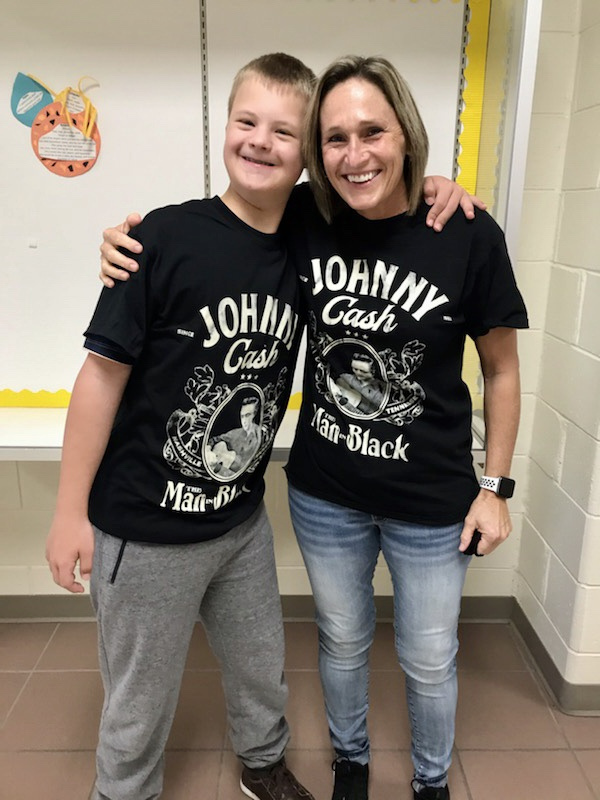
Ms. Kastel was Wil’s 7th and now 8th grade social studies teacher. 7th grade was a particularly trying time for Wil, with a change in schools and an uptick in puberty. Ms. Kastel was cognizant of this and continually worked to find ways to connect with Wil. When she discovered Wil’s love for country music, she introduced him to one of her favorites, Johnny Cash. She bought the two matching t-shirts which Wil wears proudly. Wil also loves Pringles, so he and Ms. Kastel share a Pringles cheer for a job well done in class. Not surprisingly, social studies is now one of his favorite subjects.

On our drive home, Elizabeth filled me in on her day. Katherine added commentary on their shared classes. Wil listened to both of his sisters, then hollered out, “Mac ‘n’ cheese, Mom!”

“Mac ‘n’ cheese? You had it for lunch?”

“No, made mac ‘n’ cheese.” Wil mimicked stirring a pot. “With Victoria and Anna. My Connect friends.” (Connect friends are typically-developing juniors and seniors who are paired with students who have special needs.)

Oftentimes, Wil doesn’t offer much after school. He’s generally open at bedtime, when the house is quiet and there is time and space to share his thoughts. It can be challenging to create space between his sisters’ words on the drive home. We will often ask Wil questions to create the space for him. Though we typically get a “hmph” and shrug of the shoulders in reply.

When Wil stepped into the car that day, he threw the door wide open to his school experiences. I never know when or how a breakthrough in communication will arrive, but I know it when I hear it. On this day what busted down the gates was a build-up of three straight days of working hard, making mac ‘n’ cheese with Connect friends, a darn straight awesome social studies teacher, and hard-working (even if they tease they don’t), loving sisters who naturally show Wil how to create his own space. And that’s exactly what he did.

What’d You Say?

“Oxonya,” Wil whispered in my ear.

“Oxonya? Is that someone in a movie?”

“Ugh, no!” Wil said. He leaned again to whisper in my ear, “Oloxonya.”

“Alanya?”

“Moooooom!”

“Sorry, Wil. Can you say it out loud instead of whispering it?”

He leaned in to whisper again, “Olllazanya.”

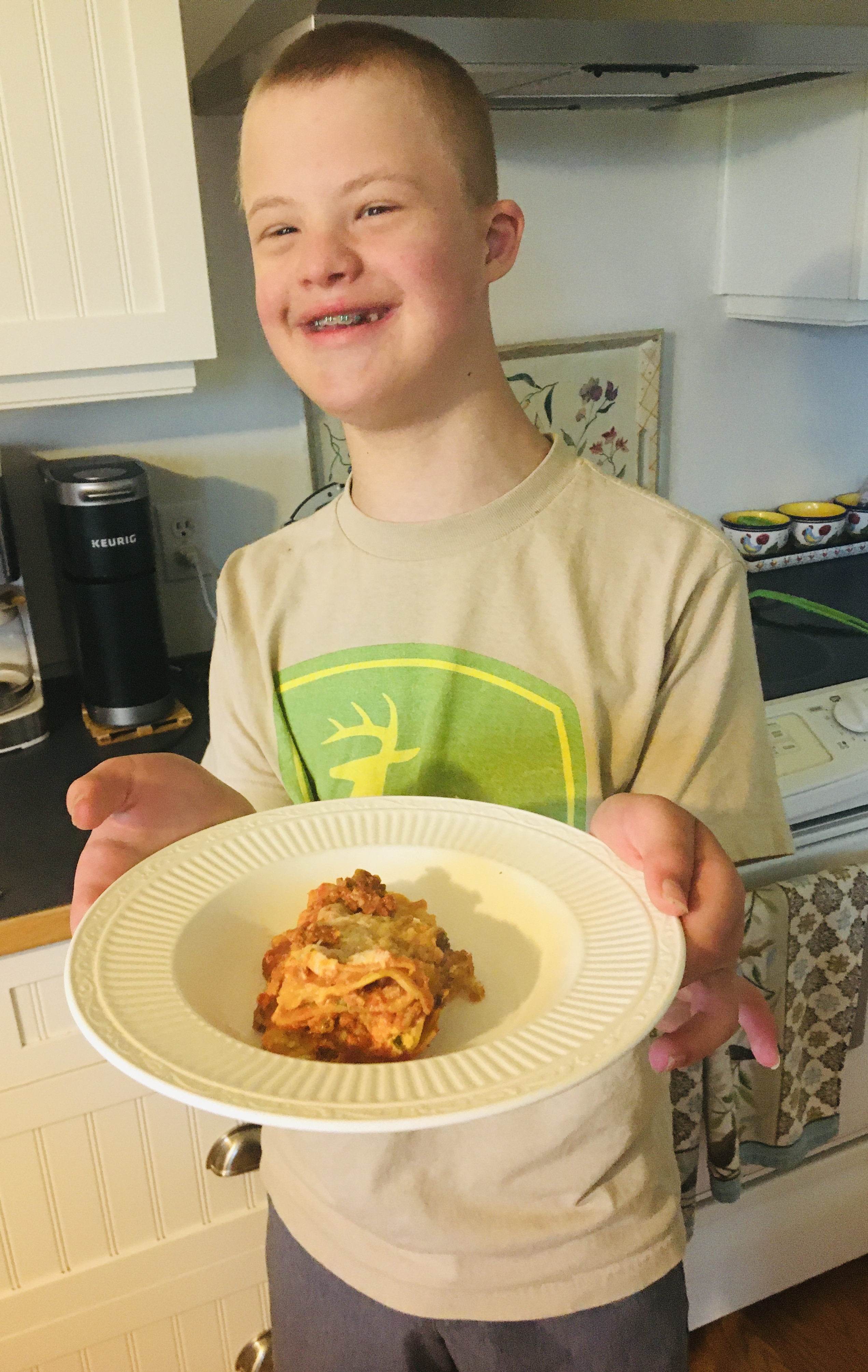
“Oh, lasagna!”

“Yes, Mom, geez.”

“Wil, say l-l-l-l asagna.” I said emphasizing the “L.”

“Oh that’s silly mom. Lalalala. That’s not how you say it.”
A8CBC901-36E0-4D4A-9024-B8E6781C1DC4

No Words to Describe the Words that Do

Wil was busy packing his backpack. Then he walked up to me and told me what he was doing and walked out the door. I didn’t understand fully what he said. So I watched him walk down the lane of our back field. If he turns right, that means he’s going to the river. If he turns left, he’s collecting sticks. He turned right.
I threw on a coat and gloves, hopped on the 4-wheeler, and sped down the lane. I hopped off and started making my way from our property to the woods.

But, before I reached the woods, there sat Wil – cross legged in the grass. His backpack was open, the soccer ball he packed had rolled out. In front of him was a spiral notebook. He held a pen in his hand and had written one word: Ashley.

“Hi Wil.”

“Hi Mom.”

“Whatcha doing?”

“Mom, look.” He started writing.

“Ashley summer? Yes, we’ll see Ashley in the summer.” He nodded and continued writing.

“Swimming with Lila? Yes, you’ll have fun swimming with Lila.” He nodded then wrote again.

“Eating? I know you love to eat!” He laughed and wrote again.

“With Mom and Dad. Yes, Wil, that’s right.”

“Mom, look.” And he wrote “I love you.”

“I love you, too, Wil. Very much. I’m also very proud of you.”

He smiled at me, and signed his name.

“I’m cold, Mom.”

“I bet. I’ll give you a ride home.”

Words can’t describe. ❤️