A singular new word Wil calmly adds to his vocabulary, in a such a way that only I — or his closest educators — would hear stands out like a stacatto flashing me back in time to a movie reel loop when he was 5 or 7 or 10, working a skill on a repeat loop that at the time I couldn’t see beyond.
But here I stand, still marveling at one added word, one added achievement, one added milestone, taking me back and pushing us forward seemingly in flow but full of staccato moments.
I’m not who I used to be raising Wil, yet I’m closer to who I am at my core.
I must pave ways for Wil and yet must leave space for him to create his own. He has a high level of vulnerability and yet has an inner strength many desire.
Wil has grown in me a patience I never knew I had, and yet also has grown an immense impatience to grow more; to learn more; to expand borders.
I have learned many stereotypes are hysterically true; and many are heretically innaccurate. Wil’s sisters called him, “Wil ‘the snail’ Taylor” every time they followed him as he two-stepped up and down the stairs. I’ve shared many laughs with fellow Ds mommas over stereotypes and shared many tears with these same mothers over stereotypes. Stereotypes can bind or separate. You need to walk the walk to know which is what.
And friendships. He has some deep ones. He also has many cheerleaders we’ll never see again once he leaves this school. But the impact his presence has made, and theirs on him, is undeniable.
Raising Wil is a paradox; surface friendships that leave a lasting impact, single breakthrough words that flash back to a former time loop on repeat, patience that creates a relentless drive, stereotypes that create binding laughs in their known truths, and stereotypes that create pain in their ignorance of the truth.
I now stand beside Wil with great hope of what’s ahead, pure enjoyment of where we stand right now, bouyed by the memories that brought us here, and on occasion flash me back.
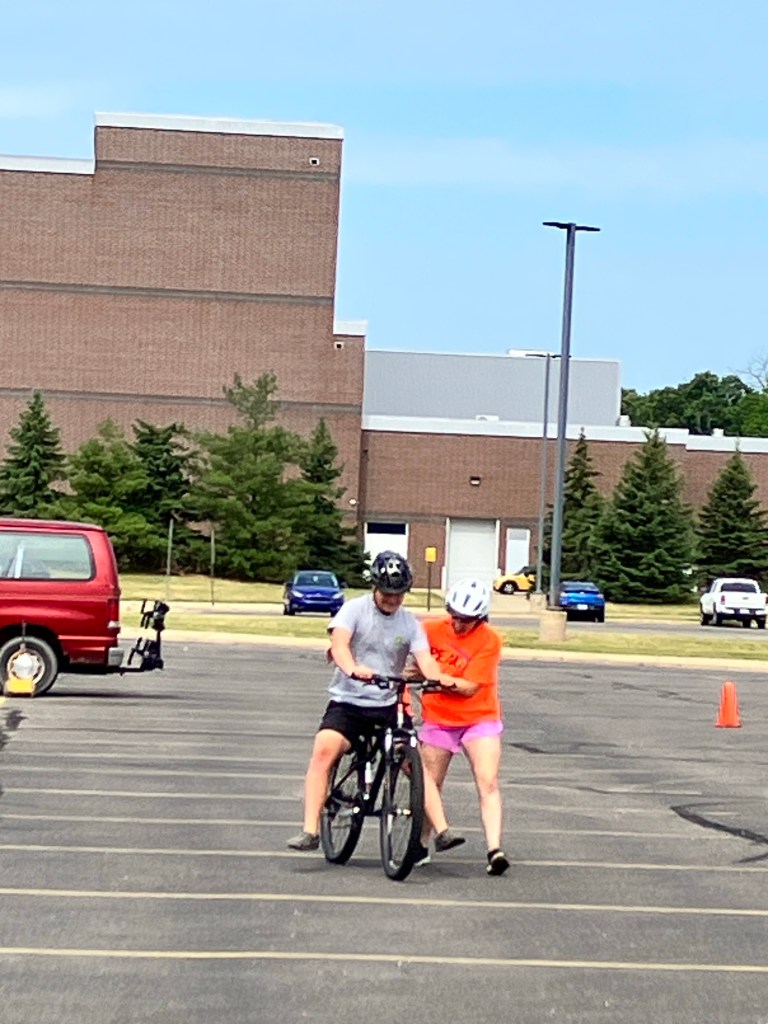
I walked into the parking lot area where Wil was to take his PEAC bike camp. I was overcome with a positive, uplifting feeling — thankfully this type of feeling is not unfamiliar. I’ve grown accustomed to this shift from breathing dense air into a higher atmosphere in only one step.
This atmosphere is one of people helping people. It is beyond a good deed. It is true unity. We innately know the difference as it’s the way we are supposed to be — together.
This is one of the many gifts individuals with special needs offer us. We only need to rise beyond ourselves to accept this handed gift.
One of my favorite parts about Special Olympics events is when I thank the volunteers for their time, and they say, “No, thank YOU! We are so very thankful for this opportunity.” And in further discussion you find they volunteered once as a “good deed” and now it’s 20 years later and they wouldn’t miss it.
Many of us seek ease as happiness; or to step in for the sole purpose of a “good deed” to check a “feel-good” box without deeper intentions. But when we make a choice instead, to dive under the surface, to see what this “other life” really and truly means, we find the challenges are actually beautiful in their own way. It’s a new adventurous world that cracks open our hearts in a way we didn’t know possible. Like the Grinch’s heart expanding outside of his chest. But he too had to dive off his own hill with one intention, only to come back with a whole new unintended perspective.
Life can be deeper if we allow it to be. It’s up to us to make the dive.
Wil attended his first taekwondo tournament last Saturday. The environment had the potential of causing sensory distress within Wil. I had been to many taekwondo tournaments in the past with Katherine, as she worked her way up to a blackbelt. There would be many people moving around on the gym floor, and spontaneous announcements over the loud speaker —both high sensory triggers for Wil. (Though we have a large dog, Wil is leery of other dogs because of spontaneous barking. The same goes for babies crying, sports announcers over a microphone, and events like pep rallies where crowds and loud noises erupt without notice).
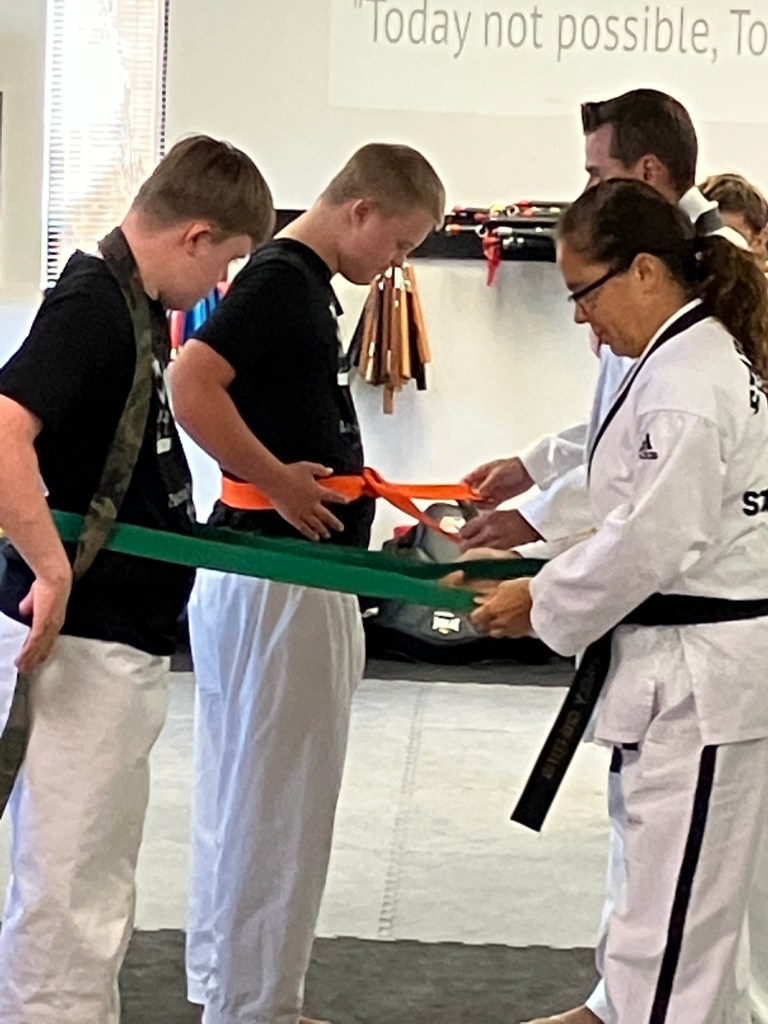
Wil, however, has grown in his ability to manage sensory distress. He’s become more self-aware and only wears his noise-cancelling headphones when he feels it’s an absolute necessity (he still won’t walk into a movie theater without them). He also loves taekwondo. He thrives on his independence in the taekwondo classroom, and also being with his friends, Alex and Nick, who have been practicing taekwondo for years. He looks up to both of them, and works hard to achieve their level of mastery.
When Senior Master practices form with Wil, Wil pays close attention. With his desire to do well, mixed with his growth in sensory rich environments, I knew the tournament would be a challenge for him, but a challenge he would deeply want to rise to.
When we arrived at Saline High School where the tournament was being held, there was a long line out the door. Wil held his excitement throughout the wait for the tournament ahead. The line moved quickly and one of the Masters at the front desk welcomed Wil by name and gave him a high-five. Wil gave him a hearty high-five in return. We were off to a great start!
We made our way down to the high school gym. Wil paused at the entry taking in the crowds. The set-up was the same as Katherine’s past tournaments. There were multiple squares of black mats, parallel to one another, with narrow walk ways in-between. Each square had a pole with a number attached to the top. As Wil’s “Special Abilities” hadn’t been called yet, I suggested we wait by a mat with fewer crowds. I took Wil’s big gear bag from him, so he could more easily maneuver his way, and we walked to the far side of the room where it was less populated. Wil stood against the wall, and I could feel him stiffen by the look on his face. But I also knew he was determined to be brave.
I attempted to break his tension with discussion about Alex and Nick. He nodded but became increasingly quiet. Even if I couldn’t see it, I knew perceptively that the tension within him was rising above his ability to manage it. I suggested we walk over to the bleachers but he shook his head. I pointed to open seats at the very first row of bleachers; I said we wouldn’t even have to climb the stairs. We could just sit and relax for a moment. He started taking little steps away, and I knew it wasn’t to sit on the bleachers. He was plotting his escape. When he took a forward step, I took one with him. I took his hand but he shook it off.
To any outsider watching, when he decided to bolt out of the gym, it would have seemed sudden. I dropped his gear bag on the spot. With the narrow walkways and crowds, I would have knocked someone over with it chasing Wil. I had no idea where Wil was going, and I didn’t want to lose him in the high school, or worse, the parking lot.
He exited the gym and took a sharp left down a long hallway. Closed double doors blocked further progress, so he took a seat in the corner between the double doors and the wall. He curled his knees up to his chest and wrapped his arms around them.
I crouched down to his eye level and talked quietly to him. He dropped his head to his knees. I knew he wanted to be in the tournament. I knew he was disappointed in running away. But he didn’t know how to get out of his emotions.
I reminded him that Master would be excited to see him. I reminded him that once he got on the mat he would be having so much fun, he’d forget everything else. Then I sat down and stayed quiet. I knew he also needed time to process everything. As hard as I tried, right now the moment was up to him.
And inside of me, I had reached my limit too. In efforts to keep Wil calm back in the gym, tension built within me. Would he run? Where would he run? Was I saying the right words or was I making it worse? Do I make him stay? Do I let him go? Do I just kept my mouth shut? Time always gives us the answer, but in situations like this time wasn’t on our side. Wil’s “Special Abilities” division would be called when it was, whether Wil was ready or not.
I was growing increasingly frustrated with myself, mixed with a sadness for him. Here we were, Wil 15 years old, and I’m sitting in a hallway with him. Will this ever get easier? Will things always be this struggle of wondering what will happen? Will I always need this patience and forethought with everything we do?
I know from experience that each tournament will be better. That Wil will know what to expect from his own experience, and we can talk about it with growing effectiveness. He can tell me if he wants to go, or not go, fully understanding the environment he’s walking into. When Wil feels ready to compete in a tournament, it will be the best day ever as we’ll both have grown from this very experience.
But that’s for another day and another time. Right there and then in the hallway, there is no sugar-coating it. It was just plain hard.
I asked Wil if he wanted to go home. He said yes. I told him I couldn’t go get his gear bag without him. That he would have to walk back through the crowds with me to get it, but that we would go right back out to the car.
So we walked back through the gym and grabbed his gear bag. I gave him credit for being so brave to walk back in, and I meant it. I knew that would build strength in him for next time. On our walk back out of the gym I heard my name called. I looked up into the bleachers and saw it was Eleanor, Alex’s mom. She was sitting with Alex, Nick, and Nick’s dad, Jeff. They waved for us to come up and sit with them. I felt envious that Alex and Nick were sitting up there, but we were about to leave. I swiped my hand across my neck symbolizing it was over for us. Eleanor’s nod back to me was like a big hug. She understood exactly what we were going through even though words were not exchanged between us.
Wil and I made it back to the car. I let the tears go silently, so as not to upset Wil, and started the car. As per usual, Wil took my phone out of my purse and clicked on the Amazon Music app, found a Luke Bryan song (right now he’s into the Spring Break album) and started singing with Luke.
It was hard to imagine Wil shrunken in hallway corner moments before as he belted out the lyrics to “Spring Break-Up.” It wasn’t that he’d already forgotten — he’d remember every detail. But to him that moment was over, and a new moment had begun.
I had more tears to let go first, and then I’d be able to move on. I guess we all have our own processing time.
It’s not that I don’t enjoy them, or learn from them, or feel a connection with them. I do. I have a few of my favorites saved in my library for quick access when I need extra help. But mostly, I enjoy the running podcast of my own life.
Like when Wil goes to Challenger baseball, I look forward to it just as much as he does. It’s as much of a supportive environment for him as it is for me.
There is both structure and freedom in the Challenger games: 3 innings, player placement in the outfield, a batting line-up, and everyone makes it to home plate. But beyond that, and sometimes within that, anything goes. It’s really the perfect parallel to raising a child with disabilities. The parents, coaches and players get it, because they live it. Every day.
Tim stepped up to bat, and Coach H. announced it was Tim’s birthday. Everyone cheered. Coach H. joked that his son, who has autism and scripts (repeats sayings), only told him 55 times that morning. After Tim hit the ball, Tim’s mom quietly told Coach H. that she’s not sure where his son heard it was Tim’s birthday; it’s really in January. But who couldn’t use an extra cheer?
Sandi was next up to bat. She hit the ball and ran to 1st base. But she didn’t stop there. Sandi ran on to join her friend on 2nd base to give him a hug. There Sandi stayed; two players on 2nd base and no one on 1st base.
James enjoys music; the same music, over and over. James’ dad’s cell phone is on a near constant repeat of animated show tunes in his pocket. But James’ dad instilled a rule: music while in the outfield, but no music while waiting to bat.
“I swear I can’t listen to that song one more time!” James’ dad said to me. James, in turn, scripted about the music the entire time he waited to bat. So, by the time James and his dad went back to the outfield, his dad was just as relieved as his son was to play music again!
I jokingly said to James’ dad, “No music on the pitching mound.” He replied, “Oh, there is going to be music on the pitching mound!”
Just before Challenger baseball, Wil, with his strong left-handed throw, tossed Elizabeth’s book into his pool. He wasn’t mad it her. Nothing precipitated his actions. He saw her book sitting on the back-porch table, and his pool was in perfect throwing distance.
He lost his iPad privileges, which means no Luke Bryan. So, he grabbed his Luke Bryan CDs, which I also said no to.
“DVD’s mom?” Wil asked.
“No,” I replied.
At the Challenger baseball game, I shared this incident with my friend, Eleanor. Her son also has Down syndrome and is Wil’s age. I knew she would understand, and sure enough, she laughed and said her son had committed similar acts with his sister’s possessions for no apparent reason. We shared other stories and how our sons always tell the truth, or remain silent, about such incidents. We’ve never heard either tell a lie. Then we watched her son crack an impressive grounder and take on the bases.
Entertainment, sports, connection, support, humor and education; no streaming required, all on a Sunday afternoon.
Last night, there was a story on the news about a young man with Down syndrome training for a full ironman. Yes, a FULL! I fanned my hands in front of my eyes. Just freaking WOW!
His motto was 1%. Every day do 1% better than the previous day. That’s something we can all commit to. A very smart and dedicated man.It’s a feel good story for sure. And it’s a barrier breaker. It’s likely getting shared all over, as it should be. These stories are powerful not only for individuals with Down syndrome, but for all of us. Who knows who just needed that 1% nudge and decided to take it after this story.
I love these front stage stories. But as a parent of a child with Down syndrome, I also want to pull back the curtain. I want to talk to his parents. Beyond the typical questions that are asked. This is how they go: We were very concerned that my child had Ds. But what a blessing! Look what he/she can do now. These are success stories, and we can relate. I know I can.
But I want to go deeper. What is the day to day like? In many ways, our kids need some support. So in giving Wil independence, he’s not always aware of dangers. How did his parents give their son independence? How did that look over time? When did they push? When did they step back? Who put the Ironman idea in his head? Did he discover it? How was he made aware of it? Was it a fitness progression over time? That is the 1% I want. What were the 1%’s each day that added up to this place for your son?
I’m not asking because I want Wil to do an Ironman. If he wants to, more power to him. But my question is more 1%. I want to know the day to day for Wil to reach the highest level of independence he is capable of. I want to know the ideas to open him up to that. I want to know the parts they opened for their son to discover on his own. All the pieces that add up to the whole, whatever that whole may be.
Last night as Matt and I watched this show, Wil was out in the back field collecting sticks. He got cold, so came in grabbed a hat then dug through the glove bin. He picked out one glove and one mitten: one fit the right hand, one fit the left. No time to find a match, there were sticks to be collected. He flew out the back door, grabbed his wagon and pulled it up to the sticks he had piled. He hefted up one after another, stacked them across the top of the wagon (they were too long to fit in the wagon). Then he pulled his wagon down the hill to the fire pit, stopping a few times to retrieve a large stick that would slide off the pile.
I didn’t want to interrupt his busy work, but I also wanted to know where he was. So I went to our master bathroom window, that has a view of where the firepit is. I watched as Wil carefully unloaded each stick into the pit. Some weren’t quite right, so he put them back in the wagon. I yelled out “Good job!” from the window.
“Oh, hi mom! Look, we can have a fire!” Then he marched back up the hill with the remnant sticks and piled them all up on our back porch. I’m not sure of their intentions as they are still there today.
Wil walked in the house, nose pink and declared, “It is time for a 4-wheeler ride now, Mom.” I was nice and snug inside. It was a grey day and dusk. I really didn’t want to go on a 4-wheeler ride. I wanted to get under a blanket on the couch. But that wasn’t happening. I’m so thankful how active Wil is and I want to keep it that way. I don’t want him to get lulled by the couch. Activity for Wil is incredibly important for his health. He has low muscle tone and low thyroid, and his independent activity keeps him fit and energized. So I wasn’t going to put the stop sign on the 4-wheeler ride. Out we went. We zipped around the back field, then up and down the hill about 1,000 times in front of our house. Oh that fresh air! It woke me up, and I felt vibrant. Wil yelled out, “Giddyup Yeehaw!” every time we sped down the hill.
Wil picking up sticks is so much more than that. It’s 1% toward whatever goals he wants to achieve in life. But he needs my support. He needs the people behind the curtain. Every 1% adds up to the whole. It’s so much more than a feel good story; it’s about adding up the 1%’s. Next time you see an inspiring story like this, take a moment to look behind the curtain. To wonder what it took to get to that place. It’s more than an inspiring story, it’s about learning. It’s about growing 1% better every day. And when you do that for someone else, you do it for yourself too. It’s about us ALL being better.
Person-first language. That was one of the first terms I learned. Wil is not a Down syndrome boy. Wil is a boy with Down syndrome.
I also learned where the word Down came from: Dr. John Langdon Down. Dr. Down wasn’t the first person to discover Down syndrome, but he was the first person to fully describe the characteristics of Down syndrome. “Down” is thus capitalized for Dr. Down’s name, while syndrome remains in lower case. I heard from many different sources that Dr. Down’s name was unfortunate and that our kids really have “Up” syndrome (be sure to only capitalize the “Up”).
Terms also got Down-right (or should that really be Up-right?) clinical. Hypotonia, hypothyroidism and epicanthal fold to name a few of the most common first terms I heard repeatedly. Except for one genetics class in college, I’d never been presented with so many photos of chromosomes in my life; and not just any chromosome. The very specific 21st chromosome pictured with 3 copies rather than the typical pair. Thus the name, Trisomy 21, the most common form of Down syndrome.
Looking back on this early learning curve full of facts and definitions, I have a visual of a news broadcaster (if you can picture a hybrid of Tom Brokaw and Ron Burgandy) sitting behind a desk. His face is very serious as he taps his important stack of papers on the desk in front of him. He looks straight into the camera, ready to deliver his very important speech. Over his left shoulder is a screen, and on it appears the cherubic face of an infant.
“Good evening, folks.” He says in a professional deep baritone voice. “What you are seeing now is a baby with Down syndrome.” He pauses for effect. “Not a Down syndrome baby. Be sure to use your person-first language only, folks.” “Note the baby’s epicanthal fold, giving the appearance of almond shaped eyes…”
The photo of the cherubic baby is replaced with 3 squiggly lines. “What you are looking at now are chromosomes. Specifically 3 copies of the 21st chromosome…”
“And remember folks,” he says in closing as the screen changes to a stock photo of laughing toddler (who has Down syndrome) with his cheerful mother,” there is nothing Down about it!” Cut to commercial.
It’s easy to poke fun now because I’ve lived this life. In the beginning, the diagnosis of Down syndrome scared the heck out of me. Mostly because I knew so little about it. An education in terms was important to me. But there is a vast difference between living a life and learning about that same life. Learning about a life relies on definitions to develop understanding. But when you live that life, everything you need to know is learned by first-hand experience, and most importantly, feeling the emotions that accompany those experiences.
Today, those stock photos of the 3 copies of the 21st chromosomes are squiggly, little lines that I just want to hug. They are part of my son. And speaking of hugs, have you ever had a Wil hug? Thanks to hypotonia, he just melts right into you. Don’t get me started on those little folds above his eyes. Talk about melting.
As for Wil’s diagnosis? The coining of Dr. Down’s name is unfortunate, who wants to be defined as Down all the time? But who is Up all the time, either? Wil is Wil. We are totally down with Wil’s syndrome (be sure to capitalize the W).
I would love to see my hybrid newscaster take on the task of presenting our potty-training adventures. The word poop was a common word in my vocabulary as both a noun and a verb. One well-meaning family member convinced my parents that the only reason Wil wasn’t potty-trained was because I was too busy. As my parents would have Wil to themselves for a weekend, this family member mentioned it would be the perfect opportunity for my parents to potty-train Wil. I said have at it! That very first night, my mom called me saying she gave up. We both had a really, good laugh over that. My parents are totally down with Wil syndrome, too.
Having low muscle tone (aka hypotonia) didn’t help the potty-training process move smoothly, so to speak. Discussions within our Down syndrome support group revolved around this subject on most occasions. We were each other’s best resource, as we had very little other resources to pull from. Typical potty-training books were soon flushed down the toilet in frustration as our kids pulled up their pull-ups and got on with another day, oblivious to our concerns we’d be buying pull-ups through their teen years.
Wil is now a teenager, and thankfully the pull-ups days are long behind us. Poop, however, has not vanished as a common word in this household. He’s a teenage boy after all. Potty talk is considered hilarious in both noun and verb form. As for me, I continue to flush typical how-to books down the toilet and find my friends within our Down syndrome support group to be my most helpful and greatest resource (with a few laughs along the way to get us through our challenges).
When you know the person first, you wouldn’t live, learn, speak or see things any other way.
It’s here!!! We are so excited to make this announcement! This work of love is live on Amazon in both paperback and ebook format.
The purpose of writing Stories of Wil: Puberty Part 1 is to connect with families through relatable stories and raise awareness.
If upon reading this work of love, you find a benefit to you in these stories, please share your thoughts with others, and I’d appreciate your time in leaving feedback in a review on Amazon.com.
I’ve priced Stories of Wil: Puberty Part 1 affordably in both paperback and ebook format during these changing times (and free on Kindle Unlimited!).
Wil was busy packing his backpack. Then he walked up to me and told me what he was doing and walked out the door. I didn’t understand fully what he said. So I watched him walk down the lane of our back field. If he turns right, that means he’s going to the river. If he turns left, he’s collecting sticks. He turned right.
I threw on a coat and gloves, hopped on the 4-wheeler, and sped down the lane. I hopped off and started making my way from our property to the woods.
But, before I reached the woods, there sat Wil – cross legged in the grass. His backpack was open, the soccer ball he packed had rolled out. In front of him was a spiral notebook. He held a pen in his hand and had written one word: Ashley.
“Hi Wil.”
“Hi Mom.”
“Whatcha doing?”
“Mom, look.” He started writing.
“Ashley summer? Yes, we’ll see Ashley in the summer.” He nodded and continued writing.
“Swimming with Lila? Yes, you’ll have fun swimming with Lila.” He nodded then wrote again.
“Eating? I know you love to eat!” He laughed and wrote again.
“With Mom and Dad. Yes, Wil, that’s right.”
“Mom, look.” And he wrote “I love you.”
“I love you, too, Wil. Very much. I’m also very proud of you.”
I wonder sometimes, do we view individuals with special needs as angelic, more so than our typical selves, because we do not apply the same societal pressures to individuals with special needs as we do to ourselves?
We see individuals with special needs for who they are.
For the love that they share.
For the hugs that they give.
Every achievement we celebrate for the dedication put in. But the achievement is not attached to the value of their person. They are loved for the whole of who they are regardless.
I wonder what kind of world this would be if we viewed ourselves through the same lens?
And conversely, discrimination exists by those who view individuals with special needs as less than because they only see the world through achievement. They disregard the love, the dedication, the whole of the person for a top grade or an occupation. I wonder what kind of world this would be if this view were broadened, expanded to see the whole of a person.
I wish I could say I always looked through the lens with the broader view. I can not make that claim. Life experiences have allowed me to upgrade my choice. And now that I have upgraded, I realize I’ve had the choice all along. It wasn’t the upgrade that cost me. Rather it was the narrower view.







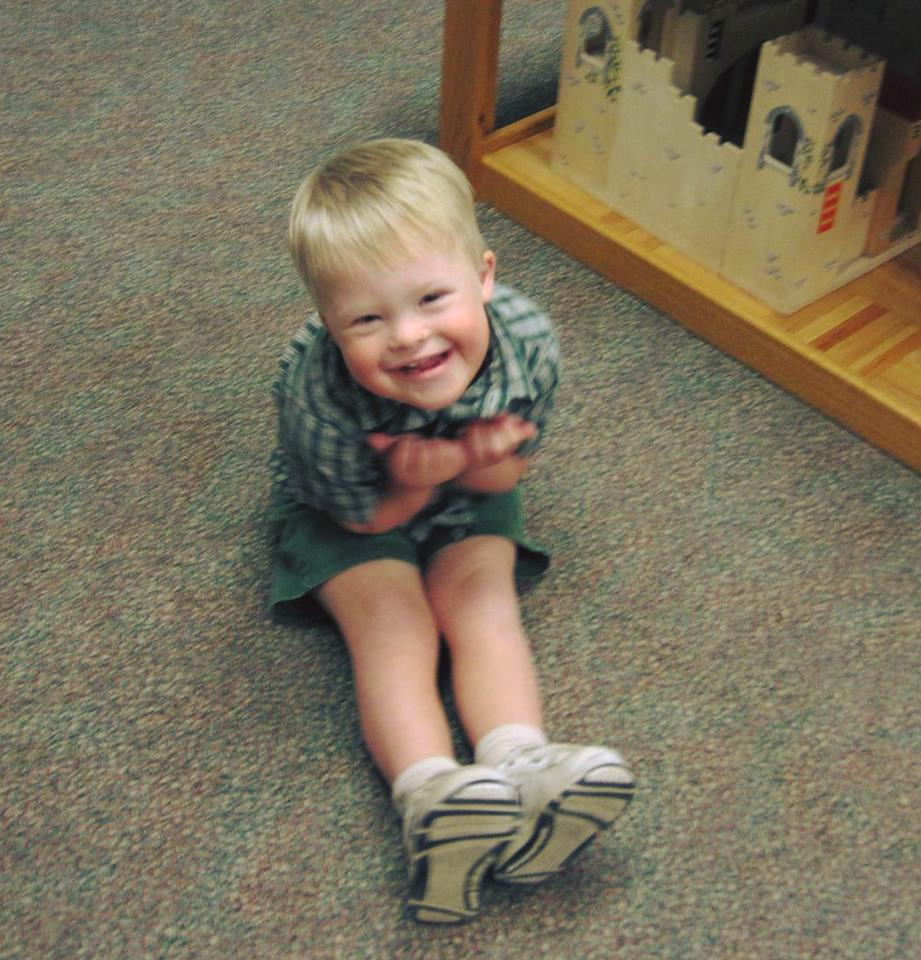




 'WIL'ingness = Willing to Embrace Extra in Life