Growing Pains

Wil went to the doctor for his well visit Friday afternoon. He’s now 5’4” and 136 pounds. Wil was a champion through all of the doctor’s tests and questions. In previous appointments, he would act silly if he didn’t understand a test, or glance at me when the doctor asked him a question. On this day he kept eye contact with the doctor, followed her cues with each test, and answered every one of her questions. 

Katherine recently secured a job as a server. She asked Wil to quiz her on the menu. It was a natural choice for her as one of Wil’s favorite subjects is food (he reads take-out menus for fun). Wil held the menu up, ordered a meal, and Katherine told him what sides or dressings it came with. Wil had so much fun with this task that he pointed out all of the items to me too!

Wil is no longer a “little guy.” Each forward step of independence is incredibly gratifying to see. But like any teenager, he also asserts his independence when he doesn’t want to do something. Wil has summer speech therapy twice a week, and occupational therapy (OT) once a week. He enjoys going so I was surprised when he resisted one morning. I tried but was unable to deduct the reasoning behind it. Thankfully Elizabeth was home and I needed to take Katherine to work first. So I told Wil I was leaving for speech and OT without him and was very sorry he made a decision to miss it. Katherine and I left. We hadn’t made it more than one minute down the road when my cell phone rang. 

“Hi Mom,” Elizabeth said, “Wil has something he wants to say to you.” Wil got on the phone and said, “Hi Mom. I want to go to speech and OT.”

Now knowing the consequences, Wil is unlikely to refuse again. But to reach that point, it can take such measures that require more than just me. I could write an entire book on how innately understanding Katherine and Elizabeth are when it comes to motivating and supporting Wil. 

There have been times when Katherine, Elizabeth and I have had to physically move Wil when he won’t leave a situation. It’s happened at the airport, when for a reason only known to him, he refused to board a connecting flight. It’s as emotionally trying as it is physically — for all of us. 

On one recent occasion, Wil didn’t want to leave my parents’ house. After much reasoning on all of our parts — even bribing with a Coke — he sat unmoving on the floor. I knew once he left my parents’ house he would unwind from whatever was keeping him stuck (once Wil is out of the physical location he’s stuck in, it’s like an emotional release too). 

When it was clear he wasn’t going to move, I came behind him, reached under his armpits and clasped my hands in front of his chest. Katherine and Elizabeth lifted him by the legs. He cried and fought us. It was awful. When we got too tired and set him down on the ground to catch our breath, I bent down to talk to him quietly and Katherine hugged him. When we managed to get him in the car, it was like a switch went off in his head. He was completely fine. However, the switch doesn’t flip that easily for Katherine, Elizabeth and myself. I sat in the car trying to hide the tears streaming down my face so as not to upset him again.  

On our drive home, Wil belted out the words to a Luke Bryan song, and Katherine and Elizabeth rolled their eyes as they usually do. I took in a deep breath and took in the equilibrium of the moment. 

Wil’s timeline is different from our timeline. Finding an equilibrium in that is one of my greatest challenges as his parent. I suppose that is why there is such a thing as growing pains. There is no growth without them; and yet the growth is always worth it. 

Stuck On You

I didn’t know exactly where or when Wil would get stuck at the party, but I knew it was a possibility. The graduate was one of his Connect mentors that he admires greatly. As Wil is used to her individualized attention at school, I knew he would expect that level of attention at her party, too. I explained — every day for a week leading up to her party — that there would be lots of guests. That she would be very happy to see him, and that she would also have many other guests to greet. 

As Wil gets older, experiences like these are valuable life lessons for him to learn from; as his reactions are valuable life lessons for me too (and reinforce the value of our close-knit community). 

When we arrived, Wil received a very warm welcome from Victoria. He understood she couldn’t spend the entire party with him, so he did well joining me to get a plate of food and sat down with friends to eat. Then, upon his own initiative, Wil walked over to join an ongoing game of cornhole.  

Wil has matured a lot this year, and I watched him play impressed with his newfound independence and self-initiative. I didn’t relax too much, however, as I knew the situation could change at any moment. 

Whenever we enter a situation Wil has built up great anticipation for, he can get stuck. His anticipation and excitement build to a point of overwhelm. His way of coping is to sit down on the spot or flee the scene. When he becomes overwhelmed, all he really needs is time to unravel his emotions. The challenge is that we don’t always have the time (we’ve almost missed plane flights), and I can’t always see from the outside what is going on inside his mind. 

And just like that, Wil took off toward the front yard. As I had one eye on him from the table, I was hot on his trail. He found a quiet spot near the front porch.

Knowing he needed time, we sat down for a moment together. Then I tried singing a Luke Bryan song with him. He told me to stop (I’m not a good singer). I asked him to do a silly dance with me, but he didn’t move. Even a bribe of a Sprite was met with a head shake. 

I racked my brain for more motivators. Anyone at the party would have been happy to help if they knew we were in the front yard (and I’d left my car keys and phone on the table).

Then I heard voices near us. Two men were now in the front driveway. I recognized one of the voices.

“Hey Jason!” I called out.

“Hey Christie! Hey Wil!” 

I asked Jason if his wife, Melanie, was there. Melanie Woods used to babysit Wil when he was a preschooler. The two formed a strong bond and to this day Wil calls her “my Melanie” and he is her Wil. 

“Yes, Melanie is here,” Jason said. “Right around the back.”

“Wil, your Melanie is here! Let’s go see her.” To my relief, Wil took my hand and walked back to the party. When we found Melanie she immediately gave Wil a hug.  I asked Melanie if she could walk Wil to the car while I thanked Victoria, and grabbed my car keys and phone. 

Wil has many stuck moments on a day-to-day basis, which is normalcy for us, but not familiar to most. As I watched Wil and Melanie walk off easily together, and said good-bye to friends, I was flooded with gratitude for the support that surrounds us. 

When I met Wil at the car he said, “Sprite now, Mom!” 

Melanie & Wil

You Are Here

Like many mothers, I loved my son before he was born. My daughters and husband placed their hands on my belly and felt his kicks and punches. We pondered names and dreamed our dreams. The field of possibilities was laid open before us.

The golden gates to that field slammed shut seconds after Wil was born. My brain valiantly fought to pry them open, objecting to each indicator the medical staff shared with me that my son may have Down syndrome.  Look at the way his arms and legs splay out, they said, see his short stubby fingers and his low-set ears, note the thickness of his neck. Interestingly enough, they never mentioned the shape of his eyes. 

As Wil melted into my chest the day he was born, I reveled in my love for him. I was careful to keep thoughts of his expected diagnosis locked tight in a separate compartment, though it hovered perilously above me. I looked down into his eyes; their shape struck me. I was both awed by their beauty and intensely terrified. My brain, still playing defense attorney, objected strenuously. But when the heart knows, the defense must concede to rest. The compartment above me busted open and everything spilled out all over us on the hospital bed. 

Just days after Wil came home from the hospital, I stared at him in his crib. Though my brain had rested its case — we even had genetic proof by this time — it begged to object. I simply could not believe I had a child with Down syndrome. But it was true. My heart held deep love for him, yet my brain kept its distance. I had never felt so contradicted in my life. As I stood there, my stomach suddenly dropped as if I was going down a roller coaster. The ground vanished below me and I stood suspended, as if in an elevator well. I visually saw darkness under me and the four walls of Wil’s room suffocated me. I knew this experience was a figment of my imagination but my body felt every sensation as if it were real. 

When I was able to regain my balance and logically analyze what happened, I knew what it meant. I felt completely out of control. Though I had many loving people around me and a packet full of helpful information, I realized more than ever that the work of acceptance is intensely personal. I had to take the first grounding step into acceptance myself. 

Acceptance has no clear start point. I never found a big, red “you are here” circle followed by dashed lines leading the way to acceptance. Rather, acceptance is like an open field surrounded by clouded mountains. You just jump in wherever you are, firmly plant both feet in the field, and figure it out from there. 

I overstepped into territory I wasn’t ready for, like reading books about teens with Down syndrome before Wil was even a year old. Those books offer a different meaning to me now for the landscape I’ve travelled, but then it was too much knowledge too soon. I learned how to back-step and move in new directions.

Fourteen years later, I’m still back-stepping and running forward, climbing, traversing, discovering; yet I arrived to acceptance the day I jumped in and firmly planted both feet on the ground. 

I know the feeling of the gates being closed on me. And that is why at the top of every mountain we ascend, like Julie Andrews in “The Sound of Music,” I open my arms wide above the clouds, spin with the wind and soak in the spectacular view of this beautiful, vast landscape I gratefully call home.  

Once Upon a Hat

On Friday morning, Wil sat on his bedroom floor rifling through his bin of hats. He couldn’t decide which one.

“Well, no hat then!” Wil announced to himself. 

“Do you need some help, Wil?” I asked.

“No.” I sat down next to him and laid his hats on the floor. He turned them all down.  We had to leave for school in 10 minutes. 

Wil had a Manchester shirt on so my best guess was he wanted a Manchester hat too. I presented his Manchester hats to him but he turned them all down. I convinced him to get off the floor, even without a hat, which was a good sign. 

A few months ago when Wil couldn’t decide on a hat, he stayed on the floor. I told him I was taking his sisters to school so they wouldn’t be late and I’d be back to get him. When I returned, he was seated on the porch step with a hat and backpack on. I was proud of him for turning his day around. 

On this Friday morning, however, when Wil stood up he fled the house without a hat or backpack. Katherine dashed after him. I grabbed Wil’s Manchester hats, his backpack, and flew out the door behind them.

I found Katherine standing in the dog kennel which is attached to the side of our garage. Wil was attempting to climb through the dog door which would have been hilarious to all of us, if we hadn’t been in a time crunch. 

“Silly Wil,” I said. “Woody is going to be jealous of you using his door. Come on, you don’t want to be late to see Ms. Campbell, do you?”

“Kristi Campbell!” Wil jumped out of the dog door and exited the kennel as he said his paraprofessional’s name. Then he stood unmoving in the driveway ­— two steps forward and one un-moving step is still a step forward in our book.

I walked behind him, put my hands on his waist and said, “Chugga-chugga choo-choo!” As I pushed him forward, he leaned back in resistance, yet kept putting one foot in front of the other. When we reached the car, Katherine opened his door but he stood firm by it. 

“All aboard,” I said. I bent his head down and kind of hoisted him into the car. He laid on his stomach with his legs hanging out. At this point his resistance was becoming a game. I was in part thankful for that, as I knew he was pulling out of his funk. But I was also running out of patience as he was in jeopardy of making his sisters late for school, which wasn’t fair to them. 

Elizabeth was in the back seat with Wil and talked him into sitting up straight and putting his backpack and seatbelt on. 

“Hey, Wil,” Elizabeth said looking at the Manchester hats I threw in the car, “that Manchester visor is mine.”

“No, my visor,” Wil said. They bantered back and forth. I knew what Elizabeth was doing. Sure enough, Wil chose the Manchester visor.

I reached my arm over the seat and splayed my hand. “Give me a turkey, Wil. You turned it around! Now you are going to have a great day.” He fist bumped my open palm. “And how about those sisters of yours? They are awesome.”

“They are bratties.” Wil said and laughed.

“No, you’re bratty,” Elizabeth said and playfully nudged Wil. (Typical sibling banter is as refreshing as it gets when life isn’t feeling so typical.)

By some miracle, we all made it to the school with 90 seconds to spare and in good spirits.

Sometimes it’s the simplest things that throw us off track, the simplest things that place us back on track, and the simplest things that we appreciate most. 

Perpetual Student

“On page 65 and 66, you said you used creativity and silliness to encourage Wil to do things. How did you think of using silliness?”

“From Wil,” I answered. “He’s the master of silly. He uses it all the time. It’s an incredible motivational tool…for me too!” 

I was the guest author of a book club meeting. The book being discussed was, “Stories of Wil: Puberty Part 1.” Upon answering the question, I realized something I had known but never consciously registered — almost everything I do to motivate Wil was originated by him. 

As I grew into adulthood, much of my silliness faded. It was revived by raising Wil. He adds silliness to nearly everything he does. And so I learned to do the same. Just last week, Wil refused to brush his teeth. I knew if I pressed the issue he would dig his heels in deeper. The night before, Elizabeth showed our family a salsa dance she learned in Spanish class. So I grabbed Wil’s hands and said, “Let’s salsa!” We salsa danced from the living room to the bathroom while I sang, “Let’s go brush, brush your teeth,” to the tune of “La Cucaracha.” The song and dance flipped a challenging morning into a joyful one.

“On page 92,” a reader from the book club stated to me, “you said that ‘I may be missing a lot of clues that someone from the outside looking in could see plainly.’ I find that astounding, that when you were struggling like you were with Wil’s behaviors, that you could step back like that and have perspective.” 

This process of stepping back, too, I learned from raising Wil. Wil’s behaviors, at times, can be challenging and difficult to identify the underlying triggers. When Wil was born, I felt the most stuck I ever have in my life. I knew I needed to take a step forward, but I didn’t even know which way forward was. So I reached out to people who were already living this life, and though the road stretched out long before me, I was guided by those who had a much wider perspective than I did at the time.

On the occasion the reader referred to, Wil was knee-deep in puberty. I was navigating new behaviors I had never seen from him before. Neither his teachers nor I knew what to do. I was receiving almost daily calls from the school. After one such phone call, I pulled into the parking lot at work and broke into tears. I knew Wil was hurting, I was hurting and his teachers were hurting. I was in that stuck place again and didn’t know a way out. I had to go into work so I took a series of deep breaths to calm myself down. I reminded myself there was a solution, I just didn’t see it yet. With each deep breath, I repeated to myself, “there is a solution, there is a solution.” A name popped in my head. Julie Feldkamp. She has been Wil’s teacher consultant since preschool. I called her quickly and she soothed my nerves immediately. She said I was not alone, she had worked with many students with varying behaviors, and we would get through this. We still had a long road ahead of us, but her words pulled me out of the abyss and placed us on the road of progress. 

At the end of the book club, the readers shared how much they learned through Wil’s stories. “As I have, too,” I said.

I may be the author, but Wil is the teacher. 

Simply Powerful

Kristi, Wil’s paraprofessional, sent me this photo of Wil cooking at school with his Connect mentor, Victoria. It was Cinco de Mayo and they were making tacos. Kristi told me he ended up eating 3! 

It’s awe-striking to me, still, even though Wil is a teenager, how powerful the simplest joys with him are. I mean, they were making tacos on Cinco de Mayo. How simple is that? But look at their faces. I think of the support he is encompassed with. Simple never is with Wil. 

When Wil was born, I knew so little about Down syndrome. I didn’t know how powerful the simplest actions could be. 

Though there was a high learning curve in early therapies and doctor’s appointments with Wil, my deepest learning came from knowing him. Knowing Wil’s smile. Knowing Wil’s hugs. Knowing Wil’s first words. Knowing a community that embraced him. 

When I reached out to Victoria, she shared, “it’s kids like him who have really made me want to go into the profession. He is so caring.”  

Victoria is way ahead of where I was. Her knowing will change lives. Not only for her chosen profession in the future, but also right now. The way she interacts with Wil, simply by being who she is, sets an example that shatters stereotypes and alleviates fears. It is not scary to know Wil. It is not hard to know Wil. In fact, it’s really darn cool to know Wil. 

Whenever I hear words like Victoria’s, I’m always drawn to thoughts of my mom’s close friend, Martha. Martha has three sons. Her oldest, Paul, is my age and has Down syndrome. Paul did not have friends like Victoria. In fact, for Paul, general classroom opportunities were scarce to non-existent. Early therapy was not available or encouraged. And a Connect mentor program would have been a far off dream. Martha navigated this life with a tiny fraction of the awareness and advocacy Wil is surrounded with. 

Wil and Victoria’s experiences are not just for Wil and Victoria. They are for the families who navigated this life before us, and for the families Wil and Victoria will open doors for. The power of advocacy is not always found in picket lines. Advocacy is also spread by our daily actions in simple, yet powerful, ways. Simple never is with Wil.

True Nature

When Wil said, “Walk to the river, Mom,” I left my phone on the countertop, took off my watch and grabbed our mud boots. With the constant tug of a virtually agenda-driven world, I was more than ready to leave behind the volitional tools that bound me to it. Woody, our yellow lab, perked up his ears at the word “walk” and was quickly on our heels as we hurdled out the door.

It was late April and the temps had recently warmed so the bugs were sparse. We reached the tree-cover and squished through mud over imprinted deer tracks. Deep puddles and fresh, bright green undergrowth lined the path. We could now hear the river and it sounded cold. Woody ran ahead and plunged in as if it were a hot summer day. He plodded around the shoreline looking for water bugs that weren’t yet existent, then swam out to the center of the river. He paddled against the current like he was on a treadmill; running hard but getting nowhere. He eventually grew tired of the grind and veered off to the other side of the river and played along that bank. 

Wil slid down a muddy embankment and stretched his legs into the river. His muck boots filled with water. “It’s cold, Mom!” He got his footing and waded out until the water reached the bottom edge of his shorts. Then he reached down into the river and pulled out a smooth, black rock. He held the rock up to admire its sheen, then threw it in the air. “Catch Woody!” 

Woody swam back across the river, even as the rock sank to the bottom; his loyalty to Wil’s call. Wil reached down for another rock, again admired its smooth surface, and tossed it. “Go get it, Woody!” Wil found a few more smooth rocks, taking a moment to admire each one, tossed them, and Woody swam toward each splash. Wil moved on to tossing sticks, which were retrievable for Woody, but watching the two play this game, I saw that winning was not about retrieval. The win for both was in the play.  

A red-headed woodpecker flew across the river, landed on the side of a tall tree, turned his head toward us and called out. He then silently stared at us for a moment, decided we were not a threat, hopped up the tree and went on with his business. 

I sat down on a low, flat rock and breathed in the earthy smell. Green buds popped out on branches all around me. The scene was picture-perfect; and yet I was thankful I had no means of taking a picture as it would steal the nature of the moment.  

Thank you Wil, for leading me on this winding, earthy, budding, flowing, green and boundless path, where there is always something found to admire and the win is in the play. Your true nature always circles me home to mine.

For What They Do

“Wil, I miss you,” popped up in the chat box from Sarah Stommen. Virtual school started back up again a week from last Friday. Wil kicked off his virtual schedule full of steam, but by Thursday the task of getting him in front of the computer was a feat. Sarah saw the look on Wil’s face at the beginning of their virtual social studies class and knew he needed some encouragement.

When I pointed out Sarah’s message to Wil, he quickly turned his attention to the chat box, read the message for himself and a wide smile crossed his face. He then remembered he didn’t want to be there and turned his head to the side.

“Hey Wil,” Ms. Kastel, their social studies teacher said, “where is your dog?” Sarah was holding her dog, Maizie. Wil usually loves to share his pets along with his classmates, but he shook his head. I ran to pick up Oreo, as he was sleeping in the sun near us. I placed Oreo in Wil’s lap but he refused to share our cat with his classmates, too.  Ms. Kastel then asked Wil a few questions about subjects he enjoys discussing, like country music (she’s fostered a love for Johnny Cash in him). Ms. Kastel has a knack for pulling Wil out of his stuck feelings, but on this day, he was determined to stay stuck.

That same afternoon, Wil’s friend, Lila Harvey, sent Wil a “snap” through Elizabeth’s Snapchat (Elizabeth shares her Snapchat with Wil). Lila knew he’d been having a tough time with virtual school and wanted to cheer him up.  

When Wil was a baby, and his diagnosis fresh, I reached out to support groups and read books. I was in a battle against the “wouldn’t be’s.” How could I prevent Wil from falling behind? What did I need to do? I signed him up for all the therapies. Though these therapies were places of growth and strength for Wil, they became those places for me too. When Wil was only months old, his occupational  therapist laid him on a blanket and dangled a toy above him. The goal was for Wil to develop the strength the reach across the centerline of his body. I never knew such details existed. I never knew such heights of joy as I watched every inch of progress Wil made on his way to reaching that toy. Every new reach, every new grasp, every new step, every new word, every new milestone was celebrated. I found myself celebrating not because I believed Wil wouldn’t; I celebrated because he did.  

It’s easy to say these 14 years later that Wil deserves loving friends and teachers. And he does. Yet I remember well the “wouldn’t be’s.” I remember well the process of growth, strength and joy that shifted my focus in a new direction. So when I celebrate friends like Sarah and Lila and teachers like Ms. Kastel for who they are and what they do, it’s not because I believe that they wouldn’t. I celebrate them because they do. 

With Chocolate chips on top

“Well, you have enough challenges raising Wil.”

I write about the challenges raising Wil, so it’s expected to frequently hear that, and I’m thankful. I used to hear, “well, he’ll always be happy.” To wrap Wil into one emotion both undermines who he is as a person, and the value of what it means to be his mother. 

There are few constants raising Wil; I live in a guessing game of interpreting his thoughts and ambitions. He very well knows, but he doesn’t always have the words to communicate his thought processes. So I am left hypothesizing, considering, deducing, reaching in and reaching out. One common saying in our Down Syndrome Support Team is: “What worked today may not work tomorrow!” To place Wil in a happy corner is laughably simplistic. He is fully, frustratingly, beautifully, imaginatively, ubiquitously challenging. Aren’t we all in our own multi-dimensional ways? 

I am in daily awe, however, of one constant in Wil’s life. That is how open and loving he lives it. His friends find a level of peace with him. He will never judge them, and that provides an internally settling feeling few other emotions can match. Wil will never grow jaded. Wil remembers slights and hurts, but he doesn’t hold on to them. He travels light. I’m ever the student when it comes to Wil.

Last Thursday night, I sat on the edge of Wil’s bed as I tucked him in and we had a conversation. His school was going virtual again and he’d just had his last day of in-person school for what we hope only lasts 2 weeks. He was feeling sad about not seeing his friends and teachers so we talked it out. Then suddenly he changed the subject. “Mom, pancakes.”

“You want pancakes for breakfast?” 

“No, made pancakes.”

“Oh, you made pancakes in school today?”

“Yes, with Kennedy.” Rachel Kennedy is Wil’s resource room teacher. Sometimes he refers to his teachers by their last names: Campbell, Kastel, Kennedy. 

Then he smiled and held up two fingers. “I made two. With chocolate chips.” 

My heart leapt with joy. That smile of his was for more than just pancakes. It was a smile of connection. A connection made through his own self-initiated words that invited me into his world.  

In Wil’s early school years, there were few words. He would get frustrated, the tears streamed, and he couldn’t tell me why. I could only ask questions, hoping I’d strike something with some accuracy that he would nod to. At times he would nod for the sake of nodding. He desperately wanted to say yes to something. To connect. So I would hug him and hide my tears, aching for the day he could express his own thoughts. You don’t know the value of a word until you know what it’s like to wait to hear just one, please just one word, that tells me what you are thinking.

I used to believe I knew what optimism meant, but I confused it with positivity. Positivity is rather one-dimensional, as is slapping someone, or something, with a happy label without care to delve deeper. Optimism lengthens with patience. Optimism holds on tight with faith. Optimism searches, reaches, climbs, knowing there is an answer, it’s simply not ready to appear yet. Optimism feels sadness but never stops believing. Optimism rejoices as optimism knows it grows through the challenges.

Yes, I have enough challenges raising Wil; as is the reason I brim with optimism. He’s grown my heart to believe with every part of my being…with chocolate chips on top.

Girl Time

Wil sat down on the bench. I sat next to him and watched a droplet of sweat slip down the side of his forehead. It was 88 degrees and he’d already been walking for 90 minutes. Katherine was to our left crouched in front of a hyena. She snapped a few close-up photos. The hyena was belly up, legs splayed, mouth open in what I swear was a smile, pink tongue hanging to the side, with the cool earth on his back and the hint of a breeze ruffling his coat; just like our pet Labrador on a hot summer day. Elizabeth and my dad were to our right watching an anteater splash himself in a pond. 

I knew there would be a point when Wil abruptly declared himself done with the zoo. I was impressed, though, that he’d made it this far. Earlier that morning, Wil jumped out of bed, stripped off his pajamas, took his still damp swimsuit off the dry rack, and pulled it on as fast as you can pull on a damp swimsuit. He jumped in my parent’s pool and played for 2 hours forgetting all about breakfast, until I reminded him it was time to eat and head to the zoo.

Wil and I sat together on the bench talking; I knew the only place he’d go from there was the exit door. After about 10 minutes, Katherine, Elizabeth and my dad joined us at the bench. Katherine and Elizabeth wanted to stay for the safari show which was in 2 hours. We came up with a plan: my dad would take Wil out to eat while Katherine, Elizabeth and I completed a tour of the zoo and watched the safari show. After that, we’d meet my dad and Wil in the parking lot and head back to my parent’s condo.

It’s a balance raising typically-developing children and a child with Down syndrome, but not an equal one. If my dad wasn’t at the zoo that day, then Katherine, Elizabeth and I would have left after we coaxed Wil up from the bench. Or, I would have sat with Wil while Katherine and Elizabeth continued the zoo tour on their own, because when Wil is ready to go, there is little chance of convincing him otherwise. Katherine and Elizabeth are deeply patient, compassionate and understanding individuals for that fact. They haven’t been outwardly taught to be that way; it’s part of their daily lives and ingrained in who they are. 

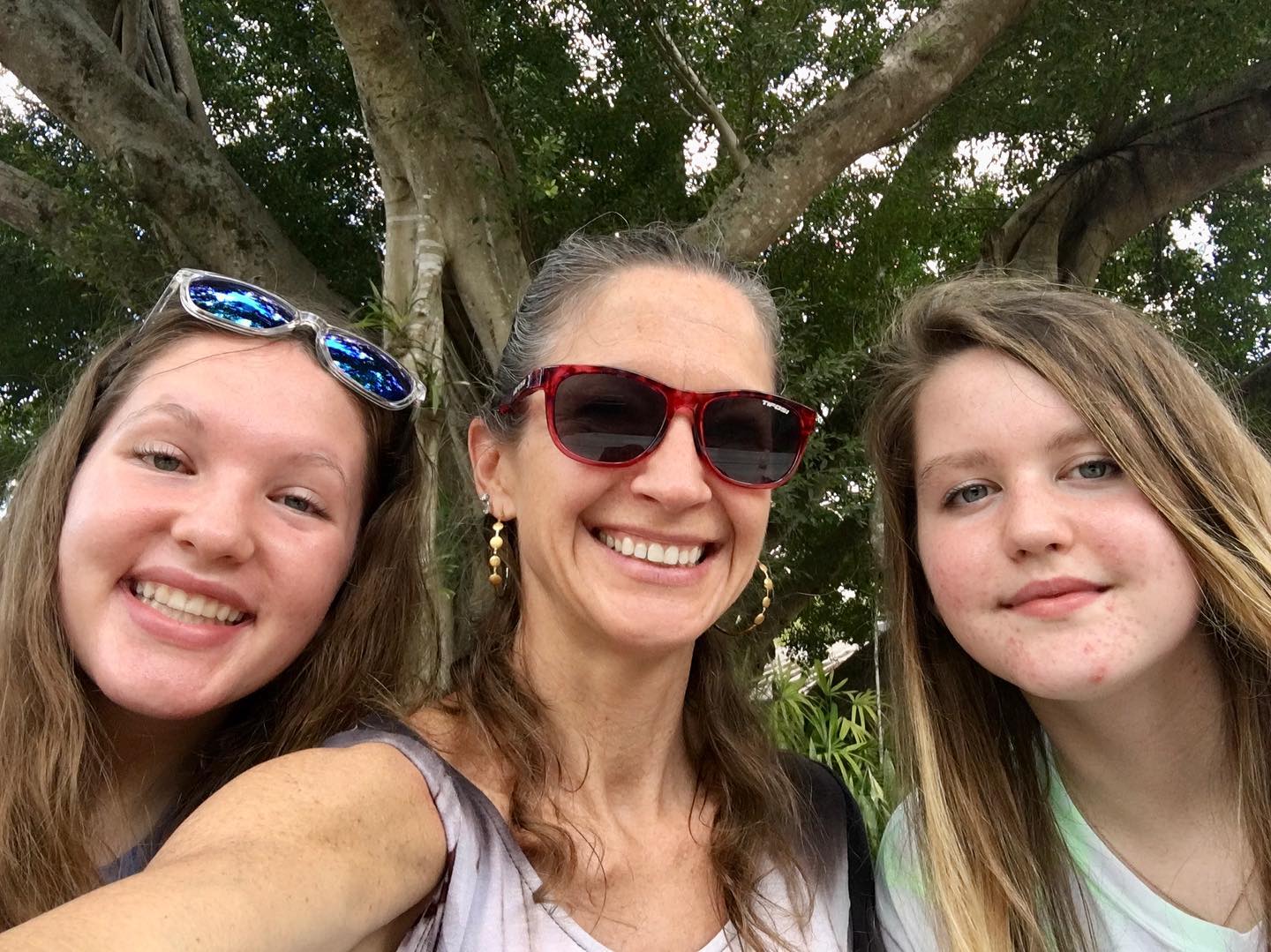
After my dad and Wil headed off to the car, Katherine, Elizabeth and I visited more animals, took pictures, browsed the gift shop, and watched the safari show — all on our own time, at our own pace, in our own way, just us girls. As we sat at a picnic table and sipped $4.00 lemonade under the shade of the Naples Zoo banyan tree, I took notice of the way the roots, stump and branches articulately wove together over time to create this magnificent tree. 

I sent a silent nod of reverence to the banyan tree, as we share the knowledge that balance is not always created in symmetry; that intertwining segments woven together over time form a foundation well-grounded. I looked my girls, and thought of sharing this, but they are teenagers and would have rolled their eyes. Instead I told them how proud I was of them, how thankful I was for this time together, and that one day they would also know their deep magnificence.