With a little help from my friends

Wil had a very hard morning. He would not get out of bed. Would not budge. Usually I tickle his feet. He laughs, sits up and says, “Hug Mom!”

He loves high school so even if he’s tired he is typically happy to get up and go. This morning was a throw back from the middle school years when hormones were running high and he had feelings he could not process or communicate at the time which lead to many new behaviors. But we emerged from that time; even if he has a slow start now, he can talk to me and work through it on school mornings.

I racked my brain as to the causes of his demeanor. My guess is a cold is brewing within him as I’m sick, plus he had Social Group Wed night and Music Therapy last night; he’s probably just plain tired.

As he laid in bed, he grew increasingly upset with himself for not moving, which ironically kept him in the “feeling stuck” loop. A wise special education teacher, Mrs. Hancock, shared with me that on these situations it’s about responding not compliance. I thought Matt, being a fresh person in the scenario, would help break him of this stuck loop.

I called my husband Matt at work on speaker phone. Wil shared with Matt that he was “upset.” I felt my heart jump up and cut through my stress with elation. For Wil to share his emotions in his current emotional state was a very important advance. After talking to Matt, Wil was able to unwind whatever was wound inside him and turn it around.

Wil started to get dressed but was still teary. I asked if he needed a hug. He gave me a tight one then I felt him loosen up. I knew then that he would be okay. I texted his teacher to let him know the situation and Wil may needed a calmer start to his day. I’m thankful he begins each school day in the life skills room rather than gen ed so he can go his pace to start and then gain momentum for choir, PE and art.

Our friend, Kate, had previously offered to drive Wil to school that morning, so again a fresh person always helps Wil’s demeanor and he adores Kate. When she walked in the door, she said she had his favorite songs ready to go in the car. Music to his ears (and mine)!

I was very rushed at that point — I hadn’t even brushed my teeth yet as I’d been trying to motivate and give Wil the time and space he needed for the last 30 minutes. I quickly made him his breakfast request to go — 2 turkey dogs with peppers, mustard and relish.

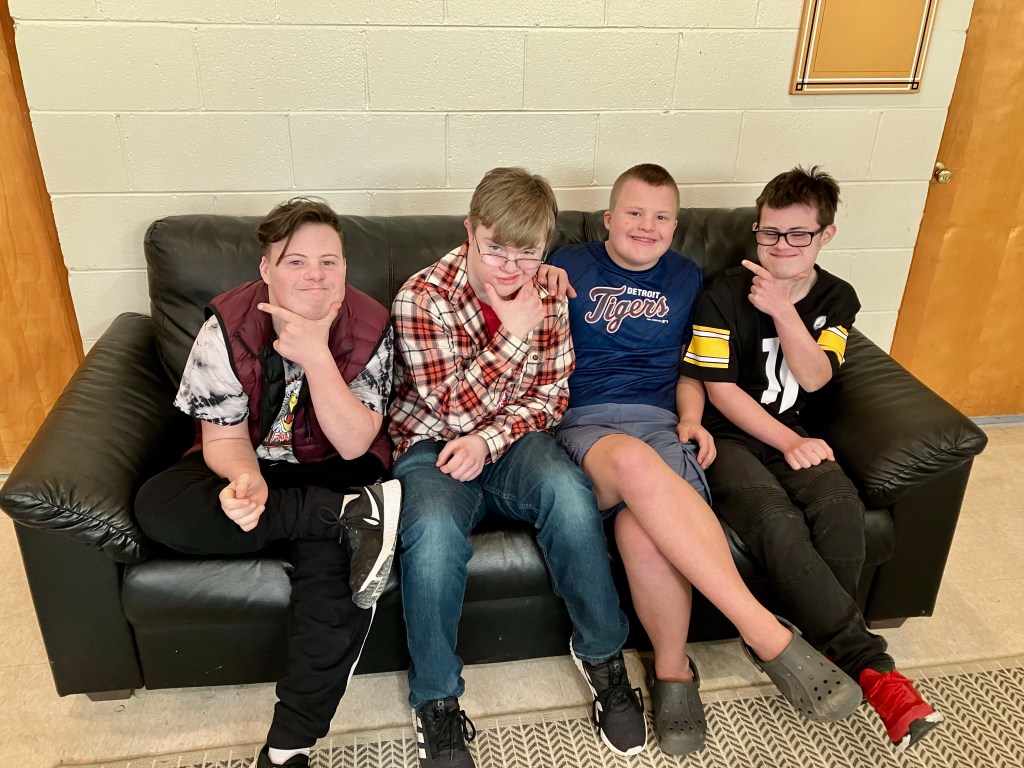
After he’d been in school for about 2 hours, I received a text from Jessica, whom I work with as a paraprofessional, forwarded a picture taken by Ashley who is working in his classroom. Seeing Wil smile big with his classmate buddies made me 🥹🥹🥹.

This morning was very hard, but as Mr. Rogers wisely said, “Look for the helpers. You will always find people who are helping.” ❤️

Inclusion

I am enmeshed in the world of people helping people; of making inclusion work. Personally and professionally. I am on a high learning curve, always, with both Wil and the children I work with. Down syndrome looks much different than other disabilities, and of course, no matter the disability, each individual is their very own person. There is always more to learn, to know, to understand, and new research and new ways of navigating situations. This world I’ve enmeshed myself in is both a challenging and beautiful place to be.

I recently heard an anti-inclusion comment. It hit me emotionally, like a pierce through the heart. It wasn’t about my son, but I felt it deeply personally. I was so saddened and I couldn’t shake it. I kept rolling it over in my mind. Though I know there are still people out there with these beliefs, it’s so outside the realm of where I am. The feelings were hard, but I didn’t want them to harden me. And thankfully, I had the perfect experience that very evening to put my perspective back in place.

Wil had his first music therapy. He was very excited and packed his acoustic guitar. As we walked into the building where Wil was to have music therapy, a mother and her daughter — her daughter had a disability — were walking out. We quickly assessed one another and shared smiles. An instant feel-good chemistry fills the atmosphere in such meetings of strangers. No matter how unique our paths are, we share a strong bond in the pursuit of unity. We know the path can be arduous, but we have chosen to walk it fully, and in that, we are conjoined warriors in the cause for the good of our children. We don’t slam doors, we open them. That’s what we do in any and every way we know how.

The music therapist welcomed us. As it was evening, her eyeliner was slightly smeared from a long day (as I’m sure mine was) and she had a pleasant, welcoming demeanor. Wil entered her room while I sat outside of it in a cushy black vinyl chair, happy for the rest. Wil and his music therapist instantly started a jam session. On the other side of the door, I heard her beautiful voice rise; I felt my whole body relax and rise in energy at the same time. She gave Wil gentle instructions on notes with his guitar. He sang his favorites, and then she sang hers.

When Wil and his music therapist emerged 45 minutes later, she had a glowing smile on her face. He is such a joy, she said, and by the way she said it, I knew she meant it. Both were high on joyous shared music and energy. And by proximity, so was I.

While I’m not thankful for the door slammer, I’m thankful for the eye-opener that the door slammer brought. To feel the sadness but not allow myself to be hardened by them; rather to rise higher with the good that surrounds us. I was reminded, right on time, of my deep gratitude for the high energy and joy of the door openers. No matter how high our learning curves, how many times things may change, or how exhausted we all may be at the end of the day, we always know, deep in our souls, that what we are doing matters. And it matters big. We are opening doors and creating shared atmospheres of inclusion no matter how unique each of our lives may look.

Take Another Think

We may believe our thinking is correct; or it is good—that we are good people.

Even those of us that call ourselves open-minded may find we have unwittingly closed off our minds when spending time with individuals with disabilities.

Why is this?

Because we have to see it their way first to understand. And many times — in some cases most of the time— their way is not easily readable. So we push our agenda on those with disabilities.

Individuals with disabilities’ way of communicating may be very different, or even non-existent in a verbal sense, so actions must be carefully observed. And even then we may remain clueless. It takes too much patience, and so we, even unconsciously, push our way on them, or we ignore them.

Our own belief system must be suspended to decipher theirs. We must let go of trying to be “good” or “helpful” because our version of what is good or helpful may not be for them. This very fact is likely the most challenging, and yet the most empowering process, in our very own lives.

When we suspend our own belief system in order to understand theirs, something shifts within us. Something bigger, something higher — spiritual even.

This process has no end. In fact, in 16 years I’m only just beginning. I’m stronger than I’ve ever been in trying to understand Wil, and understand the world’s reaction to him. I’m learning as a parapro to understand many differing abilities. It’s challenging and I need the expertise of those around me, because again what I think of as being helpful may not be helpful to them.

But it’s also so amazing to understand what in some ways may never be understandable. It wakes up something in me. Not because I’m trying to be a good person; it is because I truly want to understand what these kids are trying to say.

Those with disabilities are true gifts to us all—and yet this population is so very ignored and misunderstood. We must first forget ourselves, in full effort to understand another, and in that we find a stronger constitution of our own selves within.

To “Be” or not to “Be”

At 53 years old I am a student. At 89 years old I will be a student. When I say goodbye to this world, I will be a student.

Yesterday, I was trying to help a student who has autism. I was kind. I gave this student squeezes, I spoke calmly; soothingly. This student’s aggravation grew.

I see a lot of “Be Kind” bumper stickers. “Be Understanding,” in my opinion, is where we need to “Be,” but that’s too substantial for a bumper sticker.

I looked to the teacher for advice with this student. The teacher explained that this student was working through inner thoughts; likely about an event that happened earlier at home that we knew nothing about. This student needed space to verbally work through those emotions.

This explanation clicked immediately in my mind. It made sense in the way some times physical touch and calming words are needed; while others space is required. But without that explanation, I don’t believe I would have seen this difference on my own. But now that I did, it was set in place in my mind and I will now be better equipped to help this student when another such happening occurs.

Every day, in this way, I gain new understanding. I gain new confidence and strength in helping give these students what they need to move forward.

One of my friends, whose son has autism, said she wishes, just for a moment, she had a special key to unlock his brain, walk in, take a look around, say, “uh huh,” then close his brain back up and move on with life.

Full understanding is an unattainable goal, but when we shoot for the moon, we can reach the stars; even if it’s one star at a time.

I’ve been asked more times than I can count stars, “How do you have such patience?”

I’ve used the word “patience” regarding Wil in my stories about helping him through “stuck” patches. But now, after having the few months of experience in this work that I’ve had, my perspective on “patience” has shifted.

Now, when I consider that word, “patience” is exercised when I don’t want to take the time to understand. When time is urgent, and Wil won’t go. When I want Wil to cooperate and he won’t. So I wait him out. But when I truly learn to read his cues; when I anticipate what may happen, when I try to take the “key” so to speak and unlock what is happening in his mind, that’s not patience. That’s being a student; that is cultivating an understanding. And when you unlock even a piece of understanding, the elation is beyond words.

To truly fill up the well inside of you, don’t just “Be kind.” Be desirous to learn. Be desirous to understand. Be desirous to be a perpetual student. Reach for the moon, and even if you grab one star, you’ll “Be” substantiality beyond what any bumper sticker can preach.

The Perspective of Time

Wil has grown so much in his 10th grade year, and I can’t thank Kristi Campbell, Hope Schook and Heidi Drake enough for that! For this fact, it gives me space to snicker when I read about a day like this:

10:05 Refused to work
10:08 Turned it around
10:25 Refused to work
10:30 Turned it around
1:50 Refused to work
1:54 Turned it around

Just last week, I worked with a paraprofessional that subbed for Wil in 1st grade while his primary para was on maternity leave. We laughed that the main topic of daily conversation then was how to get Wil out from under the table most of the day. At the time, though, it was no laughing matter!

But with time, collaboration & communication with caring educators, we’ve come a long way, baby!

We are on to larger concerns, as Wil is an adventurous guy; without fear/recognition of danger which will likely be on our radar for years to come.

So seeing these little bursts of stubborness that he can resolve in minutes, is him showing his personality in full force and finding the self-desire within him to turn it around for a better day — while giving his teachers a run for their money! And we wouldn’t want him any other way!

Inclusion Slam Dunk!

Wil’s paraprofessional, Kristi, told me how Wil — of his own will — went to the closet in gym class, pulled out two baskets and two balls. He proceeded to toss the balls in the baskets. His peers joined in his created game by cheering him on.

Today I picked up Elizabeth, Wil and their friend Kimmy from school today. Elizabeth had an NHS meeting, so Wil, Kimmy and I sat in the car waiting for her with the windows down. As kids poured out of the school, Wil yelled out his hellos, and peers called out and waved to Wil. One friend, Trent, walked up to our car and chatted w Wil. Trent has about every sport there is on his letter jacket. After their chat he fist bumped Wil and walked away.

Wil takes this all in stride, having no idea how this type of interaction is not commonplace. To him, it’s just another day at school with friends.

Kimmy, whose aunt and sister have special needs, said how embracing of Wil the students are at school. I responded that it fills my heart; its what inclusion is meant to be. Wil’s experience is as it should be but isn’t how it always is.

Kimmy agreed, saying she sometimes forgets how people don’t grow up under the same circumstances as she does, and don’t always understand certain reactions and behaviors of individuals with special needs.

I’m so thankful for this Community School experience. It’s enriched my life as much as Wil’s. It’s what inclusion is meant to be — a benefit for all. It’s about friends being friends; of all abilities.

A Little Can Mean a Lot

Yesterday I went to Wolf’s Westside Automotive Service for an oil change. I had been there the previous day to have my tire patched. When I came in for my tire, the front door was propped open, the garage bay doors rolled up, and a refreshing breeze flowed through the lobby.

Yesterday was just that much warmer, so the bay and front doors were closed; a unit air conditioner cooled the lobby.

The owner, Pete, came into the lobby from the garage, sat down across from me, and delivered an update on my car’s service. Our conversation transitioned from the car to fitness and then into a story about his friend who has an adult daughter with Down syndrome. Though I don’t know Pete beyond the walls of his garage, in his storytelling, I heard true understanding. To attain that, without a child of his own with Ds, requires an openness to understand.

His shared story, and openness, were especially timely and meaningful to me as I’ve recently experienced the challenge of closed minds at a new level. I admit I’m somewhat naive in this area; thankfully. My fighting skills are weak; again thankfully. This town has always embraced Wil. I’ve needed to advocate, yes, but advocation is a conversation when you advocate with open minds.

With Wil getting older and other certain circumstances, I have now experienced lack of understanding, and the unwillingness to understand, on a broader level.

It’s hard to explain this life because a little means a lot. How do I explain, that every time I drive in the car with Wil, and he belts out Luke Bryan lyrics with complete accuracy, the elation I feel? That every word he forms beams me back to stretched-out years patiently waiting and diligently working on forming his first words? I have a million such stories.

All I need is a little crack in the door of a mind to get through. And yet, I physically feel the air fall dead between myself and a mind that is closed. I find this disconnection rarely intentional, and not meant to be hurtful. It’s not lack of experience with a disability that is the issue, it’s the unwillingness to open a door to understanding. Even the slightest creak of a hinge is all I ask. But for reasons of their own, deep within, they don’t want to know. The door remains closed. I find ways to keep knocking.

But not yesterday. There I sat, in our small town, for an oil change of all things, and with the natural flow of conversation a story was shared with full understanding. There was no knocking, no prying, no trying. The air conditioning was working, but all I felt was a needed breath of fresh air.

A little can mean a lot.

Wil and his friend, Manny

Just Make Him Do It

One of the most common things I hear (and what many of my friends who have children w disabilities hear) is, “well, just make him do it.”

I literally feel a huge distance grow between us with this seeming logic. And yet, it’s a very difficult distance to close as there is no logical explanation. It’s a “living it” thing.

We parents, special education teachers, para educators, and caregivers are constantly on the alert for “triggers” that cause our kids to dig in their heels.

Some of these triggers are constant, and we have created ways to work with them.

Some of these triggers are only known to our kids and appear spontaneously to us. And when triggered, there is no “make him do it.”

When Wil refused to get on a connecting flight, how I wish I could give the “make him do it-ers” a chance to use their logic on Wil that day. That would have been a helluva education.

Heck, I don’t know even know it all and I’ve been raising Wil for over 15 years, not to mention knowing many other children with Down syndrome quite well. And each and every kid defies this logic.

So next time you want to think it’s logical, and fits some kind of mold, I challenge you to spend a day with Wil, his friends, or in a life skills room, and let me know how that logic goes for you.

A Sucker for You

Communicating with Wil is an incredible experience. Though he has been in speech therapy since he was months old, he has always been one savvy communicator.

A tilt of his head and a smile melts you into a puddle of mush on the spot. When music takes him over, his good vibes serendipitously course through your veins with no conscious thought on your part; you find yourself both curiously and delightfully boosted. When Wil walks out the door and is hit by a breeze, he opens his arms wide and spins round and round. “Fresh!” he says into the air — this one word an invitation to open yourself to the dizzying, fresh new moment with him.

To hear Wil put words to his emotions is one of my true delights. A back-and-forth conversation with Wil was once a dedicated dream, and is now our reality. Though Wil now has a full and colorful vocabulary, he continues to be the master of condensing a myriad of meaning into one word or action.

In October, I shared with you a story about Wil refusing to sleep in his own bed. He was not forthcoming about the reason for his refusal, though he has the words. I peppered him with questions and eventually drew out one key word from him: “cats.” From that one word I had my answer. The source of Wil’s bad dream was from an “Elmo Pets” DVD. There is a “Cats” segment where a puppet tiger pounces onto the scene with a roar. The puppet is soft and cuddly, but the element of surprise combined with the loud noise terrifies and mystifies Wil. Before the bad dream happened, I found him in his room playing the tiger scene over and over. Like cranking the handle of a Jack-in-the-Box, the predictable surprise continues to startle. I removed the DVD, and the DVD player, from his room.

He’ll now sleep in his own bed for short bouts, but invariably I’ll wake up to find Wil camped out in the living room in his sleeping bag. Whenever Wil spends the entire night in his room, I commend his progress: “Great job, Wil! You slept the whole night in your room. How about we go for another night?”

After a considerable moment, Wil replies, “Maybe.” Oh, the ubiquitous power of one word!

Last week at school Wil walked down the hall with his paraprofessional, Kristi Campbell. He held a fistful of Blow-pop suckers he had been given as a gift. It was nearing time to pack up his things. While many days this is not a problem for him at all, on this day the transition built up in his mind and became overwhelming. Though he has the words to express his feelings, when the overwhelm overtakes him, sitting on the floor gets the point across much more efficiently.

Many passersby offered Wil encouraging words to motivate him up off the floor. On certain days, this encouragement breaks up the overwhelm for him. But there are also days when Wil needs a total 180 in thinking to turn his thoughts around. Kristi read what Wil was communicating that day as he remained unmoving on the floor.

“Hey, Wil,” Kristi said matter-of-factly, “can I have one of your suckers?”

“Sure,” he said.

“Ok then, let’s go.” Wil stood up, handed Kristi a Blow-pop, and they walked to his locker to pack up his things.

While Wil speaks volumes with one word or action, cracking his code can be another thing altogether. Yet when one savvy communicator meets another, it can be as easy as asking for candy from a 13-year-old.

(photo: Kristi and Wil)

The Science of Galileo & Prince Wil

Like Galileo in the cathedral observing a lamp’s swing, I, too, marvel at the back and forth motion of Wil’s days. On Monday and Tuesday Wil swooped back. He refused work and escaped the school, with his paraprofessional, Kristi Campbell, hot on his heels (I joke that Wil has turned her into a runner). The oscillation was complete with a full swing forward on Thursday that held through Friday morning. Wil lit up his reward chart with stars. By Friday afternoon, the pendulum reversed its motion to start another cycle.

Each day I evaluate Wil’s oscillation. I look at the forces that contribute to the cause. What motivated a good day? What set off a challenging day? Did he sleep well? Is he congested? Were there any changes in class transitions? Was a friend absent? Maybe a teacher out ill? A bad hair day?

Kristi told me his science teacher was out ill. And that was his first hour. Backswing. Wil likes his science teacher, but not science. So without his teacher, the subject holds little interest. Kristi has worked hard to adapt the work to capture Wil’s interest (Kristi has a hidden halo that reveals itself in photos) so he can better retain the information. But it’s just not his thing. Sorry, Galileo.

I watched some of Wil’s 8th grade science videos with him, and his mind was clearly elsewhere. I’d pause the video and ask him questions to bring back his attention. His repeated response: “We done now, Mom?” Except when we watched the video about Gregor Mendel’s discovery of genetics by crossing pure-bred green peas with pure-bred yellow peas. Wil asked to watch that video over and again. I should note that this video featured animated kissing green and yellow peas. When you are 13 years old, kissing is a very interesting subject.

As I sat and pondered Wil’s pendular days, Wil sat in his resource room hard at work. He loves to read, write and tell stories. And he loves love. We all have our equilibrium balance. Wil found his in an assignment to write about “Once upon a time…”

Wils fairy tale boock

Once upon a time there was a girl named ashley ashley was feeling good she was feeling  happy because she was going on an adventure she lived in a tower  life was weird because she was under a sleeping spell wil  the hero came to save her he did not go through troubles ashley learned wil is a prince  , they shared true love s kiss she is still asleep she woke up ashley was so happy to see prince wil the end.

I think Galileo would have approved.