
Special Needs, Peers & Boundaries

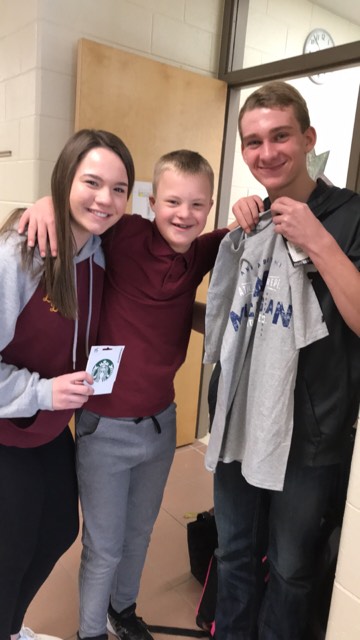
Many schools have a peer-to-peer program in the middle and/or high schools. These peer-to-peer programs are where a typically developing student is linked with a student with special needs. At our school this program is called Connect. Wil, who is in 7th grade, has been linked with two high school students, a male and a female.

Wil adores his Connect friends. They visit him during his Independent Life Skills time in the resource room. They work with him on projects, crafts and cooking. He most especially enjoys cooking with his Connect friends. It’s been an enriching experience for Wil to work with his Connect friends, and I believe for his Connect friends to work with him. On days when Wil is feeling unmotivated, his teachers will remind him he is seeing his Connect friends, and that will–on most days–perk him up.

Being in 7th grade is an interesting time for most students. Their bodies are changing, their hormones are firing, and their independence is sought. Wil is no different. His assertion for independence has him taking a few liberties with his Connect friends. He may pick up one of their spoons and throw it on the floor. Or give them a hug then mess up their hair. He’s pushing the boundaries, and also looking for attention. If he were a typical student throwing a friend’s spoon on the floor, or messing their hair, he’d get a “Hey, what did you do that for?” However, kids with special needs tend to get some extra latitude. Wil may get a laugh, rather than a reprimand. Or his behavior will go ignored as the kids simply do not know what to say. His typical peers want to be kind, and fear upsetting him.

I completely understand this, it can be complicated with the communication differences. Wil is not in elementary school anymore. Kids talk a lot faster, there is lightening back and forth processing, and Wil can feel lost in the sea of back and forth communication. A toss of a spoon, or a mess of the hair takes all of that back-and-forth and draws it to a halt. He gets the reaction he was looking for, everyone is kind and thinks, “Oh that’s just Wil,” and moves on.

If you decide to have a dialogue with Wil about why this is wrong and not respectful to friends, you will see his attention wander and probably before you are done talking, he’ll have tossed your spoon again. If you get upset with Wil, he may cry or shut down. He hears and feels the anger and takes this as an attack on his person rather than a correction of the act. A straightforward and firm, “Please do not do that. That’s my spoon, I was eating with it.” Or “Please do not mess my hair. I don’t like it.” He’ll understand that you don’t like it and why in just a few short words. I can’t promise he won’t do it again, but it will come to a halt the more that is said with each instance. And most importantly, he is being treated and respected like a peer.

This is why Wil’s relationship with his sisters is very beneficial. Basically, they don’t put up with his crap. If he does something like talking with his mouth full, Katherine will say, “Wil, that is gross. Babies do that.”

“I’m not a baby!” He will yell back. And that’s the end of that.

Or if he is badgering his sisters for attention, they will change gears with the power of distraction. “Hey Wil, let’s go walk Woody.” They will remind him to get his boots on, that it’s muddy. On the walk, Wil will find every big stick he can and show it to them. His sisters will ooooh and ahhhh at first, then growing tired of it, they will tell him that’s enough.

In that way, he learns boundaries just as naturally as anyone else does.

In many ways Wil is like any typical peer. When he is misbehaving, that misbehavior should be commented on and corrected. When he’s getting annoying by repeating an action over and over, he should be told, ok, dude, that was cool at first but now that’s enough.

Sounds simple, right? So why doesn’t it happen? Wil acts younger in many ways, so it’s easy to treat him younger. Wil is very sweet, he loves unconditionally, so his friends don’t want to hurt his feelings. All of those reasons are completely understandable. Back when I was that age, I would have done the same thing. That is also what makes these situations excellent learning opportunities. Just this morning Wil gave me a hug and started messing with my hair. I pulled out of his hug, looked at him and said, “Wil, I love your hugs. But please do not mess with my hair, or anyone’s hair. People don’t like that.”

“Ok, Mom.” He stopped messing with my hair and gave me another hug. He will likely mess with my hair again on another occasion, when he is feeling feisty. I will again say the same thing in the same way. Eventually he will stop doing it. It can take multiple reminders before he decides to respect those boundaries. Sometimes it takes just one. But the important point is the boundaries need to be set.

Wil’s Connect friends are learning how to set boundaries with Wil and Wil is learning how to respect their boundaries. What it comes down to is mutual respect amongst peers, no matter what the similarities or differences are among them. This Connect program carries with it the essential life skills of working with varying abilities and personalities with care, firmness, kindness and respect. And this crew is proving what a great time you can have doing just that.
79864123_2542951742595152_8994715820626018304_n.jpg


Life with Down Syndrome: Never a Dull Moment

Last night, Katherine had Crossfit at 5:30pm, and during her hour there, Elizabeth, Wil and I grocery shopped. I wasn’t feeling that well (some winter bug), so wanted to make it a quick visit. We picked up the necessary items for dinner, then got into the grocery line. The line was quite long. As we waited in the grocery line, Wil spied a Sprite in the cooler.

“Look, Mom, Sprite!”

“Yes, Wil, you love Sprite.”

He started to walk toward the cooler. I put my hand on his shoulder to stop him.

“Not tonight, buddy. Remember, Sprite is your reward for riding the bus. If you want a water, I’ll buy you one. Would you like a water?”

“No, Sprite.” <of course>

“Wil, if you’d like a drink, water is your choice. We are saving Sprite as your reward for riding the bus after school.”

“Yes, mom, I ride the bus.” He said this very seriously. We’ve had instances where Wil refuses to ride the bus. It’s typically when he is having a tough day for any number of reasons. It’s a way for him to have control of the situation. But his teachers and I want to develop this independent habit of getting on the bus and riding it home every day. When he does ride the bus, he feels great pride in his independence. Though I’m not a fan of soft drinks, right now I’m going with the “whatever works” policy. And what works is his knowledge of a Sprite waiting for him in the fridge when he gets off the bus.

“Yes, you do ride the bus, Wil, and I’m very proud of you for doing that. Sprite is for after the bus. Tonight, your choice is water.”

He pondered this for a moment. Right now I could tell he was on edge. In these situations it was very possible that he would decide to dig his heels in about the Sprite. Which means he would go for the cooler against my protest. If I held him back he would sit on the floor on the spot and refuse to move. If I tried to move him he would kick or push me away. He’s getting too big to pick up, but if I did that, he’d get extremely upset and cry. It’s a very sad cry. A sobbing, body shaking kind of cry. It’s more than not getting what he wants. It’s about feeling out of control of his situation.

I leaned into Elizabeth and said quietly, “If this starts to blow up, I’ll give you my keys to walk Wil to the car.” She nodded knowingly.

“Wil, how about we take a walk and see what kinds of water they have? Elizabeth, would you mind waiting in line while Wil and I pick out a water?”

“Sure,” she said.

Wi agreed, so we walked across the numbered aisles and their accompanying coolers until we found one with bottles of water. He chose the bottle of water that appealed to him and we walked back and met up with Elizabeth in line. It was all gloriously uneventful.

If Wil refused and it turned into a full blown plop-on-the-floor-on-the-spot-and-not-move situation, our best choice is to wait it out. The last time we went to the grocery store, I gave him a choice of whether he wanted to go or not. It was the weekend, so Matt was home. Wil said he wanted to go. However, when we arrived, he refused to get out of the car. Elizabeth offered to wait with him in the car while Katherine and I went in to shop. I don’t always know the reasoning behind his refusal. Sometimes he’s simply tired. Sometimes there is something about the situation that overwhelms him. Sometimes it’s a matter of exerting his independence. A friend gave me a technique where Wil and I would count back from 10 together and then make a new choice. That worked at one point, but does not work now. Sometimes I can reason with him. Sometimes I can’t. We live a life of “sometimes” and “whatever works” with Wil. Yet, even though it sounds contradictory, consistency is a must when responding to Wil. I can’t say yes to a Sprite one time for Wil, and then not another. That’s extremely confusing for him. So though I live in a “sometimes” and “whatever works” with Wil, I must reply in consistency the best I know how.

It’s important to give him the time to make a choice– whether he makes that choice by sitting on the floor, staying in the car, or walking to the coolers in the grocery store. Wil requires extra time to process what his next step will be, and every single one of us has the need to feel we have choices. Rush him and you are asking to set yourself back even further.

Last night, I found his decision to walk with me to the various coolers looking for water to be a sign of maturity. He was thinking beyond immediate gratification. He reasoned through his choices and valued the meaning of a reward in the future.

Milestones with Wil are rarely smooth to emerge. They take a lot of patience, thought and trial and error. So when they arrive like last night, they are never overlooked or taken for granted.

I was recently told by someone that they enjoy my zest for life. Situations like last night are exactly the reason. I was standing in line at a grocery store when all this happened, for goodness sakes. How mundane can you get? Yet, in this grocery line, a piece of magic happened. A milestone emerged. Life can never be mundane for me, thanks for the eye-opening life with Wil.

I know Elizabeth and Katherine see this too. I have no doubt it’s hard for either of them to have the patience they do with their brother. This level of patience with his “sometimes” behavior applies to everywhere we go. But it’s also their norm. It’s just what they do. Elizabeth has said to me on a number of occasions, “I just don’t understand why people can’t accept people just as they are.” Because that’s what she does, every single day.

81095074_10221552302498304_8401281293144293376_n

Shades of a Smile

There is something about people with Down syndrome that make strangers smile.

There are the warm, friendly smiles. These are those who have an acquaintance with Ds or have a positive image of people with Ds.

Then there are the he’s-so-darn-adorable smiles—just because he is and it makes you smile.

There are smiles of sympathy (those are where they look at Wil with concern, then the smile appears when they look up at me and there’s a sadness in their eyes).

Then, my absolute favorite, is the knowing smile. They look at Wil a little longer, and this far off smile appears on their face. You can feel the connection. Then they look up at me like we know each other—their smile says “I know you even though we haven’t met yet.” Sometimes they will share with me about the person they love with Ds. Sometimes they won’t. Either way I know they love somebody with Down syndrome. It’s a beautiful connection, if only through a smile.

2ACAE53A-AE7C-4E79-BC7A-60ABA22A73C4

Today was a Tail Feather Shaker

Driving home from work this morning I received a call from Katherine.

“Mom, Wil is in the shower and he won’t get out. We have to leave in 15 minutes.”

“Ok, see if you can urge him out. If not, keep getting yourself ready and I’ll be home in 5 minutes. Has he eaten yet?”

“No.”

“Ok, what does he want for breakfast?”

“Sandwiches.”

“Ok, good, thanks. See you soon.” 

This is no new scenerio. Some mornings Wil hops out of bed ready to go, and other mornings take more time. We all have those kinds of mornings for whatever reason. The challenging part is, where we all understand the need for urgency, Wil could care less about urgency. Any rushing sets you 10 steps back. 

Not too long ago Wil would not get out of bed. Would not, no, no, no. Even with the most patience, he was stuck in a funk. He was moving so slow, that there was no way that he and his sisters wouldn’t be late for school. I convinced him to at least get in the car so I could take his sisters to school on time, it wasn’t fair for them to be late, and that the two of us would go back and finish getting ready. Even with that extra time, he still had a challenging day. Those funks can be hard to break for all of us. Consider having verbal delays where you are unable to express in words how you are feeling–this makes it all the more frustrating. 

When these halting mornings are happening, there are typically 3 key questions that need to be answered to anticipate the outcome in this situation: Is he staying in the shower out of independence? Or is it an act of defiance? Or is he simply enjoying the shower and not ready to get out?

If it’s the first one, he’s generally in good spirits and it’s simply that he wants to determine his shower time like most tweens and teens. With a little pleasant urging, he’s usually more than happy to get out and get ready for school. But if he’s rushed, this situation can easily move into key question #2. If it’s obstinance, its hands down being late to school. It means there is something bigger brewing under the surface and I need to find a way to help him get through it. This always takes time. Any amount of rushing and his heels will find a way to dig into that slippery shower floor and they won’t be coming out anytime soon. Giving him time and allowing him to regroup his emotions is the best way to get through this bump in the road. Question #3 is my favorite. Don’t we all like to linger in the shower a little longer? 

When I arrived home, sure enough, Wil was still in the shower. I pulled back the shower curtain. 

“Hi Mommy! Watch this.” He did a pantomime dive down the the base of the tub and started to pretend to swim. 

<Phew, no obstinance. Clearly he just wasn’t ready to get out of the shower>

“That’s really good you little fish! Hey, it’s time to get to school. If we move fast enough, you’ll still have time to eat one of your two sandwiches. You can take the other one with you(he loves to take his unfinished breakfast into school).” 

“Ok!” How do you spell relief? O-K! 

He stepped out of the shower, picking up his towel, held it in front of him, and shook his bare little tail feather in a dance. I wrapped the towel around him and he ran off still dripping water to his room. 

When I followed him into his room, I saw he had already picked out his clothes. His shirt, pants and underwear were all neatly stacked on his bed. Can you spell Independence with a Capital I?!!! 

We had five minutes left. I slapped together his sandwiches and he ate one while I put on and tied his shoes. I put the other in a tupperware dish to carry to school. 

“You’ll be able to eat one and take the other with you.”

“Ok!” Did I just hear the sound of music? So many ok’s at once, my heart overflows. Clearly this morning, he was ready to hustle and get off to school. 

We only left the house 3 minutes later than usual and the kids arrived to school on time. 

When halting mornings happen, I typically start them with questions. And when they don’t work out well, I ask more and more questions. When you are raising a child with communication barriers, the questions are necessary for everyone’s success. Some questions will never be answered, but many will–those answers help us take the next step forward. After many halting mornings where there were seemingly no answers, today was a resounding success. 

When I pulled back the shower curtain I did not know what I was going to get. To hear Wil’s uplifted voice say, “Hi Mommy!” was music to my ears. That swift 18 minutes this morning was a life-winning race. Today it feels like Katherine, Elizabeth, Wil and I are all wearing medals around our necks. 

Shake your tail feather to big, little victories! Onward!


Hula Hoop With Me: How friends with Down syndrome put a positive spin on our lives

Yesterday evening, when I left for work Wil’s comforter was still in the wash machine. I told him I’d put a different one on his bed. As I fanned it out over his bed, before it had even fully settled, Wil jumped up and landed spread eagle across the comforter on his bed. He closed his eyes, smiled and uttered an, “Ahhhhh.”

I’m not a scientist. I’m not a psychologist. But I do know one thing. Spending time with people with Down syndrome sure brings out those feel good feelings we are all looking for.

And it’s a lasting happiness. Each time I see that comforter fan in the air and Wil jump up upon it and live his simple joy out loud, I’m lifted a little higher. It may be simple, but it is no less powerful. I can do today in a better way. I truly believe a positive biochemical change happens in us spending time with people with Down syndrome. Our instinctual feel good hormones are released naturally, without the aid of substances.

I have a vision — a vision of a large gym room. Wil is there. Friends with Down syndrome are there. They are jumping rope. Twirling with hula hoops. Shooting baskets. Some basketballs “swooosh” through the basket while others bounce off the backboard. Wil is attempting with all his heart to keep the hula hoop around his hips. It continues to fall to the floor. He laughs, picks it up, and tries again. A small group of “typical” individuals who are struggling in life walk in. They are desperately seeking happiness. They may be overly competitive. Have social anxiety. Low level energy. One grabs a hula hoop. Another picks up a jump rope. And some others gather to shoot a baskets. The social anxiety kicks in. They can’t hula hoop. They haven’t jumped rope in years. The intensely competitive feel their juices flowing. I’ll hit every one of these and drown these suckers. Wil urges the woman next to him to try the hula hoop. His laughter as the hoop falls and he picks it up again is contagious. She tries. Hers falls. She picks it up again. She still feels self-conscious. Others are watching. But Wil encourages her. She tries. She finds the trying is more fun. She forgets others are watching for brief seconds at a time. This is the most fun she has had in years. 

Our competitive friend shoots and sinks every basket. Another friend with Down syndrome congratulates him. He starts to talk to him. Our competitive friend can’t quite understand. He nods his head like he does understand. Who has time for this? He’s got things to do. But does he? The two guys shoot more baskets together. They start to talk again. Our competitive friend really has to listen this time. He’s been asked a question. He has to talk a little slower. They get into conversation. They shoot more baskets. Though their success rate differs, they both find each other congratulating or encouraging another effort. But now it’s time to go. Our competitive friend doesn’t know what just happened, but somehow, he feels like he just took in a huge breath of fresh air. And he hasn’t done that for a long, long time.

They meet again in the gym the next day. Our friends with Down syndrome yell out the visitors names and run up for high-fives, fist-bumps and hugs like long-time friends though they have only met the day before. They pick up the hula-hoops, jump ropes and basketballs. They pick up right where they left off, but somehow feel years lighter than only a day before.

They come back again the next day. And the next. And the next. They start to make real friends. They get better at shooting baskets, jumping rope and hula hooping. Those that made their first full twirl before the hoop fell are congratulated just as enthusiastically as those who just hit their 20th. What is recognized is doing better than the day you did before. Each and every day, big enthusiastic greetings are the norm. The talking is slower, the listening needs to be more intense. While this may have first resulted in impatience in our visiting friend’s “outside” life, they begin to see how gratifying slowing down is. How taking time to listen is actually a “feel good” mechanism. Go figure.

Our visiting friends find themselves bringing some of these attributes to their life outside of the gym. They greet others more enthusiastically. Genuinely. They listen. Like really listen. They’ve slowed their roll some, but notice they actually have made stronger connections. Their accomplishments take on a different meaning. They are more fulfilled for the connections made. In that, they are able to honor their own achievements as well as others. 

I can be any of those people that walk in the gym. I can get overly competitive. I can get anxious about what others will think. Heck, even sharing this post I can hear you saying, “What kind of utopian world does she live in thinking this gym vision would have any impact?” 

But here’s the thing, I walk into that gym every single day. And thankfully I also come back the next day. And the next. And the next. I need the reminders the gym life has to offer. Because the outside world does everything it can to take me away from what is important. How amazing is it that I am greeted enthusiastically every single morning? This fact alone makes me want to greet others the same way. Slowing down is a toughy for me. But my goodness, how incredibly rewarding that is once you do it. To listen, to offer your best self, whatever that looks like for you. Not in comparison to another. And all the while, finding a way to have fun doing it.