Where There’s a Why

“Wil, are you going to get dressed?”

“Why?” 

“Because its morning.”

“Why Mom?”

“Because the earth made another full rotation.”

“Oh, ok.” Wil went to his bedroom and got dressed.

Though Wil’s 8th grade year had its challenges, in comparison to his 7th grade year, it was smooth sailing. But it took what we learned in his 7th grade year to break way to the “oh, ok” of where we are now. 

When 7th grade hit, so did puberty and hormones. And they hit hard. Wil developed multiple new behaviors that stumped his teachers and me. With Wil’s communication delays, I repeatedly asked my own series of whys to uncover his thought processes. I knew we would break way to that “oh, ok” moment, but I didn’t know what that looked like or how many whys it would take to get there. 

My first personal experience with a behavior plan was in Wil’s 7th grade year. Behavior plans are more “if then” plans that follow their own timeline. Wil’s teachers and I planned ways to support him through his pubescent changes. We learned from each experience, asked more why questions in relation to that experience, and revised the plan with what we learned. In this way we inched ahead, why-by-why, experience-by-experience.  Eventually, one of his barriers would break and he’d fly forward at full speed. I stood there with my head spinning at the seemingly instant transformation.

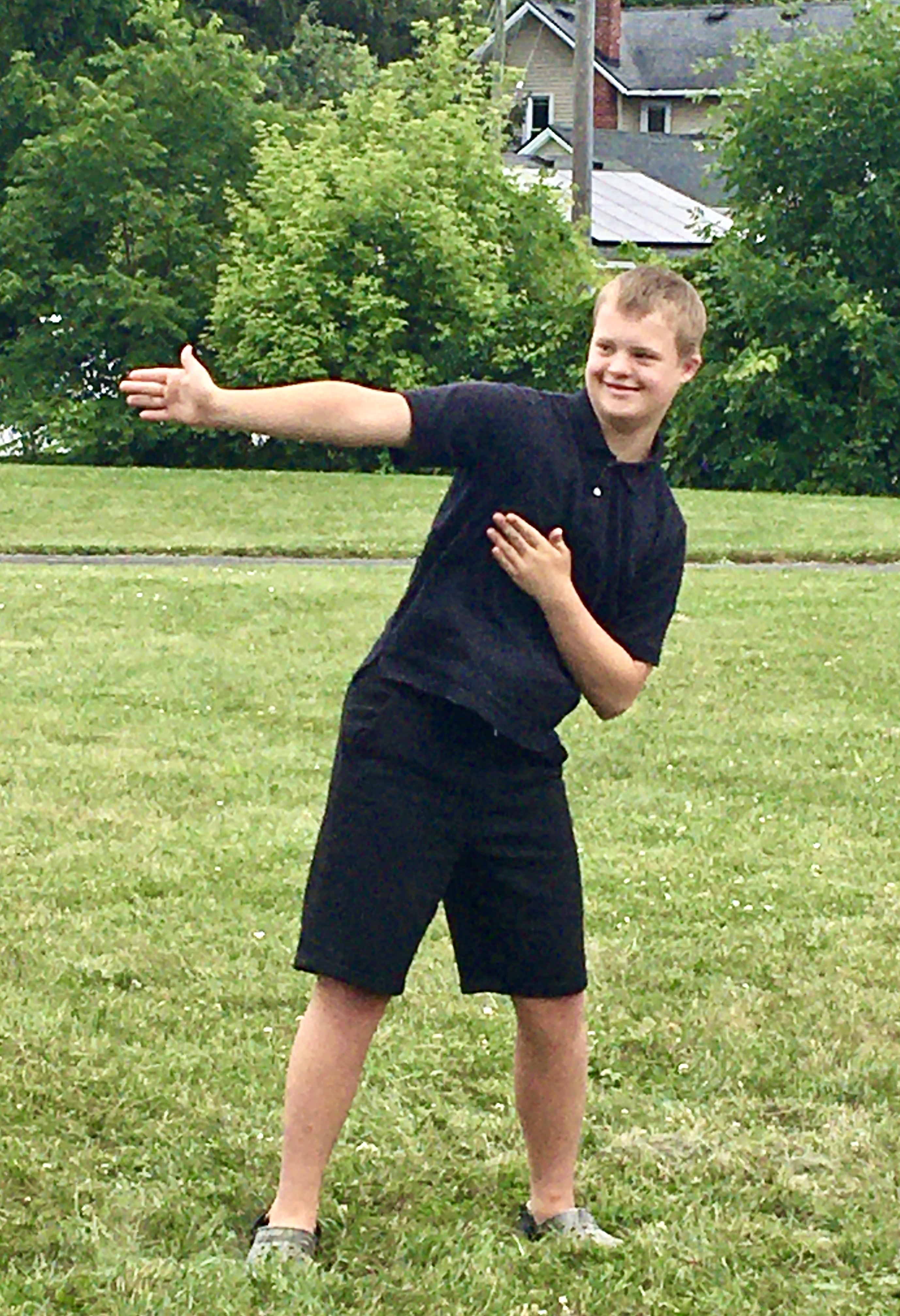
Wil has a recumbent bike that he drives like a madman. He cuts corners burning rubber and flies down the grassy hill in our front lawn. The fenders over the front and back tires are bent from spills. Fortunately a fall from a recumbent bike isn’t far. Wil gets back up, and gets back to riding full speed ahead.

Wil recently rode his bike over something sharp— likely a big rock, but he won’t tell me what that something was. Maybe in time he will tell me. Whatever it was, it tore a hole through the actual tire and into the inner tube. His bike was sidelined.

I’ve never fixed a tire on a bike before. I checked the sizing of the inner tube and tire, bought a new one of each, and set to work on replacing it. When I googled directions on how to fix a bike tire, I read that a proficient cyclist can complete the task in about 7 minutes. For the novice, like myself, it can take 20 minutes or more. I didn’t time myself, but I can assure you it took me all of that 20 minutes and more.

After replacing the tire, I gave Wil’s bike a quick test spin. Then I called Wil to come outside. Seeing the new tire, he jumped on his bike and tore around the driveway without hesitation. 

“It’s fixed mom!” He said in surprised awe. 

“It took me some time but I got it done for you, Wil.” 

“Why?” Wil asked. 

“Because I love to see you fly.”

“Oh, ok,” he called back to me already nearly to the bottom of the hill.

When fueled by our why, no matter the timeline, we find a way to fly. 

Vocal-Ease

It was just after 9 p.m. and I heard the back patio door click shut. I tucked Wil into bed only moments before. But I knew it was him. My alarm was set for 3:20 a.m. to rise for work, so I’d recently tucked myself into bed too. 

I got out of bed, walked to the kitchen, and opened the patio door. I saw Wil walk to the far edge of our yard. He stopped at the outcropping of alfalfa. About five deer were scattered across our back field contentedly grazing. Two of the deer lifted their heads; more in curiosity than with concern.

Woody, our yellow lab, sniffed the grass close to Wil. Woody would have created chase with the deer in his younger years. But now with arthritic hips, Woody guarded Wil in close proximity.

Wil turned around and saw me standing on the back porch. Instead of running away, he walked over to the hammock. Woody followed him then rolled in the grass. Wil attempted to open the material of the hammock wide enough to lie down. He decided that was too much work, sat down on the hammock, gripped the material on either side of him, and swung gently as if on a swing.

“Not tired yet, Wil?” I asked.

“Hmph.” With this response, I knew pressing or prying would only tighten the knot of his emotions and he’d clamp down, resisting any type of communication.

“It’s a nice night. Look at Woody roll in the grass.” Wil looked at Woody, then back at me. His open response to my comment, even if non-verbal, was a good sign. I decided to take a chance. “Are you upset because your sisters aren’t home?” 

“Yes,” he said and dipped his chin. 

“Don’t worry, they will be home soon. How about I walk you back to bed and give you extra snuggles?” I said.

“Ok, Mom. You going to work in the morning? Can you make me breakfast?”

“Sure, Wil. I’ll leave it on the island for you. I bet I’m back home before you’ve put your plate away!” 

“Thanks, Mom. Hugs!” Wil jumped off the hammock and barreled into me. Only a year ago he likely would have responded by running away from me or remained on the hammock refusing, or unable, to explain his upset. But on this night, with only minimal resistance, he shared his feelings of sadness about his sisters not being home. And as he typically makes his own breakfast, his asking me to make it revealed the extra comfort he desired in my absence.

I tucked Wil back in bed, with the extra promised snuggles, then crawled back into my bed. I’d barely pulled up my sheets when I heard Wil’s heavy footsteps move toward the kitchen (with low muscle tone, he’s not exactly light on his feet). This time it wasn’t the patio door that I heard shut. It was a kitchen cabinet. Then I heard Wil scoop up ice, pour it in a cup, turn on the faucet, and walk back to bed. 

“Ah, fresh,” Wil said (a phrase he commonly uses sipping a cold drink). With these words of satisfaction, I knew sleep would soon follow. And it did, for both of us.

A milestone in communication had been attained that night. It was mutually understood…no explanation necessary. 

Growing Pains

Wil went to the doctor for his well visit Friday afternoon. He’s now 5’4” and 136 pounds. Wil was a champion through all of the doctor’s tests and questions. In previous appointments, he would act silly if he didn’t understand a test, or glance at me when the doctor asked him a question. On this day he kept eye contact with the doctor, followed her cues with each test, and answered every one of her questions. 

Katherine recently secured a job as a server. She asked Wil to quiz her on the menu. It was a natural choice for her as one of Wil’s favorite subjects is food (he reads take-out menus for fun). Wil held the menu up, ordered a meal, and Katherine told him what sides or dressings it came with. Wil had so much fun with this task that he pointed out all of the items to me too!

Wil is no longer a “little guy.” Each forward step of independence is incredibly gratifying to see. But like any teenager, he also asserts his independence when he doesn’t want to do something. Wil has summer speech therapy twice a week, and occupational therapy (OT) once a week. He enjoys going so I was surprised when he resisted one morning. I tried but was unable to deduct the reasoning behind it. Thankfully Elizabeth was home and I needed to take Katherine to work first. So I told Wil I was leaving for speech and OT without him and was very sorry he made a decision to miss it. Katherine and I left. We hadn’t made it more than one minute down the road when my cell phone rang. 

“Hi Mom,” Elizabeth said, “Wil has something he wants to say to you.” Wil got on the phone and said, “Hi Mom. I want to go to speech and OT.”

Now knowing the consequences, Wil is unlikely to refuse again. But to reach that point, it can take such measures that require more than just me. I could write an entire book on how innately understanding Katherine and Elizabeth are when it comes to motivating and supporting Wil. 

There have been times when Katherine, Elizabeth and I have had to physically move Wil when he won’t leave a situation. It’s happened at the airport, when for a reason only known to him, he refused to board a connecting flight. It’s as emotionally trying as it is physically — for all of us. 

On one recent occasion, Wil didn’t want to leave my parents’ house. After much reasoning on all of our parts — even bribing with a Coke — he sat unmoving on the floor. I knew once he left my parents’ house he would unwind from whatever was keeping him stuck (once Wil is out of the physical location he’s stuck in, it’s like an emotional release too). 

When it was clear he wasn’t going to move, I came behind him, reached under his armpits and clasped my hands in front of his chest. Katherine and Elizabeth lifted him by the legs. He cried and fought us. It was awful. When we got too tired and set him down on the ground to catch our breath, I bent down to talk to him quietly and Katherine hugged him. When we managed to get him in the car, it was like a switch went off in his head. He was completely fine. However, the switch doesn’t flip that easily for Katherine, Elizabeth and myself. I sat in the car trying to hide the tears streaming down my face so as not to upset him again.  

On our drive home, Wil belted out the words to a Luke Bryan song, and Katherine and Elizabeth rolled their eyes as they usually do. I took in a deep breath and took in the equilibrium of the moment. 

Wil’s timeline is different from our timeline. Finding an equilibrium in that is one of my greatest challenges as his parent. I suppose that is why there is such a thing as growing pains. There is no growth without them; and yet the growth is always worth it. 

What They Can’t Tell You

Wil ran up to me, then reached into his pajama pants pocket. He pulled out an adhesive mustache and stuck it under his nose. “Look at me, Mom!” He leaned his face so close to mine that I saw double.

“You are so close I can’t see you!” He stepped back, his mustache upside-down, the edges tickling his cheeks. He smiled at me with that upside-down mustache and I thought, this is what they can’t tell you.

The silliness started at about 7:30 that morning. Wil busted out of his bedroom, in his stripe-legged pajamas, the music from his CD player trailing behind him. He placed his hands on the living room floor and kicked his bare feet up in the air. “Look at me, Mom!”

“Look at you, Fancy Pants! Nice moves.” Though I’m a coffee drinker, there is no amount of caffeine that can lift me higher in the morning than Wil’s dance moves. It’s like being handed a fistful of balloons and feeling your feet leave the ground.

Sadly, I had to bring us back to earth. It was time to log in to school. “Wil, you look very handsome in your mustache. How about you show off your mustache in class? You are going to be late if you don’t log in now.”

“Ugh, Mom, no.” He flopped himself on the floor then laid face-down.

I dropped to the floor, laid on my belly and put my face close to his head. In a deep, sing-songy voice I said, “I see you! Time to log in to school, Wil.”

He lifted his head, leaned his forehead into mine and mimicked my deep sing-songy voice, “Ok, Mr. Mom.” Then he started laughing. When Wil laughs, he laughs with his whole body. I thought, this is what they can’t tell you.

They can’t break through your tears, into your hurt heart, after you learn your child gained one extra chromosome, and explain how a smile under an upside-down mustache, a leg-kicking pajama dance, and a body-racking belly laugh on the floor will make you feel like you hit the jackpot.

Because you did. You just have to live it to know it.

Open Book Ice Cream

My high school science teacher was amazing. And I had very little interest in science. He practically leapt off the floor explaining the periodic table. It was like someone just put this amazing hot fudge sundae in front of him and he couldn’t wait to dig in.

What amazed me the most was that he taught this same lesson again and again, year after year. Yet every single day, he brought the excitement. To that same old periodic table. Everything fit in this nice, little box. The combinations, even if dynamic, were predictable. No surprises. I was bored out of my mind. But I loved my teacher. He almost made me want to love science, just because I loved his enthusiasm for the subject. 

Then, in college I discovered blue book tests. I could scrawl my thoughts, in glorious freehand, across the blissfully empty white pages with pale blue lines. An empty white page to me is one of the most beautiful sights there is. And to take your own pen and feel the flow under your own hand, now we are talking digging into rich, luscious hot fudge sundaes!

And I could make it a different sundae every day! Carmel on smooth, groovy days. Strawberry on fresh, sticky, summer days. Pineapple when I was feeling prickly and tart. Blue books were so beautifully, uniquely open-ended — there were no predictable combinations when interpreting a book or poem, even if the character’s names never changed. Every person is full of surprises!

When Wil went from preschool to kindergarten, he was able to string beads — big beads with big strings. But he had to take a test to evaluate his skills. In the test, he was to string a small bead with a small string. He couldn’t do it. There were only two boxes to check. A yes box and a no box. 

As a result, Wil entered kindergarten testing at a 6 month old fine motor skill level. He was well beyond that. The test failed, Wil didn’t. The same thing happened when Wil went to his 1st endocrinologist. Wil didn’t fit in the predictable boxes. As soon as I checked the “no box” that he hadn’t achieved a certain skill, I was told to skip to the next page. “But, wait, he can do some of the other skills on this page.” “No, he can’t.” Was the answer I received. Where was the blue book for me to fill out about my unpredictable son?

Upon the news of Wil’s kindergarten testing results, his speech therapist spoke up and said that there will be very open communication between Wil’s preschool teachers and Kindergarten teachers. That though the test measured certain skills, it will be the open communication that determines where Wil will start with his ability level. I felt the beautiful, crisp new pages open upon her words. 

I also found a new endocrinologist. I knew she was the one because when I told her of our experience, she handed me a blank sheet of paper along with the test. She said to write down all the skills the test does not cover and we’d go from there. Hot fudge sundae, anyone?

On February 5th, 2007, I learned first-hand that you can change just like that. That the person you were one second can change in the next. I couldn’t force Wil to be a typical boy. My choice was to learn what all of this meant and to write our own pages with it. That is why I’m deeply offended by any claims to “cure” Down syndrome. He is a beautifully, varied and valuable human being and his story is just beginning to be written. Why burn the pages when being part of the story is so much more meaningful?

I loved my science teacher even though I never grew a love for science. What I learned most from him is we all have our different passions. And not a single one of us fits in a perfect, little box. That may be why he felt the love for his periodic table. How everything had an answer when life didn’t. And for that, I love my blue book pages. Where I can scrawl out, in long free-hand, the ever changing and evolving interpretation of what’s around me. As long as we can make our life new every day, be it by the periodic table or a blue book, then it will be a place we can’t wait to dig into…and we get to choose the topping! 

Just Friends Being Friends

“I was just wondering if Wil wanted to be part of the 7 dwarfs. We were thinking he could be Snuggly, Giggly, Silly, or Smiley! Considering Wil has all those traits!” I received this text from Ashley about Halloween costumes. Ashley and Wil, now in 8th grade, have gone to school together and been friends since preschool.

I read Ashley’s text aloud to Wil. He jumped up and responded, “Yes!” Wil chose Smiley, then I received another text from Ashley: “Or Seeger was thinking he could be the prince if he wanted to.” (Seeger is another good friend of Wil’s from school.)

“The prince!” Wil said without an ounce of hesitation. Which is quite apt, as Wil’s friends, who are planning a Snow White-style Halloween, are all girls.

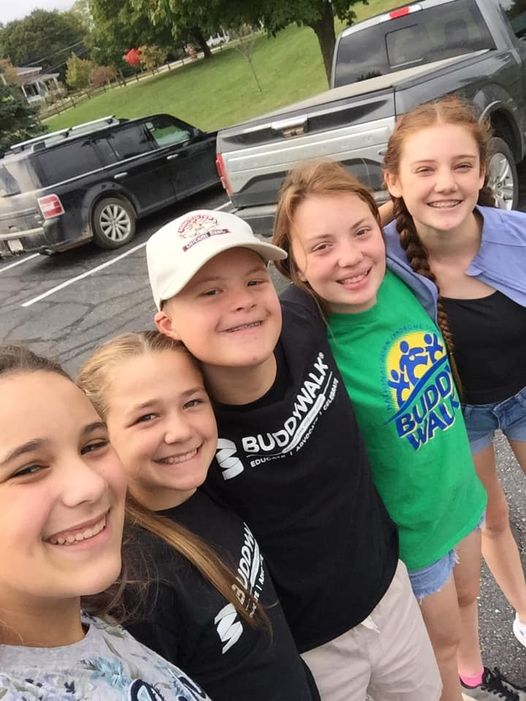
Our Down Syndrome Support Team holds an annual Buddy Walk the last Sunday of September to raise awareness and acceptance for individuals with Down syndrome. With the pandemic, the decision was to hold a virtual event. Wil and his friends were not to miss out, so we held a small, local walk to which about 30 friends participated in. Wil, of course, walked with his close buddies, Ashley, Seeger, Lila and Sarah. At one point during the walk, Wil decided he needed a break and sat down on the sidewalk. Wil’s friends stopped and cheered him on. With their encouragement, Wil jumped up and they all started running. The friends joked it was the “Buddy Run.”

Near the end of the walk, we climbed to the top of school bus loop. Once at the top, Wil’s friends ran down the steep, grassy hill along the side of the bus loop. Wil remained at the top, looking trepid. Once again, the cheering section arose. His friends’ cheers nudged Wil over the edge and he tore down the hill. Once united, the friends jumped, laughed and cheered in a circle. It’s just as rewarding to be the cheerleader as it is to be the cheered.

Last year, I was talking to Ashley after school. She told me about an activity in gym the group of friends enjoyed participating in together. Then she said Wil grew tired and laid flat out on the gym floor. She shrugged her shoulders, smiled and said, “That’s just Wil being Wil.”

When Wil doesn’t have the words, his actions are his communication. Wil’s friends understand his language. Wil doesn’t judge others or create drama; it’s simply not in his arsenal. In that way, his friends are fully free to be themselves. If you are sad, he accepts your sadness without question. If you are happy, he accepts your happiness fully. If you feel goofy, he’s more than willing to join you in the silliness. If you need a hug, he has one at the ready. If that’s your clothing style, then it’s cool. To Wil, that’s just you being you.

As a parent of a child with special needs, I know first-hand the fight for acceptance. I also know first-hand that acceptance is quite fundamental: It’s just friends being friends.

What Grows Us

We all have experiences that “grow us.” We move along in life, doing what we do, thinking what we think, then, whoomp, there it is. The something that “grows us.”It’s impactful enough to rethink the way we think. To resee what we thought we saw. To listen again to what we thought we heard.

What “grows us” changes us, in both perceptible and imperceptable ways. Its a deeply interesting question to me in what “grows us.”

Was it uncomfortable and unwelcome? Was it deeply beautiful? What is something that began as unsettling that turned beautiful? Or the reverse? How did it uproot familiar ways to facilitate such a change?

What opens our eyes to what others are blind to? What drops us to our knees and causes us to look up in thanks, while others cry why me? What song brings a joy to our heart where others hear only noise? What “grows us” opens us to a different level of perception for its impact. What we believe we know for certain — there is always another level of perception to learn from.

Life is forever interesting in the way that it “grows us.”

We All Have Hard Stuff

Yesterday, I just didn’t have it in me. Yesterday, I did not have the patience that on somedays I find miles of.

Some days I wish Wil would just get up and get in the car when I ask him to. Some days I wish I could say, “We are leaving in 20 minutes,” and he’d go get his hat and shoes, and then we’d be on our way. But it doesn’t work like that.

Every time we need to go somewhere it’s a process. I start 30 minutes ahead of time with Wil. I ask him to get his shoes and pick out the hat he wants. Then I check in 10 minutes later. He may have moved closer to his destination, or he may not have. There is more coaxing. And then, eventually, he is ready to go. Or not. This is not once in awhile. This is all the time.

Yesterday Katherine and Elizabeth had driver’s education at 6pm, and that means we needed to leave at 5:30pm. I was making dinner and realized it was already getting past 5pm. It was time to let Wil know it was time to get ready to go.

I walked downstairs and told Wil it was time to go. “Ok, Mom. Hugs.” This is all normal. He’s big on hugs. I’m big on his hugs. That’s the beauty of not being in a hurry with Wil. You never forget to give and receive hugs.

After our hugs, I asked Wil to get his Crocs and pick out the hat he wanted to wear. He said ok and I went back upstairs to continue with dinner. Ten minutes later I didn’t hear any noises from him getting ready to go. I went back downstairs and he was sitting on the floor. He had been good-natured so I wasn’t sure what this resistance was about. With more hugs and coaxing, I told him it was time to go. He refused to budge. As I didn’t understand the reasons behind this particular refusal, I wasn’t sure how to talk him through it. It may have been a simple case of being a teenager and exerting his independence.

At times, Katherine or Elizabeth are able to get him moving. Katherine came downstairs. “Wil, can you get up and hold my hand? I really need a hug.” Wil looked at her and considered this, then ducked his head down. Not a good sign.

At this point, we were running out of time. “Wil, we need to go,” I said. “This is not fair to your sisters. You had plenty of time to get ready, and it’s time to get up.” He looked at me and looked back down. “Come on, one last hug. Can you get up and give me one last hug?” I hugged and tried to lift him up, which sometimes works. He resisted strongly. At this point, we were on the verge of being late. I asked Katherine for help. She asked Wil for another hug, but he sunk down deeper.

Elizabeth came downstairs to see what was happening because it was time to go. We literally had minutes left. I don’t like lifting Wil against his will, but I also don’t like sending him a message that this behavior is ok. We all need to work together – and that’s what we did, well at least three of us. Sometimes you have to do things you don’t want to do. After all of our coaxing and hugging, Katherine, Elizabeth and I lifted him up.

Wil is over 100 pounds, has low muscle tone so can wiggle out of your grip like a noodle, and he was unwilling. We made it up half of the steps to the landing and set him down. I again asked Wil to get up on his own.

“Don’t carry me. I’m not a baby.” Wil said.

“You are right Wil. You are not a baby. You are 13 years old. You are very big. So let’s stand up on your own and walk to the car like a big, grown up 13 year old does.”

No response. We picked him up again and made it to the door. Again, he refused to walk on his own. So we picked him up and made it to the car. Again, he refused to get in on his own. We picked him up again and got him in the car.

This whole process was physically and mentally exhausting for all of us. Wil was withdrawing in the backseat of the car, and I was doing all I could not to break down in a full out ugly sob. I hesitate to use the word traumatic, as that is quite extreme, but in that moment that is the best word I had to describe what I felt. It was a very heavy feeling. I just hated lifting him up like that and making him do something so against his will. But he also needs boundaries and to understand that we need to go and do things when he doesn’t feel like it; that’s just part of life. How to do that, how to balance that, I don’t know. I’ve learned a lot raising Wil, but I have a lot more to learn. And gosh does it hurt sometimes.

He was upset for some time in the car, understandably so. Katherine and Elizabeth seemed like they were fine, and we talked it out. I don’t like that they have to go through this either. This is part of their everyday life too. We never just get in the car and go. For them, everything is a process, and much of it revolves around Wil. Surely it has created great compassion and strength in them that many will never understand fully. I just don’t want this to cause resentment toward their brother. At this point, I’ve certainly seen loss of patience, which all siblings have, but thankfully no signs of resentment, and I’d like to keep it that way.

On the drive home, while Katherine and Elizabeth were at driver’s training, I asked, “Wil, do you know why we lifted you up in the car?”

“Hmph.”

“Wil, your refusing to leave was being very inconsiderate of your sisters. They cannot be late to this class and your refusing to leave almost made them late. When you have somewhere to go your sisters are very considerate of you. I’m asking you to be considerate of them, too.”

“Mom, I’m not listening to you.”

I stifled a laugh – this was so pure, typical teenager. I’m balancing Down syndrome and typical teenager with Wil. On one hand, this comment is a milestone for him; using his words in this way to express his emotions. On the other hand, the mother of a teenager in me was thinking, “Oh yes you will be listening to me.”

After I had picked up Katherine and Elizabeth from driver’s training and we had made it back home, Wil had recovered and was bouncing around in his happy state. Me, not so much. I still felt the deep turmoil in the pit of my stomach. Do you ever have this deep sob within you and it just needs to come out? That’s what I had and I was trying to hold it down in my stomach and process through it piece by piece to make sense of it. Sometimes I can do that. As I process each emotion and what it means, it eases the pain, bit by bit, until the sob has dissipated. This time though, the turmoil remained jumbled up in my stomach and I just couldn’t find the state of mind to unravel it.

Later that evening, we were all sitting on the couch and Matt asked Elizabeth how driver’s training was.

“Well, we were almost late thanks to Wil. But we made good time.” Elizabeth responded.

“What happened with Wil?” Matt asked.

Elizabeth told Matt what happened. I confirmed and filled in a few details.

“It looks like he’s fine now.” Matt said.

“He was upset for some time,” I said. “I hope the message sunk in. It was so hard. I know he’s bouncing around now, but he was really mad at me for a while.”

“Mad at you?” Elizabeth said and looked at me. How did that girl get so smart? She has amazing perspective for her age. Looking at her, and feeling how grateful I am for how both Elizabeth and Katherine roll with those tough times, and take it in stride, the sobs came up to the surface before I could even process what was happening. There was no stopping them then. I didn’t want the girls to see me like that so I went to my bedroom and I let it all out.

Matt came in and hugged me. I was so thankful to have him to hold on to. I sobbed my heavy sobs and held on to him around his waist.

We talked a little bit. I told him how I feel lost with Wil sometimes. That I don’t know the right thing to do when he’s like that. I don’t know if the message was received by him. I don’t like to force him, but reasoning with him is not always an option. And we talked some more. We are also raising two fifteen year old girls and that has its own challenges. There are days I feel like I’m failing, and this was one of them. Then Matt stood up and picked up this little note I keep Elizabeth made years ago that said, “Best mom ever.” He handed it to me. I loved him so much at that moment. More tears.

He said to me, “Everyone has their stuff, Christie. It might look different, and they might not always talk about it, but everyone has hard stuff they have to deal with. This is some of our hard stuff.”

And that’s why I’m writing this now. What compels me the most is for you to see the big picture on raising a child with Down syndrome. Some see our kids as happy all the time. They are not. Some see raising a child with Down syndrome as an always challenging journey. It is not. It’s a mix of everything, just like everyone else’s life. We all have hard stuff, even if it looks different and we don’t always talk about it.

This morning on the way to Wil’s swim lesson, he was jamming to his favorite Luke Bryan songs. The sun was shining and his high spirit was contagious. I couldn’t help but sing with him, as we ventured forward into a fresh, new day.
2E78851E-14F9-4486-9A9F-FE38B66BC1EB

The Stage is his Playground

I was listening to a podcast and the host said that when he started speaking publicly, he was terrified of the size of the stage. There was too much room, too much space. So he started awkwardly, standing in his spot. He looked awkward, sounded awkward, moved awkwardly.
When he started to view the stage as his playground, all of the awkwardness disappeared.
Wil is not a good singer. But he sings loud anyway. When he hears a new song he likes, he will find it on his iPad. He will play it over and over, rewinding in certain parts as many times as he needs, until he knows every word. Or what he thinks is every word. He’ll play the song so many times, and sing the song so many times, that if he has a lyric wrong, when I hear the actual song in the car without Wil, I’m like, “Luke Bryan, you are singing it wrong!”
Almost every morning, Wil has his iPad on full blast, his voice on full blast and his dancing on full blast. Though none if it comes together in beautiful symmetry, I would never define it as awkward. He is free and full of the moment. The stage is his playround, and that makes you want to jump right on stage with him. And I do.
I am not a good singer, and my dancing could use some help. But when Wil is rocking out, I rock right out with him. When there is a guitar solo, we are head-banging with the best of them, even if it is country music.
If there was any sense of a bad mood, it falls right off the edge of the stage. It’s a beautifully freeing feeling, full of authenticity, even if we may sound and look ridiculous. But that is part of its charm.
On the drive to Wil’s swim lessons, he is DJ. He turns up his favorite tunes on Amazon Music, and with the windows down, we are jamming. When we pulled up to the stoplight, some utility men were working there. I turned down the music and Wil turned it right back up. One of the men looked over with a frown, then saw Wil singing and grooving in his seat. He smiled and waved at Wil.
When we entered the club entrance where Wil has his lessons, we drove by a golf course. I turned down the music again and told Wil we needed to be quieter here in respect for the golfers. He hit stop on my phone. “Mom, after swim lessons, let’s listen to “One Margarita.”
After swim lessons, and quietly driving past the golf course, Wil cranked up “One Margarita” at 9:30AM. We waved at the utility men as we drove by, windows down, belting out in our bad voices, “Don’t worry ’bout tomorrow
Leave all your sorrow out here on the floatin’ dock.”
Wil makes the stage everyone’s playground.
13592177_10210017467174630_6609019425543637371_n

Opening the View

I’m embarrassed of things I said before Wil was born. I was ignorant. I just didn’t know. Now, when I hear or read certain words, I cringe immediately. My kids cringe immediately. We know better, thank God.
When words hurt, our primitive drive is to react with a fight. Eliminate that word! It is evil. Words are easy targets. They are tangible. Something to go to war on. But is it the word? Or the feeling behind the word? The feeling is in the soul of the word. Once the word is killed, the soul will live on. Like a disease, if the spirit of the feeling goes untreated, it will come back in a different form.
So how do we fight a feeling? How do you fight the spirit of something? Or is even putting up a fight the right thing?
Nobody had to fight me to change my mind. I was instantaneously in a place where I needed to listen. I needed to learn. All that I thought I knew, or better yet, what I thought I didn’t want to know about, was staring me right in the face.
I may have opened my mind over the years with life experiences without having a child with special needs. I already was a fairly open-minded person, but I still closed my mind to things I didn’t want to know about. But now, oh how I want you to see this place. I want so badly for you to understand what I once didn’t. I want you to see how incredibly amazing this place is. How full, vibrant and enriching it is. How you would never, ever think think to throw stones in our direction if you only knew.
I don’t want to fight ignorant feelings. I don’t want to throw the stones thrown at us right back at the thrower. I want to open eyes. I want to open ears. I want to open all senses to the beauty that is right here in plain view.
You can’t eliminate a feeling with a fight. But you can transform a feeling by opening the view to meet all of the senses.
IMG_7376