Behind the Magic

Wil jumped onto the tube without hesitation.

Wil’s friend CJ, who we were visiting, propped himself on the tube next to Wil. Elizabeth laid down on the opposite side. CJ’s dad, Randy, asked if they were ready. All three gave a unanimous thumbs up. Randy fired up the boat and CJ’s mom, Cheri, was already expertly snapping pictures. Heavy clouds loomed; we wanted to tube as much as possible before the storm hit. 

With Wil’s apparent confidence, Randy took the tube over some higher waves. Wil’s smile never wavered.

Last year’s tubing expedition took loads of coaxing to get Wil on the tube. It was Cheri who was finally successful. She climbed on the tube wearing her sunglasses. She told Wil she didn’t want to lose them, so the tube would stay right next to the boat. Wil inched his way onto the tube next to Cheri. He had a tight grip and winced at every slight movement. 

Once Wil secured himself next to Cheri, he looked around the lake in awe. He couldn’t believe it! He’d made it onto the tube. After crossing that threshold, Wil never looked back. His bravery had clearly stuck with him into the next summer.

CJ, who will be a junior in high school this year, gives daily weather reports which he started during the pandemic. His weather reports became so popular that the local news has also broadcast them. CJ is a daredevil with watersports, is on the school’s marching band and bowling team, and shoots a mean 3-pointer. CJ, like Wil, has Trisomy 21, the most common form of Down syndrome. CJ recently started strength training and flexed his biceps for us. CJ asked Wil to join him in a few push-ups. Wil jumped right in with him. It became clear Wil needs to improve his core and upper body strength to do proper push-ups, but he saw CJ do it, so he knows he can do it too with time and practice. 

All of CJ’s interests may or may not match Wil’s, but it’s important for Wil to see what can be done by a slightly older peer. When Wil was a toddler he watched his sisters, Elizabeth and Katherine, swim in the lake. He wanted so badly to swim like they did but he didn’t like how the bottom of the lake felt on his feet. Even with water shoes, he was hard to convince. One day he put on one of his sister’s bathing suits thinking he could magically swim. He quickly found that wasn’t so. 

My parents, who live on the lake, kept walking Wil to the steps that led into the water. Little-by-little, step-by-step, he eased in. With time, encouragement and practice, mixed with the desire to swim like his sisters, he learned that he didn’t need magical powers. Now when he steps into the lake and jumps on a raft, his smile never wavers. 

Wil doesn’t have to sink repeated 3-pointers to have value (though he’s sunk a few). However, each new jump he achieves adds value to his life. There is no magic behind it — it’s role models like Katherine and Elizabeth, my parents and friends like CJ, Cheri and Randy plus a dose of desire, patience and leaps of faith. 

The smile on the other side of the leap, though…that’s all magic.

Tunes of the Territory

Wil had become overwhelmed and fled the situation with little warning. I chased after him and tried to get him to open up. He never did. 

Wil has grown greatly in his communication skills, and each time we go somewhere he grows in independence too. However there are multiple stops that must break way to starts. The unexpected throws Wil off and we find ourselves at a standstill. It’s all part of the territory, but at times the repeated standstills weigh on me. 

I’ve heard you need to fight for your joy. And some days I do. It seems the only way to get through at times. But whenever I take a deep breath, step back, open my eyes (and ears), I’ve found joy has a way of letting itself in.  

Last Wednesday night McKenna Marsh, a senior at Wil’s school, came over to watch Wil while Matt and I had a date night. Though we know McKenna and her family, this was the first time she would be Wil’s caregiver. Wil was very excited about this (as was I) so when McKenna arrived he ran to the door to let her in. We walked to the kitchen and started chatting. Wil’s high energy fell to silence. 

“Wil, you are very quiet. I know you are excited to spend time with McKenna. Is something on your mind?” I asked.

He tucked his head, and with a coy sideways smile at McKenna said, “I’m feeling a little bit shy.”

Joy flooded through me! Wil hadn’t retreated into deeper silence. He hadn’t run away. I hadn’t asked multiple questions to draw out his emotions. He opened up of his own will — by being a flirt! 

The next night, driving home from Special Olympics golf, with the windows down and country music blasting, Wil and I belted out the country songs at the top of our lungs. 

“Mom look!” As I rounded a curve, off to the right, hanging low over a wide-open field, the sun was an oversized fiery pink ball. Scattered clouds absorbed its color creating a brilliant sky. We fell in silent awe. 

Wil and I looked at each other with easy smiles and synchronously resumed our loud and off-pitch tunes. I never regret the weight of this territory, otherwise I may never know such heights.

Brace Yourself

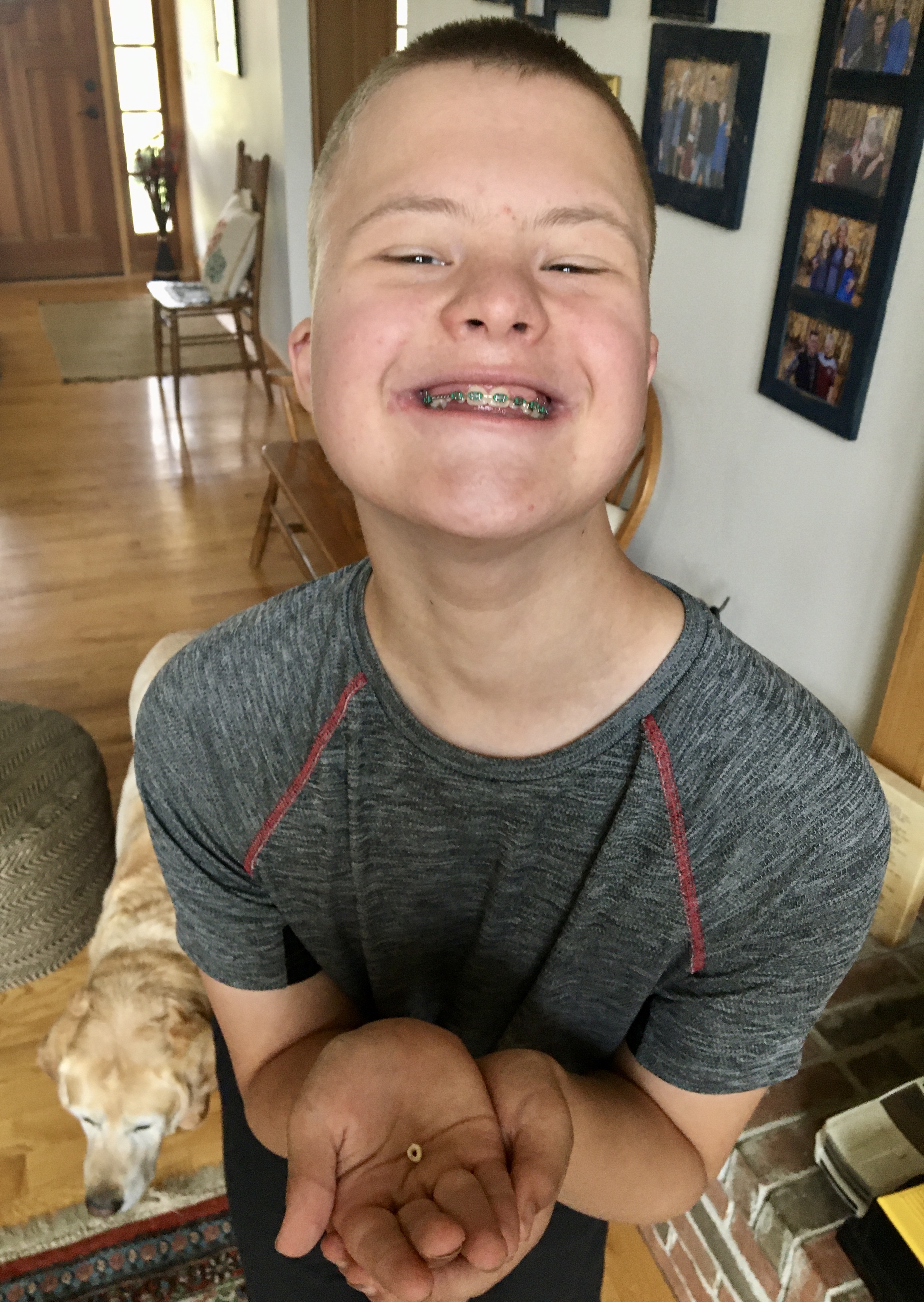
“Look, Mom!”  Wil widened his smile. A thick cord of wire ran through every braces bracket attached to the top row of Wil’s teeth. Then I noticed one of the brackets hung suspended over the jagged edges of an emerging adult tooth. Wil had just lost the baby tooth that previously held the bracket in place. 

Wil reached down to the coffee table and carefully picked up a little white tooth. He cupped both hands and presented the tooth to me, as if in offering. 

Though Wil is 14 years old, every missing tooth is as exciting as the first — and it has nothing to do with the Tooth Fairy. When Wil lost his first tooth, I showed him how to put it under his pillow. When he awoke he exclaimed, “Shiny coins!” Then, “Where’s my tooth?” My explanation that the Tooth Fairy took his tooth in exchange for the shiny coins was not a fair deal to Wil. He wanted his tooth back. Fortunately the Tooth Fairy was still orbiting the area and made a return visit.

Wil is entering high school this fall. I was recently asked by a mother whose daughter with Down syndrome is years younger than Wil: “How did you decide that Wil should receive a Certificate of Completion rather than a high school diploma? And when did you know?”

When Wil was a baby I would have answered emphatically, “Wil is getting a high school diploma! Wil will have full inclusion in school and take college courses.”

As Wil grew in age, I learned step-by-step with him. In his Kindergarten year alone, his teachers and I made multiple changes to his IEP (Individualized Education Plan) in determining the right balance for Wil between the general education classroom and the resource room. Wil excelled learning with his peers in the general education classroom in some subjects, but he also learned math best in the resource room. Though I had linear plans for Wil, they took many detours as I learned by experience what best fit his needs.

By Wil’s middle school years, I knew without a doubt that the Certificate of Completion was Wil’s best option. I was not saddened by this fact, as my earlier self might have been. Living experience-by-experience with Wil, the loss of earlier dreams also created openings for new growth. But I could not know or appreciate what that new emergence of growth looked like until I gained a widened perspective over time.  

A friend, whose daughter with Down syndrome is the same age as Wil, recently shared colleges she investigated that have classes adapted for our kids. There are multiple life skills as entrance requirements. She has implemented those very skills into her daughter’s IEP which I think is brilliant. Because of this conversation, I’m going to look into the same options for Wil; I still hold college course plans for him. That said, my friend and I also have multiple alternate goals in mind understanding the flexibility required along this journey.

It’s vital to be educated, to have goals and plans. I value my bond with friends with whom I openly share experiences and learn from. Even so equipped, there will always be unexpected suspensions in time that appear devoid of answers. Linear plans change no matter how tightly bound. There are no fairies that place shiny solutions under my pillow, or that orbit back to deliver what I once believed lost. I have felt the depth of challenge in each of those spaces, but I now hold an underlying excitement with each one — from the first up to Wil’s entrance to high school and beyond. Not because I anticipate smooth transitions; rather I know, with each step forward I gain a widened perspective that reveals each jagged edge as an offering of new growth.  

Open the Door to LEt In the Know

Last night my neighbor came over to deliver some squash and zucchini from her garden. Wil was sitting in the Lazy-boy watching Wild Kratts. He’d been to the pool, then outside playing, and had just finished eating dinner. He was chillin’.

My neighbor, Nancy, asked him some questions. He didn’t want to answer. Nancy takes Wil to the Dollar Store on a weekly basis to help him with life skills. She also has an adult son with autism. She understands how these situations can go. Wil kept making “umf” responses. “Well, I guess I am interrupting his TV show,” she said. “See you tomorrow, Wil.” As soon as she left Wil said, “Dollar Store with Nancy tomorrow.”

As simple as this moment in time seems, it was not to me. First of all, Nancy understood Wil. She urged words out of him, but didn’t force them or give up, either. She took time to understand the situation. And many times, as simple as that sounds, it’s not so simple when you don’t understand.

I wrote recently about Wil having a melt-down at my parent’s house. My sister and her kids were visiting, staying with my parent’s. Wil wanted to spend the night after a day of playing. It was not a good scene and all of us were exhausted afterwards.

The next day, going back to my parent’s to visit, we discussed the incident. My sister said her daughter’s friend works at a camp for kids with disabilities. This friend said it is helpful to anticipate what is going to happen. I sat there speechless. In my mind, my ego responded first. A 16-year-old girl who spent a summer with kids with disabilities knows more than I do? Puh-lease! My next thought was that I live in anticipation. Every single day, even for the simplest of tasks. Just going to the store might take an extra half-hour because Wil gets stuck on what hat he wants. Or he simply refuses to go. I’m always planning ahead for whenever and whatever. That is my norm, as well as the norm for Katherine and Elizabeth. Then I realized she just doesn’t know. She is trying to help. She lives 5 hours away and sees Wil about twice a year.

And that’s what it mainly comes down to. People aren’t trying to hurt, they just don’t know. They aren’t trying to be mean, but our egos kick in because we live this every day. Its easy to get defensive rather than inform. Every single moment is a teaching moment in our lives; not only with our kids, but for the world that surrounds us.

Where There’s a Why

“Wil, are you going to get dressed?”

“Why?” 

“Because its morning.”

“Why Mom?”

“Because the earth made another full rotation.”

“Oh, ok.” Wil went to his bedroom and got dressed.

Though Wil’s 8th grade year had its challenges, in comparison to his 7th grade year, it was smooth sailing. But it took what we learned in his 7th grade year to break way to the “oh, ok” of where we are now. 

When 7th grade hit, so did puberty and hormones. And they hit hard. Wil developed multiple new behaviors that stumped his teachers and me. With Wil’s communication delays, I repeatedly asked my own series of whys to uncover his thought processes. I knew we would break way to that “oh, ok” moment, but I didn’t know what that looked like or how many whys it would take to get there. 

My first personal experience with a behavior plan was in Wil’s 7th grade year. Behavior plans are more “if then” plans that follow their own timeline. Wil’s teachers and I planned ways to support him through his pubescent changes. We learned from each experience, asked more why questions in relation to that experience, and revised the plan with what we learned. In this way we inched ahead, why-by-why, experience-by-experience.  Eventually, one of his barriers would break and he’d fly forward at full speed. I stood there with my head spinning at the seemingly instant transformation.

Wil has a recumbent bike that he drives like a madman. He cuts corners burning rubber and flies down the grassy hill in our front lawn. The fenders over the front and back tires are bent from spills. Fortunately a fall from a recumbent bike isn’t far. Wil gets back up, and gets back to riding full speed ahead.

Wil recently rode his bike over something sharp— likely a big rock, but he won’t tell me what that something was. Maybe in time he will tell me. Whatever it was, it tore a hole through the actual tire and into the inner tube. His bike was sidelined.

I’ve never fixed a tire on a bike before. I checked the sizing of the inner tube and tire, bought a new one of each, and set to work on replacing it. When I googled directions on how to fix a bike tire, I read that a proficient cyclist can complete the task in about 7 minutes. For the novice, like myself, it can take 20 minutes or more. I didn’t time myself, but I can assure you it took me all of that 20 minutes and more.

After replacing the tire, I gave Wil’s bike a quick test spin. Then I called Wil to come outside. Seeing the new tire, he jumped on his bike and tore around the driveway without hesitation. 

“It’s fixed mom!” He said in surprised awe. 

“It took me some time but I got it done for you, Wil.” 

“Why?” Wil asked. 

“Because I love to see you fly.”

“Oh, ok,” he called back to me already nearly to the bottom of the hill.

When fueled by our why, no matter the timeline, we find a way to fly. 

Vocal-Ease

It was just after 9 p.m. and I heard the back patio door click shut. I tucked Wil into bed only moments before. But I knew it was him. My alarm was set for 3:20 a.m. to rise for work, so I’d recently tucked myself into bed too. 

I got out of bed, walked to the kitchen, and opened the patio door. I saw Wil walk to the far edge of our yard. He stopped at the outcropping of alfalfa. About five deer were scattered across our back field contentedly grazing. Two of the deer lifted their heads; more in curiosity than with concern.

Woody, our yellow lab, sniffed the grass close to Wil. Woody would have created chase with the deer in his younger years. But now with arthritic hips, Woody guarded Wil in close proximity.

Wil turned around and saw me standing on the back porch. Instead of running away, he walked over to the hammock. Woody followed him then rolled in the grass. Wil attempted to open the material of the hammock wide enough to lie down. He decided that was too much work, sat down on the hammock, gripped the material on either side of him, and swung gently as if on a swing.

“Not tired yet, Wil?” I asked.

“Hmph.” With this response, I knew pressing or prying would only tighten the knot of his emotions and he’d clamp down, resisting any type of communication.

“It’s a nice night. Look at Woody roll in the grass.” Wil looked at Woody, then back at me. His open response to my comment, even if non-verbal, was a good sign. I decided to take a chance. “Are you upset because your sisters aren’t home?” 

“Yes,” he said and dipped his chin. 

“Don’t worry, they will be home soon. How about I walk you back to bed and give you extra snuggles?” I said.

“Ok, Mom. You going to work in the morning? Can you make me breakfast?”

“Sure, Wil. I’ll leave it on the island for you. I bet I’m back home before you’ve put your plate away!” 

“Thanks, Mom. Hugs!” Wil jumped off the hammock and barreled into me. Only a year ago he likely would have responded by running away from me or remained on the hammock refusing, or unable, to explain his upset. But on this night, with only minimal resistance, he shared his feelings of sadness about his sisters not being home. And as he typically makes his own breakfast, his asking me to make it revealed the extra comfort he desired in my absence.

I tucked Wil back in bed, with the extra promised snuggles, then crawled back into my bed. I’d barely pulled up my sheets when I heard Wil’s heavy footsteps move toward the kitchen (with low muscle tone, he’s not exactly light on his feet). This time it wasn’t the patio door that I heard shut. It was a kitchen cabinet. Then I heard Wil scoop up ice, pour it in a cup, turn on the faucet, and walk back to bed. 

“Ah, fresh,” Wil said (a phrase he commonly uses sipping a cold drink). With these words of satisfaction, I knew sleep would soon follow. And it did, for both of us.

A milestone in communication had been attained that night. It was mutually understood…no explanation necessary. 

Growth Rings

Last week, after swimming at the Saline Rec Center, I gave Wil a dollar bill and 2 quarters to buy a Gatorade in the vending machine. 

He held the dollar bill in a pincher grasp (between his forefinger and thumb). It took him a moment to steady the dollar bill so it would fit through the narrow slot. Wil then secured the same pincher grasp on each quarter, which was slightly more challenging due to their size, and slid each one through the coin slot. I then asked him which Gatorade flavor he wanted. He pointed to the lemon-lime. 

“Ok, do you see the letter and number under the Gatorade you want?” I asked. “Punch in those same buttons.” Wil punched in the buttons with care, and a lemon-lime Gatorade slid out of its place and fell to the bottom of the vending machine. Wil reached down, pulled his Gatorade out of the machine and raised it in victory.

I had a quick flashback of Wil sitting in his high-chair. Theresa, his speech therapist, was teaching him how to pick up a Cheerio with a pincher grasp. Wil tried to scoop it with his fist. The fine motor skills required to achieve a pincher grasp was (and still is to a lesser extent) very challenging for Wil. It took much patience, care and repetitive practice for him to achieve. Like many of Wil’s achievements, there is more than what is seen on the surface. Each success has a depth to it; like the rings within the trunk of a tree. 

Our neighbor, Nancy, recently started taking Wil to Dollar General to work on his life skills. As a retired educator with the Washtenaw Intermediate School District, Nancy has years of experience working with people with disabilities. Nancy’s grown son has autism, so she understands the many rings of this tree as a mother, too. 

When Nancy first took Wil to Dollar General, he just followed her around. This fact didn’t surprise me, but shook me up all the same. When Wil and I grocery shop, he may run ahead to pick out something he wants, or help me take items off of the shelf, but I’ve never given him more ownership than that. I realized, talking to Nancy, how easy it is to fall into familiar routines and miss obvious growth opportunities. 

On Wil’s last visit to Dollar General with Nancy, I gave him $10.00. Elizabeth asked him to buy her Chapstick and I asked him to buy himself toothpaste. Then Wil bought himself a drink. The cashier asked Wil for $7.30. Wil gave the cashier $2.00. Nancy said, “Try again. $7.30.” Wil gave the cashier $3.00. Nancy said, “Try again. $7.30.” Nancy’s goal is to teach Wil to listen to what the cashier asks for. He then gave the cashier $7.00 and $1.00 more for the change (“One more for the change” is a term Nancy taught Wil for covering the change. Wil now chants, “And one more for the change!”). 

As much as I revere how far we’ve come, and cheer with each new victory, I also fall unconsciously into repetitive familiar circles. Until a friend like Nancy comes along, shakes up the tree, prompts another look, another listen, and to try again. And that’s how the rings on the tree grow one more for the change! 

Wil & Nancy

In Our Wheelhouse

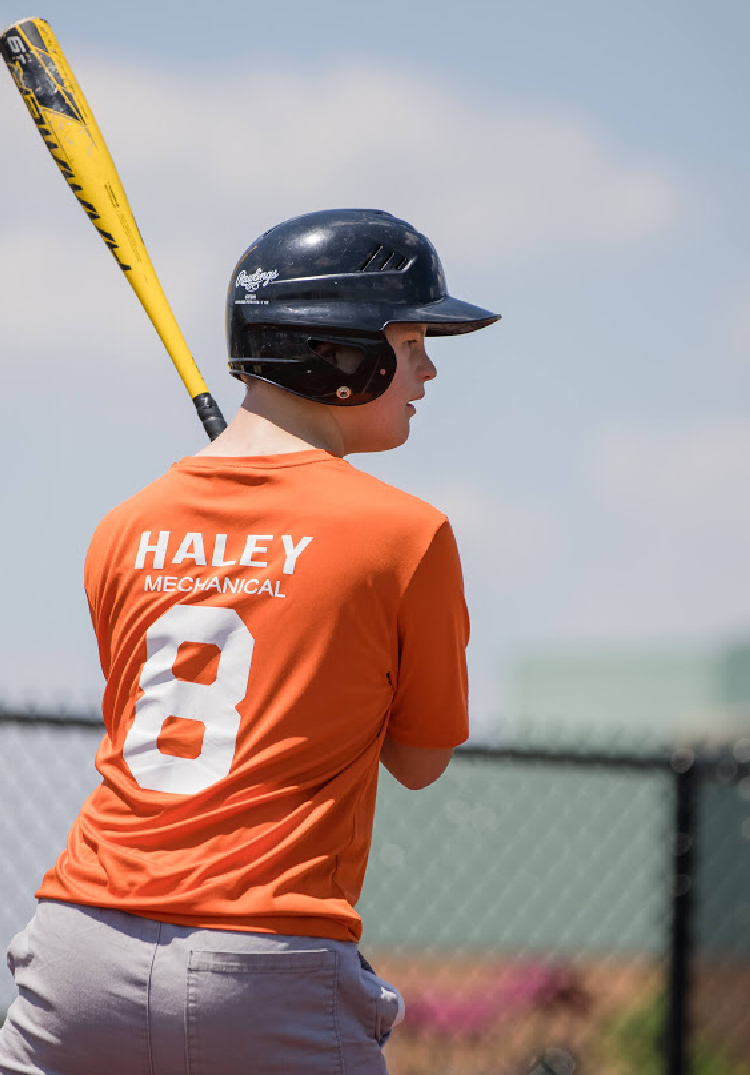
Wil sat down in the outfield. A bead of sweat slowly slid down the side of his pink cheek. The outfield was made of rubber; I’m sure it felt like a cushiony relief to him. Wil gets overheated very easily. I placed an icepack I had carried with me on the back of his neck. 

At his previous Challenger baseball game, Wil played 2nd and 3rd base. The weather was cooler and my parents were spectating, so he had plenty of showing off to do. Wil ran after every ball and threw it to his coach on the pitcher’s mound without hesitation. (The coach is diligent about Wil stopping, taking a step and throwing. Wil is equally diligent about following those instructions.) 

A batter in a wheelchair bunted the ball and her sister grabbed the handles of the wheelchair and ran her to first base. The next batter runs every base in a single hit, no matter where his ball lands. Sure enough, after he hit the ball, he tapped all the bases (passing those already on base), then sped across home plate. He raised his arms in success and the spectators cheered. The next batter stepped up to plate and the inning would continue until every player made it home. 

When a strong hitter came up to bat, the coach asked everyone in the outfield to back up. Wil didn’t budge. A father, who had been standing near us with his son, walked over and crouched down to talk to Wil. The father then reached out his hand, Wil took it and stood up, then we all walked deeper into the outfield. 

I thanked him and he said, “It’s always easier when it’s not coming from Mom or Dad. Music is the only thing that motivates my son. Some days I swear I have constant music playing on my phone.” 

Last Sunday at our Down Syndrome Support Team picnic, Elizabeth and I walked by a boy of about 10 years old. He was walking backwards with his arms spread out wide. His younger sister, a cute blond with pigtails, was trying to run past the width of her brother’s arms and escape to the parking lot. Their parents were a few feet behind them packing up their belongings.  

The boy smiled at us and said, “One thing I don’t like about Down syndrome is they don’t listen!” 

Elizabeth and I laughed. “We know exactly how that is,” I said. “I think we’ve chased her brother at least one thousand times!” 

I find it incredibly refreshing, rejuvenating actually, to be in places where our kids can be themselves without stares, sideways glances or need for explanation. No matter how diverse or similar our children’s disabilities are, there is an underlying understanding. Though you can feel it on the inside, on the outside, it is seen in gestures such as an outstretched hand, cheers for home runs (in any order), and laughs about siblings. 

Kindness, I have found, looks quite “typical” in any place it is shared.

You Are Here

Like many mothers, I loved my son before he was born. My daughters and husband placed their hands on my belly and felt his kicks and punches. We pondered names and dreamed our dreams. The field of possibilities was laid open before us.

The golden gates to that field slammed shut seconds after Wil was born. My brain valiantly fought to pry them open, objecting to each indicator the medical staff shared with me that my son may have Down syndrome.  Look at the way his arms and legs splay out, they said, see his short stubby fingers and his low-set ears, note the thickness of his neck. Interestingly enough, they never mentioned the shape of his eyes. 

As Wil melted into my chest the day he was born, I reveled in my love for him. I was careful to keep thoughts of his expected diagnosis locked tight in a separate compartment, though it hovered perilously above me. I looked down into his eyes; their shape struck me. I was both awed by their beauty and intensely terrified. My brain, still playing defense attorney, objected strenuously. But when the heart knows, the defense must concede to rest. The compartment above me busted open and everything spilled out all over us on the hospital bed. 

Just days after Wil came home from the hospital, I stared at him in his crib. Though my brain had rested its case — we even had genetic proof by this time — it begged to object. I simply could not believe I had a child with Down syndrome. But it was true. My heart held deep love for him, yet my brain kept its distance. I had never felt so contradicted in my life. As I stood there, my stomach suddenly dropped as if I was going down a roller coaster. The ground vanished below me and I stood suspended, as if in an elevator well. I visually saw darkness under me and the four walls of Wil’s room suffocated me. I knew this experience was a figment of my imagination but my body felt every sensation as if it were real. 

When I was able to regain my balance and logically analyze what happened, I knew what it meant. I felt completely out of control. Though I had many loving people around me and a packet full of helpful information, I realized more than ever that the work of acceptance is intensely personal. I had to take the first grounding step into acceptance myself. 

Acceptance has no clear start point. I never found a big, red “you are here” circle followed by dashed lines leading the way to acceptance. Rather, acceptance is like an open field surrounded by clouded mountains. You just jump in wherever you are, firmly plant both feet in the field, and figure it out from there. 

I overstepped into territory I wasn’t ready for, like reading books about teens with Down syndrome before Wil was even a year old. Those books offer a different meaning to me now for the landscape I’ve travelled, but then it was too much knowledge too soon. I learned how to back-step and move in new directions.

Fourteen years later, I’m still back-stepping and running forward, climbing, traversing, discovering; yet I arrived to acceptance the day I jumped in and firmly planted both feet on the ground. 

I know the feeling of the gates being closed on me. And that is why at the top of every mountain we ascend, like Julie Andrews in “The Sound of Music,” I open my arms wide above the clouds, spin with the wind and soak in the spectacular view of this beautiful, vast landscape I gratefully call home.  

Once Upon a Hat

On Friday morning, Wil sat on his bedroom floor rifling through his bin of hats. He couldn’t decide which one.

“Well, no hat then!” Wil announced to himself. 

“Do you need some help, Wil?” I asked.

“No.” I sat down next to him and laid his hats on the floor. He turned them all down.  We had to leave for school in 10 minutes. 

Wil had a Manchester shirt on so my best guess was he wanted a Manchester hat too. I presented his Manchester hats to him but he turned them all down. I convinced him to get off the floor, even without a hat, which was a good sign. 

A few months ago when Wil couldn’t decide on a hat, he stayed on the floor. I told him I was taking his sisters to school so they wouldn’t be late and I’d be back to get him. When I returned, he was seated on the porch step with a hat and backpack on. I was proud of him for turning his day around. 

On this Friday morning, however, when Wil stood up he fled the house without a hat or backpack. Katherine dashed after him. I grabbed Wil’s Manchester hats, his backpack, and flew out the door behind them.

I found Katherine standing in the dog kennel which is attached to the side of our garage. Wil was attempting to climb through the dog door which would have been hilarious to all of us, if we hadn’t been in a time crunch. 

“Silly Wil,” I said. “Woody is going to be jealous of you using his door. Come on, you don’t want to be late to see Ms. Campbell, do you?”

“Kristi Campbell!” Wil jumped out of the dog door and exited the kennel as he said his paraprofessional’s name. Then he stood unmoving in the driveway ­— two steps forward and one un-moving step is still a step forward in our book.

I walked behind him, put my hands on his waist and said, “Chugga-chugga choo-choo!” As I pushed him forward, he leaned back in resistance, yet kept putting one foot in front of the other. When we reached the car, Katherine opened his door but he stood firm by it. 

“All aboard,” I said. I bent his head down and kind of hoisted him into the car. He laid on his stomach with his legs hanging out. At this point his resistance was becoming a game. I was in part thankful for that, as I knew he was pulling out of his funk. But I was also running out of patience as he was in jeopardy of making his sisters late for school, which wasn’t fair to them. 

Elizabeth was in the back seat with Wil and talked him into sitting up straight and putting his backpack and seatbelt on. 

“Hey, Wil,” Elizabeth said looking at the Manchester hats I threw in the car, “that Manchester visor is mine.”

“No, my visor,” Wil said. They bantered back and forth. I knew what Elizabeth was doing. Sure enough, Wil chose the Manchester visor.

I reached my arm over the seat and splayed my hand. “Give me a turkey, Wil. You turned it around! Now you are going to have a great day.” He fist bumped my open palm. “And how about those sisters of yours? They are awesome.”

“They are bratties.” Wil said and laughed.

“No, you’re bratty,” Elizabeth said and playfully nudged Wil. (Typical sibling banter is as refreshing as it gets when life isn’t feeling so typical.)

By some miracle, we all made it to the school with 90 seconds to spare and in good spirits.

Sometimes it’s the simplest things that throw us off track, the simplest things that place us back on track, and the simplest things that we appreciate most.