We may believe our thinking is correct; or it is good—that we are good people.
Even those of us that call ourselves open-minded may find we have unwittingly closed off our minds when spending time with individuals with disabilities.
Why is this?
Because we have to see it their way first to understand. And many times — in some cases most of the time— their way is not easily readable. So we push our agenda on those with disabilities.
Individuals with disabilities’ way of communicating may be very different, or even non-existent in a verbal sense, so actions must be carefully observed. And even then we may remain clueless. It takes too much patience, and so we, even unconsciously, push our way on them, or we ignore them.
Our own belief system must be suspended to decipher theirs. We must let go of trying to be “good” or “helpful” because our version of what is good or helpful may not be for them. This very fact is likely the most challenging, and yet the most empowering process, in our very own lives.
When we suspend our own belief system in order to understand theirs, something shifts within us. Something bigger, something higher — spiritual even.
This process has no end. In fact, in 16 years I’m only just beginning. I’m stronger than I’ve ever been in trying to understand Wil, and understand the world’s reaction to him. I’m learning as a parapro to understand many differing abilities. It’s challenging and I need the expertise of those around me, because again what I think of as being helpful may not be helpful to them.
But it’s also so amazing to understand what in some ways may never be understandable. It wakes up something in me. Not because I’m trying to be a good person; it is because I truly want to understand what these kids are trying to say.
Those with disabilities are true gifts to us all—and yet this population is so very ignored and misunderstood. We must first forget ourselves, in full effort to understand another, and in that we find a stronger constitution of our own selves within.
Yesterday afternoon Wil had a challenging moment. It’s been awhile since he’s tried to flee a situation; it was an impromptu situation with lots of moving parts. Of course, Wil’s challenging moment means a challenging moment for me and those around me, as well. After all was resolved and I had calmed myself down, I thought back on all the circumstances that led to that moment.
There are always impromptu and unpredictable moments; that’s life. Though I tried to be proactive in certain areas, I was already way behind in others. And once I was behind, I was left with no choice but to chase Wil. Please do not mistake my comments for blame on myself or anyone else. There is no blame; there is only the situation, the string of events that unfolded within the situation, and how I can do better next time for Wil, myself and those around me.
Thinking back, now armed with the knowledge of how the events unfolded, I see ways I can be more proactive. As the unpredictables of that situation are now predictable. I now know how to do better for Wil, for myself and for those around me.
Even so prepared, there will be fresh unpredictabilities; cause that’s life! I will again need to reassess the events leading to those challenging moments — when the unpredictables are then predictable — and learn again how to be better and do better for Wil, myself and those around me.
Challenging moments are never a step back; unless we don’t look back, turn the unpredictabilities into predictabilities, and learn and grow from them. In fact, they can be quite an empowering lift forward once the dust has settled.
At 53 years old I am a student. At 89 years old I will be a student. When I say goodbye to this world, I will be a student.
Yesterday, I was trying to help a student who has autism. I was kind. I gave this student squeezes, I spoke calmly; soothingly. This student’s aggravation grew.
I see a lot of “Be Kind” bumper stickers. “Be Understanding,” in my opinion, is where we need to “Be,” but that’s too substantial for a bumper sticker.
I looked to the teacher for advice with this student. The teacher explained that this student was working through inner thoughts; likely about an event that happened earlier at home that we knew nothing about. This student needed space to verbally work through those emotions.
This explanation clicked immediately in my mind. It made sense in the way some times physical touch and calming words are needed; while others space is required. But without that explanation, I don’t believe I would have seen this difference on my own. But now that I did, it was set in place in my mind and I will now be better equipped to help this student when another such happening occurs.
Every day, in this way, I gain new understanding. I gain new confidence and strength in helping give these students what they need to move forward.
One of my friends, whose son has autism, said she wishes, just for a moment, she had a special key to unlock his brain, walk in, take a look around, say, “uh huh,” then close his brain back up and move on with life.
Full understanding is an unattainable goal, but when we shoot for the moon, we can reach the stars; even if it’s one star at a time.
I’ve been asked more times than I can count stars, “How do you have such patience?”
I’ve used the word “patience” regarding Wil in my stories about helping him through “stuck” patches. But now, after having the few months of experience in this work that I’ve had, my perspective on “patience” has shifted.
Now, when I consider that word, “patience” is exercised when I don’t want to take the time to understand. When time is urgent, and Wil won’t go. When I want Wil to cooperate and he won’t. So I wait him out. But when I truly learn to read his cues; when I anticipate what may happen, when I try to take the “key” so to speak and unlock what is happening in his mind, that’s not patience. That’s being a student; that is cultivating an understanding. And when you unlock even a piece of understanding, the elation is beyond words.
To truly fill up the well inside of you, don’t just “Be kind.” Be desirous to learn. Be desirous to understand. Be desirous to be a perpetual student. Reach for the moon, and even if you grab one star, you’ll “Be” substantiality beyond what any bumper sticker can preach.
Wil was just giggling to a tv show. Now he squished himself next to me in the Lazy-boy, as I was reading quietly, and started giggling. When I made him breakfast earlier, he danced around the kitchen, giggling.
In embracing our vulnerable population we embrace our own vulnerabilities.
We crave Love. Love is the base of all things. Love is survival. We crave, live and breathe for Love.
In embracing individuals that we previously misconceived as having lesser value, we find in fact their value is greater than ours as theirs is the truth-pathway to LOVE. In embracing those we do not fully understand; we must find within ourselves a deep patience and seek to view life in new and fresh way. It is in this way we find Love — a love deeper than we knew existed. A love that touches and speaks of God. We feel God and His Presence even if we are not religious; even if we are non-believers. Whatever we believe, we cannot deny what we feel. We call it Love. And yet it matters not what we call it. It only matters that we FEEL it.
Once we are touched by that feeling, we crave more. This Love lifts us, lights a fire within us. We find it hard to believe it was something we closed ourselves to. But we did not know we were living behind a closed door until our child with a disability; or our experience with individuals with disabilities opened the door for us. The blast of fresh air is what alerts us once we open our minds. It blasts us with a gust, not unlike a hurricane; it forces us out of our closed mind so far that we can never go back. We never want to go back. In fact all we want to do now is pound on closed doors in our desire that those behind the closed doors know this Love.
We see the fear, and know the difficulty to get past that fear. But once you feel the blast of fresh air in your face you cannot but want more of it, and want more of it for others. And so you advocate for your child, but it is so much more than equal rights and acceptance. It is a Love, a Love for all that lays hidden. A Love that is locked away inside of us. We are scared of it’s immensity. But in the fight for your child you release it. You must, for their sake more than yours. And you find in this unlocking a Love greater than you ever knew existed but it does exist in immensity all around you. And when you breathe it in fully it grows and grows and grows. There is no end to it, and though it is bigger than you could ever conceive, even a small slice of it breathes new life into. You cry in the sheer love that you feel. And you know you can never run out of that love because it is always there, it is bigger than anything your mind can conceive.
You must re-open yourself to this Love every day. Recharge yourself with it. When the doors start to shut due to habit or other’s actions — your child opens the door for you with a kiss on the cheek, a simple gesture, or a silliness. And when you try to describe this type of grand simplicity that has the power to open a door, those behind closed doors see only the simplicity of the gesture, as they have not opened themselves to the grandness. They refuse to open the door to this Love, staying in a sheltered space they know. Fully unaware that the immensity of Love is available to them if they only unlock the door. But when we don’t know, and what we only know is behind the door there is great security in that. There is great control in that. And we think we are thriving when really we are not. We have created a life that feels good behind the closed door. Even when it doesn’t feel good, it is what we know — how terrifying to go outside of what we know.
When we spend time to truly know and understand our vulnerable population, oh, what LOVE. It is open, it is free. Our children never tire of opening the door; it is their nature. It is on us to open ourselves to them.
You will know when you feel the Love. This Love is yours, it is all of ours. It is in endless supply. Let us circulate it. Let us ventilate closed doors. Let us embrace our vulnerable population.
Most of us don’t choose to be caregivers. Then next thing you know, you find yourself standing on a house of cards.
Last night a friend was at a neighboring table for dinner with her husband and another couple. After they had eaten dinner, the other couple left. As our friend tried to leave, her husband refused. As he’s endured multiple severe health issues, life circumstances now have our friend in the dual role of wife and caregiver. He wouldn’t leave because he’d forgotten he’d eaten dinner, and thought his wife was trying to make him leave before eating. Try as she might to convince him he’d already eaten, he sat steadfast.
Though the differences are many, I saw many parallels in Wil’s determination not to be swayed and our friend’s husband’s determination. I intimately knew the tears in her eyes. I felt her frustration not of just that moment, but of all the moments built as carefully, patiently, diligently and lovingly as a teetering stack of cards; that in just one moment, comes falling down.
After the cards collapse a number of times, you just feel so tired of it all. All of those cards, all over the floor, and one by one you must build them back again. Sometimes, it goes smoothly, and sometimes that one card keeps falling so as it’s impossible to build on it.
I knew this cycle with Wil. The only two solutions our friend had at this point were to wait him out until he decided for himself it was time to go (which could be hours) or a fresh voice to break the spell (as the caregiver’s voice is heard so many times, pleas can fall on deaf ears). It is a new face, or a new voice, that often breaks the spell.
My dad was the one who stepped in, and I looked at our friend, our eyes connecting in a knowingness. It’s hard, and no one asked this kind of hard, but there is so much love here, so much that we’d do for our loved ones, that makes the hard parts both more challenging, and yet strengthens us at the same time. And when friends step in to help, the wobbly card steadies and we can start building again.
Just before the holidays, a member at work shared with me that she was bringing her mother, who has dementia and lives in Florida, back to Michigan for a visit. She said, “Though Wil and my mom have many differences, I now know how you feel when you fly with him. You just don’t know if they will cooperate or not, so you prepare the best you can. Then you find out there is always something you didn’t think of, and things fall apart. And other times things go so smoothly that you wondered how you worried at all. You just don’t know.”
While visiting my parents in Florida, Katherine, Elizabeth, Wil and I went to the Naples Zoo. Wil gets hot easily, so we went on the coolest day. When he grew tired and too hot, I found an area by the zebras which was shady and he really enjoyed. Though Wil is very capable of walking the zoo for the day, its his building overstimulation with the heat, with the crowds and with the animal noises that eventually get to him.
Every year I find ways to keep him at the zoo longer. Every year I learn from the previous year. But I never let him sit it out. Because every year Wil learns how much more he can do. I’m fortunate that the twins can walk off to enjoy the zoo on their own, and circle back to Wil and me, instead of stopping every time Wil and I do. They know how this works. We build the house of cards together.
When Wil finally hits a wall after stops and starts, he still has to make his way back to the zoo entrance. As this zoo is near my parents’ home, they are fortunately available to pick Wil up when that “wall” is hit. I sit with Wil as long as he needs me to, as his will to walk to the entrance is his only way out.
We don’t choose our situations; they choose us. But we do choose how to utilize the time within our situation. We do choose whether to keep building, even after the cards have fallen. When times get hard, locking tearing eyes of understanding mean more than words could ever convey. They give us strength to build again and again; as many times as it takes.
Internal victories are what carry you and lift you through the hard times. Even 30 more minutes at the zoo on this visit delivered an internal joy with iron-clad strength—a strength and joy that will not fade with time or circumstances. I can build a million cards with the super-sonic strength of 30 extra zoo minutes many take for granted.
Caretaking is unpredictable and challenging, yet it brings out our best, and brings us all together if we allow it to. It’s what humanity is all about. (But if you challenge a caretaker to a house of card building game, they will mercilessly kick your ass.)
Though the questions remain static; our answers come from different places.
****
Last night Wil and I drove to Elizabeth’s basketball game in Bedford (just north Toledo). A dark sky, flat un-scenic roads — minus the occasional Christmas lit homes — and nearly a full week of school put Wil to sleep quickly.
Wil remained upright in the passenger seat; his neck stretched to the right at 180°, head at rest on his shoulder. (He can also fold himself in half — thanks to low muscle tone — chest on thighs. It was the seatbelt, not his flexibility, that prevented this sleeping position.)
When Wil woke we were 20 minutes away from Bedford High School. He looked out the passenger window. Same dark skies and flat roads. “Too long, Mom.”
“I know, Wil. Almost there.” I knew the basketball game would be a challenge for him with the loud buzzers. He’d been to enough games to know that too. I gave him the choice to stay home with Matt. But he wanted to go. To cheer on Lila, his friend since grade school. She had aged up to play on the varsity team with Elizabeth.
When we arrived at Bedford High School, I was heartened as Wil entered the school with no hesitation. (There are times when he’s very excited to do something, but when the time comes he has second thoughts.)
The entry doors opened to a long hallway that led to the gym. About halfway down the hallway Wil stopped. “Headphones, Mom.”
I set my briefcase-sized purse (for such occasions) on the ground and took out his noise-cancelling headphones. Wil took off his hat and we made the exchange.
As we were ready to regain our progress, a custodian walked by us. He looked friendly so I jokingly said to Wil within the custodian’s earshot, “We better hurry or he’s going to put you to work.”
(Though I wasn’t conscious of it at the time, writing this now, I realized it’s become a habit in me to keep situations as light and upbeat as I can when there is an opportunity for Wil to become over-stimulated.)
“Oh, yes,” The custodian said and smiled. “And there is a lot of work. I just finished cleaning the ceramics classroom. That’s the most challenging. Scraping clay off the ground. Every day.”
The three of us chatted our way down the hall; our moods remained light as I hoped with this friendly interaction. Wil and I parted ways with the custodian and peeked into the gym. There was a stack of bleachers about four-high from the gym floor. There was also a second floor balcony with about 20 rows of seating. I suggested to Wil that we go to the balcony; the buzzer noise would be lessened.
But then Wil saw Steve, Lila’s dad. Wil adores Steve and ran into the gym to sit with him —only feet from being directly under the buzzer. I followed and thought, well, the more Wil is able to tolerate the buzzers the better (as most of us game-goers do — tolerate buzzers).
The game started, as did the buzzing and announcements over the loud speaker. When the second period was over, so was the honeymoon period of Wil’s chosen prime seat next to Steve and cheering on his friend and sister. Over-stimulation had taken over. I suggested we take a walk.
It was quiet down the long hallway. We took note of the artwork on the walls as we strolled; when we reached a line of the custodian’s trash pails blocking our path, we turned around and slowly made our way back, stopping at a bench for a seat. Wil sang an a cappella version of Luke Bryan’s “Whatcha Doin’ a Little Later On?” In the song, Luke imitates a high-pitched woman’s voice in her response to his titled question; of course, Wil does the same in his a cappella version. We always laugh when Wil hits that high range. In the car, or at home, I sometimes join Wil; the more obnoxiously high-pitched we can get the better! But I wasn’t as brave as Wil to do so in a school hallway, even being the only ones there. I laughed with him on his high notes, and his bravery, and marveled for the thousandth time of how he knows the purity of fun, and I have a standing first-class ticket to join him.
When it was nearly time for the second half to start, it was time to get back to the business of re-entering the game. We walked back toward the gym. About 15 feet from the entry Wil made an abrupt stop. I sandwiched my body behind his and wrapped my arms around his chest. I gently moved forward, which in-turn moved him forward, in baby-steps. He laughed at first, but after a few steps he stood firmly in place. When I tried to push more, he bent his knees which meant he’d take a full seat on the ground if I kept it up. I suggested we go to the second floor balcony and this time he agreed.
There was a large landing at the top of the stairwell with a window. To the right of the landing were propped open double doors that led to the bleachers overlooking the basketball court. Wil walked to the window and looked out. Then walked back to the top of the steps and took a seat near the wall with his feet on the first step.
“Do you want to stay there?” I asked.
“Yes, Mom.”
The stairwell was divided in the middle by sets of railings. Each railing would span about 3 steps, with an open step so you could cross to the other side, then the next 3 steps would be railed with an open step. I saw the logistical wisdom of this with Wil seated at the top. He was next to the wall so people could easily walk by him, but sometimes people would cross over to the other side giving him space.
Teenagers, individually or in small groups, were in almost constant flow up and down the stairs. I mused over a commonality I witnessed; each teen gave a slight pause of surprise at the sight of the blond teenager with noise-cancelling headphones at the top of the stairs, then resumed their conversation and pace up or down the stairs; sometimes crossing over to the other side, and sometimes walking by him. Just business as usual.
During one of the game’s time-outs, the song “Low” was played, which Wil loves, and he continued singing it on his own. The teenagers traversing the stairs gave no more pause than before.
I saw not a single prolonged stare — not a single one —that indicates the processing of something strange or unusual. Every pause, and I’ve become an expert at identifying pauses (and smiles for that matter…I can discern a friendly smile, or a smile of pity, in .001 seconds flat). These teens paused only long enough for their brains to say, hey! Something is happening that on a typical day isn’t. Oh, it’s just a guy sitting on the stairs. Onward.
From the second floor landing, I watched the game through the propped open double doors. I could see one of the nets and about ¾ of the court. To the far right of my view, standing at the railing and overlooking the court, stood a man and who I guessed was his teenaged son, their backs to me. They talked almost constantly, one turning their head to talk to the other, then back to the game, then turning their heads to one another, then back to the game.
I admired their ease with one another. How this father never in his life gave thought to his son sitting in the stairwell and refusing to walk into the game. How they enjoyed the flow of conversation between them, taking this moment for granted without even realizing they were doing so.
Then I looked at Wil, singing “Low” — he rocked to his own beat, his blond hair poked up over the ridge of his noise-cancelling headphones. He looked absolutely adorable and I was flooded to almost tears with my blessings. I, too, take many moments for granted without even realizing I do so. In a span of less than two hours, I experienced multitudes of small-big happenings that are easily overlooked or not even noticed at all; but raising a child with Down syndrome these moments are highlighted in bold bright colors.
****
I’ve never been skydiving so I looked up how skydivers describe it: “Skydiving is quite breathtaking and gives you a refreshing, incredible perspective on the world.”
The word hard never came up. It’s much too expansive of an experience.
I pulled up in the driveway at 7:45AM after coaching. Just as I was about to exit my car to go inside our home and check on Wil’s readiness for school, he ran outside and into the car!
He was fully dressed, complete with his hoodie, backpack and even socks (which sometimes prove challenging for him to put on) under his Crocs.
Ever since Wil chose to set his own alarm and get up and ready for school on his own a few weeks ago, he’s been gaining momentum by the day. At first I had to nudge him with a few things. Today, Wil whittled it down to zero nudges, with a bonus of him walking outside to meet me (rather than my coming in to meet him).
Last year he simply wasn’t ready for this next step. There were too many “stuck mornings.” But in true “Wil fashion,” when he’s ready the next step turns quickly into a leap. It’s like what was once stuck is now a well-oiled locomotive that quickly gains forward momentum.
I’ve learned over the years to take Wil’s milestones a day at a time. To not look too far ahead; and yet to keep trying and never give up. Because over and again his readiness builds ever so silently under the surface, and when it emerges for us all to see, it’s like BAM! Here we go!
Wil set the alarm on his iPad last night for school (I showed him how after asking the twins if they had an old alarm clock Wil could use. Elizabeth said, “Mom, just use his iPad” 🙄).
On mornings I work, Katherine or Elizabeth typically wake Wil. He is very independent now, and it’s getting rarer for him to have sluggish mornings. Even if he does get stuck at times, he recovers much quicker.
As getting Wil out of bed does not require the patient encouragement it used to, I suggested he try getting himself up. He was all about it.
Just last year, setting his own alarm would not have been an option. He would have felt abandoned. He required our encouragement and our consistency to start his day right. If there was even one chink in the chain, it could throw the whole day off.
Many of Wil’s behaviors have been associated with challenges in communication. But with his desire for independence, his communication skills continue to expand.
He has the maturity now to see how communication gets him where he wants to go. His ability to ask for help when he needs it, and to more clearly identify and express his emotions, has helped him make forward strides. He still runs off when he is overwhelmed or frustrated, and likely will for some time. But again, he recovers more quickly than in times past. The more exposure he has with these situations, such as his recent choir experience I wrote about, the more confidence he’ll build.
This morning Wil woke to his alarm, dressed in the outfit he picked out the night before, ate breakfast, filled his water bottle and put it in his backpack. When I got home from work, he was rocking in the rocking chair watching Wild Kratts.
“Mom! I’m all dressed!” He said as he popped out of the rocking chair with both arms raised.
Whenever Wil hits a growth spurt like this my head spins in wonder. Only a year ago, this leap wasn’t possible. Whenever I force time on Wil, he forces back. But when the foundation is laid, and we progress the best way we know how, the time reveals itself.








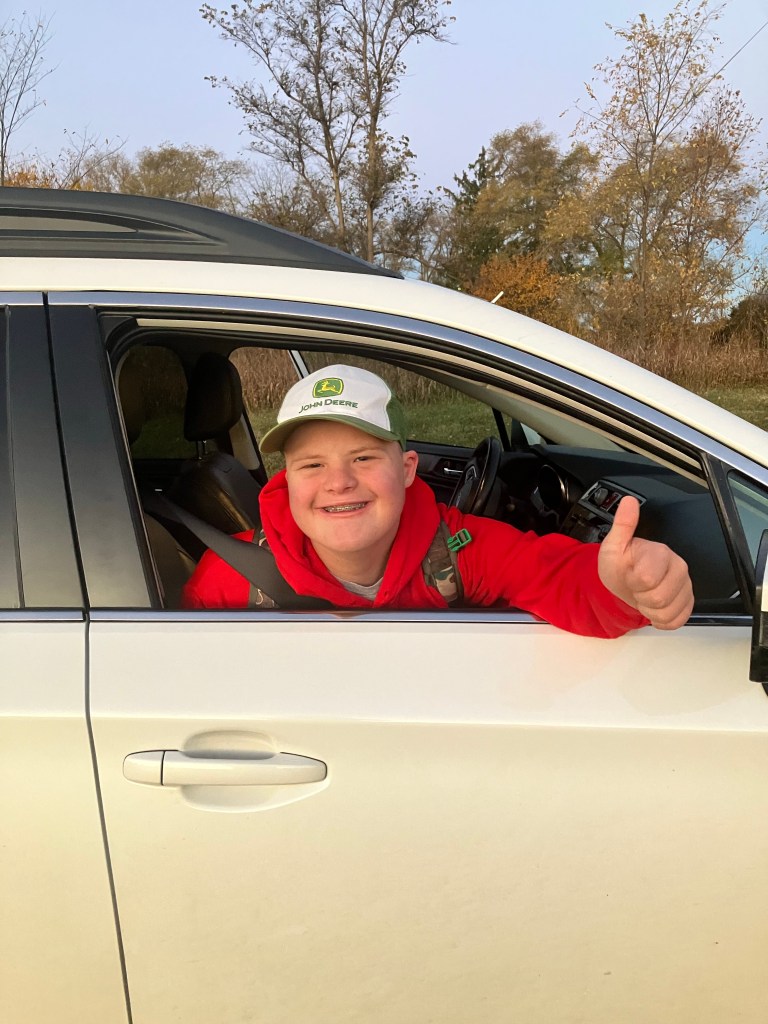


 'WIL'ingness = Willing to Embrace Extra in Life