Wil was just giggling to a tv show. Now he squished himself next to me in the Lazy-boy, as I was reading quietly, and started giggling. When I made him breakfast earlier, he danced around the kitchen, giggling.
Wil’s a giggle creator. 💙😃
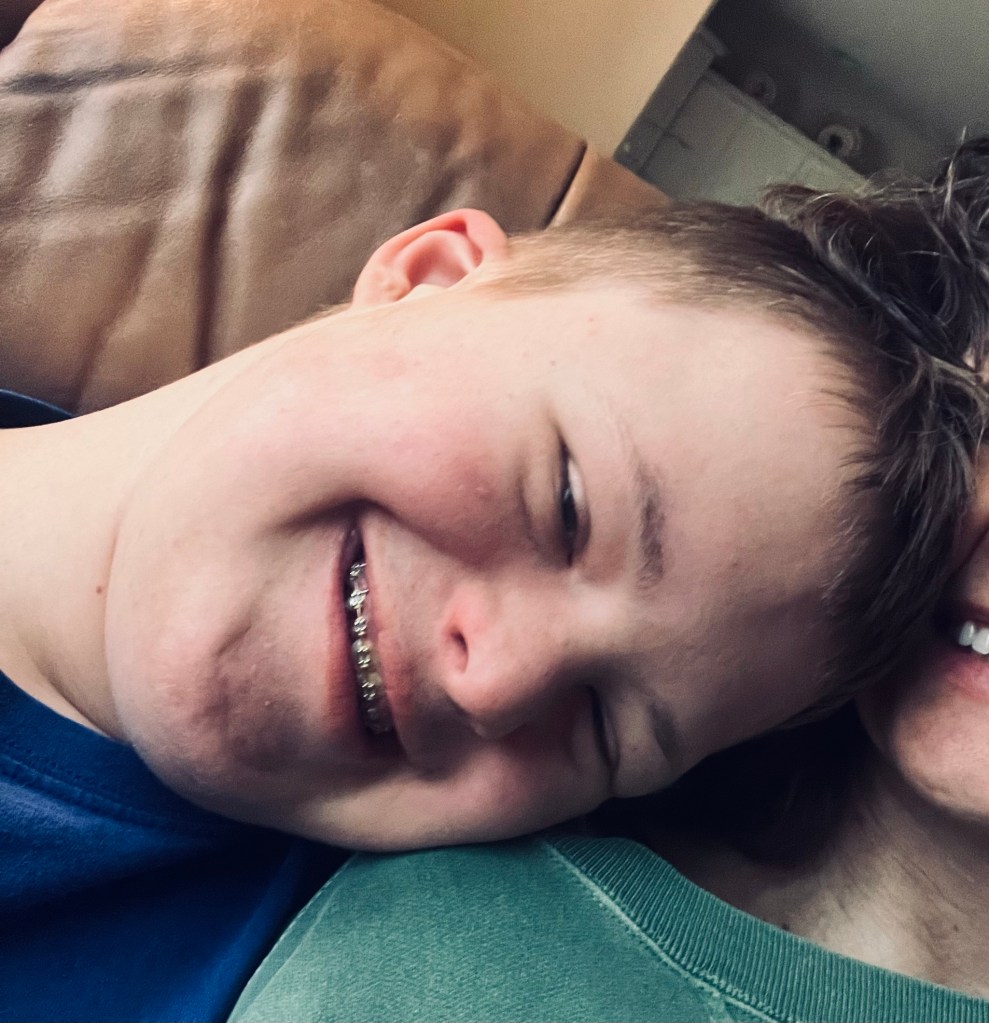
Wil was just giggling to a tv show. Now he squished himself next to me in the Lazy-boy, as I was reading quietly, and started giggling. When I made him breakfast earlier, he danced around the kitchen, giggling.
Wil’s a giggle creator. 💙😃
“The first problem for all of us, men and women, is not to learn, but to unlearn. We are filled with popular wisdom of several centuries just past, and we are terrified to give it up.”
Gloria Steinem may have had women’s rights on her mind with this quote, but it rings very true for our friends with Down syndrome. I was so scared when I received Wil’s diagnosis. Why? Because of an outdated belief system handed down to me from centuries just past. I had no other frame of reference; it was what I knew and the unknown is a scary place.
When I opened my mind; when I truly looked at Wil and accepted anything and everything to come — all the knowns and most importantly the unknowns — is when my world first cracked open, then burst open, and love flowed in place of the fear.
HAPPY WORLD DOWN SYNDROME DAY!! #WDSD2023

At a social function a man said to me that he felt sorry for people who had children with Down syndrome. How hard it must be. Then he met a woman he love’s daughter, who has Down syndrome. Now he can’t imagine life without knowing her daughter. He shared how much bigger and brighter life is.
Some heads won’t be knocked open, no matter how hard you fight, claw and shout. But there are those whose hearts will open without even trying. They only need to be invited in.
Welcome, my friends ❤️

Wil’s paraprofessional, Kristi, told me how Wil — of his own will — went to the closet in gym class, pulled out two baskets and two balls. He proceeded to toss the balls in the baskets. His peers joined in his created game by cheering him on.
Today I picked up Elizabeth, Wil and their friend Kimmy from school today. Elizabeth had an NHS meeting, so Wil, Kimmy and I sat in the car waiting for her with the windows down. As kids poured out of the school, Wil yelled out his hellos, and peers called out and waved to Wil. One friend, Trent, walked up to our car and chatted w Wil. Trent has about every sport there is on his letter jacket. After their chat he fist bumped Wil and walked away.
Wil takes this all in stride, having no idea how this type of interaction is not commonplace. To him, it’s just another day at school with friends.
Kimmy, whose aunt and sister have special needs, said how embracing of Wil the students are at school. I responded that it fills my heart; its what inclusion is meant to be. Wil’s experience is as it should be but isn’t how it always is.
Kimmy agreed, saying she sometimes forgets how people don’t grow up under the same circumstances as she does, and don’t always understand certain reactions and behaviors of individuals with special needs.
I’m so thankful for this Community School experience. It’s enriched my life as much as Wil’s. It’s what inclusion is meant to be — a benefit for all. It’s about friends being friends; of all abilities.

In embracing our vulnerable population we embrace our own vulnerabilities.
We crave Love. Love is the base of all things. Love is survival. We crave, live and breathe for Love.
In embracing individuals that we previously misconceived as having lesser value, we find in fact their value is greater than ours as theirs is the truth-pathway to LOVE. In embracing those we do not fully understand; we must find within ourselves a deep patience and seek to view life in new and fresh way. It is in this way we find Love — a love deeper than we knew existed. A love that touches and speaks of God. We feel God and His Presence even if we are not religious; even if we are non-believers. Whatever we believe, we cannot deny what we feel. We call it Love. And yet it matters not what we call it. It only matters that we FEEL it.
Once we are touched by that feeling, we crave more. This Love lifts us, lights a fire within us. We find it hard to believe it was something we closed ourselves to. But we did not know we were living behind a closed door until our child with a disability; or our experience with individuals with disabilities opened the door for us. The blast of fresh air is what alerts us once we open our minds. It blasts us with a gust, not unlike a hurricane; it forces us out of our closed mind so far that we can never go back. We never want to go back. In fact all we want to do now is pound on closed doors in our desire that those behind the closed doors know this Love.
We see the fear, and know the difficulty to get past that fear. But once you feel the blast of fresh air in your face you cannot but want more of it, and want more of it for others. And so you advocate for your child, but it is so much more than equal rights and acceptance. It is a Love, a Love for all that lays hidden. A Love that is locked away inside of us. We are scared of it’s immensity. But in the fight for your child you release it. You must, for their sake more than yours. And you find in this unlocking a Love greater than you ever knew existed but it does exist in immensity all around you. And when you breathe it in fully it grows and grows and grows. There is no end to it, and though it is bigger than you could ever conceive, even a small slice of it breathes new life into. You cry in the sheer love that you feel. And you know you can never run out of that love because it is always there, it is bigger than anything your mind can conceive.
You must re-open yourself to this Love every day. Recharge yourself with it. When the doors start to shut due to habit or other’s actions — your child opens the door for you with a kiss on the cheek, a simple gesture, or a silliness. And when you try to describe this type of grand simplicity that has the power to open a door, those behind closed doors see only the simplicity of the gesture, as they have not opened themselves to the grandness. They refuse to open the door to this Love, staying in a sheltered space they know. Fully unaware that the immensity of Love is available to them if they only unlock the door. But when we don’t know, and what we only know is behind the door there is great security in that. There is great control in that. And we think we are thriving when really we are not. We have created a life that feels good behind the closed door. Even when it doesn’t feel good, it is what we know — how terrifying to go outside of what we know.
When we spend time to truly know and understand our vulnerable population, oh, what LOVE. It is open, it is free. Our children never tire of opening the door; it is their nature. It is on us to open ourselves to them.
You will know when you feel the Love. This Love is yours, it is all of ours. It is in endless supply. Let us circulate it. Let us ventilate closed doors. Let us embrace our vulnerable population.

Down syndrome is not all of him — it is a very real part of him to not only be accepted, but also embraced to embrace the whole of him. 💙
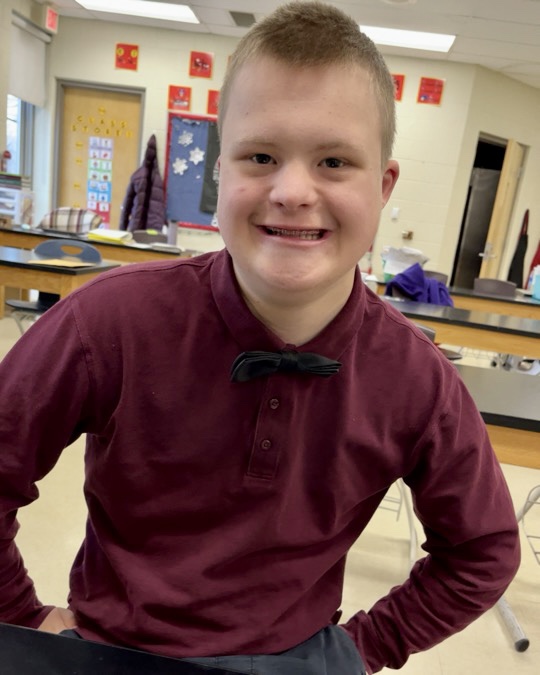
Today Wil and Manny went bowling. Both are teens with Down syndrome. Manny’s mom, Laura, and I share frequently about our plans, thoughts and concerns for the future. Thoughts about our boys as they age out of the school system; after friends have moved on to college, to jobs, to get married. How will our boys adapt to the change? What programs are available now and in the works for the future? And of the programs available, are they a good fit for our boys?
Last night my friend, Cheri, who’s son CJ (who you may know from his weather reports—WCJR weather) called me. CJ is graduating high school this year and also has Ds. Cheri and I shared our thoughts and plans for our boys’ futures. Cheri is always a step ahead of me in raising CJ, and I learn greatly from her experiences.
Not everyone has a teen child with Ds. We must actively seek one another out, actively seek out programs, and discern if what’s available is the appropriate fit for our soon-to-be adults. In fact, just today, Wil had an interview with a summer camp I’ve tried for years to get him into. Wil is ready for an overnight camp, but not without an aide. Just going to a typical summer camp is not an option for him. And that is the case for many people with disabilities; thus the long waiting list. The interviewer said Wil’s a really good fit, but spaces are very limited. She was wonderful, we connected immediately, and said she’d do what she can for him to get in.
Recently talking with my friend, Vanessa, who has a teen daughter w Ds said to me, “You bend for the ones you love.” That statement delivered great clarity to me. It makes sense of what connects me to a camp counselor I just met on a 30 minute Zoom meeting, but knew her innate understanding immediately; and also what connects me, on a deeper level, with my friends. We bend to create understanding and opportunities for people with disabilities. We bend together for the ones we love.
As Vanessa spoke those words, I visualized trees that stay closed in, protecting the roots they know, refusing to bend. Then I visualized trees firmly rooted in love, but with branches reaching, stretching, bending, some almost impossibly yet never breaking, open to receive the sun along with the rain — both of which serve to strengthen them.
If you were a tree, what kind of tree would you be? 😉

I shared with Wil’s friend, that during the snow days off school, “Wil and I played with these big blow-up things that you put over your hands and then punch each other with.”
Wil interrupted me with a flat-toned, “They are called Socker Boppers, Mom.”
Wil is at a stage where he reads everything around him — even the words printed on the big blow-up things that you put over your hands, that I clearly took no time to read. But when you discover you can read about anything around you, then that’s what you do!
So within that one sentence Wil interrupted me with, I felt elation for his high interest in reading everything around him, mixed with an internal chuckle over his very typical teenaged eye-roll comment.
Life may be found in the present moment. But I have also found that observing the progression of moments over time fill the present with more life.

I remember, when Wil was a brand new baby, I walked into my first Down Syndrome Support Team (DSST) meeting. Young kids with Down syndrome were running around playing like young kids do. Everything was so normal, and yet it wasn’t to me, because all these kids had Down syndrome. I went home, though very supported by the parents, crying my eyes out. My mother-in-law, who was at our house watching the twins (who were not even 2 years old yet), asked how it went. I broke down crying again. My emotions felt too big to process.
Yeaterday, at a DSST teen event, our kids acted like…you guessed it, total teenagers. They went between competitive games of pool, foosball, and Apples to Apples, to being cool and aloof. We finished the event with a dance party, and our teens got down like James Brown! I went home floating on a cloud.
What was the difference between then and now, other than age? Its the same, but also not. And in the process of learning the “not” I fell in love with the whole.
And when you can embrace the whole, there is an elation with a depth to it. Kind of like a James Brown charasmatic scream 🙂
I feel good!! Oww!!

I made Wil’s breakfast and busied myself in the kitchen awaiting Wil’s typical wide-armed entry into the living room with a hearty, “Look at me, Mom!” (He takes great pride in his clothing selection each day.)
“Oooo, fancy!” I’ll reply. This morning, however, just enough time had passed to suspect something was wrong.
“Do you need help, Wil?” I called out from the kitchen. I received no response.
I walked into Wil’s bedroom. He sat on the floor, shoulders slumped, still in his pajamas. The underwear drawer hung open in front of him.
“Wil, you have underwear in your drawer.” I picked up a pair.
Wil put his hand up. “No mom.”
“What’s wrong. Do you want a different color?”
“My new underwear, mom.”
“Oh, I have some in the dryer. I’ll be right back with them.” (I recently bought Wil new bamboo-based underwear for his skin sensitivity.)
I returned to Wil’s bedroom and playfully tossed him 2 pair of underwear in different colors (I was trying to keep the mood light. I didn’t know if this was simply about underwear or if it was a deeper problem.)
“Two pair!” He exclaimed as he caught the underwear. I relaxed. It was just about underwear.
“Hey Wil, thanks for telling me what was wrong. That way I could help you. See how easy that was? Next time, just come and tell me what you need. If you tell people what is wrong, then they can help you. Otherwise we just don’t know, and then we don’t know how to help.”
A short 2 years ago there is absolutely no way I could have had this conversation with Wil. He would have stayed on the floor without a word. His shoulders would have slumped further, and any more words from me, no matter how reasonable or helpful, would not be reasonable or helpful to him. More words would drive him deeper into his frustrated state.
A short 2 years ago I would have sat next to him, and maybe even silently cried because we had so many such mornings. Like many teenagers, hormones and body changes put him in challenging moods, and with a communication barrier I had to guess at the reasons for his upset.
Different underwear than what was in his drawer would have been the last on my checklist of guesses. Because school was challenging for him at that time, my mind would have leapt to problems at school. I would have become increasingly upset and sad for him. I then would have texted his paraprofressional (who is wonderful!) and probed her for any clues as to what may have been setting him off. We both would have poured over recent events trying to discern what was wrong so we could unravel it for him.
And yet, for all our surmising, the solution was a different pair of underwear.
And so, this very morning, I was the happiest mom on earth. I had a conversation with Wil, and Wil responded back to me. His back step of getting stuck with lack of communication was also a forward step in expansive conversational communication.
Over and again, Wil reminds me that what seems simple on the surface often is not; and what seems complicated on the surface often is not. And that no moment — be it simple or complicated — is to be taken for granted.


 'WIL'ingness = Willing to Embrace Extra in Life