This Monday there was not a 7 minute standoff success story as I shared last Monday. In fact, after 20 minutes I remained the only one standing.
After giving Wil silent time to process, there was not a hint of progress. I tried being silly. Wil loves being silly, so the tug to join my silliness is often hard for him to resist. All I got in response was a flat-toned, “Mom, stop.”
I finally called it — even though Wil already had — he’d stay home.
I never call “calling it” a loss. It’s hard, yes. It’s frustrating, yes. It can put me, his sisters, his therapists, his friends — whoever we have a commitment with — at an inconvenience. The time they have set aside has now been dashed. Gratefully, most who know Wil, know that he makes most of his commitments, but sometimes he gets deeply stuck. And when that happens, it’s not going to happen.
The winning side is that Wil and I both learn through times like this. Even if it doesn’t show at the time.
His is a quiet learning; growing under the surface like the roots of a tree. Stretching, reaching, drawing upon water, all underground. Then one day, these roots now strong, bust through the surface breaking a sidewalk slab in two, seemingly out of nowhere.
I create the environment for growth. Figuring out how much water, how much sun. Last week I got it right. This week I overdrenched. He dug in deeper underground. There’s no exact formula. You go by experience, by hunches, by what you heard another parent try. And keep trying.
Today the roots lay dormant, but just maybe I shared a burst of sunshine or quiet rain that was needed for growth to emerge on another day.
“It’s hard raising a child with disabilities.” If I had a quarter for every time I heard or read that statement. Bear with me while I flip the coin for a moment. No story is ever one-sided.
When I watched Wil walk off to his cabin for his first overnight camp, without even a glance back at me, my chest literally felt like it would burst open. Every part of my being begged to melt into an all-out uninhibited sob and fully feel all the emotions flow through and over me.
It felt like I had a million birds fluttering in my chest, crying to burst out. Each bird a story built upon another story that brought Wil and me to this very spot; stories of backward steps that said we’d never make it, stories of forward steps giving hope that we just might. Stories of angels on earth that took my hand and walked me through hardships; stories of those that withdrew emotional support and left me to walk on my own. Stories of my own inner growth; my own inner strength, my own education and devotion to this life. All of these stories now bound together begging to fly high together and exclaim in one unanimously strong and beautiful Hallelujah!
But I couldn’t let the birds free. I couldn’t give way to my sobs. I’d embarrass Wil. So I allowed tears to stream quietly down my cheeks. And that’s how almost every success Wil’s had has been. We work for it and work for it, and when it appears he’s like, “Yeah, what’s the big deal? We’re here now. Moving on.” We are like ducks paddling in the water—I know the destination, but I’m working under water. Coaching him how to paddle his legs. Sometimes he listens, sometimes we speed ahead, and sometimes we go backwards, sideways or float for a while. Sometimes I have to change course; sometimes I need to be patient with the course we are on. But we always arrive somewhere, and when we hit land, I surface and take a big breath in of the fresh air. The joy of the destination we worked for overtakes me. Wil looks around proud himself but with an inner knowing, like yeah, I knew we’d get here. You do know by now this is on my time and not yours. So here we are, right on time. Get control of yourself, lady!”
To Wil, I’m just his mom. I support him, I annoy him, I push him, and I spoil him. He’s moving forward in the way he intends to do. To him, this camp was right on time. To me, I knew what it took behind the scenes to get here.
We parents raising our kids are often called saints. That often puts me off because it puts us on a pedestal, rather than walking the earth right beside them.
I’m no saint, I’m just a mom that does what she does because she loves her child. But I have touched heaven being Wil’s mom; many times. Most recently I was standing on a little patch of grass at a summer camp, watching my son walk independently away. So maybe the saint-callers do have a point, because I would never have known that level of joy if I didn’t know the depth of the flip side.
There is no magic formula to acceptance of our friends with disabilities.
Acceptance, in its essence, is very simple.
You don’t need to be a special person. You don’t need to be born kind or compassionate or patient. You don’t need to be energetic or inspirational.
You don’t need to be anything other than willing to open your mind to acceptance.
That’s it. You don’t need anything else. It’s simply to be or not to be.
Once you truly open your mind to acceptance, the rest will come. The new ways of thought. The adventures you never considered. The new friends you wouldn’t have known otherwise. It’s the experience, once accepted, that delivers the specialness, the kindness, the compassion, the inspiration, the energy and the patience.
But if you keep your mind closed, then you’ll never know the amazing you are missing.
Acceptance is not a natural-born talent or a skill; it’s a choice. And that choice is up to you.
A sticky, filmy, wiggly smudge snaked across my computer screen. I’m not a fan of snakes, but I looked at this one endearingly.
Just a few days ago Wil was flipping through photos on my computer. They were photos of experiences at Camp Sunshine; the camp he’d be going to this very weekend. He smiled and called out to me to talk about each photo.
“Mom, a pool! Mom, a talent show! Mom, dancing! Mom, look a stage!” Wil’s finger followed the action of each photo. As he was on Camp Sunshine’s Facebook page, he went in deeper and deeper through the years. He didn’t want to stop looking, because he couldn’t contain his excitement about camp. He wanted the experience right here, right now.
It would be his first camp away from home; 3 nights, 4 days. Clearly, he was ready. I was ready for him. I’d been trying to get him into this camp for the last 4 years. When I finally was able to secure him a space, we then had an interview with Josie, his camp counselor. When we met Josie for the first time via Zoom she said, “The bad news is it’s hard to get in. The good news is for that same reason, once you are in, you are in.” Wil can go to this camp every year for as long as he lives.
When Wil and I entered the camp grounds, the camp was swimming in counselors with blue shirts on, and I’ll be darned if I could find one of them without a smile on their faces. The counselors were loaded to overflowing with just as much excitement as the incoming campers.
Many of the campers and the counselors had been coming back for years. As Wil and I waited in the line to hand medications to the nurse, we met Pete and his mom. Pete was 27 years old and this was his 6th year coming to the camp. At least 4 of the camp counselors approached Pete calling him by name as we waited in line.
“Hi!” A woman about my age with short, spiky gray hair in a blue camp shirt said to Wil. “My name is Kathy. What is yours?”
“Wil.” He smiled at her.
“Do you like fist bumps, high-fives or hugs?”
“Hugs!” Wil said. Kathy leaned in and the two embraced.
“And who is the beautiful woman you are with Wil?”
“That’s my mom!” Wil answered.
We were approached by many camp counselors just as friendly and effervescent as Kathy. Every counselor, without exception, addressed Wil directly. (You’d be amazed how many questions I get asked about Wil when he’s standing right there!) The counselors pointed every one of their questions to Wil as you would to any 16-year-old. As it should be.
After Wil was checked in and his medication handed over, it was time for Wil to go off on his own to camp. A young counselor named Conor placed a lanyard with Wil’s name badge over his head. As Wil bowed to receive his name badge, I felt the process almost knightly.
Next was the crossing-over ceremony. Multitudes of blue-shirted counselors lined each side of a walkway that lead to the cabins. Parents were not welcome on this walk. It was only for the campers and the counselors from here on.
“Do you want a loud or quiet send-off Wil?” Conor asked.
“Loud!” Wil answered without hesitation.
Cheers erupted as Wil marched forward through the walkway, pulling his suitcase behind him, never once looking back.
I stood on the sidelines trying my hardest not to fall into a body-shaking sob. My tears though, held no sadness. I cried feeling deep gratitude for the people that create a space such as this. A place that embraces my son for all of who he is. I cried seeing my son’s independence — it was an independence we had always worked toward but was never guaranteed. Many parents work this hard and certain levels are just not reached. So we celebrate every advance we work toward no matter where it lands us. And thus far, this is where we have landed and it is to be greatly celebrated.
It truly takes a village. Wil, our family, our friends, our educators, camp counselors and all of his supports. We all created this space together, in our own ways, and his independence means celebration for him, and also for the village.
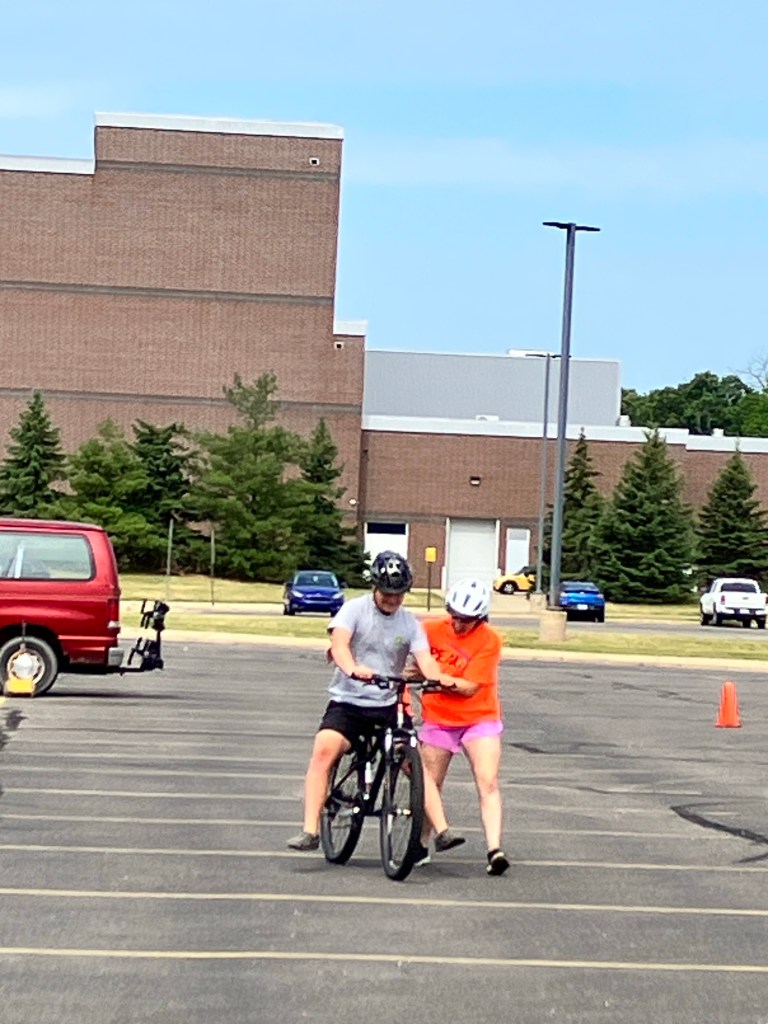
I walked into the parking lot area where Wil was to take his PEAC bike camp. I was overcome with a positive, uplifting feeling — thankfully this type of feeling is not unfamiliar. I’ve grown accustomed to this shift from breathing dense air into a higher atmosphere in only one step.
This atmosphere is one of people helping people. It is beyond a good deed. It is true unity. We innately know the difference as it’s the way we are supposed to be — together.
This is one of the many gifts individuals with special needs offer us. We only need to rise beyond ourselves to accept this handed gift.
We may believe our thinking is correct; or it is good—that we are good people.
Even those of us that call ourselves open-minded may find we have unwittingly closed off our minds when spending time with individuals with disabilities.
Why is this?
Because we have to see it their way first to understand. And many times — in some cases most of the time— their way is not easily readable. So we push our agenda on those with disabilities.
Individuals with disabilities’ way of communicating may be very different, or even non-existent in a verbal sense, so actions must be carefully observed. And even then we may remain clueless. It takes too much patience, and so we, even unconsciously, push our way on them, or we ignore them.
Our own belief system must be suspended to decipher theirs. We must let go of trying to be “good” or “helpful” because our version of what is good or helpful may not be for them. This very fact is likely the most challenging, and yet the most empowering process, in our very own lives.
When we suspend our own belief system in order to understand theirs, something shifts within us. Something bigger, something higher — spiritual even.
This process has no end. In fact, in 16 years I’m only just beginning. I’m stronger than I’ve ever been in trying to understand Wil, and understand the world’s reaction to him. I’m learning as a parapro to understand many differing abilities. It’s challenging and I need the expertise of those around me, because again what I think of as being helpful may not be helpful to them.
But it’s also so amazing to understand what in some ways may never be understandable. It wakes up something in me. Not because I’m trying to be a good person; it is because I truly want to understand what these kids are trying to say.
Those with disabilities are true gifts to us all—and yet this population is so very ignored and misunderstood. We must first forget ourselves, in full effort to understand another, and in that we find a stronger constitution of our own selves within.
At 53 years old I am a student. At 89 years old I will be a student. When I say goodbye to this world, I will be a student.
Yesterday, I was trying to help a student who has autism. I was kind. I gave this student squeezes, I spoke calmly; soothingly. This student’s aggravation grew.
I see a lot of “Be Kind” bumper stickers. “Be Understanding,” in my opinion, is where we need to “Be,” but that’s too substantial for a bumper sticker.
I looked to the teacher for advice with this student. The teacher explained that this student was working through inner thoughts; likely about an event that happened earlier at home that we knew nothing about. This student needed space to verbally work through those emotions.
This explanation clicked immediately in my mind. It made sense in the way some times physical touch and calming words are needed; while others space is required. But without that explanation, I don’t believe I would have seen this difference on my own. But now that I did, it was set in place in my mind and I will now be better equipped to help this student when another such happening occurs.
Every day, in this way, I gain new understanding. I gain new confidence and strength in helping give these students what they need to move forward.
One of my friends, whose son has autism, said she wishes, just for a moment, she had a special key to unlock his brain, walk in, take a look around, say, “uh huh,” then close his brain back up and move on with life.
Full understanding is an unattainable goal, but when we shoot for the moon, we can reach the stars; even if it’s one star at a time.
I’ve been asked more times than I can count stars, “How do you have such patience?”
I’ve used the word “patience” regarding Wil in my stories about helping him through “stuck” patches. But now, after having the few months of experience in this work that I’ve had, my perspective on “patience” has shifted.
Now, when I consider that word, “patience” is exercised when I don’t want to take the time to understand. When time is urgent, and Wil won’t go. When I want Wil to cooperate and he won’t. So I wait him out. But when I truly learn to read his cues; when I anticipate what may happen, when I try to take the “key” so to speak and unlock what is happening in his mind, that’s not patience. That’s being a student; that is cultivating an understanding. And when you unlock even a piece of understanding, the elation is beyond words.
To truly fill up the well inside of you, don’t just “Be kind.” Be desirous to learn. Be desirous to understand. Be desirous to be a perpetual student. Reach for the moon, and even if you grab one star, you’ll “Be” substantiality beyond what any bumper sticker can preach.
Wil has grown so much in his 10th grade year, and I can’t thank Kristi Campbell, Hope Schook and Heidi Drake enough for that! For this fact, it gives me space to snicker when I read about a day like this:
10:05 Refused to work 10:08 Turned it around 10:25 Refused to work 10:30 Turned it around 1:50 Refused to work 1:54 Turned it around
Just last week, I worked with a paraprofessional that subbed for Wil in 1st grade while his primary para was on maternity leave. We laughed that the main topic of daily conversation then was how to get Wil out from under the table most of the day. At the time, though, it was no laughing matter!
But with time, collaboration & communication with caring educators, we’ve come a long way, baby!
We are on to larger concerns, as Wil is an adventurous guy; without fear/recognition of danger which will likely be on our radar for years to come.
So seeing these little bursts of stubborness that he can resolve in minutes, is him showing his personality in full force and finding the self-desire within him to turn it around for a better day — while giving his teachers a run for their money! And we wouldn’t want him any other way!
My son will not play in the NBA; my son will not invent a new vaccine. My son will not design a software program nor manage your finances. My son will not drive a car nor drive a recycling truck.
But my son sang for nearly 4 hours on our drive up north without any music playing other than what was in his head. My son can put an impromptu Luke Bryan medley together faster and more expertly than Luke himself. My son knows the lyrics to well over 100 country songs. My son still jumps in puddles at age 16, finds reasons to laugh over things we’ve long forgotten, and has a joie de vivre that is enigmatically contagious.
My son is also frustratingly slow when he doesn’t want to do something, often coming to an abrupt halt. He will not be bullied, pushed or cajoled. He will do things in his own time; not mine and not yours. My son is hurt deeply when others try to force their timeline or opinions on him; yet he doesn’t hold a grudge against others. He quickly forgives, but he never forgets.
My son has his own opinions, idiosyncrasies, habits and preferences. My son, just like you and me, is fully human in beautifully challengingly ways. That is where we all can meet.
Wil does not have to win a pulitzer prize to prove his worth to this world. In fact, his having a disability gives us the opportunity to be better humans than we are. Wil, in his own way, is a pearl.
Wil was always a pearl; it was my heart that was the sand that needed to be molded and shaped.
Many do not take the time to look within their own hearts to see the sand; and this is required to take the time to understand my son. To understand Down syndrome. Our closed minds are the sand that we must mold over time and experience, and in that we find the pearl of his existence. And the beauty of that journey is we come to value what human life is about. It’s more than achievement. It’s more than habits. It’s about remembering the songs in our hearts before the sand gritted and obscured them.
I don’t want a cure for Down syndrome; I want a cure for a belief system. I want to turn sand into pearls within us. If we can create vaccines and information systems and recycling systems, can we not do this?






 'WIL'ingness = Willing to Embrace Extra in Life