Word Up!

When Wil tries to figure something out, he has a back-and-forth conversation with himself: “Wear the grey shirt? Yes, yes, the grey shirt.” This will go on for his hat and shorts, too; and with most any task that requires decision-making.

He’s been having these conversations for about 5 years now. At first, I was concerned. He didn’t talk to himself, then all of a sudden he did — all the time. I worried these conversations developed because his peer group didn’t speak at his speed, and this was a coping mechanism to keep himself company. I did, however, enjoy hearing his thoughts, as he wasn’t always able to communicate them to me. And when he got stuck on something, I knew why.

Raising a child with a disability, you grow accustomed to digging into behaviors. Behavior is communication, but when your child isn’t capable of communicating, you put on your Sherlock cap and get to work. At first it’s something you figure out, then it becomes part of your everyday lifestyle. You don’t even realize you are doing it.

If Katherine or Elizabeth started talking to themselves, I wouldn’t think anything of it. I talk to myself out loud sometimes. It helps to clarify thoughts. And come to find out, that’s exactly what Wil was doing. But I didn’t see it because I’m always looking deeper than surface level, and not even realizing it. Wil doesn’t have the social filter that Katherine Elizabeth and I do in this area. To him, he’s simply making decisions out loud with no concern about who is listening.

Looking further into this behavior, I discovered it’s very common in people with Down syndrome, and can carry into adulthood. Now that Wil has been doing it for some time, I don’t even notice it as different anymore — because it’s not.

Today was a fun leap in Wil’s personal conversation. When he has his hands full getting out of the car, he’ll say, “Mom, I can’t do it, I don’t have enough hands!” (Don’t I know the feeling!). I’ll reply: “Sure you can!” And give him a few tips, such as tucking things under his arms, or making two trips — but who does that? Then I leave him to it. Some days he gets frustrated and sits in the car, and some days he takes my suggestions right away. Either way, he figures it out.

Today, Wil tried to get out of the car with a stack of CDs and his water bottle. Rather than addressing me this time, he said to himself: “I can’t do it, I don’t have enough hands!” Then he replied to himself, “Sure you can!”

He grabbed his CDs in a stack, opened the car door with his other hand, then got his water bottle, and bumped the door shut with his hip.

Now you’re talking, Wil! 😀

Mixed Medley

I dropped Wil off on the second morning of his first all-day camp.

He talked about camp for weeks; water balloon tosses, scavenger hunts, a trip to the beach – and parent-free. There were no tears at drop-off; Wil and I were both ready for this leap in independence.

This summer has been the Mom & Wil show. As 17-year-olds, Katherine and Elizabeth have taken trips, worked, and enjoyed the freedom of driving teenagers. As such, this summer has been a sneak-peek into life with Wil when Katherine and Elizabeth are away at college. As close as Wil and I are, we both require a level of time on our own. I knew it was time to find a way to spread our wings — but how and where?

This first all-day camp experience would be an ideal situation for Wil. It is where he takes taekwondo, so he is familiar with the staff and the venue. Master and his staff are very understanding of Wil’s abilities. They know when to push him, and when to give him space. Wil would enjoy time with typically developing peers and two of his taekwondo buddies who also have Down syndrome.

Even so, it would be a long day for Wil. He was focused on the fun; I was focused on preparing him for a full day.

“Wil, you know camp is a full day; the same as a school day. You’ve got to hold it together.”

“Ok, mom.”

“You are going to have a lot of fun. But you may get tired. And that’s ok. Just tell someone. Find Master, or one of the helpers in a red shirt. Tell them you need a break. Use your words. No plopping or running off. Got it?”

“Ok, mom. Camp! Yay, woohoo!”

I played my preparatory words on repeat in the weeks leading up to camp. It may seem redundant, but I knew from experience that he’d fly in blazing, only to find that it truly was a long day. He’d then fizzle into an exhausted plop on the floor, or flee overwhelmed out the door. His words, or words by others spoken to him, would be lost. Only time and space would unravel him.

Wil is fully capable of communicating that he needs a break. He just needs to be prepared to use his words before overwhelm or exhaustion overtake him. Therefore, we play things on repeat around here.

Wil focuses much of his life on the fun side, and I’m on a joy-ride with him. The flip side of that is anticipation, preparation, and words on repeat — and I’m on a replay-loop of constant-ness with him. Sometimes I need to step out of the loop and take time for myself, while Wil needs to take a step away from me, and forward into independence.

On the drive to camp this morning, Wil sang his own impressive a cappella medley of Luke Bryan songs — I thought dang! Even Luke would be taking notes on what Wil put together. But then again, Wil knows better than most how a mixed medley works.

Yesterday Was a When

Yesterday, Wil and I had lunch and a conversation on the back porch.

One night, I sat on the edge of Wil’s bed. It was the school year of 2016. In the quiet before sleep, Wil was most apt to share his day. I always started with questions about his friends and lunch; they were (and still are) his favorite topics. I also knew the answers, so could prompt him if he got stuck.

“Who did you sit with at lunch today?”

“Ashley.”

“And…”

“Lila.”

“And…”

“Sarah.”

“Did you play on the playground?”

Wil nodded.

“What did you play?”

“Hmpf.”

“Did you play with a ball?”

“Hmpf.”

“The swings?”

As I prompted him, word-by-word, Wil shared pieces of his school day.

Then the tears came. They seemed out of nowhere, but I knew they came from somewhere.

“Wil, what is wrong honey? Why are you crying?” No answer.

This is where it got tricky. Did I continue to ask questions? Questions could further frustrate Wil, causing him to clam up. Or questions could do the opposite; open Wil up and help him feel understood. I’d ask leading questions, as he wouldn’t be able to offer what happened. But even the leading questions had consequences.
On another occasion, when Wil was unexplicably upset, I asked: “Was someone mean to you?” He looked up at me like “Why would anyone be mean to me?” And there I did it, his very own mother, who most wanted to protect him from mean people, put the very idea of mean people in his head.

“Wil, do you feel sad?” He nodded.

“Wil, do you feel mad?” He nodded.

“Can you tell me one thing that upset you?” He nodded.

“Would you like a hug?” He nodded and we hugged for a long time. My tears started too. I needed to understand his emotions, and he needed me to understand them, too.

Communication barriers are very sturdy. They take extreme patience and diligence to break through. I never know what question will lead to a hairline crack. Or what question will seal it shut.

What I do know is the answer to most things with Wil is time.

Given enough time, the words would come. I just didn’t know when.

I’ll never know what happened that day. It may have simply been overwhelm from everyday life. Wil’s teacher and paraprofessional were a dream team that year. If anything had happened to Wil at school on their watch, I’d know about it.

There are so many painful memories; days I wished I could even make a hairline fracture in the communication barrier. But Wil couldn’t meet me where I was, and I didn’t know how to meet him where he was.

Over time, we made progress. Like Thor’s mighty hammer, we made big, clunky breaks. Some on purpose and some by trial and error.

But when you make a break, you can’t miss it.

It flows — like a lunchtime conversation carried away on a summer breeze.

Yesterday was a when

It’s in the Experience

The teenaged lifeguard; tall, lean and curly-haired, stood on the edge of the wave pool blowing his whistle — at me.

I saw her face in his; though she was his senior by at least 20 years, with straight brown hair and a brisk uniform. She was resolute to get Wil’s boarding pass — from him.

Though the airport incident happened over 2 years before the wave pool incident, time came together in their parallels.

When a pool or a plane is involved, Wil is the happiest guy on the planet; until he’s not. Both travel and swimming fill Wil with excitement, unless it brims over to overwhelm; rendering him stuck on the spot.

In the airport, Wil was well on his way to overwhelm. I saw it building, so did my best to keep him distracted and on-the-move. But the heaviness was taking him over. Wil has never had a problem going through security, so I didn’t anticipate an issue. But when we approached the podium, either Wil read this security guard’s demeanor, or overwhelm finally overtook him. He sat on the ground, smack dab in front of the security guard’s podium. Not the wisest choice, but there we were.

I offered to hand the security guard Wil’s boarding pass, but she refused. He had to do it. I explained he was overwhelmed and had Down syndrome. That wasn’t enough for her. A grown woman chose a stand-off with a then 13-year-old boy with Down syndrome.

Fortunately, a few podiums over, another security guard was witness to what was happening. She asked how she could help. I explained our situation. She reached her hand out to Wil, he accepted it, and she walked us down to another podium. I heard the stolid security guard, upon our leaving, say to the security guard that helped us, “I was just doing my job.”

“I understand we need to get out of the pool,” I said to the curly-haired lifeguard. “My son won’t get out on his own. Just give me a minute.” (I sent up a silent prayer that a minute was all we’d need.)

I crouched down next to Wil and explained that it was dangerous to stay in the water; that a storm was coming; that when lifeguards hear thunder we need to get out; that we need to respect the rules; that they are there for our safety.

I knew my words wouldn’t motivate Wil out of the water now, but they would have meaning later should this happen again. Wil doesn’t fully grasp danger, but he does have an ironclad memory. When I preface a pool trip with the words “we have to get out if there is thunder” these will no longer be empty words. Experience gives Wil meaning to the words, thus being the best teacher.

A pretty lifeguard with white-blond hair stood only a few feet from us. Wil, being a teenager, would certainly respond better to her than me. I walked up to her and said, “My son isn’t wanting to get out. When he’s like this, he does much better with people who are not mom. Would you mind asking him to get out. Maybe offering him your hand?”

She willingly agreed, and approached Wil with an outstretched hand. Wil lifted his head, but couldn’t quite motivate himself to fully reach back. Though he stayed in the pool, I could see she had released some of his resistance.

Two female sheriffs that were nearby approached Wil.

“Would you like a sticker?” They held golden star badges up for Wil to see. I appreciated their efforts, but there was no way a sticker was going to prompt him out of the water (but maybe a trip to the clink would!).

Then another teenaged lifeguard, with auburn hair, walked up to me and said, “Can I help?”

The clouds parted and angels sang! No, that didn’t happen. Or else we would have got back to swimming. But that’s exactly how those words felt.

Three little words; only 8 letters in their entirety. And yet, I knew they were more than words; there had to be experience behind them.

The auburn-haired lifeguard, with a calm, friendly demeanor, reached her hand out to Wil and said, “Would you like to come with me?” Wil must have read her demeanor, because he stood up without hesitation and took her hand. He then looked at the blond lifeguard and took her hand too. Wil walked out of the water hand-in-hand with the two lovely lifeguards. Then the sheriffs gave Wil his stickers. I hope curly-haired whistle-blower was watching 😉

With Wil now out of the water, my main focus was to keep him moving forward. If this were not the case, I would have circled back to ask the auburn-haired lifeguard what inspired her to ask to help (same with the helpful security guard). What experience is in their back-pocket to step in and offer help?

Could it simply be a strong desire to help? Possibly, but my guess is it goes deeper than that. Is it gained from the experience of inclusion during their school years? Is it gained from experience with a family member or friend with a disability? Is it gained from experience as first being an observer then learning from situations such as these?

What transforms a stolid whistle-blower into an asker? What opens a mind from “doing my job” to “can I help?”

These are key questions that lead to the progression of acceptance and understanding of people with disabilities.

Within each of these questions, and likely within each of the answers, lies one common theme: experience.

And that gives me hope, because we can all learn from experience, if we choose to.

Just Make Him Do It

One of the most common things I hear (and what many of my friends who have children w disabilities hear) is, “well, just make him do it.”

I literally feel a huge distance grow between us with this seeming logic. And yet, it’s a very difficult distance to close as there is no logical explanation. It’s a “living it” thing.

We parents, special education teachers, para educators, and caregivers are constantly on the alert for “triggers” that cause our kids to dig in their heels.

Some of these triggers are constant, and we have created ways to work with them.

Some of these triggers are only known to our kids and appear spontaneously to us. And when triggered, there is no “make him do it.”

When Wil refused to get on a connecting flight, how I wish I could give the “make him do it-ers” a chance to use their logic on Wil that day. That would have been a helluva education.

Heck, I don’t know even know it all and I’ve been raising Wil for over 15 years, not to mention knowing many other children with Down syndrome quite well. And each and every kid defies this logic.

So next time you want to think it’s logical, and fits some kind of mold, I challenge you to spend a day with Wil, his friends, or in a life skills room, and let me know how that logic goes for you.

Drum Roll Please, Common Ground at Play!

When Wil entered 4th grade, the gap in his abilities relative to his typically-developing peers took a large leap. Wil’s classmates talked faster than he did and played at a higher intensity. Even so, Wil and his friends, whom he had been in school with since kindergarten, formed a strong bond over the years. Whenever I witnessed Wil and his friends on the playground together, no one was left out. He and his friends created or altered games so they could all join in together. There was no shortage of singing, dancing and laughing.

Wil played recreational soccer with his peers through 3rd grade, but it was clear that would be his last year. Though his coach and teammates fully included and encouraged him, the faster pace simply wasn’t for him. The next season Wil went to  TOPSoccer, designed for people with disabilities. He played with TOPSoccer for the next 4 years. 

Now in 9th grade, Wil is happily settled into the familiar schedule of school with his friends. The friends are just as close as ever, but the reality is they are all teenagers now. Outside of school, Wil’s friends are balancing rigorous homework with multiple extracurricular activities, as are his sisters. Play time together is caught in brief snippets of time. 

Isolation is a reality for many people with disabilities as they grow older. The gap expands and the opportunities shrink. As parents, siblings and friends of our loved ones with disabilities, we constantly seek and create opportunities for common ground. It is in the creation of new pathways, that our bonds grow even stronger. 

When Wil was younger, he had a small drum set. Though Wil is a joyous bundle of energy most of the time, at times he would get overwhelmed with friends and run off. During one such time, Wil’s friend Lila spied his drum set, and they played together on that for hours. From then on, if Wil became overwhelmed when friends were over, they’d all circle back to the drum set. 

I just put up a trampoline for Wil last week. My intention was for the trampoline to be his teenage version of the drum set (but quieter). It’s both a fun activity for Wil to enjoy on his own, as well as with his friends and family. 

Last night Elizabeth and Wil, now equal in height, chased each other around the trampoline. Laughing, jumping and bouncing, they circled the perimeter over and over. 

Over the course of these near 15 years of Wil’s life, I’ve uncovered a few core truths:

  • Connection is not guaranteed with full inclusion, but strong bonds are rarely formed without it. 
  • Preparation alleviates fear of the unknown, but the unknown will present itself without it.
  • Creation is necessary to move forward, but circling back also leads us where we want to go.  
  • And no matter how many hours you’ve heard a drum roll, when common ground is at play, you’ll want to shout “drum roll, please!” 

Complex Simplicities

She usually wears shoes to golf but in this heat, my guess is she wouldn’t leave the house without her flip-flops. She slipped off her flip-flops at the driving range and sliced the golf ball just as expertly as she did with shoes on.

She sat down to brush the dirt off her feet. Her bare feet were lifted to nearly chin level. Hypotonia (low muscle tone) allows our kids with Down syndrome great flexibility. The loose dirt fell off, but a dark stain remained on her heel. She wanted that to come off too, but wasn’t able to brush it off. She knows me as Wil’s mom, so I bent down and asked if I could help. She nodded. I poured water from my water bottle across her heel then scrubbed with my hand. She tilted her foot inward to get a better look, but never let her feet fall below chin-level. The dark stain had faded but she shook her head. Not good enough.

I poured more water on her heel and scrubbed again. She tilted her foot inward, took another look and shook her head. Another parent ran up to the golf course’s restaurant to get some napkins. But even those didn’t remove the dirt to her satisfaction. Her dad soon walked over, as he was volunteering on the putting green. By his expression I could tell he knew what was happening. He bent down and had a quiet conversation with her. She finally let her feet fall down to the ground then slid on her flip-flops. Victory! She took her dad’s hand, I waved good-bye and they headed toward the parking lot.  

The next day was equally as hot, but the evening had slightly cooled, so I sat on the back porch and Wil got his recumbent bike out. He expertly maneuvered the handles to make perfect cuts and turns across the grass. Sweat dripped down the side of his face but I don’t think he even noticed. Wil turned his head toward me and smiled every few seconds to be sure I was watching. 

When Wil was a baby he wore tiny lycra biker shorts with the inseam sown together. Otherwise his legs would flop out as Wil also has hypotonia. The idea of these shorts was to strengthen his hips and train his body to keep his legs in. Every time I watch Wil ride his bike, I’m brought back to those tiny biker shorts.  

Wil clomps heavily when he walks, and has a slight side-to-side swagger. Wil had speech therapy with his friend Teddy this summer. Teddy’s mom and I would always share a smile as Teddy and Wil clomp, clomp, clomped off to the classroom together. 

When Wil was born, I was told by parents who were ahead of me on this journey: “It may be hard to see now, but your life will be so much fuller with Wil in it.” 

That remained stuck in my head because it both struck a chord, and yet felt too abstract. I wanted more details. I wanted to know how my life would be fuller. What did that mean exactly? 

But how do you share with a new mom how endearing a flip-flop stand-off is when she is navigating the complexity of acceptance? How do you explain the depth of joy in watching your child ride his bike when she is navigating doctor appointments and therapies? How do you share the feeling of a deep-down connection in another mom’s smile when she is bewildered by a new journey full of new, unknown people. 

My answer to that now is no more detailed than the response I received over 14 years ago. I had to first embrace the complexities before I fully received the gifts of the simplicities.

You Are Here

Like many mothers, I loved my son before he was born. My daughters and husband placed their hands on my belly and felt his kicks and punches. We pondered names and dreamed our dreams. The field of possibilities was laid open before us.

The golden gates to that field slammed shut seconds after Wil was born. My brain valiantly fought to pry them open, objecting to each indicator the medical staff shared with me that my son may have Down syndrome.  Look at the way his arms and legs splay out, they said, see his short stubby fingers and his low-set ears, note the thickness of his neck. Interestingly enough, they never mentioned the shape of his eyes. 

As Wil melted into my chest the day he was born, I reveled in my love for him. I was careful to keep thoughts of his expected diagnosis locked tight in a separate compartment, though it hovered perilously above me. I looked down into his eyes; their shape struck me. I was both awed by their beauty and intensely terrified. My brain, still playing defense attorney, objected strenuously. But when the heart knows, the defense must concede to rest. The compartment above me busted open and everything spilled out all over us on the hospital bed. 

Just days after Wil came home from the hospital, I stared at him in his crib. Though my brain had rested its case — we even had genetic proof by this time — it begged to object. I simply could not believe I had a child with Down syndrome. But it was true. My heart held deep love for him, yet my brain kept its distance. I had never felt so contradicted in my life. As I stood there, my stomach suddenly dropped as if I was going down a roller coaster. The ground vanished below me and I stood suspended, as if in an elevator well. I visually saw darkness under me and the four walls of Wil’s room suffocated me. I knew this experience was a figment of my imagination but my body felt every sensation as if it were real. 

When I was able to regain my balance and logically analyze what happened, I knew what it meant. I felt completely out of control. Though I had many loving people around me and a packet full of helpful information, I realized more than ever that the work of acceptance is intensely personal. I had to take the first grounding step into acceptance myself. 

Acceptance has no clear start point. I never found a big, red “you are here” circle followed by dashed lines leading the way to acceptance. Rather, acceptance is like an open field surrounded by clouded mountains. You just jump in wherever you are, firmly plant both feet in the field, and figure it out from there. 

I overstepped into territory I wasn’t ready for, like reading books about teens with Down syndrome before Wil was even a year old. Those books offer a different meaning to me now for the landscape I’ve travelled, but then it was too much knowledge too soon. I learned how to back-step and move in new directions.

Fourteen years later, I’m still back-stepping and running forward, climbing, traversing, discovering; yet I arrived to acceptance the day I jumped in and firmly planted both feet on the ground. 

I know the feeling of the gates being closed on me. And that is why at the top of every mountain we ascend, like Julie Andrews in “The Sound of Music,” I open my arms wide above the clouds, spin with the wind and soak in the spectacular view of this beautiful, vast landscape I gratefully call home.  

True Nature

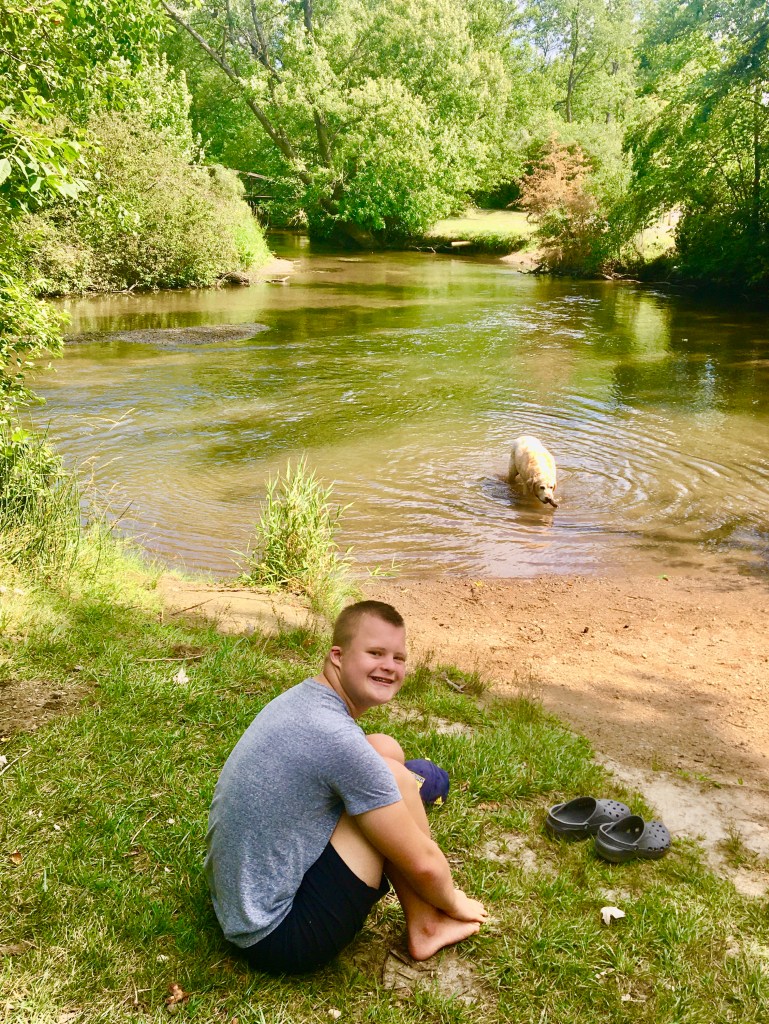
When Wil said, “Walk to the river, Mom,” I left my phone on the countertop, took off my watch and grabbed our mud boots. With the constant tug of a virtually agenda-driven world, I was more than ready to leave behind the volitional tools that bound me to it. Woody, our yellow lab, perked up his ears at the word “walk” and was quickly on our heels as we hurdled out the door.

It was late April and the temps had recently warmed so the bugs were sparse. We reached the tree-cover and squished through mud over imprinted deer tracks. Deep puddles and fresh, bright green undergrowth lined the path. We could now hear the river and it sounded cold. Woody ran ahead and plunged in as if it were a hot summer day. He plodded around the shoreline looking for water bugs that weren’t yet existent, then swam out to the center of the river. He paddled against the current like he was on a treadmill; running hard but getting nowhere. He eventually grew tired of the grind and veered off to the other side of the river and played along that bank. 

Wil slid down a muddy embankment and stretched his legs into the river. His muck boots filled with water. “It’s cold, Mom!” He got his footing and waded out until the water reached the bottom edge of his shorts. Then he reached down into the river and pulled out a smooth, black rock. He held the rock up to admire its sheen, then threw it in the air. “Catch Woody!” 

Woody swam back across the river, even as the rock sank to the bottom; his loyalty to Wil’s call. Wil reached down for another rock, again admired its smooth surface, and tossed it. “Go get it, Woody!” Wil found a few more smooth rocks, taking a moment to admire each one, tossed them, and Woody swam toward each splash. Wil moved on to tossing sticks, which were retrievable for Woody, but watching the two play this game, I saw that winning was not about retrieval. The win for both was in the play.  

A red-headed woodpecker flew across the river, landed on the side of a tall tree, turned his head toward us and called out. He then silently stared at us for a moment, decided we were not a threat, hopped up the tree and went on with his business. 

I sat down on a low, flat rock and breathed in the earthy smell. Green buds popped out on branches all around me. The scene was picture-perfect; and yet I was thankful I had no means of taking a picture as it would steal the nature of the moment.  

Thank you Wil, for leading me on this winding, earthy, budding, flowing, green and boundless path, where there is always something found to admire and the win is in the play. Your true nature always circles me home to mine.

With Chocolate chips on top

“Well, you have enough challenges raising Wil.”

I write about the challenges raising Wil, so it’s expected to frequently hear that, and I’m thankful. I used to hear, “well, he’ll always be happy.” To wrap Wil into one emotion both undermines who he is as a person, and the value of what it means to be his mother. 

There are few constants raising Wil; I live in a guessing game of interpreting his thoughts and ambitions. He very well knows, but he doesn’t always have the words to communicate his thought processes. So I am left hypothesizing, considering, deducing, reaching in and reaching out. One common saying in our Down Syndrome Support Team is: “What worked today may not work tomorrow!” To place Wil in a happy corner is laughably simplistic. He is fully, frustratingly, beautifully, imaginatively, ubiquitously challenging. Aren’t we all in our own multi-dimensional ways? 

I am in daily awe, however, of one constant in Wil’s life. That is how open and loving he lives it. His friends find a level of peace with him. He will never judge them, and that provides an internally settling feeling few other emotions can match. Wil will never grow jaded. Wil remembers slights and hurts, but he doesn’t hold on to them. He travels light. I’m ever the student when it comes to Wil.

Last Thursday night, I sat on the edge of Wil’s bed as I tucked him in and we had a conversation. His school was going virtual again and he’d just had his last day of in-person school for what we hope only lasts 2 weeks. He was feeling sad about not seeing his friends and teachers so we talked it out. Then suddenly he changed the subject. “Mom, pancakes.”

“You want pancakes for breakfast?” 

“No, made pancakes.”

“Oh, you made pancakes in school today?”

“Yes, with Kennedy.” Rachel Kennedy is Wil’s resource room teacher. Sometimes he refers to his teachers by their last names: Campbell, Kastel, Kennedy. 

Then he smiled and held up two fingers. “I made two. With chocolate chips.” 

My heart leapt with joy. That smile of his was for more than just pancakes. It was a smile of connection. A connection made through his own self-initiated words that invited me into his world.  

In Wil’s early school years, there were few words. He would get frustrated, the tears streamed, and he couldn’t tell me why. I could only ask questions, hoping I’d strike something with some accuracy that he would nod to. At times he would nod for the sake of nodding. He desperately wanted to say yes to something. To connect. So I would hug him and hide my tears, aching for the day he could express his own thoughts. You don’t know the value of a word until you know what it’s like to wait to hear just one, please just one word, that tells me what you are thinking.

I used to believe I knew what optimism meant, but I confused it with positivity. Positivity is rather one-dimensional, as is slapping someone, or something, with a happy label without care to delve deeper. Optimism lengthens with patience. Optimism holds on tight with faith. Optimism searches, reaches, climbs, knowing there is an answer, it’s simply not ready to appear yet. Optimism feels sadness but never stops believing. Optimism rejoices as optimism knows it grows through the challenges.

Yes, I have enough challenges raising Wil; as is the reason I brim with optimism. He’s grown my heart to believe with every part of my being…with chocolate chips on top.