Life Beyond Definitions

He has delayed speech but he’s not delayed speech. Some of our traits carry deep meaning, and others just are what they are – we give them little thought. Or maybe they are fun to play with, like changing our hair color. It is our choice in what meaning we give to our various traits. And that can change over time with the experiences of our lives. But we are not the only ones who give meanings to our traits – there are others who may assign different meaning to who we are. For some, Wil’s delayed speech makes his person less valuable. Such limited thinking about who a person in is linked in fear. It gives our brain a certain satisfaction to categorize what we don’t understand, or more accurately what we don’t care to understand:

“That’s retarded. What?! It doesn’t mean anything. It’s just a joke.”

“He’ll always be happy. But it’s a compliment.”

“They are all angels.”

Whether the above is considered positive, negative, or otherwise, these are extremely limited definitions of who we all are as complex human beings, no matter how many working parts we have, no matter how many chromosomes we have, etcetera etcetera etcetera. None of us fit within a box, even an angelic one.

Who were you when you were 7 years old? When you were 12? 16? 25? 32? 41? 52? We are always flexing the margins of who we are due do internal and external circumstances.

My instinctual reaction to Wil’s diagnosis was full of limited thoughts. This is instinctual. Having fear protects us from the dangers of the unknown. Fight or flight. But it doesn’t have to be a way of existence. Though instinct may initially rule our brain, we can then take the next step to make different choices. Situation-by-situation learning opens more doors to new ways of thinking if we allow them to come in.

I don’t want to spend my life fighting for my son. There may be instances where I do. And maybe this writing I’m sharing with you is fighting for my son. But I don’t see it as combative. It’s a sharing of knowing him. I’m sharing with you what I have learned about my son, and how he has changed my life not in easy ways, but in profoundly simple ways. And that is simply getting to know him. Yes Wil has Down syndrome, but Wil is Wil. And Wil changes every day as we all do.

Yes, Wil needs speech therapy. Yes, Wil has moderate cognitive delays. Yes Wil does not understand certain dangers and concepts. Those things are different from me. And some of those things cause me concern. But I see them, I don’t hide from them. I don’t fight them. But they are different so sometimes I struggle with them. Sometimes I get jealous of seeing my empty nester friends have freedoms I do not. But that is just one window of the many I look through in life. I see life in so many different ways than I once did. Though some doors may not be as open to me as others, that is how life is anyway. I am open to opportunities around me, and I walk through those doors and I evolve with them. That is feeling life. That is knowing life. I don’t need to understand life, Down syndrome or many other things in a scietific way, but rather a relational way.

There was a school board member at our school that wanted to reduce special education staff. He went back to a statute in the 1970s to back his cause. If you went to school in the 70s, or even as I did in the 80s, there simply were no students with disabilities in our schools. Or if there were, they were in the basement or otherwise segregated. Inclusion as we know it now did not exist. If it did, that was a rare and very fortunate experience. I’ve read a lot of books on the civil rights acts and how obtuse politicians were about making changes for people with disabilities. It’s hard to read. Have you ever seen pictures of people in institutions? It’s abhorrent to even think of how people with disabilties were treated in the 70s and an antiquated law from this time was used as his reference. This particular school board member was invited to sit in the resource room to better understand what special education staff did. You guessed it – he never did.

All it takes to stop improving the world for our kids is to take a stand (to stand still) on a fear of unknowing.

All it takes to improve the world for our kids is to care enough to know more – then live, evolve, grow and share life beyond definitions.

In Sync

As Wil has gotten older, it’s clear he needs closer friends with Down syndrome. He has wonderful friends at school that love and support him fully. As the gap in abilities with his typical peers grows and social lives expand, Wil also needs to cultivate friendships with those whose abilities match his.

Manny’s family lives in the neighboring town, so his mother, Laura, reached out to get our boys together. Manny will be entering 9th grade, and Wil 8th.

When Manny arrived at our house, it was our second get-together. We had met at Portage Lake the previous week and a friendship was formed. Though both Manny and Wil had talked of this second get-together for days, when Manny entered our house he went to the couch and Wil retreated to his bedroom. They were overwhelmed.

I took a big sigh of relief. Why? Because this was normal behavior not for just one of them, but for both of them.

I coaxed Wil out of his room, and Laura coaxed Manny to show Wil the toys he brought. Manny won Wil’s heart by bringing him a can of Sprite to drink with lunch.

The two laughed and were silly with lunch, and that broke the ice. But after lunch, they separated again. Even this separation was refreshing to me as it’s usually Wil I’m coaxing while others wait. This day, we were all gloriously on the same page, even if Manny and Wil were apart. Manny’s older sister, Grace, was there, and she kept the conversation going engaging both Wil and Manny. Like Katherine and Elizabeth (who were at a birthday party), this is Grace’s normal, and she handles it, well, with grace.

Laura suggested a movie to start the ball rolling again. And roll the ball we did — Manny chose Hotel Transylvania 3 and we played a game where we sat on the floor and rolled the ball to each other. When the music in the movie played, that was the kryptonite to whatever was holding them back. Manny and Wil broke out their dance moves. Then Wil broke out his karaoke player and jammed to Luke Bryan while Manny jammed on his Bluetooth mic he brought from home.

After the jam session, we headed outside to the driveway to ride bikes. Manny tried Wil’s recumbent bike while Wil rode his bike with training wheels. The handles on the recumbent bike are what steer it. Manny is used to using an elliptical machine, so he was pumping the handles back and forth zig zagging around. I thought that was a smart technique. With a few more tries, he figured it out and was zooming around, even on the grass!

Then I took Manny on the 4-wheeler. He “woohoo’d” the entire time. The guy has a need for speed!

Soon it was time for them to go, and we said our goodbyes until next time. I talked to my sister that evening, and told her how great it is to have a get-together where the kids are on the same level. It’s something you just don’t take for granted.

A day full of stops, starts, zig-zags, and full speeds ahead — all the while, remaining gloriously in sync.

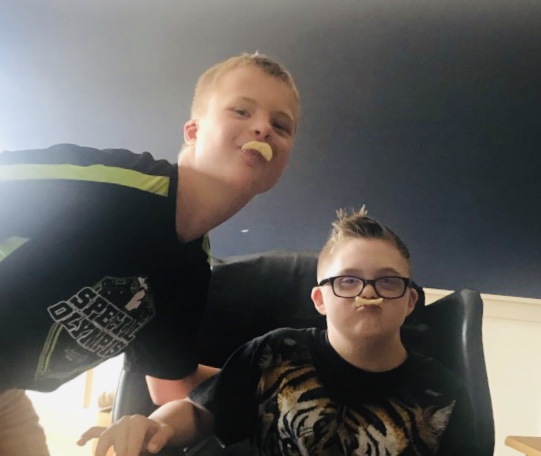
(Photo: Potato chip lips)

9E7D0BEE-DC6A-4D29-9121-FF07C91A70B8

Special Needs, Peers & Boundaries

Many schools have a peer-to-peer program in the middle and/or high schools. These peer-to-peer programs are where a typically developing student is linked with a student with special needs. At our school this program is called Connect. Wil, who is in 7th grade, has been linked with two high school students, a male and a female.

Wil adores his Connect friends. They visit him during his Independent Life Skills time in the resource room. They work with him on projects, crafts and cooking. He most especially enjoys cooking with his Connect friends. It’s been an enriching experience for Wil to work with his Connect friends, and I believe for his Connect friends to work with him. On days when Wil is feeling unmotivated, his teachers will remind him he is seeing his Connect friends, and that will–on most days–perk him up.

Being in 7th grade is an interesting time for most students. Their bodies are changing, their hormones are firing, and their independence is sought. Wil is no different. His assertion for independence has him taking a few liberties with his Connect friends. He may pick up one of their spoons and throw it on the floor. Or give them a hug then mess up their hair. He’s pushing the boundaries, and also looking for attention. If he were a typical student throwing a friend’s spoon on the floor, or messing their hair, he’d get a “Hey, what did you do that for?” However, kids with special needs tend to get some extra latitude. Wil may get a laugh, rather than a reprimand. Or his behavior will go ignored as the kids simply do not know what to say. His typical peers want to be kind, and fear upsetting him.

I completely understand this, it can be complicated with the communication differences. Wil is not in elementary school anymore. Kids talk a lot faster, there is lightening back and forth processing, and Wil can feel lost in the sea of back and forth communication. A toss of a spoon, or a mess of the hair takes all of that back-and-forth and draws it to a halt. He gets the reaction he was looking for, everyone is kind and thinks, “Oh that’s just Wil,” and moves on.

If you decide to have a dialogue with Wil about why this is wrong and not respectful to friends, you will see his attention wander and probably before you are done talking, he’ll have tossed your spoon again. If you get upset with Wil, he may cry or shut down. He hears and feels the anger and takes this as an attack on his person rather than a correction of the act. A straightforward and firm, “Please do not do that. That’s my spoon, I was eating with it.” Or “Please do not mess my hair. I don’t like it.” He’ll understand that you don’t like it and why in just a few short words. I can’t promise he won’t do it again, but it will come to a halt the more that is said with each instance. And most importantly, he is being treated and respected like a peer.

This is why Wil’s relationship with his sisters is very beneficial. Basically, they don’t put up with his crap. If he does something like talking with his mouth full, Katherine will say, “Wil, that is gross. Babies do that.”

“I’m not a baby!” He will yell back. And that’s the end of that.

Or if he is badgering his sisters for attention, they will change gears with the power of distraction. “Hey Wil, let’s go walk Woody.” They will remind him to get his boots on, that it’s muddy. On the walk, Wil will find every big stick he can and show it to them. His sisters will ooooh and ahhhh at first, then growing tired of it, they will tell him that’s enough.

In that way, he learns boundaries just as naturally as anyone else does.

In many ways Wil is like any typical peer. When he is misbehaving, that misbehavior should be commented on and corrected. When he’s getting annoying by repeating an action over and over, he should be told, ok, dude, that was cool at first but now that’s enough.

Sounds simple, right? So why doesn’t it happen? Wil acts younger in many ways, so it’s easy to treat him younger. Wil is very sweet, he loves unconditionally, so his friends don’t want to hurt his feelings. All of those reasons are completely understandable. Back when I was that age, I would have done the same thing. That is also what makes these situations excellent learning opportunities. Just this morning Wil gave me a hug and started messing with my hair. I pulled out of his hug, looked at him and said, “Wil, I love your hugs. But please do not mess with my hair, or anyone’s hair. People don’t like that.”

“Ok, Mom.” He stopped messing with my hair and gave me another hug. He will likely mess with my hair again on another occasion, when he is feeling feisty. I will again say the same thing in the same way. Eventually he will stop doing it. It can take multiple reminders before he decides to respect those boundaries. Sometimes it takes just one. But the important point is the boundaries need to be set.

Wil’s Connect friends are learning how to set boundaries with Wil and Wil is learning how to respect their boundaries. What it comes down to is mutual respect amongst peers, no matter what the similarities or differences are among them. This Connect program carries with it the essential life skills of working with varying abilities and personalities with care, firmness, kindness and respect. And this crew is proving what a great time you can have doing just that.

79864123_2542951742595152_8994715820626018304_n.jpg