Turning the Tide: A Story of Growth and Inclusion

Growing up, Wil has loved boat rides with his Grandma and Grandpa. So when his sisters were invited on an impromptu trip around the lake with some of the neighbor’s kids, they jumped on — and Wil stayed back with his grandparents.

My dad noticed a shift in Wil’s demeanor. He didn’t say anything, but my dad could feel it — that quiet pause, the internal processing. He turned to my mom and said, “Wil wanted to go too.” They decided they’d take Wil out for his own boat ride to lift his spirits. So off they went, stopping at his favorite swim spots along the way. Wil jumped in the water as he always does, with my parents jumping in with him. It worked — his mood lifted (there’s good reason Wil adores his grandparents!).

But the moment they returned to the dock, Wil spotted his sisters and the neighbors hanging out in the yard. My mom said he couldn’t get off the boat fast enough to join them.

Whenever Wil turns a corner in maturity, I feel a sudden wave of sadness for him — and then, not long after, I’m chuckling at his light-hearted ingenuity.

This summer in speech, Wil is working on initiating conversations. He struggles with finding ways to insert himself — to say things like, “Hey! I want to go too!” It seems so simple, but that’s just not in his current arsenal. He wanted to go, but didn’t know how to insert himself. But eventually, he found his way.

Processing time may be slower for Wil, but that does not mean his ways are not effective.

I share this story because no one intentionally left Wil out. In the past, he’s always chosen boat rides with his grandparents — that’s been his comfort zone. If he had said he wanted to go, he would’ve been welcomed. So sometimes, inclusion isn’t about purposeful exclusion. It’s about learning how to speak up — and that’s exactly what Wil is learning to do now.

I’m curious now to see if Wil does start to speak up more. He’s entering a new season — he’s graduated high school, and he’ll be around new people who don’t know him as well. They won’t read his cues the way longtime friends have. That shift will come with challenges, but maybe also with opportunities.

Because often, inclusion really just begins with getting to know someone. And showing up — or speaking up — in a way that you can be known.

Down Right Perfect

I remember one day wearing a “Down Right Perfect” t-shirt as I marched up to the high school doors to collect Wil after school hours because he had run from getting on the bus. He booked it up the steps to the second floor and hid. Once he was found, Mr. Walsh walked him down to the media center, and waited with him until my arrival. In that moment, I felt the irony of what I was advertising on my t-shirt.

We parents of children with Down syndrome also get a “Down Right Perfect” label, too. Like our kids, the label doesn’t always stick. If we are specifically chosen to raise our children with Down syndrome, I believe it’s because we have extra learning to do that goes hand-in-hand with extra chromosomes. I’ve certainly learned extra patience with Wil, but there are many times my patience misses the bus and books it up the steps until I go up to determinedly collect it.

At noon today, Wil sat on the floor in his pajama top and underwear. Speech therapy was in 30 minutes, and it’s a 20-minute drive. Wil and I had been going round and round. I’d gotten him from the basement to his bedroom, giving him the patience and space he needed. But once he got up to the bedroom, he came to a full stop.

I was quickly draining patience. His refusals used to be a regular occurrence. Depending on the occasion, I’d prep him an hour to 30 minutes before the event. But now he rarely declined doing something he enjoyed. He also knows his daily schedule – when he got up this morning, he cheerfully said, “Summer speech today!”

“Yep, at 12:30, just after lunch,” I replied, just as cheerful, woefully unprepared for the stop sign up ahead that would materialize out of nowhere.

I didn’t know what turned the tide for him. I didn’t know what turned the tide for me either. Whatever flipped his switch set off a detonator on mine, too. I called Matt to talk to Wil because I knew I wasn’t in a mental space to. I put Matt on speaker. Wil responded to Matt’s call and started to get dressed. I took a deep breath. But as soon as I hung up the phone, Wil stopped all forward motion. I called Matt again. Now I knew I was getting on his nerves, too. None of this was going in any forward type of direction.

I left Wil’s bedroom to give us both space. I texted the speech therapist that Wil was stuck and likely late. She is no stranger to Wil or to what “stuck” for our kids means.

“No line dancing tomorrow, Wil!” I heard Wil say to himself. He recently started personal training with Brandi, and she knows his country vibe. She’s a Southern girl; the two of them are a great match. She promised a line dance at their session tomorrow. Wil was grounding himself from something he wanted to do because he wasn’t getting dressed. I walked back into his bedroom.

“Wil,” I said, “I don’t know what is going on. You love speech therapy. You love Miss Kim. I set all these activities up for you, and I ask you first. I don’t make you do anything you don’t want to do. You are 18 years old and you need to honor your commitments.” I don’t know what else I said, but I went on in that vein, and there is no way he could have processed it all. To him, I was like one of the adults from the Peanuts cartoons, “Wah wah wah wah wah.” Then I realized I had also butt-dialed Matt. WAH!!!

Wil did eventually get dressed, and Katherine drove him to speech therapy. I asked her to take her time, not rush; they knew he was going to be late (Thanks, Katherine!). Kim, the speech therapist, was very kind and understanding. She even sent me a text message after their session saying he did great (Thanks, Kim!). That Mr. Rogers was always Down Right Perfect in his advice: “Look for the helpers. You will always find people who are helping.”

I thought over all the things I coulda, woulda, shoulda done. I think I’m just overwhelmed with all the things I’m coordinating for him right now. When Wil did the PEAC bike camp a few years ago, the founder of the program said to me, “Activities for our kids don’t just happen. You have to create them.”

Raising a child with a disability, at least for me, is this mix of intense proactive coordination and gratitude for what is. There is so much to get ahead of, to be proactive with, and to premeditate. On the flip side, I’m incredibly grateful for what is available, for the people who care, for the people who make mountains move, for the helpers and understanders.

I think it really was as simple as me feeling all the stops and starts and desiring a flow, while at the same time Wil needed to put a plug in things. We were playing a game of red light, green light from opposite directions.

When Wil got home he was hungry.

“What do you want?” I asked.

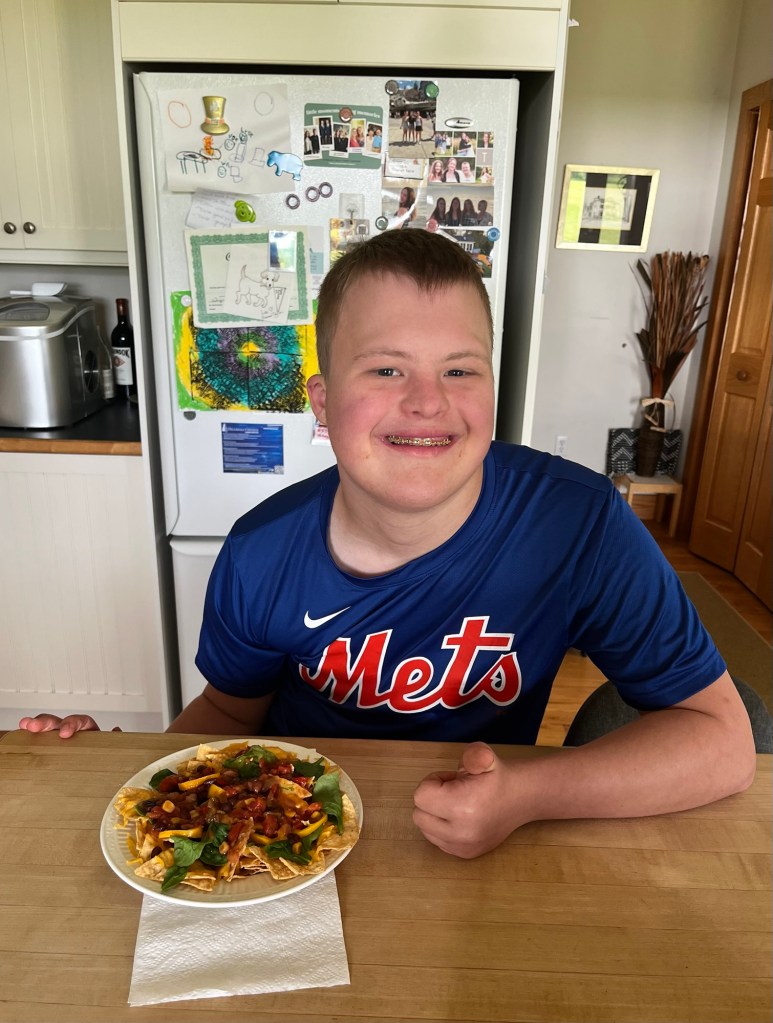
“Nachos.”

“Ok, let’s get out all the fixings.”

As we assembled the nachos, I asked him why he got stuck earlier.

“The rain.”

“Oh, the rain. Thanks for telling me. Now I know for next time.”

“Yep! Mom, these look good.”

“Down Right Perfect, Wil!”

Paradoxical Path

A singular new word Wil calmly adds to his vocabulary, in a such a way that only I — or his closest educators — would hear stands out like a stacatto flashing me back in time to a movie reel loop when he was 5 or 7 or 10, working a skill on a repeat loop that at the time I couldn’t see beyond.

But here I stand, still marveling at one added word, one added achievement, one added milestone, taking me back and pushing us forward seemingly in flow but full of staccato moments.

I’m not who I used to be raising Wil, yet I’m closer to who I am at my core.

I must pave ways for Wil and yet must leave space for him to create his own. He has a high level of vulnerability and yet has an inner strength many desire.

Wil has grown in me a patience I never knew I had, and yet also has grown an immense impatience to grow more; to learn more; to expand borders.

I have learned many stereotypes are hysterically true; and many are heretically innaccurate. Wil’s sisters called him, “Wil ‘the snail’ Taylor” every time they followed him as he two-stepped up and down the stairs. I’ve shared many laughs with fellow Ds mommas over stereotypes and shared many tears with these same mothers over stereotypes. Stereotypes can bind or separate. You need to walk the walk to know which is what.

And friendships. He has some deep ones. He also has many cheerleaders we’ll never see again once he leaves this school. But the impact his presence has made, and theirs on him, is undeniable.

Raising Wil is a paradox; surface friendships that leave a lasting impact, single breakthrough words that flash back to a former time loop on repeat, patience that creates a relentless drive, stereotypes that create binding laughs in their known truths, and stereotypes that create pain in their ignorance of the truth.

I now stand beside Wil with great hope of what’s ahead, pure enjoyment of where we stand right now, bouyed by the memories that brought us here, and on occasion flash me back.

Wil is graduating; this is a hard one. Raising Wil I’ve gone through what I think of as “3 acceptances” so far:

  1. Acceptance of Ds
  2. Acceptance of new behaviors of puberty. (That was a tough one!! That truly took a village!)
  3. Acceptance of transitioning out of high school.

Wil is ready to graduate, though; he’s ready for this next step. But for me, there is so much. So, so much. All that I personally have navigated through his birth and school years. The scenery is different raising a child with a disability. It has to be because disability forces us to see life in a different way.

There are two boys, Eli & Ethan who have higher levels of autism. I love watching their reels. They are quirky and fun and frustrating. When you see them for who they are, you can’t help but fall in love and feel the shift of scenery as you tune into their lives.

I can feel Eli & Ethan’s mother’s joy when one new word emerges. I understand all of her pauses, giving her boys the time and space to speak.

Our world with disabilities is warp speed and turtle-slow processing all wrapped into one.

I’m standing here spinning, on the edge of this next level. It’s dizzying but all the same I’m thankful for the eyes to view the world from this place. ❤️

Leaders in Life

Our Human Services leader is telling us to be weak. To be devasted by a diagnosis. To feel damaged because our children are neurodiverse and may not pay taxes.

I was devastated but I CHOSE to RISE! I CHOSE to love my child for who they were and to find others that gave me strength when I couldn’t yet find it in myself.

Now I am a warrior.

I love my child and have a new appreciation for differences that I would not otherwise have if I were justified by “leaders” in my devastation. In fact, thats how so many with disabilities were housed in institutions. The photos from that time are unbearable to look at.

True strength is doing the INTERNAL WORK of understanding neurodivergence. Not pointing from the outside looking in and making judgements. And telling an entire country to make that judgement.

Here is my advice AS A LEADER BECAUSE I LIVE IT. Feel the devastation if that’s real for you, then choose to walk in it and feel the exhilarating growth of what seeing life from a new perspective feels like. That’s being a warrior, my friend. That’s being a true contributor, a true leader, to society.

Or choose to point to what you see as devastation and lack, and watch the lack and devastation grow because that’s what you choose to believe in.

I know what I have chosen. I chose to do the work of understanding neurodiversity, and I still am. It’s a path worth eternally growing in every.single.day.

Don’t let this so called leader set the clock back on our kids. Listen to the true leaders. Those of us who walk the walk and would never, ever call it devastation. Though many of us did once feel that devastation, we didn’t stand there long.

It’s a journey that first chose us, and now we undoubtedly and assuredly choose this Journey.

Light 💡 Ranch

Not so long ago, if anyone gave Wil choices he’d pick the last choice offered.

This morning I asked him, “What dipping sauce do you want? Ranch, mustard, ketchup or honey mustard?”

“H — Ranch.” Wil corrected his auto-response for what he wanted.

Life is full of tiny miracles embedded within everyday occurrences. Our kids with disabilities slow life down just enough to reveal these hidden gems for the light they are.

Wil rode is bike to school!

Wil wanted to ride his bike to school. We live on a busy road so we agreed on him riding from a park about a mile away. He’s 17 years old so of course did NOT want me with him. We agreed I’d meet him where the sidewalk curves to the high school.

It’s very cold so it wouldn’t be unusual for him to feel cold, get off his bike and just walk off anywhere. So yes, when I saw him crest the hill I was very happy; as was he happy to be given this independence. He even got cheers from a friend driving by!

Wil had to cross the street to the high school, so it was a non-negotiable that I be there to facilitate that. I wish I could see who was in the pickup truck at the Crosswalk. That driver saw Wil’s approach well before Wil arrived at the Crosswalk and waited there extra time until Wil approached and crossed.

That’s what I love about this small community. How we know and look out for one another. ❤️

Lift in Learning

Wil jumps on the trampoline. Free. Fun. Full of joy. His play is not forced; nor is it self-conscious. He hoots, he hollers. He’s in the moment. When tiredness sets in he rests. He sits on the black circular mat, looks around, and soaks in the feeling of his heart relaxing. This is not a conscious action. It’s a feeling. When his breath is caught he resumes his play. He resumes his laughter. The cycle of play and rest continues, not in perfect time, but perfectly all the same. His time on the trampoline is conducted all on his own time. And if someone wants to join in, the net is always open. His play is not pushed or forced; his rest is not laziness. It is a balance of body and mind in time and always open to friendship.

When I watch him, I wonder, can I be as free as that again? Can I still truly play? Can I still hear my inner compass? Can I be purposeful without pushing? Can I still allow my heart to rest without inviting in laziness? Society is so loud today. So many voices telling me what is right and what is wrong.

I went to buy some paint yesterday. As I walked in the young man behind the desk had very low energy. I still gave him a hearty hello and went on my business. When I went up to the counter he still had very low energy. My instinct was to be low energy back, as wasn’t it his job to welcome me to the store? I was spending my money there. But then I thought, “No, that’s an instinctive reaction to match like for like. You have a choice. Just play today. Unzip the net of the trampoline, and invite him in to play. Even on our hardest days, even if we don’t want to play, it’s still important to offer the invite.” So I shared my smile and kept my spirits high as he rang up my items. I didn’t force my joy, I just held a natural joy within me. The man then took out a $5 coupon and scanned it to my order. Maybe he used that coupon on every order, but I received it as the special $5 gift it was.

“Thank you for the coupon!” I said. He looked up at me quizzically. There was a pause. Then he smiled back at me. He accepted my invitation to play.

This summer I’m working with a student who turns very aggressive immediately. He punches, kicks, and swears. He’s called me a freak and a bitch and he’s only 6 years old. This challenging behavior is not in my wheelhouse. I’m raising Wil, a happy, joyful, and stubborn child. He’s not physically or verbally aggressive. My learning curve this summer has been high. But I’m learning a lot as the teachers around me have a wealth of knowledge and are very supportive. They’ve invited me to play.

Being on constant guard with this student is wearing at times. I need to be between him and the other students in case he blows up at a moment’s notice. One day he was particularly on edge. He enjoys going to a room with a swing and a crash pad. So I asked if he wanted to take a motor break there and he agreed. After a few rounds on the crash pad, he laid down and started pushing a bookshelf with his feet.

“Please don’t push on that. It’s not safe.”

“Why not?” He asked defiantly. He was trying to push my buttons. Fortunately, the change of environment was a break I needed too. I was able to think more clearly.

“Because it could tip over. It’s not secured. I care about you and don’t want you to get hurt.”

His attitude lightened completely when I said I cared about him. That was all he needed to hear. With his demeanor change, I also changed because my learning and understanding deepened. I had all the tools that worked with him written down. All the things to say that de-escalated his behavior. But this was off the cuff. It was not on any script. It flowed from my mouth not from thought but from something natural within me. If we had still been in the classroom with both of us stressed, I would have resorted to the script because I would not have been able to access that part of my brain. We would have both been in fight or flight. But now having had this experience, a mental block from my naturalness has been removed. I am now better equipped to handle higher stress situations, and inner knowing will have more space to come through to help this student and future others.

I’m learning to go back to what I already knew while I learn from what I didn’t know. I now recognize $5 gifts as special to me even if they are plentiful for every customer; valued gifts expand well past any monetary amount. I now will change venues when my heart needs rest so I may better serve both myself and others with a calmer heart. I will hold my natural joy and extend it – the shared energy of the giver does not deflate one and inflate the other. Just watch Wil on the trampoline. The joy he feels could light up the world.

It’s the Chocolate Chips in Life

“It has chocolate chips in it, Mom.”

It’s those details that you never miss. The telling me about something, when at one time he couldn’t. I used to ask questions I knew he could answer. Because if he didn’t think he could, he’d shut down and I’d get nothing.

When Wil used to eat a chocolate donut – this is no joke – he’d mumble, “mmmmmmm” the whole time! I was like, that’s how you eat a chocolate donut! So my question of “Is that donut good?” was rhetorical but I would get an “Mmmhmm!” out of him.

Wil loves chocolate shakes. When he was younger, though I was the person who ordered the chocolate shake, when he was drinking it I’d ask, “What flavor is your shake?”

“Chocolate!”

Now he just tells me things. It may be sometimes later, well after the fact, but he’ll tell me things without my asking. The other day, well over a week after camp, he blurted out, “Walking tacos Mom!”

“Yes, you had walking tacos at camp. Those are so good! What were your favorite toppings?”

“Cheese, peppers, salsa…mmmm.” (His camp counselor said one of his favorite parts was the food!)

Last night he came home from the new ice cream place in town. As he walked in the door he said, “Want a taste?”

He held out his spoon. I took a bite and remarked on how good it tasted.

That’s when he offered, “It has chocolate chips in it, Mom.”

I suppose it could be said of such moments, “It’s the simple things in life.”. However, experiencing such moments built upon one another day-by-day and piece-by-piece, makes that saying much too rote.

If we do have to summarize such things, I’d much rather it be said, “It’s the chocolate chips in life.” Wil would give a big mmmmhmmm to that!

Steps in Time

Just 2 years ago during graduation party time I needed an eagle eye on Wil. At one party he fled the party and would not leave the front porch. At another he ran to a side street and sat in the middle of it. Yesterday, at each grad party he hung with his buddies. And made new buddies. He played cornhole with known and new friends. He joined a basketball game with upper classmen from MSU. At each party, I only went to check on him here and there. A stark contrast from two short years ago.

He’ll be a senior next year, and then likely on to a young adult program. When he’s 20 he may have a whole new level of independence from what he has now. Time, opportunities, supports and his own will will tell.

Every individual is their own, no matter their disability. We cannot define nor predict their growth, but we can observe, we can open doors, and we can learn where to step in and offer supports, and as I’m currently learning, when to step back.