I have recently gotten back in the pool (after a year 😅) thanks to our friend, Dawn, taking great care of Wil after school and honing in on his life skills learning.
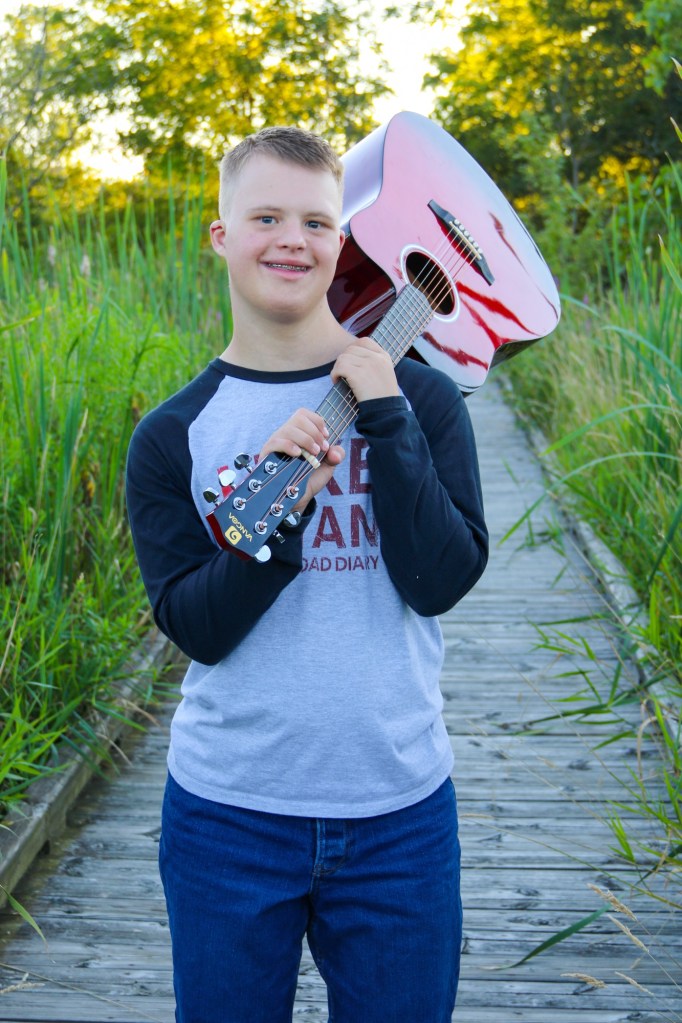
While I swam Monday, Dawn’s husband came over to have a guitar jam session with Wil 🎸
When you have a dependent child, your schedule revolves around that child’s schedule. It takes a lot to find someone you fully trust, and that matches your schedule, so you and your child both can enjoy needed independence time.
Wil is my buddy, and he is so much fun! I’m thankful he’s not flying from this nest for some time to come. And yet, Wil is almost 19. He deserves someone other than mom all the time to expand his young adult life.
When I mention respite care outside of our disability circle, I receive a blank stare in response. That likely wouldn’t have been in my vocabulary either! But independence doesn’t happen without it when you have a dependent child.
When you meet someone with a dependent child, know that they most likely love having their child home, but at the same time, both parent and child need time to spread their wings, and that doesn’t happen without an extra set of loving, caring hands.
Our lives always include extras, and that extra includes extra special people with extra special hearts. 💕
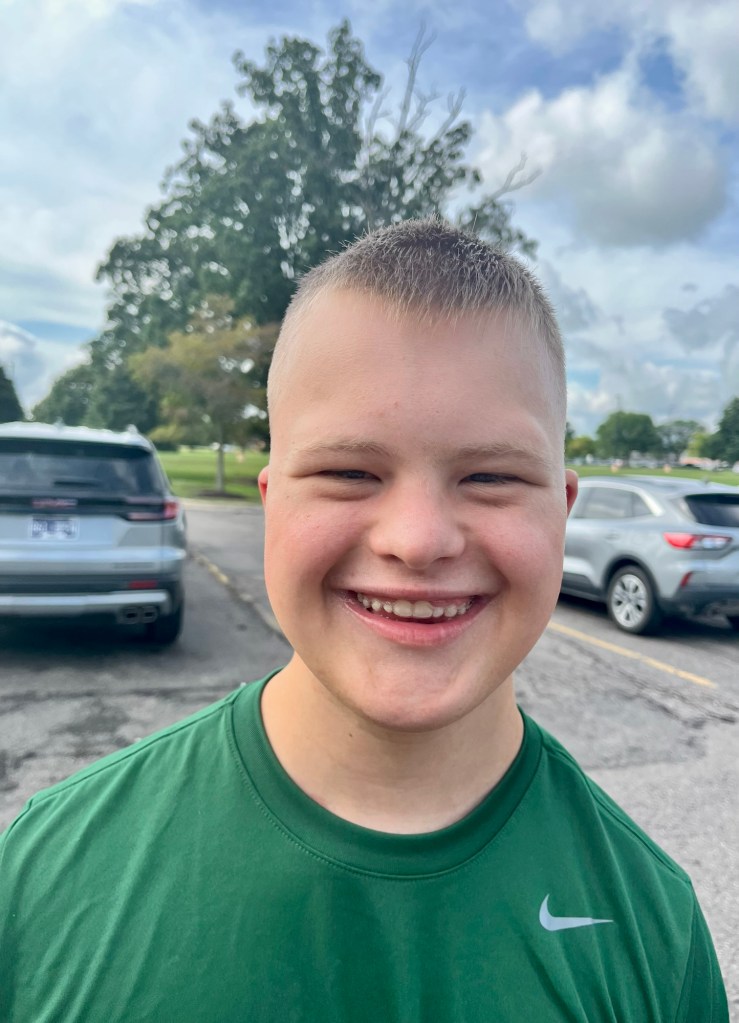
Watching Wil get his haircut today had me nearly in tears. The clippers buzzing, Wil chatting, smiling, relaxed.
Years ago this sight was a distant dream. The haircut triggered my emotions, but deep down it’s about progress.
It’s about feeling so desperate and on-guard with almost anything you do, because so much is a struggle for your child to acclimate to.
It’s about walking out the door, but never just walking out the door.
It’s about always thinking ahead, strategizing what might trigger your child. And even as much as you think ahead random things happen. A dog barks and dang, its the one time you forgot the noise-cancelling headphones, and your child takes off and you sprint after them before they hit the parking lot on the way to the car. Leaving the house is never just leaving the house. You always have to leave with as much of a crystal ball as you can muster.
And then fast-forward to watching your grown child calmly sit, and you actually left the house without much of a plan.
I think, a lot of times, happiness is not some elusive place, but a place of working hard for something. Of just climbing that ladder every day, and you are so used to climbing it, that you don’t even realize you’ve hit this certain level until one ordinary day you are blissfully suspended in air.
And once your brain’s thought process catches up to that elevated feeling and brings you back to earth, you realize happiness is about progress.
A singular new word Wil calmly adds to his vocabulary, in a such a way that only I — or his closest educators — would hear stands out like a stacatto flashing me back in time to a movie reel loop when he was 5 or 7 or 10, working a skill on a repeat loop that at the time I couldn’t see beyond.
But here I stand, still marveling at one added word, one added achievement, one added milestone, taking me back and pushing us forward seemingly in flow but full of staccato moments.
I’m not who I used to be raising Wil, yet I’m closer to who I am at my core.
I must pave ways for Wil and yet must leave space for him to create his own. He has a high level of vulnerability and yet has an inner strength many desire.
Wil has grown in me a patience I never knew I had, and yet also has grown an immense impatience to grow more; to learn more; to expand borders.
I have learned many stereotypes are hysterically true; and many are heretically innaccurate. Wil’s sisters called him, “Wil ‘the snail’ Taylor” every time they followed him as he two-stepped up and down the stairs. I’ve shared many laughs with fellow Ds mommas over stereotypes and shared many tears with these same mothers over stereotypes. Stereotypes can bind or separate. You need to walk the walk to know which is what.
And friendships. He has some deep ones. He also has many cheerleaders we’ll never see again once he leaves this school. But the impact his presence has made, and theirs on him, is undeniable.
Raising Wil is a paradox; surface friendships that leave a lasting impact, single breakthrough words that flash back to a former time loop on repeat, patience that creates a relentless drive, stereotypes that create binding laughs in their known truths, and stereotypes that create pain in their ignorance of the truth.
I now stand beside Wil with great hope of what’s ahead, pure enjoyment of where we stand right now, bouyed by the memories that brought us here, and on occasion flash me back.
Wil wanted to ride his bike to school. We live on a busy road so we agreed on him riding from a park about a mile away. He’s 17 years old so of course did NOT want me with him. We agreed I’d meet him where the sidewalk curves to the high school.
It’s very cold so it wouldn’t be unusual for him to feel cold, get off his bike and just walk off anywhere. So yes, when I saw him crest the hill I was very happy; as was he happy to be given this independence. He even got cheers from a friend driving by!
Wil had to cross the street to the high school, so it was a non-negotiable that I be there to facilitate that. I wish I could see who was in the pickup truck at the Crosswalk. That driver saw Wil’s approach well before Wil arrived at the Crosswalk and waited there extra time until Wil approached and crossed.
That’s what I love about this small community. How we know and look out for one another. ❤️
It happened after an event in the high school gymnasium. I don’t remember the event, but the after-scene is a moving photograph vivid in my mind. Wil approached a group of male high school peers on the gymnasium floor. At his approach, the circle broke with fist bumps, hellos, and high-fives with Wil. Two boys asked him a few questions, which drew Wil into the circle. Wil’s words – spoken with a slight stutter as he often does when he has so much to say, but his brain struggles to push the words out as quickly as he thinks them – had their attention. When Wil finished sharing, the boys resumed their conversation. The boys talked and laughed; the circle grew subconsciously tighter. Wil stood in the same place but found himself on the periphery.
These boys were not consciously excluding Wil. They were engrossed in their own stories and had forgotten Wil was there. It broke my heart to watch Wil walk around the circle of boys trying to find ways to re-insert himself.
Contrast this with Wil choosing to sit with a group of boys in the lunchroom mid-year. He one day, seemingly randomly, positioned himself at their table. They all welcomed him in and he joined them every day after that. The lunch table is also a more conducive environment for Wil to remain prominent while everyone is seated around a table. He can more adequately speak at his own pace. A few years ago, I spoke with a classmate about when Wil randomly sat at her lunch table. She said that at the time there was a lot of drama and gossip happening at their table. When Wil joined them, the drama stopped and the fun returned.
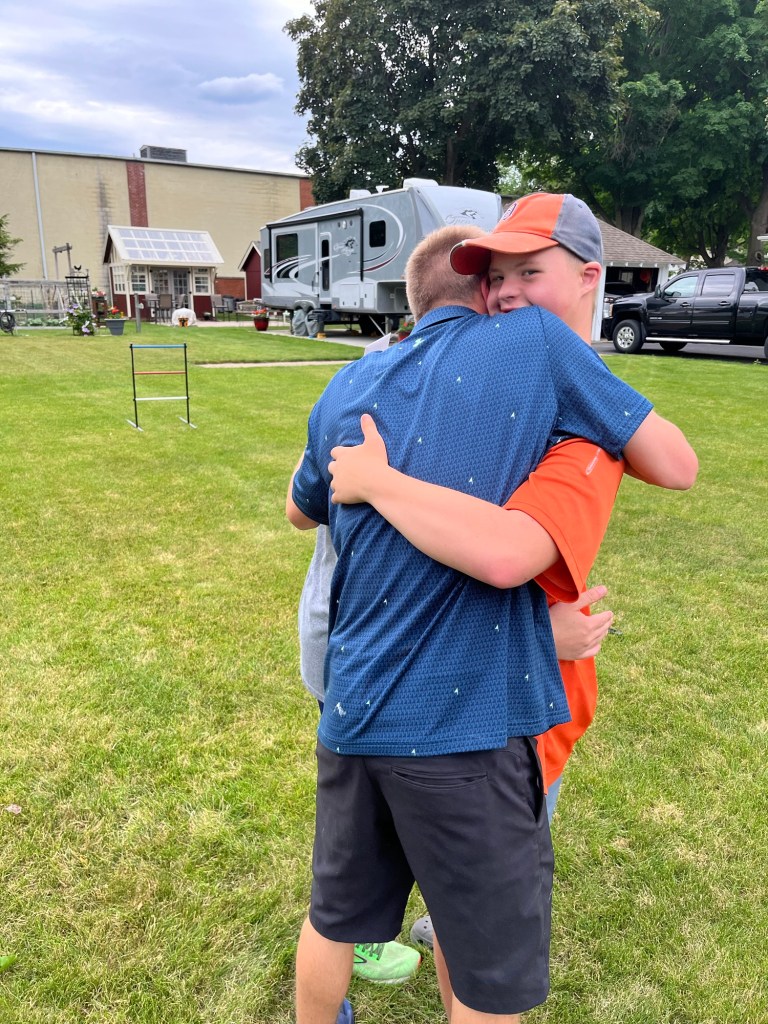
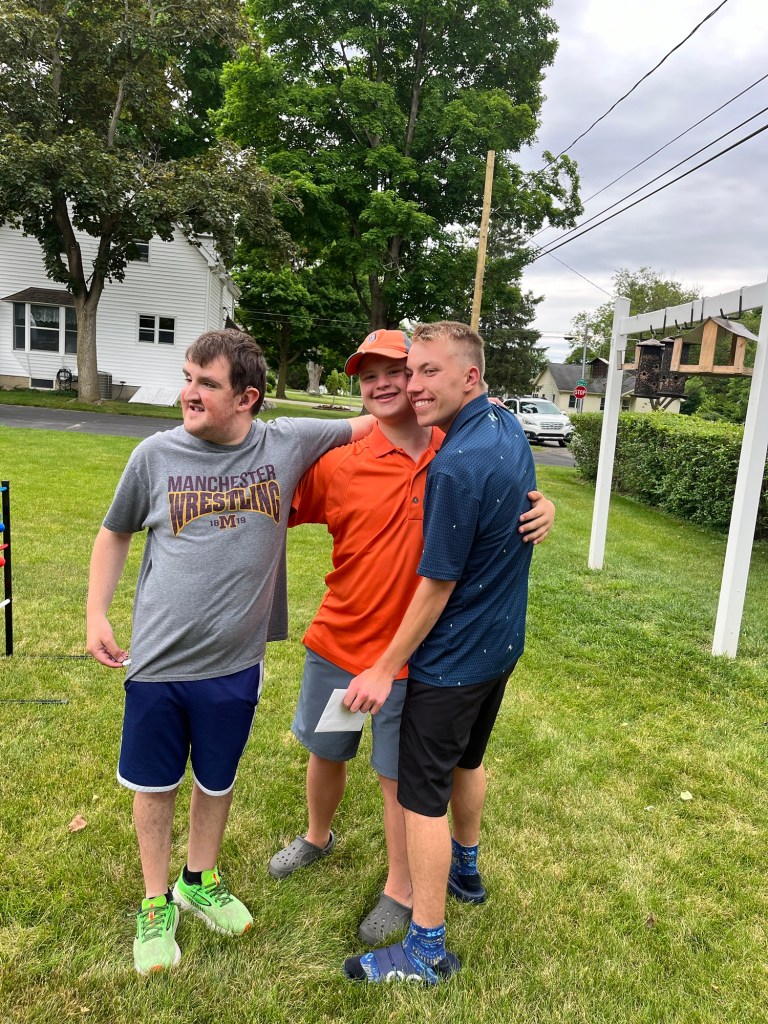
Wil recently went to his friend, Will D.’s, graduation party. Will D. also has a disability but has a much higher athletic ability than Wil T. Will D. has run ½ marathons and was on the track, cross-country, and baseball teams. As such, many typically developing athletic classmates attended Will D.’s graduation party. Two of these teammates were playing cornhole out in the sideyard when we arrived. These two boys gave a hearty hello to Wil T. and invited him to play cornhole with them. All the players found an equilibrium; their conversations were well-matched, relaxed, and fun. Watching this filled my heart.
At the water park yesterday Wil was floating down the lazy river in his tube. The lazy river is designed like an oblong circle, which splits and rejoins at one end. At the split, you choose to go under faucets spouting water or take the faucet-free dry option. Wil would alternate his decisions at the split, weighing more heavily on the “get wet” side. I watched as he by-passed certain tubers, and slowed to join others. He hung around a group of tween girls for some time, laughing when they laughed, choosing the same split in the river as the girls did. He then moved on to join a group of three young men. The men engaged him in some talk and fist-bumped him. When those young men exited the river Wil joined other young-ish groups. Down syndrome was on his side in this environment. No one questioned him, they immediately accepted him when he floated into their circle. Even if they didn’t converse, they shared the enjoyment and togetherness of the moment.
I wonder, what would the world look like if we all just opened our circles a little?
Just 2 years ago during graduation party time I needed an eagle eye on Wil. At one party he fled the party and would not leave the front porch. At another he ran to a side street and sat in the middle of it. Yesterday, at each grad party he hung with his buddies. And made new buddies. He played cornhole with known and new friends. He joined a basketball game with upper classmen from MSU. At each party, I only went to check on him here and there. A stark contrast from two short years ago.
He’ll be a senior next year, and then likely on to a young adult program. When he’s 20 he may have a whole new level of independence from what he has now. Time, opportunities, supports and his own will will tell.
Every individual is their own, no matter their disability. We cannot define nor predict their growth, but we can observe, we can open doors, and we can learn where to step in and offer supports, and as I’m currently learning, when to step back.
Wil was being a full-on teenager and I was being a full-on frustrated parent of a teenager.
I had prepared him for this orthodontist appointment for over a week. And he likes the orthodontist. He likes the orthodontic hygienists. He likes picking out new colored bands for his braces.
The issue was not the orthodontist. The issue is transitioning from one thing to the next. It always has been.
Wil’s appointment was at 11:15. We needed to leave at 10:55 at the very latest. I gave him countdowns all morning. We need to leave in 2 hours. We need to leave in one hour. Almost a half hour, let’s start wrapping up what you are doing. At 10:30 I asked him to get his hat and crocs. He replied “Ok, Mom” without resistance or complaint to my reminders. When it was time to go he dug in his barefooted heels into the grey plush carpet.
“Wil, it’s time to go. I gave you plenty of time to prepare. And you like the orthodontist. You get new colored bands today.”
He was watching a show on his iPad. He was comfortable seated on the plush carpet. Why would he want to leave? He knew I couldn’t do anything about it.
Fortunately I had 2 aces in my back pocket.
“If you don’t go to the orthodontist, that means you won’t be able to go bowling with Kristi Campbell (his paraprofessional we all adore) and you won’t be able to go to Special Olympics softball tonight. You’ll just have to stay home and be bored all day.” (I hung on to the last “L” of all for a few seconds.)
Though Wil was comfortable in his current spot, the thought of being bored is very uncomfortable. Adding in the discomfort of missing bowling with Kristi and softball would be powerful motivators. But even with those 2 added aces, I had to play my cards right. The more I talked, the more noise I’d put in his head. So I shut up and let him mull this over.
While Wil pondered and processed, my internal frustration grew. The clock was ticking. He’d refused a previous orthodontist appointment, and they’d been very understanding and not charged us the missed appointment fee. But I didn’t want to take advantage of that. And most importantly, I didn’t want to send Wil the message that he could miss his appointments. I had a fighting chance to send Wil the message I wanted to. I just needed him to get up off the floor first.
Spontaneity isn’t Wil’s friend, unless it’s on his terms.
When Wil was 13 years old, his refusal to move would have been a full stop sign. There would be no reasoning with him. This world moves fast for all of us, and for Wil even faster. He needs time to feel in control of his situation and emotions as we all do. Rarely do we fully achieve this level of control, but all of us need some semblance of this to move forward.
But Wil is not 13 years old anymore; and age is quite relative anyway. I know my son, and he was being more of a teenager asserting his independence than needing extra processing time. After a period of silence to allow Wil to think over his options, I reminded him that he was 16 years old and a Junior in high school. I asked him if 16-year-old Juniors sat on the floor when they didn’t feel like doing something. I asked him if he ever saw his sisters sit on the floor and refuse to go somewhere. No, when you are 16, you do what you need to do.
Wil honors his independence. He’s always trying to catch up to his sisters in age. In the window that they are one year apart, he believes that he’s almost gained on them.
Wil won’t even step foot in the elementary school where I work. He believes that will set him back in age. Even if I have to run into the school for a short while, he waits outside or in the car.
Still seated on the grey carpet, Wil talked to himself. About being 16 years old. About bowling with Kristi. About softball. This was a good sign. I watched as he worked through his emotions.
My tension built with each passing minute. Finally, I burst.
“Wil, enough. You know what you need to do. It is time to go. Get your hat and crocs.”
He pondered this for a minute then looked at me. “Hot chocolate at Biggby ?”
“It’s a deal. Let’s go.”
Once he was in the car we talked it over. About his independence, about honoring his commitments. I’m not sure if he fully wraps his mind around commitments. But it’s time to start talking about it with him. Anything that relates to independence has meaning to him.
I don’t know the level of independence Wil will reach. I don’t know if he will ever stop having stuck moments. But I do know how much he’s grown through the years. I keep growing and navigating it with him.
But I do get frustrated. Yesterday, when Wil was stuck, it wasn’t just yesterday. It was all the yesterdays I’ve been through with him. Some days I have the patience of Job, but yesterday I was done with it. When it’s time to go, I just want to go. I thought, how many years do I have to prepare him for days? How many years do I have to wonder if he will get up and go, or get stuck? It gets really old sometimes. Sometimes, I just don’t wanna, just like Wil just doesn’t wanna.
I suppose I’m a lot like Wil — spontaneity isn’t my friend either, unless it’s on my terms.
This Monday there was not a 7 minute standoff success story as I shared last Monday. In fact, after 20 minutes I remained the only one standing.
After giving Wil silent time to process, there was not a hint of progress. I tried being silly. Wil loves being silly, so the tug to join my silliness is often hard for him to resist. All I got in response was a flat-toned, “Mom, stop.”
I finally called it — even though Wil already had — he’d stay home.
I never call “calling it” a loss. It’s hard, yes. It’s frustrating, yes. It can put me, his sisters, his therapists, his friends — whoever we have a commitment with — at an inconvenience. The time they have set aside has now been dashed. Gratefully, most who know Wil, know that he makes most of his commitments, but sometimes he gets deeply stuck. And when that happens, it’s not going to happen.
The winning side is that Wil and I both learn through times like this. Even if it doesn’t show at the time.
His is a quiet learning; growing under the surface like the roots of a tree. Stretching, reaching, drawing upon water, all underground. Then one day, these roots now strong, bust through the surface breaking a sidewalk slab in two, seemingly out of nowhere.
I create the environment for growth. Figuring out how much water, how much sun. Last week I got it right. This week I overdrenched. He dug in deeper underground. There’s no exact formula. You go by experience, by hunches, by what you heard another parent try. And keep trying.
Today the roots lay dormant, but just maybe I shared a burst of sunshine or quiet rain that was needed for growth to emerge on another day.
There is no magic formula to acceptance of our friends with disabilities.
Acceptance, in its essence, is very simple.
You don’t need to be a special person. You don’t need to be born kind or compassionate or patient. You don’t need to be energetic or inspirational.
You don’t need to be anything other than willing to open your mind to acceptance.
That’s it. You don’t need anything else. It’s simply to be or not to be.
Once you truly open your mind to acceptance, the rest will come. The new ways of thought. The adventures you never considered. The new friends you wouldn’t have known otherwise. It’s the experience, once accepted, that delivers the specialness, the kindness, the compassion, the inspiration, the energy and the patience.
But if you keep your mind closed, then you’ll never know the amazing you are missing.
Acceptance is not a natural-born talent or a skill; it’s a choice. And that choice is up to you.
A sticky, filmy, wiggly smudge snaked across my computer screen. I’m not a fan of snakes, but I looked at this one endearingly.
Just a few days ago Wil was flipping through photos on my computer. They were photos of experiences at Camp Sunshine; the camp he’d be going to this very weekend. He smiled and called out to me to talk about each photo.
“Mom, a pool! Mom, a talent show! Mom, dancing! Mom, look a stage!” Wil’s finger followed the action of each photo. As he was on Camp Sunshine’s Facebook page, he went in deeper and deeper through the years. He didn’t want to stop looking, because he couldn’t contain his excitement about camp. He wanted the experience right here, right now.
It would be his first camp away from home; 3 nights, 4 days. Clearly, he was ready. I was ready for him. I’d been trying to get him into this camp for the last 4 years. When I finally was able to secure him a space, we then had an interview with Josie, his camp counselor. When we met Josie for the first time via Zoom she said, “The bad news is it’s hard to get in. The good news is for that same reason, once you are in, you are in.” Wil can go to this camp every year for as long as he lives.
When Wil and I entered the camp grounds, the camp was swimming in counselors with blue shirts on, and I’ll be darned if I could find one of them without a smile on their faces. The counselors were loaded to overflowing with just as much excitement as the incoming campers.
Many of the campers and the counselors had been coming back for years. As Wil and I waited in the line to hand medications to the nurse, we met Pete and his mom. Pete was 27 years old and this was his 6th year coming to the camp. At least 4 of the camp counselors approached Pete calling him by name as we waited in line.
“Hi!” A woman about my age with short, spiky gray hair in a blue camp shirt said to Wil. “My name is Kathy. What is yours?”
“Wil.” He smiled at her.
“Do you like fist bumps, high-fives or hugs?”
“Hugs!” Wil said. Kathy leaned in and the two embraced.
“And who is the beautiful woman you are with Wil?”
“That’s my mom!” Wil answered.
We were approached by many camp counselors just as friendly and effervescent as Kathy. Every counselor, without exception, addressed Wil directly. (You’d be amazed how many questions I get asked about Wil when he’s standing right there!) The counselors pointed every one of their questions to Wil as you would to any 16-year-old. As it should be.
After Wil was checked in and his medication handed over, it was time for Wil to go off on his own to camp. A young counselor named Conor placed a lanyard with Wil’s name badge over his head. As Wil bowed to receive his name badge, I felt the process almost knightly.
Next was the crossing-over ceremony. Multitudes of blue-shirted counselors lined each side of a walkway that lead to the cabins. Parents were not welcome on this walk. It was only for the campers and the counselors from here on.
“Do you want a loud or quiet send-off Wil?” Conor asked.
“Loud!” Wil answered without hesitation.
Cheers erupted as Wil marched forward through the walkway, pulling his suitcase behind him, never once looking back.
I stood on the sidelines trying my hardest not to fall into a body-shaking sob. My tears though, held no sadness. I cried feeling deep gratitude for the people that create a space such as this. A place that embraces my son for all of who he is. I cried seeing my son’s independence — it was an independence we had always worked toward but was never guaranteed. Many parents work this hard and certain levels are just not reached. So we celebrate every advance we work toward no matter where it lands us. And thus far, this is where we have landed and it is to be greatly celebrated.
It truly takes a village. Wil, our family, our friends, our educators, camp counselors and all of his supports. We all created this space together, in our own ways, and his independence means celebration for him, and also for the village.








 'WIL'ingness = Willing to Embrace Extra in Life