A singular new word Wil calmly adds to his vocabulary, in a such a way that only I — or his closest educators — would hear stands out like a stacatto flashing me back in time to a movie reel loop when he was 5 or 7 or 10, working a skill on a repeat loop that at the time I couldn’t see beyond.
But here I stand, still marveling at one added word, one added achievement, one added milestone, taking me back and pushing us forward seemingly in flow but full of staccato moments.
I’m not who I used to be raising Wil, yet I’m closer to who I am at my core.
I must pave ways for Wil and yet must leave space for him to create his own. He has a high level of vulnerability and yet has an inner strength many desire.
Wil has grown in me a patience I never knew I had, and yet also has grown an immense impatience to grow more; to learn more; to expand borders.
I have learned many stereotypes are hysterically true; and many are heretically innaccurate. Wil’s sisters called him, “Wil ‘the snail’ Taylor” every time they followed him as he two-stepped up and down the stairs. I’ve shared many laughs with fellow Ds mommas over stereotypes and shared many tears with these same mothers over stereotypes. Stereotypes can bind or separate. You need to walk the walk to know which is what.
And friendships. He has some deep ones. He also has many cheerleaders we’ll never see again once he leaves this school. But the impact his presence has made, and theirs on him, is undeniable.
Raising Wil is a paradox; surface friendships that leave a lasting impact, single breakthrough words that flash back to a former time loop on repeat, patience that creates a relentless drive, stereotypes that create binding laughs in their known truths, and stereotypes that create pain in their ignorance of the truth.
I now stand beside Wil with great hope of what’s ahead, pure enjoyment of where we stand right now, bouyed by the memories that brought us here, and on occasion flash me back.
Not so long ago, if anyone gave Wil choices he’d pick the last choice offered.
This morning I asked him, “What dipping sauce do you want? Ranch, mustard, ketchup or honey mustard?”
“H — Ranch.” Wil corrected his auto-response for what he wanted.
Life is full of tiny miracles embedded within everyday occurrences. Our kids with disabilities slow life down just enough to reveal these hidden gems for the light they are.
Wil and I decorated the Christmas tree. It’s the first time we’ve done it just the two of us.
Usually the twins are here so he’ll hang a few ornaments, but then move on to singing or other activities around us.
As Wil was home sick, and we needed low-key activities to stave off boredom, I suggested we decorate the tree. The tree was up, we were just waiting for the twins to come home this weekend. But I said let’s do it.
That’s all I needed to say. Wil got the box of ornaments from the basement and we got to work.
As it was just the two of us decorating, he put up more ornaments than usual. He picked one area of the tree and put all the ornaments there. Fine motor skills are hard for him (such as pinching his fingers together), so when he got frustrated putting the ornament loops over branches, he just shoved the ornaments into the tree.
“Wil, take a break when you need to. I know this gets tiring for you. But watch this, if you hold it like this it’s easier. And feel free to spread out.”
He did take a brief break. Then he tried looping a few more ornaments but stuck to the same spot.
All of his ornaments in one spot, many shoved in, was so darn cute — like a younger child would do. But also mixed with the teenage defiance of “you can tell me what to do but I’ll do it my way.”
Tree decorated, we cleaned up pieces of sparkle and felt that had fallen off of older handmade ornaments.
Wil picked up a red piece of felt, held it under his nose and said, “Look Mom, a mustache!”
Wil is an expert at spontaneous joy. As frustrated as he gets at things that are hard for him, he always has a silly something up his sleeve. It’s these moments that have changed my life. How otherwise mundane tasks can be incredibly joyful in the simplest of ways.
Which is one of the many reasons I don’t like the question: “What mental age is he?”
Ummm, he’s 5, 10, 17, 25 all in one moment. What mental age are you?
Some of us, like Wil, have all our ages all bunched up together in one spot.
Sometimes we need some guidance to spread out, and other times we know exactly how to make the best of right where we are. ❤️
I’m not a patient person. But I’ve been called patient a lot since raising Wil. And I started to believe I grew in my patience. It’s possible I did.
Last weekend Wil got stuck, and we had a very important wedding to get to. As the clock ticked I grew very frustrated. I wasn’t feeling patient at all. You could say I lost my patience, but it was that very loss that a new realization within me occurred. Patience is not a driving force.
It is a desire to understand.
It’s that simple. And it’s that hard sometimes.
When I was pressed for time, I may have lost my patience, but more importantly is that I lost my desire to understand where Wil’s resistance was coming from. Standing there with the patience of Job wouldn’t have helped any of us without a desire to understand. I thought for a minute.
“Do you want to wear your new outfit in the car?”
Wil looked up at me and nodded.
“Ok, it’s a 2 hour drive and you’ll get all wrinkled. We are stopping at Grandma and Grandpas on the way. How about you change there?”
“Mmhmm,” he agreed. And that was that.
Sometimes it’s not that quick. But sometimes it is. Most importantly, who doesn’t want to feel heard, especially when they can’t find or process the words?
I may have to find patience within, but the desire to understand is what leads the way.
I was in the living room. Wil was sitting in his bedroom adjacent to the living room.
Wil often talks to himself – many of us do. It helps us better process our thoughts, and it’s the same for Wil and for many people with Down syndrome. I quite like eavesdropping on Wil to better understand what is on his mind. Every morning he has a back-and-forth conversation with himself on what to wear: “Wear the blue shirt? Yeah, yeah, the blue shirt. Ok, the blue shirt.”
His exclamation about the marble though, was no back-and-forth conversation with himself. He wanted me to hear it. He was waiting for my response. Wil’s sister Katherine was home so he didn’t have my full attention as he’s grown used to since his sisters went away to college.
His attention-seeking strategy was effective. I went straight into his room.
“Wil did you really swallow a marble?”
“Hmph.”
“Wil, please tell me as this could be serious. I need to know. Did you swallow a marble?”
“Yes.” Then a moment later, “No.”
I actually had no idea if this was serious or not. I quickly googled swallowing a marble and found that it was quite common in young children. As a marble is round and smooth, most pass without issue. I sighed relief. But I didn’t want Wil to think he could add marbles to his diet.
I sat down next to him. “Wil, if you did swallow a marble, it’s very important that you tell me if your stomach hurts right away. Ok?”
“Ok.”
“So, did you swallow a marble?”
“No.” Then, “Yes.”
He was getting the attention he wanted from me and was holding tight to it.
“Ok, how about we go watch Olaf’s Frozen Adventure,” I said. Wil loves Frozen, and I love Olaf, so this was a show we both have watched together multiple times, which is why I chose it in this moment.
“Yes!”
I still have no idea whether he swallowed a marble or not. Wil does not outwardly lie. I’ve never heard him lie, and I don’t think he even knows what lying is. In this case he wanted my attention.
Other times, if I ask a question and he doesn’t know the answer, he will throw out a yes or no just to answer me, or whomever is asking. His eye exams can be quite challenging as this happens a lot.
But yesterday, he took one of his friend’s phones as a joke, and his teacher let him know this was no joke. His teacher then Facetimed me, with Wil, about this so we could all talk it out. Wil then understood the seriousness of taking other’s possessions. When Matt and I talked about this incident with Wil after school, he was very honest. As he always is with these types of questions.
After about 5pm every day, Wil will blurt out a detail about his day. This is a quieter time at home, or when we are in the car on the way to a therapy or the grocery store. He’ll blurt out, “Chocolate chip cookies!” Or, “Omelets!” Which is what he made in cooking class that day and then we can talk about it. But if I ask too soon, he won’t tell me. Wil shares on his own timeline when he’s had time to unwind and process his day. Then, he’s an open book.
Sometimes I don’t understand what he’s saying, so I’ll ask him to spell it. Yesterday I asked him what he did in choir.
“Whales.”
“Whales?”
“Yes, whales.” He said. Thinking I misunderstood him I asked what letter it started with.
“W.”
“Oh, ok.” Now realizing I heard him correctly, but the context was out of place for me, I then asked, “Did you watch a movie about whales?”
“Yes!”
It’s really interesting how breakdowns in communication can happen. I did hear what Wil said, but as I didn’t connect whales with choir, I thought I misunderstood him. I’m not the best listener, but with Wil I am because I have to be.
I used to say, “Oh, I’m not that kind of person.” But I quit doing that, because raising Wil I’ve had to be many kinds of people that I didn’t think I was.
Many think raising a child with a disability is a burden. But in fact, my experience has been that Wil has brought so much freedom in my life, in altering the way I think, hear and see the world.
My Grandma used to wrap presents in newspaper. In the opening, my fingers would be covered in smeary black smudge, but as a kid who cared? My Grandma didn’t much care either, which is why she didn’t spend time buying pretty wrapping. What was important to her was the giving.
Now I look back and both chuckle and endear the memories of gifts covered with my black fingerprints. The receiving of the gift also had my mark on it.
Curiosity, to me, is like those black smudged gifts.
There was once a day I did not want a child with Down syndrome until I birthed a child with Down syndrome. I got as curious as I have ever been in my life that day Wil was born.
My experiences were messy. I didn’t know what I didn’t know. Oh, I had advice. Lots and lots, but even in our community of parents raising kids with Ds, we laugh together about how what works one day likely won’t work the next.
Our culture also draws hard lines about what is right and wrong. But maybe, with experience, those lines may be smudgier than you realized.
No matter how much we know, or think we know, think back on all those smudgy experiences that led you to your beliefs today. Allow space for curiosity in yourself, allow space for curiosity in others.
Sometimes unwrapping the best gifts are when we have to get our fingers dirty first.
Wil talks all the time. He talks to me, he talks to friends, he talks to himself. I wonder at the time, listening to him today, how one hesitant word was cause to drop everything and celebrate. His verbalization today was once a distant, fuzzy dream. Like reaching for a cloud that my hands couldn’t quite grasp.
Wil does have a tendancy to stutter when he’s excited — his emotions overtake his ability to choose his words and his words get jumbled up. I get it; even the most poetic words could never fully describe an emotion.
When Wil sings, however, there is no stuttering. His emotions, paired with the words, are set free in song.
When Wil talks to himself, there is no hesitation in his words either.
“Lunch?” He’ll ask himself.
“Yeah, yeah, lunch.” Is his reply.
“What do you want? Hot dogs?” He prods.
“Mmm, hot dogs? Yeah, hot dogs.” He answers himself.
“With mustard and peppers. And relish. Mom! Lunch!”
When his self-talk first emerged, I worried. I remember when I first heard it. He was sitting on the floor of his bedroom in front of his closet. He had a back-and-forth conversation with himself on what toys to play with. It was also at this time that the gap in abilities with his peers was becoming very clear. So this timing had me wondering if he had created an imaginary friend because he felt lonely.
Wil has had the same peer group since kindergarten and they exemplify what inclusion is. Even so, I wondered how this gap in abilities that I saw expanding was affecting Wil emotionally. He didn’t act sad about it. He still talked about his friends in the same way. But there was this self-talk emerging and I didn’t know where it was coming from – other than Wil, of course.
I googled “self-talk Down syndrome.” I found this phenomenon is very common amongst individuals with Down syndrome. It’s simply a way to process thoughts. As Wil grew older and we spent more time with teens in our Down syndrome support group, I realized how typical this is. Now it’s just what Wil does. It’s just what is.
As Wil grows on the outside, I grow on the inside. The stigma of the outside disappears when I find understanding on the inside. I frequently look back and wonder at what I once wondered at. It’s an emotion beyond words.
Yesterday Wil and I were driving to get his hair cut. Wil always takes my phone, searches what he wants to play on Amazon music.
If he diverges from Luke Bryan he’ll say to himself, “how to spell Dierks Bentley” and type it out using phonics. Sometimes this works, and sometimes it leads to frustration and more tries. I listen as he figures it out, only helping when necessary.
Wil used to think Rodney Atkins’ name was Ronnie. He was adamant about this. But his searches lead to dead ends.
“Wil, it’s Rodney. Like a fishing rod, and your knee. Rod-knee.” I mimicked throwing a fishing line then pointed to Wil’s knee. Wil liked this explanation so gave up his strong adherence to Ronnie. Rodney became a joke between us, Wil throwing a line and hitting his knee.
There are two parts to nearly every story with Wil. As a parent, I always notice the learning happening. Always. It’s part of my every day with Wil and has been since day one. He needs extra in life, and the extra given gives back, without fail, in every experience, no matter how seemingly small.
The other part of each story is the joy. It’s pure. Because Wil is Wil. He’s all in to who he is, and that can not be faked. That’s why people are drawn to him.
There is a vulnerability to that which scares me. He can easily be taken advantage of. And yet, his vulnerability is the bravest way of being a human being without the effort to be brave. Wil is Wil.
When Wil listens to music he is all in. He rocks back and forth in his seat. As I’m driving, I sing and move my head but don’t rock at his level or I’d be off the road!
As is often the case, we will reach a destination and he wants to finish the song. I decided to match his back and forth rocking. It was a damn workout and I only matched his pace for just over a minute.
We’ve been at stop lights where people look over because he is moving so much. He never notices them looking but if he did, he’d look over and smile and keep on going without missing a beat. That’s authentic joy ~ freely sharing your inner joy outwardly with whomever wants to join in, and if they don’t he’s not bothered because he is all in.
As for me, I’m always learning too. The extra I give Wil always gives back more than I could ever give or have imagined to receive.
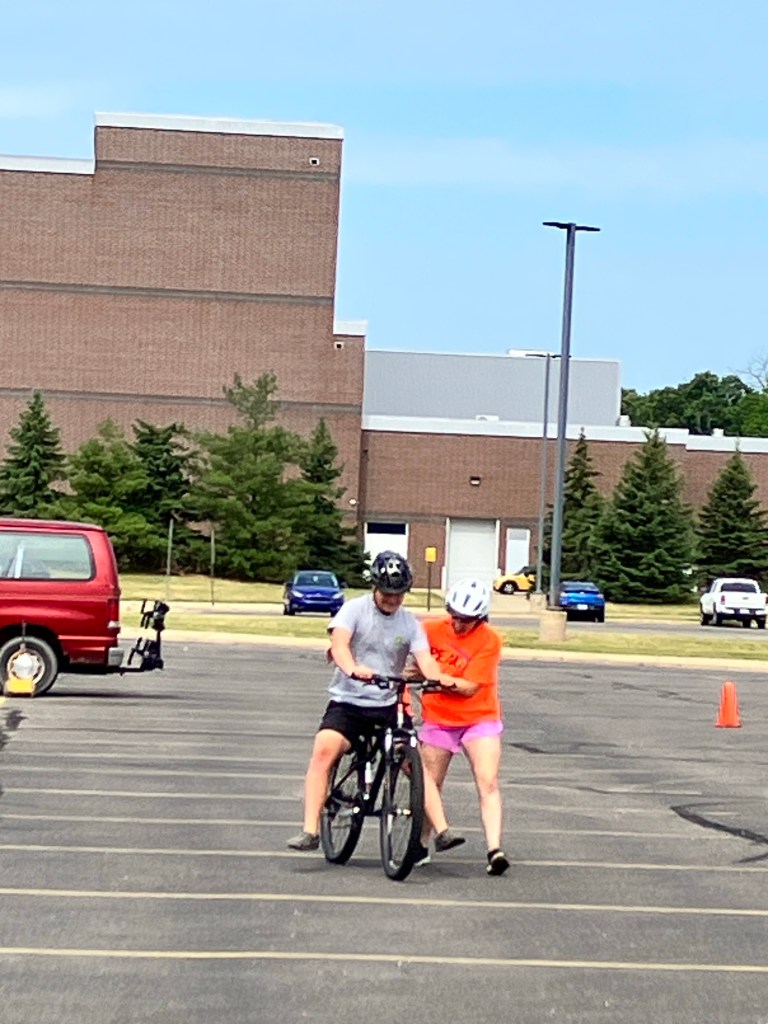
I walked into the parking lot area where Wil was to take his PEAC bike camp. I was overcome with a positive, uplifting feeling — thankfully this type of feeling is not unfamiliar. I’ve grown accustomed to this shift from breathing dense air into a higher atmosphere in only one step.
This atmosphere is one of people helping people. It is beyond a good deed. It is true unity. We innately know the difference as it’s the way we are supposed to be — together.
This is one of the many gifts individuals with special needs offer us. We only need to rise beyond ourselves to accept this handed gift.
The past fall, I struggled with the thought of never truly being an empty nester. My thoughts were a twisted, tangled jumble of yarn – strands of prickly burlap wound tight around strands of brilliant, transparent glitter.
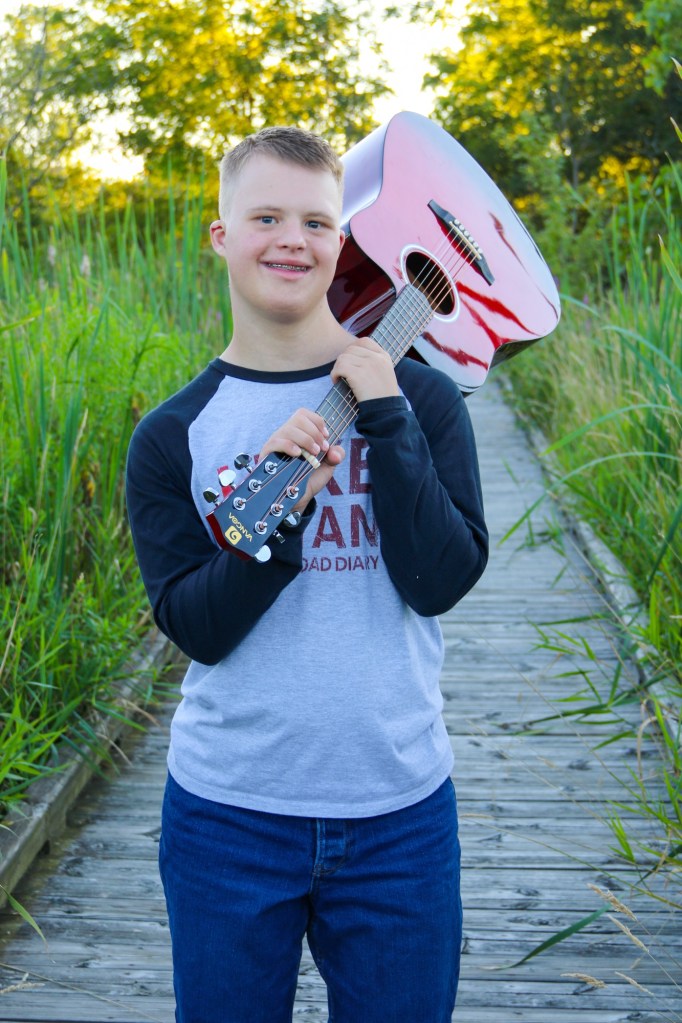
The brilliant strands of glitter represent Wil’s near constant song. Nearly every event calls for a song — when he’s playing, in the shower, in the car, or outside for a walk; anything and everything is inspiration for music. The brilliant strands of glitter also represent Wil’s ever-creative and impromptu silliness. Just yesterday Wil grabbed a branch, held it up and said, “Look Mom! I’m Tree Wil.” And we both broke up into giggles. I can count thousands of such impromptu acts over the years. There is nothing too small for Wil to make big of. He could make a brown paper bag fun—and has, many times! The brilliant strands of glitter also represent Wil’s ever-expanding growth, independence and self-advocacy. Each year he reveals to us more and more of what his true abilities are.
And yet, even at Wil’s highest levels of self-advocacy and independence, he will always be vulnerable. He will always need some level of care beyond his own. When thoughts of Wil’s vulnerability overwhelm me, the prickly strands of burlap sprout and wrap themselves tightly around the brilliant glittery strands, shrouding their luminescence and razzle-dazzle, weighing them down like a heavy, clingy, weedy vine.
It is the burlap strands I’m stuck in when I envy my empty-nesting friends their freedoms. Don’t get me wrong, I am happy for them – I thrill at listening to their planned or dreamed of future adventures. It is the sense of freedom that lay before them that I envy. I envy that for them this is the natural order of things – that this type of freedom is expected.
For our family, a lot more is to be considered — Wil’s care must always be considered. He can’t be left alone for extended periods so we are always aligning schedules. Vacations must be made that suit his needs. If a situation is loud and very crowded, Wil may refuse to go in. If Matt and I chose to go out on our own, who would care for Wil while we were gone?
I also felt the same when people talked about not wanting to live past a certain age. One night after a sporting event, Matt and I went out to dinner with only 2 friends that I knew and the rest were acquaintences of Matt’s. We were all spread out down a long, rectangular table. A man about my age and his girlfriend were seated directly across from me. During the course of conversation the man said, “Well, I don’t want to live past 80.” I then asked him why that was so. His reasoning, as you would expect, concerned his own abilities. I then asked him, “What if you had a child with a disability that relied on you? Would that change your mind?” He stared blankly at me.
We only see what we know. But there is so much more to see than what we know.
This past fall, I was seeing things just as that man across the dinner table. A tightly woven, blocked perspective.
If my mind stays stuck on certain freedoms that I don’t have, how will I open my mind to see all the freedoms that I do have? And all the freedoms available that I don’t yet see.
Wil continues to grow and expand in his maturity because he sees beyond a finish line to growth that many of us draw for ourselves. Wil’s creativity and spontaneity knows no bounds for the same reason. At one point, we stopped seeing branches that could be created to form Tree Wil. In fact, now many of us walk past branches that we don’t see at all.
There are so many things that I do not see! And Wil reveals that to me every day, many times a day. So why can I not unravel the heavy, clingy prickly parts of my own life and instead view them in a new light? Why not let the brilliant, glittery strands elevate my perspective?
Why, because my life may look different than another’s, can I not shine light on a whole new natural order of things? Why must my natural order match another’s?
What I see – and more importantly what I don’t allow myself to see – are the only blocks to my very own freedom no matter where I go, or don’t go.









 'WIL'ingness = Willing to Embrace Extra in Life