I have recently gotten back in the pool (after a year 😅) thanks to our friend, Dawn, taking great care of Wil after school and honing in on his life skills learning.
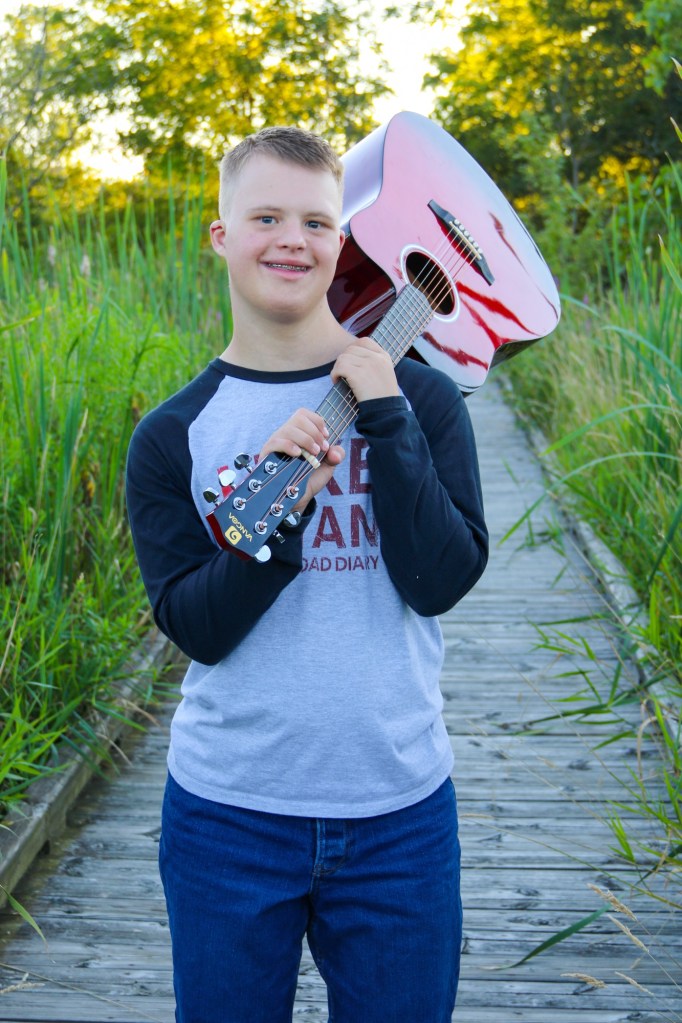
While I swam Monday, Dawn’s husband came over to have a guitar jam session with Wil 🎸
When you have a dependent child, your schedule revolves around that child’s schedule. It takes a lot to find someone you fully trust, and that matches your schedule, so you and your child both can enjoy needed independence time.
Wil is my buddy, and he is so much fun! I’m thankful he’s not flying from this nest for some time to come. And yet, Wil is almost 19. He deserves someone other than mom all the time to expand his young adult life.
When I mention respite care outside of our disability circle, I receive a blank stare in response. That likely wouldn’t have been in my vocabulary either! But independence doesn’t happen without it when you have a dependent child.
When you meet someone with a dependent child, know that they most likely love having their child home, but at the same time, both parent and child need time to spread their wings, and that doesn’t happen without an extra set of loving, caring hands.
Our lives always include extras, and that extra includes extra special people with extra special hearts. 💕
A singular new word Wil calmly adds to his vocabulary, in a such a way that only I — or his closest educators — would hear stands out like a stacatto flashing me back in time to a movie reel loop when he was 5 or 7 or 10, working a skill on a repeat loop that at the time I couldn’t see beyond.
But here I stand, still marveling at one added word, one added achievement, one added milestone, taking me back and pushing us forward seemingly in flow but full of staccato moments.
I’m not who I used to be raising Wil, yet I’m closer to who I am at my core.
I must pave ways for Wil and yet must leave space for him to create his own. He has a high level of vulnerability and yet has an inner strength many desire.
Wil has grown in me a patience I never knew I had, and yet also has grown an immense impatience to grow more; to learn more; to expand borders.
I have learned many stereotypes are hysterically true; and many are heretically innaccurate. Wil’s sisters called him, “Wil ‘the snail’ Taylor” every time they followed him as he two-stepped up and down the stairs. I’ve shared many laughs with fellow Ds mommas over stereotypes and shared many tears with these same mothers over stereotypes. Stereotypes can bind or separate. You need to walk the walk to know which is what.
And friendships. He has some deep ones. He also has many cheerleaders we’ll never see again once he leaves this school. But the impact his presence has made, and theirs on him, is undeniable.
Raising Wil is a paradox; surface friendships that leave a lasting impact, single breakthrough words that flash back to a former time loop on repeat, patience that creates a relentless drive, stereotypes that create binding laughs in their known truths, and stereotypes that create pain in their ignorance of the truth.
I now stand beside Wil with great hope of what’s ahead, pure enjoyment of where we stand right now, bouyed by the memories that brought us here, and on occasion flash me back.
Wil loves putting ornaments on the Christmas tree. Using his fine motor skills has always been a challenge for him; especially pinching.
As you can imagine, placing ornaments with loops on top gets tiresome quickly for Wil — but Wil always finds a way. When his pinching fingers are worn out, he puts the ornament loop on the very edge of a branch, or just slides that ornament right into the tree and nestles it between branches. He has as much pride in this placement of ornaments as he is still participating in decorating the Christmas tree.
I’ll wake in the morning to multiple ornaments on the floor that slipped off their precarious perch over night. I then look up and browse the ornaments he’s tucked into the Christmas tree. As I stand there my entire being is consumed in a humorous joy that is from somewhere deep inside me. My joy is such it could elevate me directly to the ceiling like in a Mary Poppins floating tea party.
My deep joy is born of deep worries. Deep worries I had in Wil’s younger years when I learned of his low muscle tone. Of when I cried seeing his fine motor skills test scores report a 6-month-old’s ability level when he was 5 years old simply because he couldn’t string beads yet.
I’ve learned a lot about the values and deficiencies of tests over the years. I’ve learned what to take at face value and what to hit the delete button on. I’ve learned a lot about taking life day-by-day. I’ve found myself celebrating what I didn’t know would ever happen— I’ve found a patience in myself waiting for even a glimmer of it to happen. And I’ve found myself become someone who celebrates in vivid colors “what is,” while “what isn’t” quieted itself into a hazy, distant background I once knew.
What I once worried about does mean a lot. But not in the way I thought it would mean today.
This nestled ornament is not only made of paper, styrofoam, cotton balls and glue — it is a symbol of deeply nestled worries grown into a deep, uplifting joy.
In this house we take no such statements for granted.
In middle school, Wil riding the bus proved unsuccessful. He was already having a hard time transitioning to a new school with new educators and hormones were in full effect. The middle school years are challenging; then add in communication barriers and cognitive delays that a body’s progression into puberty does not wait for, and you’ve got behaviors. Every day was a new experience, and we were rewriting the plan over and again. Finally, I called “Uncle” on the bus riding as it was adding stress to Wil amongst all the other areas we were navigating at the time. It’s challenging to do that, as you never know if you are giving up at the right time, or too soon. But what I have learned is no matter what the success — or lack there of — looks like from the outside, there is groundwork being laid on the inside.
Wil is now in 11th grade. He loves being 16 years old. And he is fond of reminding me he will be 17 years old on his birthday. He wants to go to college like his sisters. We will cross that bridge — in this house we are very used to crossing bridges as they come. As he is growing into his indepedence and his maturity has blossomed, he told me he wants to ride the bus home. I joyously concurred.
Last spring, he did ride the transfer bus from his high school to the elementary school where I work. This was very successful, so I think it was the perfect nudge to riding the bus the full way home.
All was going smoothly until 2 weeks ago. Wil walked to the bus like he always did, but then just kept on a-walking. His teacher ran after him and walked him back to the bus. Wil refused to get on. So Wil and his teacher walked to the office. His teacher called me and I picked him up. This happened every day for a week.
All I could get out of Wil was that the bus was too crowded. He refused to sit up front where it was quieter. But he is in 11th grade, so why would he want to do that? I suggested his noise-cancelling headphones. Wil is very aware of his looks, and doesn’t want to look different. I want to make clear that he is in no way ashamed of his disabilty, nor should he be. And noise sensitivity is part of his disability. But Wil puts great importance on his appearance, and you know by now his deep affection for baseball hats, so noise-cancelling headphones would throw off his style; and his hat. (Wil only wears his headphones now if he is at the movies or a concert, but he’ll only go to these loud places if he really wants to be there.)
So, here we were. Wil refused to ride up front where it was quieter. He wanted to sit in the back with his friends. But it was too crowded. So it makes total sense that he would attempt to walk up to the bus, get nervous and keep going.
Just being able to make sense of things is HUGE!! When Wil was in middle school, he was not able to express to me his reasons for being nervous on the bus. His educators and I had to do our best detective work, but with so many factors at play, our best guesses were only that — guesses.
As Wil could now tell me the reason for not riding the bus, we could have a discussion about it. Now Wil had true ownership in his decision as we could have a conversation about his options as I knew what the struggle was.
Whether what we come up with works for the long-term or not is to be seen. But what is most important is that Wil has a voice in this, and that is something he’s always deserved to have, and we’ve worked hard for him to share it.
With this knowledge, Wil’s teacher created a chart to hang in the classroom. Each day Wil rides the bus he will get a sticker. Wil thrives on recognition so was immediately into this idea. Every 3 stickers, I will take Wil to the market to pick out a handmade sandwich of his choice and a drink. He also loves this type of adventure.
Today is day one of this plan. I went up to the school and parked in the lot just in case Wil refused (I parked out of Wil’s sight so he wouldn’t backtrack.)
Wil’s teacher walked with him, and he successfully made it on the bus!
In this house, we celebrate successes!
Today is one day, tomorrow will be another. And so will the next. Every day we cross a new bridge. Every day I will feel a tightening in my stomach at 2:45 with one eye on my phone. And every day it doesn’t ring I’ll release the butterflies in my stomach to fly in celebration.
In this house, every day is a new day. We never take such things for granted.
Picture day was today. Last night Wil took a shower in preparation, and spent extra time choosing a shampoo. I heard him talking to himself as he smelled each one.
“Ewww! Too strong. Hmmm, this is old. Mmmm, smells good.”
With his sisters gone to college, Wil can safely use what they’ve left behind without swift sibling reprimands. When his sisters were home, the slightest change in position of their shampoo, conditioner or body lotion bottles was expertly detected.
Wil eventually, and excitedly, exited the shower, put on his fluffy blue robe, and walked directly to me. He bent his wet head so I could smell his freshly showered hair, then lifted his arm for me to smell his fresh skin. Wil shared no words with these actions. This routine went back to the days of him refusing to bathe, and me adding positive reinforcement when he did. This same routine also remains with him blowing his minty fresh breath in my direction after he brushes his teeth.
“Oooo, fresh!” Is my expected, and routine reply. He’s 16 years old now, and we really don’t need this routine anymore, but it makes us both laugh, so we keep it up.
He combed his hair, played it into a Mohawk, “like this Mom?” We laughed again, he put on his pajamas, and he went to bed.
I’m not sure what happened overnight, but he was a different version of himself this morning. I had to coax him out of bed, then he wouldn’t get dressed. My guess would be overwhelm. He typically wears a favorite dressy shirt on picture day, but today he picked a black cotton Luke Bryan shirt that wasn’t exactly unwrinkled. He was muttering to himself, which meant he knew he picked this shirt to pick a fight. He wanted me to tell him to pick something else. And it would be him flat out refusing to do anything.
If he had simply picked out a shirt, without the muttering, I would have asked him to go back and take another look. I would help him if he wanted. And he’d do that, and come out saying, “This one, Mom?”
But I knew this muttering mood well. And it’s one where I give him space to work through what he needs to. And that’s what I did. Almost. His hair dried funny in the back. So I waited until he was eating breakfast (aka when he was happy and distracted) and put a wet comb through it.
“Mooooooom!”
“Wil, I know you’ll be disappointed if your hair is sticking up.” As he wears a baseball cap every day, I asked him to wait to put it on until after pictures. Well, in the mood he was in, you can guess what he did. Hat on.
“Wil, if that’s what you want to do, fine. But think about when you get your pictures and your hair is all sticking up. Is that what you want?” I asked. He pondered this.
“Gel, Mom.” He said. Vanity does have its perks!
Wil is a wild card, with a few wild hairs! I never quite know what will offset him, so I’m always reading his cues. I think that’s why I enjoy our predictable routines — oooo, fresh!—-even if he’s outgrown them. When we make it to the car every school morning, and he starts singing, it’s like I scored all aces, and we both turn up the volume on our voices and laugh, as we always do, at our ridiculousness.
This Monday there was not a 7 minute standoff success story as I shared last Monday. In fact, after 20 minutes I remained the only one standing.
After giving Wil silent time to process, there was not a hint of progress. I tried being silly. Wil loves being silly, so the tug to join my silliness is often hard for him to resist. All I got in response was a flat-toned, “Mom, stop.”
I finally called it — even though Wil already had — he’d stay home.
I never call “calling it” a loss. It’s hard, yes. It’s frustrating, yes. It can put me, his sisters, his therapists, his friends — whoever we have a commitment with — at an inconvenience. The time they have set aside has now been dashed. Gratefully, most who know Wil, know that he makes most of his commitments, but sometimes he gets deeply stuck. And when that happens, it’s not going to happen.
The winning side is that Wil and I both learn through times like this. Even if it doesn’t show at the time.
His is a quiet learning; growing under the surface like the roots of a tree. Stretching, reaching, drawing upon water, all underground. Then one day, these roots now strong, bust through the surface breaking a sidewalk slab in two, seemingly out of nowhere.
I create the environment for growth. Figuring out how much water, how much sun. Last week I got it right. This week I overdrenched. He dug in deeper underground. There’s no exact formula. You go by experience, by hunches, by what you heard another parent try. And keep trying.
Today the roots lay dormant, but just maybe I shared a burst of sunshine or quiet rain that was needed for growth to emerge on another day.
My son will not play in the NBA; my son will not invent a new vaccine. My son will not design a software program nor manage your finances. My son will not drive a car nor drive a recycling truck.
But my son sang for nearly 4 hours on our drive up north without any music playing other than what was in his head. My son can put an impromptu Luke Bryan medley together faster and more expertly than Luke himself. My son knows the lyrics to well over 100 country songs. My son still jumps in puddles at age 16, finds reasons to laugh over things we’ve long forgotten, and has a joie de vivre that is enigmatically contagious.
My son is also frustratingly slow when he doesn’t want to do something, often coming to an abrupt halt. He will not be bullied, pushed or cajoled. He will do things in his own time; not mine and not yours. My son is hurt deeply when others try to force their timeline or opinions on him; yet he doesn’t hold a grudge against others. He quickly forgives, but he never forgets.
My son has his own opinions, idiosyncrasies, habits and preferences. My son, just like you and me, is fully human in beautifully challengingly ways. That is where we all can meet.
Wil does not have to win a pulitzer prize to prove his worth to this world. In fact, his having a disability gives us the opportunity to be better humans than we are. Wil, in his own way, is a pearl.
Wil was always a pearl; it was my heart that was the sand that needed to be molded and shaped.
Many do not take the time to look within their own hearts to see the sand; and this is required to take the time to understand my son. To understand Down syndrome. Our closed minds are the sand that we must mold over time and experience, and in that we find the pearl of his existence. And the beauty of that journey is we come to value what human life is about. It’s more than achievement. It’s more than habits. It’s about remembering the songs in our hearts before the sand gritted and obscured them.
I don’t want a cure for Down syndrome; I want a cure for a belief system. I want to turn sand into pearls within us. If we can create vaccines and information systems and recycling systems, can we not do this?
Wil’s paraprofessional, Kristi, told me how Wil — of his own will — went to the closet in gym class, pulled out two baskets and two balls. He proceeded to toss the balls in the baskets. His peers joined in his created game by cheering him on.
Today I picked up Elizabeth, Wil and their friend Kimmy from school today. Elizabeth had an NHS meeting, so Wil, Kimmy and I sat in the car waiting for her with the windows down. As kids poured out of the school, Wil yelled out his hellos, and peers called out and waved to Wil. One friend, Trent, walked up to our car and chatted w Wil. Trent has about every sport there is on his letter jacket. After their chat he fist bumped Wil and walked away.
Wil takes this all in stride, having no idea how this type of interaction is not commonplace. To him, it’s just another day at school with friends.
Kimmy, whose aunt and sister have special needs, said how embracing of Wil the students are at school. I responded that it fills my heart; its what inclusion is meant to be. Wil’s experience is as it should be but isn’t how it always is.
Kimmy agreed, saying she sometimes forgets how people don’t grow up under the same circumstances as she does, and don’t always understand certain reactions and behaviors of individuals with special needs.
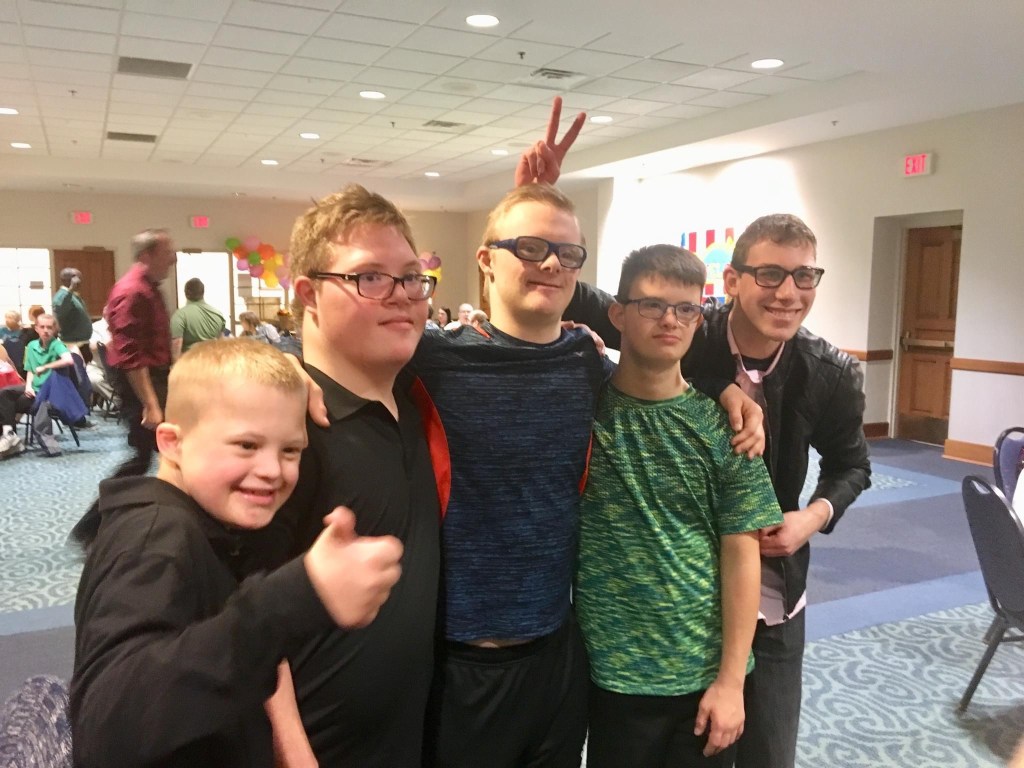
I’m so thankful for this Community School experience. It’s enriched my life as much as Wil’s. It’s what inclusion is meant to be — a benefit for all. It’s about friends being friends; of all abilities.
Today Wil and Manny went bowling. Both are teens with Down syndrome. Manny’s mom, Laura, and I share frequently about our plans, thoughts and concerns for the future. Thoughts about our boys as they age out of the school system; after friends have moved on to college, to jobs, to get married. How will our boys adapt to the change? What programs are available now and in the works for the future? And of the programs available, are they a good fit for our boys?
Last night my friend, Cheri, who’s son CJ (who you may know from his weather reports—WCJR weather) called me. CJ is graduating high school this year and also has Ds. Cheri and I shared our thoughts and plans for our boys’ futures. Cheri is always a step ahead of me in raising CJ, and I learn greatly from her experiences.
Not everyone has a teen child with Ds. We must actively seek one another out, actively seek out programs, and discern if what’s available is the appropriate fit for our soon-to-be adults. In fact, just today, Wil had an interview with a summer camp I’ve tried for years to get him into. Wil is ready for an overnight camp, but not without an aide. Just going to a typical summer camp is not an option for him. And that is the case for many people with disabilities; thus the long waiting list. The interviewer said Wil’s a really good fit, but spaces are very limited. She was wonderful, we connected immediately, and said she’d do what she can for him to get in.
Recently talking with my friend, Vanessa, who has a teen daughter w Ds said to me, “You bend for the ones you love.” That statement delivered great clarity to me. It makes sense of what connects me to a camp counselor I just met on a 30 minute Zoom meeting, but knew her innate understanding immediately; and also what connects me, on a deeper level, with my friends. We bend to create understanding and opportunities for people with disabilities. We bend together for the ones we love.
As Vanessa spoke those words, I visualized trees that stay closed in, protecting the roots they know, refusing to bend. Then I visualized trees firmly rooted in love, but with branches reaching, stretching, bending, some almost impossibly yet never breaking, open to receive the sun along with the rain — both of which serve to strengthen them.
If you were a tree, what kind of tree would you be? 😉
Yesterday, checking out at the grocery store, the grocery clerk commented on the cupcakes I bought. I said the cupcakes were for my son’s classroom for his birthday.
The grocery clerk asked how old my son was. I replied that he was my baby, and it was hard to believe he was already 16 years old. I shared that he has Down syndrome and his Life Skills class really enjoys birthday celebrations. She nodded her head silently and continued to check my items without another word. Ugh, I thought, I overshared.
After that pregnant pause she said her baby was 35. She went on to say her son was recently diagnosed with Schizophrenia. But he didn’t believe he had Schizophrenia; that everything happening to him was real. He was in the hospital, so at least they could be sure he took his meds, but when he got out, she’d be the one to ensure that.
Wow, you just never know what people are going through. Here I thought I shared too much with the grocery clerk; but rather unknowingly created a vulnerable space for her to share what was heavy on her mind. Though it was heavy, in a way we were both lifted by that encounter with one another.








 'WIL'ingness = Willing to Embrace Extra in Life