Not so long ago, if anyone gave Wil choices he’d pick the last choice offered.
This morning I asked him, “What dipping sauce do you want? Ranch, mustard, ketchup or honey mustard?”
“H — Ranch.” Wil corrected his auto-response for what he wanted.
Life is full of tiny miracles embedded within everyday occurrences. Our kids with disabilities slow life down just enough to reveal these hidden gems for the light they are.
Wil wanted to ride his bike to school. We live on a busy road so we agreed on him riding from a park about a mile away. He’s 17 years old so of course did NOT want me with him. We agreed I’d meet him where the sidewalk curves to the high school.
It’s very cold so it wouldn’t be unusual for him to feel cold, get off his bike and just walk off anywhere. So yes, when I saw him crest the hill I was very happy; as was he happy to be given this independence. He even got cheers from a friend driving by!
Wil had to cross the street to the high school, so it was a non-negotiable that I be there to facilitate that. I wish I could see who was in the pickup truck at the Crosswalk. That driver saw Wil’s approach well before Wil arrived at the Crosswalk and waited there extra time until Wil approached and crossed.
That’s what I love about this small community. How we know and look out for one another. ❤️
Wil and I decorated the Christmas tree. It’s the first time we’ve done it just the two of us.
Usually the twins are here so he’ll hang a few ornaments, but then move on to singing or other activities around us.
As Wil was home sick, and we needed low-key activities to stave off boredom, I suggested we decorate the tree. The tree was up, we were just waiting for the twins to come home this weekend. But I said let’s do it.
That’s all I needed to say. Wil got the box of ornaments from the basement and we got to work.
As it was just the two of us decorating, he put up more ornaments than usual. He picked one area of the tree and put all the ornaments there. Fine motor skills are hard for him (such as pinching his fingers together), so when he got frustrated putting the ornament loops over branches, he just shoved the ornaments into the tree.
“Wil, take a break when you need to. I know this gets tiring for you. But watch this, if you hold it like this it’s easier. And feel free to spread out.”
He did take a brief break. Then he tried looping a few more ornaments but stuck to the same spot.
All of his ornaments in one spot, many shoved in, was so darn cute — like a younger child would do. But also mixed with the teenage defiance of “you can tell me what to do but I’ll do it my way.”
Tree decorated, we cleaned up pieces of sparkle and felt that had fallen off of older handmade ornaments.
Wil picked up a red piece of felt, held it under his nose and said, “Look Mom, a mustache!”
Wil is an expert at spontaneous joy. As frustrated as he gets at things that are hard for him, he always has a silly something up his sleeve. It’s these moments that have changed my life. How otherwise mundane tasks can be incredibly joyful in the simplest of ways.
Which is one of the many reasons I don’t like the question: “What mental age is he?”
Ummm, he’s 5, 10, 17, 25 all in one moment. What mental age are you?
Some of us, like Wil, have all our ages all bunched up together in one spot.
Sometimes we need some guidance to spread out, and other times we know exactly how to make the best of right where we are. ❤️
Wil jumps on the trampoline. Free. Fun. Full of joy. His play is not forced; nor is it self-conscious. He hoots, he hollers. He’s in the moment. When tiredness sets in he rests. He sits on the black circular mat, looks around, and soaks in the feeling of his heart relaxing. This is not a conscious action. It’s a feeling. When his breath is caught he resumes his play. He resumes his laughter. The cycle of play and rest continues, not in perfect time, but perfectly all the same. His time on the trampoline is conducted all on his own time. And if someone wants to join in, the net is always open. His play is not pushed or forced; his rest is not laziness. It is a balance of body and mind in time and always open to friendship.
When I watch him, I wonder, can I be as free as that again? Can I still truly play? Can I still hear my inner compass? Can I be purposeful without pushing? Can I still allow my heart to rest without inviting in laziness? Society is so loud today. So many voices telling me what is right and what is wrong.
I went to buy some paint yesterday. As I walked in the young man behind the desk had very low energy. I still gave him a hearty hello and went on my business. When I went up to the counter he still had very low energy. My instinct was to be low energy back, as wasn’t it his job to welcome me to the store? I was spending my money there. But then I thought, “No, that’s an instinctive reaction to match like for like. You have a choice. Just play today. Unzip the net of the trampoline, and invite him in to play. Even on our hardest days, even if we don’t want to play, it’s still important to offer the invite.” So I shared my smile and kept my spirits high as he rang up my items. I didn’t force my joy, I just held a natural joy within me. The man then took out a $5 coupon and scanned it to my order. Maybe he used that coupon on every order, but I received it as the special $5 gift it was.
“Thank you for the coupon!” I said. He looked up at me quizzically. There was a pause. Then he smiled back at me. He accepted my invitation to play.
This summer I’m working with a student who turns very aggressive immediately. He punches, kicks, and swears. He’s called me a freak and a bitch and he’s only 6 years old. This challenging behavior is not in my wheelhouse. I’m raising Wil, a happy, joyful, and stubborn child. He’s not physically or verbally aggressive. My learning curve this summer has been high. But I’m learning a lot as the teachers around me have a wealth of knowledge and are very supportive. They’ve invited me to play.
Being on constant guard with this student is wearing at times. I need to be between him and the other students in case he blows up at a moment’s notice. One day he was particularly on edge. He enjoys going to a room with a swing and a crash pad. So I asked if he wanted to take a motor break there and he agreed. After a few rounds on the crash pad, he laid down and started pushing a bookshelf with his feet.
“Please don’t push on that. It’s not safe.”
“Why not?” He asked defiantly. He was trying to push my buttons. Fortunately, the change of environment was a break I needed too. I was able to think more clearly.
“Because it could tip over. It’s not secured. I care about you and don’t want you to get hurt.”
His attitude lightened completely when I said I cared about him. That was all he needed to hear. With his demeanor change, I also changed because my learning and understanding deepened. I had all the tools that worked with him written down. All the things to say that de-escalated his behavior. But this was off the cuff. It was not on any script. It flowed from my mouth not from thought but from something natural within me. If we had still been in the classroom with both of us stressed, I would have resorted to the script because I would not have been able to access that part of my brain. We would have both been in fight or flight. But now having had this experience, a mental block from my naturalness has been removed. I am now better equipped to handle higher stress situations, and inner knowing will have more space to come through to help this student and future others.
I’m learning to go back to what I already knew while I learn from what I didn’t know. I now recognize $5 gifts as special to me even if they are plentiful for every customer; valued gifts expand well past any monetary amount. I now will change venues when my heart needs rest so I may better serve both myself and others with a calmer heart. I will hold my natural joy and extend it – the shared energy of the giver does not deflate one and inflate the other. Just watch Wil on the trampoline. The joy he feels could light up the world.
It’s those details that you never miss. The telling me about something, when at one time he couldn’t. I used to ask questions I knew he could answer. Because if he didn’t think he could, he’d shut down and I’d get nothing.
When Wil used to eat a chocolate donut – this is no joke – he’d mumble, “mmmmmmm” the whole time! I was like, that’s how you eat a chocolate donut! So my question of “Is that donut good?” was rhetorical but I would get an “Mmmhmm!” out of him.
Wil loves chocolate shakes. When he was younger, though I was the person who ordered the chocolate shake, when he was drinking it I’d ask, “What flavor is your shake?”
“Chocolate!”
Now he just tells me things. It may be sometimes later, well after the fact, but he’ll tell me things without my asking. The other day, well over a week after camp, he blurted out, “Walking tacos Mom!”
“Yes, you had walking tacos at camp. Those are so good! What were your favorite toppings?”
“Cheese, peppers, salsa…mmmm.” (His camp counselor said one of his favorite parts was the food!)
Last night he came home from the new ice cream place in town. As he walked in the door he said, “Want a taste?”
He held out his spoon. I took a bite and remarked on how good it tasted.
That’s when he offered, “It has chocolate chips in it, Mom.”
I suppose it could be said of such moments, “It’s the simple things in life.”. However, experiencing such moments built upon one another day-by-day and piece-by-piece, makes that saying much too rote.
If we do have to summarize such things, I’d much rather it be said, “It’s the chocolate chips in life.” Wil would give a big mmmmhmmm to that!
I’m no born-natural. I’m not made to raise a child with Down syndrome.
But here I am. And working as a paraprofessional, no less. I have a lot to offer, we all do. But I have a lot to learn; that’s exactly why am I where I am. Not because I was born with a special gift. I’m here because I have reason to care. And I do care; I care a lot.
The children I work with now have very different skill sets than Wil. Navigating these little humans’ ways of processing their world has been a great challenge and a great joy. I have good days and I have bad days. The bad days are hard. I beat myself up, and I’m working on that within myself. But I’m working with humans, and when I make a mistake it hits me personally. The upside is this is a high motivation for me to learn more – I’m always trying to figure out how to do things better the next time.
Raising a child with a disability I have come to learn one truth: life does not move in a straight line. When you think you’ve got one strategy down, you get thrown back 3 feet the next day. It reminds me of a game my Grandpa used to play with my sister and me as young kids. He’d sit on the back porch, leaning back in a cushioned chair blowing out smoke rings from a Viceroy cigarette. My sister and I would stand all the back at the end of the yard. He’d call out if we were to take small or giant steps forward and back. If we forgot to ask “Mother May I” we’d have to go all the way back to start.
Some days there is this invisible trigger within these children that I trip, and just like forgetting to say Mother May I, I get sent all the way back to start. But I get smarter, and I learn more and forget less. And finally, when I’m able to help one of these children through their emotional distress and they open up in communication, and they look up and smile at me, I float higher than one of my Grandpa’s smoke rings that I loved jumping up and catching on those long, summer days.
My work is hard. Raising Wil is hard. But so is just about everything else that we at first do not understand. Seek first to understand. Within those four wise words is enrichment in life. I’ve never lived so deeply as when I fully accepted my son. I still revert at times. I still go back to wanting the kids I work with to just do it my way. It’s easier that way – for me. But it’s not their way. It’s not the way their brains were made to work. And it’s also not all about everyone having their own way either. It’s about learning to work together.
Wil and I are recovering from Influenza A. He was all excited to get out of the house, but when it was time he got stuck. I sat down with him. I asked him what his upset was. Wil takes time to process and time to share. So I just sat there for 5 minutes. Not because I’m made for this, but over the years I made myself for this. And we unwound his wound-upness and we left the house without further issue. No one pushed anyone. We both had our say. It’s just time.
That’s what I am navigating now with the kids I work with. I’m learning again like I learned with Wil. I’m learning their way of doing things. Their way of thinking. And when I find that patience within myself, and I give these kids the space they need, it’s the most enriching experience ever. But sometimes it’s really, really hard to get there. Sometimes I’m just worn out from a 45-minute bout of emotional deregulation with still no progress and I walk away in tears. Because this is a human being and I’m disappointed in myself for not finding a way, and I’m tired and frustrated. Again, I’m not made for this but I’m finding my way because it’s so worth it. But like that game with my Grandfather, even though it can feel like it’s a setback, it’s really a setup for growth. A setup for being made for this. I get smarter, and I do better for these kids.
Inclusion is not easy, but it’s not evil either. On paper, it looks beautiful, and there are many proponents of inclusion that are more in love with the thought of inclusion than the reality of it. On the flip side of the paper, I still hear people say they “don’t want my kids with those kids.” Both stances are ignorant. Inclusion takes work. Inclusion takes listening and understanding what our kids with disabilities need just as we do for typically developing kids. It’s a game of Mother May I. When Wil had his first behavior plan in middle school, the first thing the educators told me was that it was a very fluid plan. We knew where we wanted to go, and we set parameters to get there, but the exact timeline and the exact steps would have to be navigated and adjusted along the way. What mattered most was that everyone at that table cared. We cared a lot. And that is what got us all through Wil’s puberty years to successful high school years.
No one is special and we all are special. We all belong together, no matter how pretty or messy it is and how many steps it takes and in how many directions we have to go.
The only requirement is to care. And that I know is natural within all of us. We just need reason to find it.
Wil loves putting ornaments on the Christmas tree. Using his fine motor skills has always been a challenge for him; especially pinching.
As you can imagine, placing ornaments with loops on top gets tiresome quickly for Wil — but Wil always finds a way. When his pinching fingers are worn out, he puts the ornament loop on the very edge of a branch, or just slides that ornament right into the tree and nestles it between branches. He has as much pride in this placement of ornaments as he is still participating in decorating the Christmas tree.
I’ll wake in the morning to multiple ornaments on the floor that slipped off their precarious perch over night. I then look up and browse the ornaments he’s tucked into the Christmas tree. As I stand there my entire being is consumed in a humorous joy that is from somewhere deep inside me. My joy is such it could elevate me directly to the ceiling like in a Mary Poppins floating tea party.
My deep joy is born of deep worries. Deep worries I had in Wil’s younger years when I learned of his low muscle tone. Of when I cried seeing his fine motor skills test scores report a 6-month-old’s ability level when he was 5 years old simply because he couldn’t string beads yet.
I’ve learned a lot about the values and deficiencies of tests over the years. I’ve learned what to take at face value and what to hit the delete button on. I’ve learned a lot about taking life day-by-day. I’ve found myself celebrating what I didn’t know would ever happen— I’ve found a patience in myself waiting for even a glimmer of it to happen. And I’ve found myself become someone who celebrates in vivid colors “what is,” while “what isn’t” quieted itself into a hazy, distant background I once knew.
What I once worried about does mean a lot. But not in the way I thought it would mean today.
This nestled ornament is not only made of paper, styrofoam, cotton balls and glue — it is a symbol of deeply nestled worries grown into a deep, uplifting joy.
Last night driving Wil home from the first Special Olympics golf of the season (he was in a high mood as he loves SOMI golf and was counting the days until it started again) he started calling me by my full name of Christie Leigh Taylor and cracking himself up.
“That’s Mom to you sir!” I said.
He laughed and repeated Christie Leigh Taylor several times in a row.
“Ok Willy Jimmy,” I said (Wil’s middle name is James).
“Willy Jimmy?” He asked. Then getting it he cracked up once again.
Back and forth we went— Christie Leigh Taylor on repeat and Willy Jimmy on repeat. We progressed to inserting our names into song lyrics. Then Wil came up with Christie Lee Murphy (after country singer David Lee Murphy) and about lost control of himself with belly laughs.
Wil is just so fun. There is no car ride that is without a made-up game, songs or laughs.
To the moms who supported me in those early years and beyond…
Instead of sighing, we laughed. Instead of crying, we laughed. Instead of our differences, we laughed. Laughter did not make light of. Laughter did not negate the challenge of. Instead, laughter is depth of connection. Instead, laughter is inner understanding. Instead, laughter is unity. Instead, laughter is fortitude to navigate the challenge of. Instead, laughter is kinship.
Wil was just giggling to a tv show. Now he squished himself next to me in the Lazy-boy, as I was reading quietly, and started giggling. When I made him breakfast earlier, he danced around the kitchen, giggling.



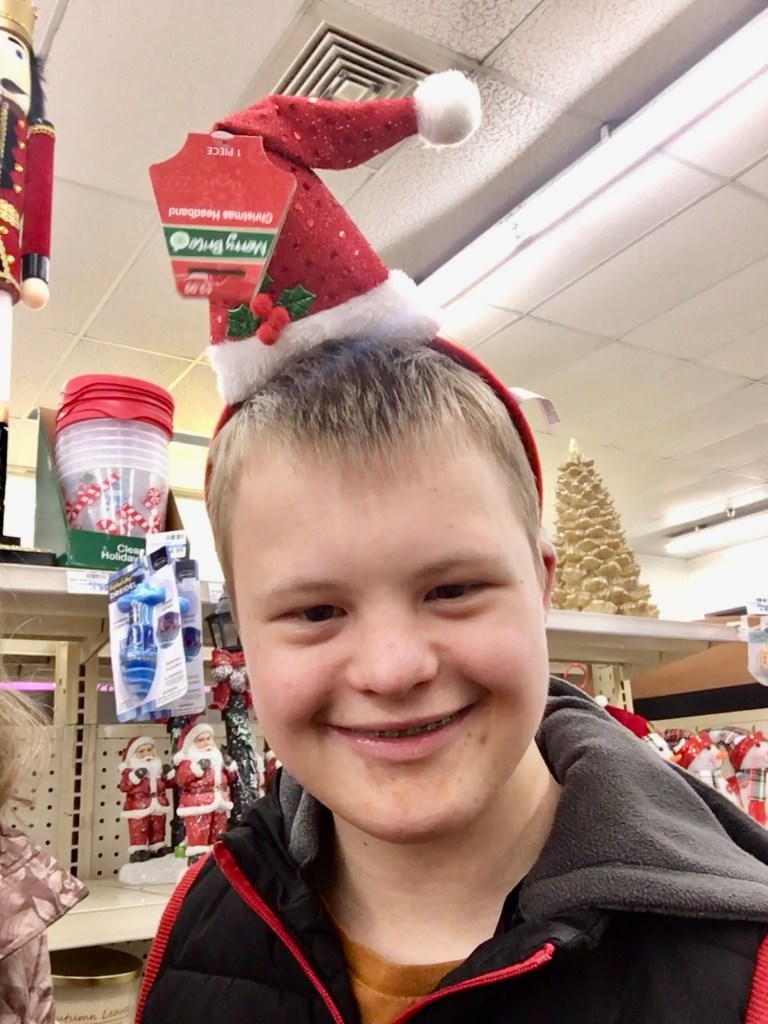


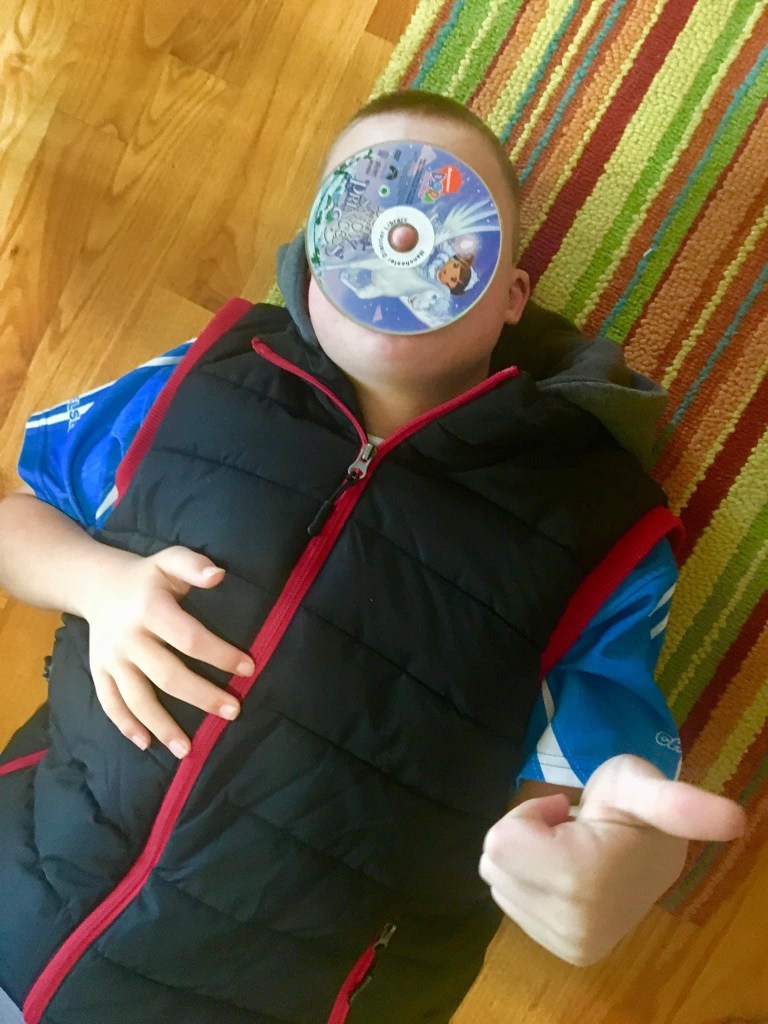

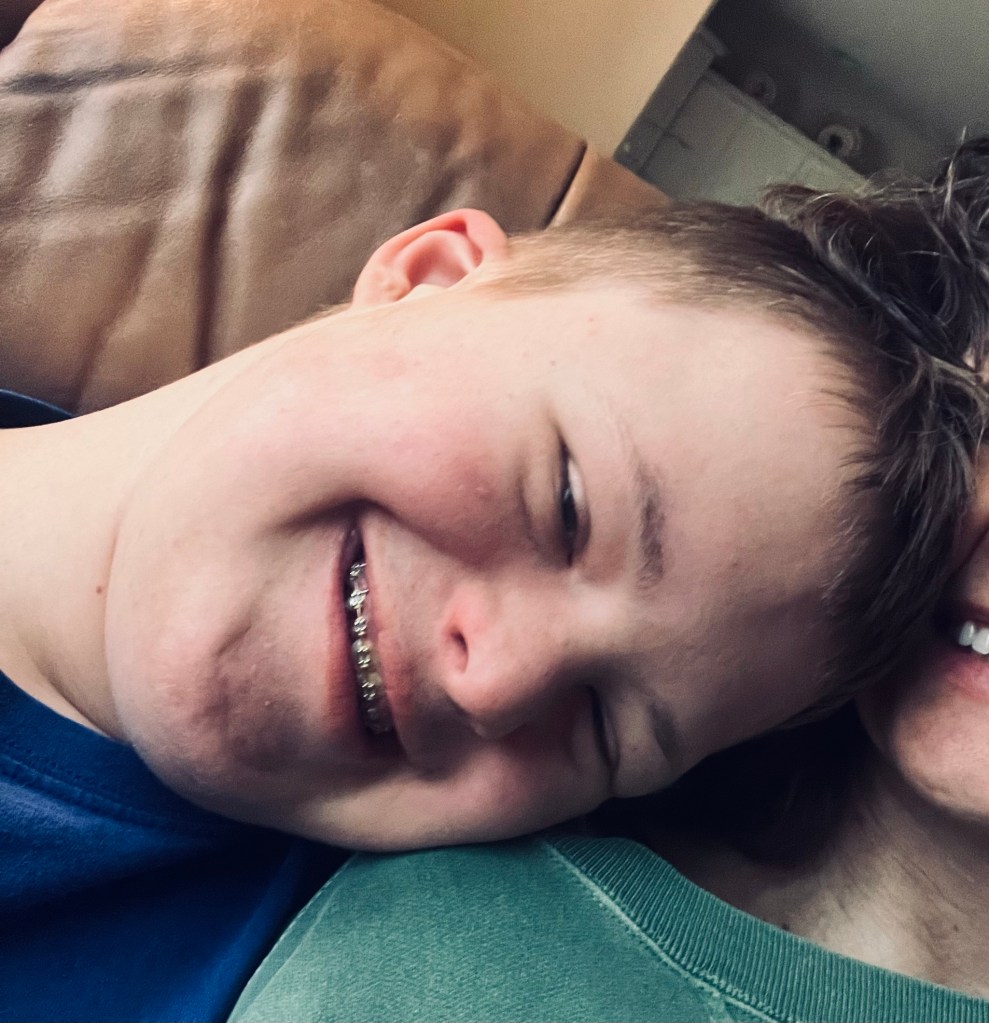

 'WIL'ingness = Willing to Embrace Extra in Life