Lifting the Mask

“What do you want to be for Halloween, Wil?”

“A meeeeaaaan pumpkin, grrrr!” Wil lifted his arms up and curled his hands into claws. 

Wil and I searched the Web for a “mean pumpkin” mask. We found the perfect fit! A jagged-toothed jack-o’- lantern mask that lit up. Next was the shirt. We found a black long-sleeved t-shirt decaled with two triangular orange-flamed eyes and an evil orange-flamed smile. 

Wil’s resource room class was invited to wear their Halloween costumes to school last Thursday (as there was no school on Friday). Wil made a mission of scaring his teachers — I heard he made Ms. Kastel jump! After every scare, he cracked himself up (even the scariest jack-o’-lantern is a sweet pumpkin underneath). 

When Wil was diagnosed with Down syndrome shortly after his birth, I prayed there was some mistake. My heart knew, but my brain fought my heart every step of the way. As time went on I realized that it wasn’t Down syndrome I was scared of. It was my vague understanding of what Down syndrome meant. Now that I know my big-loving, super awesome hugging, silly, joke-making, forever singing, strong-willed, Luke Bryan’s biggest fan teenage guy, the mask of fear has long been lifted. I’m just another mom who loves her son. 

I begin work as a paraeducator with Saline Middle School this week (and reduced my fitness coaching schedule to 2 days a week). Before Wil was born, I would not have considered a career as a paraeducator. That was reserved for “special people.” I had a deep admiration for those who worked in special education, and still do, but at the time I only had a vague understanding. Raising Wil, I have seen first-hand that there are most certainly people born with a natural affinity to work in this field. But I also discovered that life experiences can thus equip us. Though not born with this natural ability, life experience has grown in me an in-born desire to contribute in ways I never previously considered. 

I can’t wait to get to know the middle school students that I will be working with. To dive below the surface and understand who they are, what they love to do and what really ticks them off; all that tween and teenage stuff. I also want to know who they want to become and help them to become that. That’s what I now find to be special.

This will be my last weekly article. With my new position as a paraeducator, in addition to my current job coaching, I will no longer have the time to create a quality article on a weekly basis. The Manchester Mirror (our community paper who publishes Wil’s stories) has graciously left the door open if, upon life settling into this new rhythm, I should start writing weekly again.  A very heartfelt thanks to Manchester Mirror in sharing our community’s news and stories; they truly bring our community together.

Thank you for sharing in Wil’s stories. I hope in some way, I’ve lifted the mask of vague understanding and uncovered what is truly special. Until next time, Wil sends his biggest hug (and mean pumpkin scare, grrrr!). 

Drum Roll Please, Common Ground at Play!

When Wil entered 4th grade, the gap in his abilities relative to his typically-developing peers took a large leap. Wil’s classmates talked faster than he did and played at a higher intensity. Even so, Wil and his friends, whom he had been in school with since kindergarten, formed a strong bond over the years. Whenever I witnessed Wil and his friends on the playground together, no one was left out. He and his friends created or altered games so they could all join in together. There was no shortage of singing, dancing and laughing.

Wil played recreational soccer with his peers through 3rd grade, but it was clear that would be his last year. Though his coach and teammates fully included and encouraged him, the faster pace simply wasn’t for him. The next season Wil went to  TOPSoccer, designed for people with disabilities. He played with TOPSoccer for the next 4 years. 

Now in 9th grade, Wil is happily settled into the familiar schedule of school with his friends. The friends are just as close as ever, but the reality is they are all teenagers now. Outside of school, Wil’s friends are balancing rigorous homework with multiple extracurricular activities, as are his sisters. Play time together is caught in brief snippets of time. 

Isolation is a reality for many people with disabilities as they grow older. The gap expands and the opportunities shrink. As parents, siblings and friends of our loved ones with disabilities, we constantly seek and create opportunities for common ground. It is in the creation of new pathways, that our bonds grow even stronger. 

When Wil was younger, he had a small drum set. Though Wil is a joyous bundle of energy most of the time, at times he would get overwhelmed with friends and run off. During one such time, Wil’s friend Lila spied his drum set, and they played together on that for hours. From then on, if Wil became overwhelmed when friends were over, they’d all circle back to the drum set. 

I just put up a trampoline for Wil last week. My intention was for the trampoline to be his teenage version of the drum set (but quieter). It’s both a fun activity for Wil to enjoy on his own, as well as with his friends and family. 

Last night Elizabeth and Wil, now equal in height, chased each other around the trampoline. Laughing, jumping and bouncing, they circled the perimeter over and over. 

Over the course of these near 15 years of Wil’s life, I’ve uncovered a few core truths:

  • Connection is not guaranteed with full inclusion, but strong bonds are rarely formed without it. 
  • Preparation alleviates fear of the unknown, but the unknown will present itself without it.
  • Creation is necessary to move forward, but circling back also leads us where we want to go.  
  • And no matter how many hours you’ve heard a drum roll, when common ground is at play, you’ll want to shout “drum roll, please!” 

Happy Endings

Wil leaned his head against the passenger-side window. His brand-new and carefully-chosen checkered shirt, maroon tie and navy pants were dry, but his spirits were dampened. My dad was parked next to us in the United Methodist Church lot, which was just a flight of stairs above the football field. 

“I know it’s raining, but do you want to roll down the window and talk to Grandpa?” I asked. 

Wil didn’t answer me, but he lifted his head and pressed the window button down. My dad asked Wil multiple questions to elevate his spirits. (Thank goodness for amazing grandparents!)

The MHS homecoming game had been delayed by a lightning strike. Then by another strike. A downpour of rain followed. We were now nearly into an hour of delay. During the school day, Wil had practiced walking across the football field with his paraprofessional, Kristi Campbell. Wil and I talked about his being on the homecoming court all week, so he was well-prepared to cross the field with Memphis, who also represented the freshman class. I anticipated a chance of rain, and knew Wil wouldn’t want to cover up his new clothes with just anything, so we bought a new raincoat. The largest obstacle I foresaw was the band. Wil doesn’t like loud noises, and he might refuse to move. I assured Wil that he’d be crossing the field after the band played, and I’d have his ear protectors on hand. What I didn’t anticipate was a lightning delay. 

My cell phone rang. It was Kristi Campbell. She and Memphis were headed up to the parking lot to meet us. Kristi suggested taking pictures under the front overhang of the church. 

Wil’s eyes widened at the sight of Memphis. She was gorgeous in a full-length, sparkling seafoam-colored dress. Wil stood tall and proud linking arms with Memphis for pictures. Though they weren’t on the football field as planned, this was definitely a moment for Wil. (As Kristi knew it would be. Thank goodness for amazing paraprofessionals!)

Multiple cars exited the parking lot as the delay continued. I knew Wil wouldn’t want to go home. Fortunately, his sister Katherine was working as a server at a local restaurant.  I suggested we visit Katherine and order some food.

At the restaurant, Wil asked me about the homecoming dance. I sadly didn’t have an answer for him. Then, almost as if on cue, my cell phone rang. It was Kristi Campbell. The game was cancelled but the homecoming court would now be at 9:00pm followed by the dance. It was 8:58pm. Our food hadn’t arrived, so I asked Katherine to change our order to a carry-out that we’d pick up later.

We met Memphis back in the parking lot, as her family had quickly returned too. The rain, and the band, had taken leave, so Wil walked onto the football field without hesitation (and without his raincoat). He smiled for every picture and soaked it all in.  

Wil’s friends, Sarah and Seeger, ran up to congratulate him. They asked Wil if he was going to the dance. The dance would be a major independent experience for Wil. When Wil gets tired, there is no turning back. Not everyone can read his cues, and by the time they do, he has shut down. But Wil’s friends know him well. I asked Sarah and Seeger if they could text me when Wil grew tired and I’d be right up at the school to pick him up. They accepted that responsibility without hesitation. Wil made it through nearly the entire dance with his friends. After the dance, Wil’s friend Ashley texted me videos of Wil dancing the night away. (Thank goodness for amazing friendships and happy endings!)

Growing Together

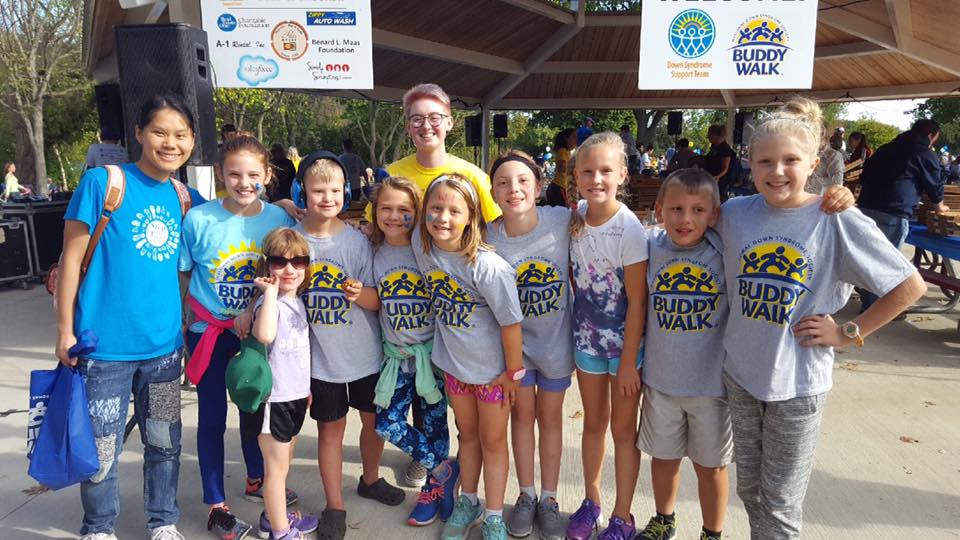
Families and friends gathered for the annual Down Syndrome Support Team Buddy Walk the last Sunday of September. It is traditionally held on that date— though here and there over the years the Buddy Walk has jumped up or back a week. The Buddy Walk takes place on a one mile loop in Gallup Park, then walkers return for Pizza House pizza, music, a silent auction, raffles and games. Last year due to the pandemic we cancelled the walk. It felt good to be back, even with a few changes. 

With the strain of the pandemic on businesses we chose not to solicit for the silent auction. However, many beautifully generous raffle baskets were donated and we held a 50/50 raffle. The popcorn machine was going and the band, Know Obstacles, was playing. Leonardo, the lead singer, always packs extra instruments for the kids to play and invites them to jump up on the stage. We chose not to have open pizza due to the pandemic (though we sure missed our Pizza House pizza!) and instead offered pre-packaged snacks that the kids loved.

The weather was an incredible blessing. The skies were a high, bright blue and the temperatures hovered in the low 70s. A light breeze offered just the right refreshment. 

Wil’s first Buddy Walk was when he was 7 months old. At the time, the University of Michigan gymnastics team volunteered at the Buddy Walk. I have a photo of all the gymnasts gathered together holding baby Wil. It was 90 degrees that day. 

The next year the Herron family joined us and have nearly every year since. Theresa Herron was Wil’s speech therapist at the time. I met her daughters, Ivy and Amelia, and they began to babysit Wil. Each year at the Buddy Walk, it became tradition for Wil to take turns getting piggy-back rides along the walk with Theresa, her husband Jordan, Ivy, Amelia and their brother Elijah.

Beckie Brewis, Wil’s Early On coordinator joined us each year, too, as did the Helquists, Desbroughs and Gregorys; friends we made through a program led by Beckie called First Steps. When Wil entered preschool then elementary school, he met Sarah Stommen, Ashley Bobo and Lila Harvey. Their families have joined us nearly each year since. As Wil grew, the love from our Manchester community grew too, and many more families have joined and supported the Buddy Walk. Manchester’s very own SteeleGrafix made the Buddy Walk t-shirts this year! 

The Buddy Walk love has now extended to the friends I have made in my workplace, Orangetheory Fitness. It always awes me how love can spread. 

This being our family’s 15th Buddy Walk (we had our own personal Buddy Walk with friends last year in Manchester), we have walked through rain, sunshine and unprecedented heat. We now walk through unprecedented changes in our lives. However, the spirit of the Buddy Walk remains constant – the love and support of individuals with Down syndrome. 

Waves

Wil and I went to see Luke Bryan on his Farm Tour at the Kubiak Family Farm in Fowlerville, MI. We parked in a field, with 20,000 other fans, just over a mile from the stage. I grabbed our bag that Wil stuffed with 2 Luke Bryan pillows, 4 Luke Bryan hats and 4 Luke Bryan t-shirts (Wil wore the Farm Tour t-shirt our friend Jen, who secured us tickets, had gifted him). I squeezed in 2 light jackets and a blanket. I took Wil’s hand and we made our trek to the stage.

When Wil caught sight of the lights on the stage he stopped in his tracks. He let out a breathless, “Mom look!” Though Wil watches Luke Bryan concerts on his iPad daily, the real life experience took his breath away (and seeing through Wil’s eyes, it took mine too).

Wil handled the mile long trek like a champ. Without breaking stride, he put his ear protectors on as the music of the opening band grew louder. When we met the ticket scanner, he came to a complete stop. A long line of fans stood behind us but he refused to move. He knew a threshold was being crossed. I braced myself behind his body, wrapped my arms around his torso, and forced him forward. 

Wil suddenly needed the bathroom excruciatingly. We walked to a long row of porta-potties. Each had an extensive line. I quickly scanned the row for a handicapped porta-potty then walked Wil to the front of the line. I explained our situation. Wil crouched down to the ground and clamped his hands over his ear protectors. 

“What, does he have autism?” The woman in front of the line asked. 

“He has Down syndrome. He is in a lot of distress. And this is the handicapped bathroom.”  I don’t think that authorized me to take cuts but I was desperate. A woman behind us in line said we could take her spot. She then asked to hold my bag. I thanked her profusely. The couple in front of her then said Wil could take their spot. With this overflow of kindness, the woman in the front of the line relented. When the porta-potty door opened, Wil refused to go in! I again braced myself against him and pushed him into the stall. 

When we got past that, we found a space in the field and spread our blanket. Wil relaxed. I stacked his 2 pillows and he sat down on them. When Wil recognized a song the opening band played, he jumped up, danced and sang. 

When Luke hit the stage, Wil never sat down. Wil kept up word-for-word with Luke, rocked his body and pumped his fist. Multiple fans surrounding us walked over to comment on how much they enjoyed Wil’s energy. 

When Luke played “Waves,” it seemed not as well-known as crowd grew perceptively quieter but Wil didn’t miss a beat. How fitting, I thought. Wil knows better than most how waves work. The crest cannot be reached without friction. 

When Wil was ready to leave, he sang with Luke as we walked back to our car; the concert ended before we reached it. We began our drive home and Wil talked excitedly about the concert, then fell silent. A light snore escaped him.  

“Keep coming in waves keep on coming in waves keep coming in waves…”

From Monday to Friday in 60 Minutes

This week’s story is an excerpt from “Stories of Wil: Puberty Part 1” (publ. July 2020)…

When I woke Wil up, he was very sluggish. 

“Hey, buddy, time to wake up,” I said. I sat on the edge of his bed and tickled him lightly under his chin. 

“Hmmph!” Wil turned his face into his pillow and commenced fake snoring. 

“Oh Wil, I almost forgot. It’s your favorite day of the week today. It’s Monday. Happy Monday, Wil!” Wil turned his head from his pillow, opened his clenched eyes, and looked up at me. 

“Ugh, Mom. It’s Friday.”


“Hmmm, I’m pretty sure it’s Monday today. Let’s go Monday!” “Mom,” he bolted upright in bed, “it’s Friday.” 

“Ok, I guess it’s Friday. Ho-hum. How boring. The end of a week of school. I think the beginning is much more fun. Too bad it’s not Monday. Time to get dressed now.” 

“Oh, Moooooom. Hugs now.” 

“Yes, we can’t forget our hugs,” I said, and hugged him. “Ok, let’s get up and dressed and ready for our Monday.” 

“Oh, Moooooom. Ok, I’ll get dressed. Go Friday!” 

Later that morning as I was driving all three kids to school, Elizabeth said, “So Wil, what’s for lunch on Mondays?” 

“It’s FRIDAY!” Wil replied. 

“Oh, it is? Phew, I thought it was Monday,” Elizabeth said. Then as they all exited the car at school, Elizabeth said to me, “Have a great Monday, Mom!” 

“You too, Elizabeth!” 

“Sheesh, you guys. It’s FRIDAY! Let’s go Friday!” Wil laughed and took off running to the school. 

A sluggish start can easily extend itself into a very challenging day at school for Wil. Silliness is the kryptonite to his sluggishness—it doesn’t always work, but it’s always worth a try (and the bonus is the silly start added fun for all of us). Let’s go Friday! 

Who’s Counting?

7th grade was one of Wil’s most challenging years. He entered a new school — the Jr./Sr. High School — with new teachers, new schedules, all while going through puberty. Mix that together with delayed communication skills and it was one heck of a ride! 

The only constant were his friends he’s had since elementary school; and the steady calm of his paraprofessional, Kristi Campbell. When Wil went through multiple behavior changes that year, his friends already knew Wil as Wil.  Wil is their friend that gives the best hugs, always knows how to make them laugh, will sing and dance anytime or anywhere, and sometimes gets stuck.  

Wil would get stuck almost daily in the lunch room. Nearly anything could be the cause for a shut-down in this type of transitionary period between classes. Kristi had to do some serious detective work. Is it too loud in the lunch room? Did something happen in class just before lunch? Was he anticipating his next class? Or did he just want different salad dressing? Kristi’s navigational skills and Wil’s friends were often the only thing that got Wil from Point A to Point B during that time. 

Fast-forward 2 years later and Wil tells Kristi if it’s too loud, why he doesn’t want to go to a classroom, if he’s tired, if he needs a break, and he asks for the salad dressing he wants. It doesn’t mean he doesn’t get stuck anymore, but now it doesn’t last as long. 

When Wil came home from his first day of 9th grade, I asked him about his day. He was excited to see Kristi and his friends. He mentioned having lunch with Lila and Ashley but not Sarah. 

“And Sarah too, right?” I asked. Wil shook his head. I asked where she was. Wil shrugged his shoulders. (Though Wil now has the words, he’s also very much a teenager that may choose not to use them.) 

The next day Sarah’s Mom, Heather, reached out to me. Heather Stommen was Wil’s 3rd grade teacher and he excelled under her tutelage. And she didn’t give him extra special treatment because Wil has an extra chromosome — ask any 46-chromosomed student about Mrs. Stommen and you’ll hear all-star reviews.  (Kim Clore was Wil’s paraprofessional in 3rd grade and had been with him since 1st grade. Knowing Wil as she did, combined with Mrs. Stommen’s teaching skills made for a strong year of growth. As you can see, consistency is an important factor for Wil).  

Heather said that Sarah came home from her first day of 9th grade full of enthusiasm. Sarah told her mom and her dad, Pat, all about her day. Her excited conversation continued throughout dinner. After dinner, the family moved into the kitchen to wash dishes with Sarah still gushing about her day. Then she came to abrupt stop and burst into tears.

Sarah’s reaction brought Heather and Pat to an abrupt stop too. Then Heather saw what triggered this change in emotion. The Pringles can on the kitchen counter. 

Back in 7th grade, Wil’s teachers and I sat down to come up with a behavior plan. The idea was to reinforce positive behavior as Wil navigated puberty and a new school. We tried many, many things. Some of which worked not at all; some at best sporadically. I was giving Wil Pringles as a special treat if he rode the bus home. So we tried Pringles. They worked 95% of the time! Not the healthiest choice, but at that point, we were just trying to get Wil through the day.

The Pringles strategy caught on. By 8th grade it became a game amongst Wil’s teachers to find a new flavor of Pringles, and Kristi always had some on hand. Wil’s social studies teacher, Ms. Kastel, would give Wil a Pringle’s cheer for a job well done.

Sarah was in Ms. Kastel’s class with Wil in 8th grade. Ms. Kastel came up with names for them depending on the lesson — Sarah-toga and Wil-bot stuck. 

Sarah had intended to give the Pringles can to Wil the first day of 9th grade. But she discovered they didn’t have any classes together. Not even lunch. Ever since elementary school, even if they weren’t in the same classroom, Sarah would make a point of visiting Wil in his classroom. Sarah was distraught at not seeing her friend. The friend who always made her laugh.

Fortunately, a class switch Sarah had applied for was approved the 2nd day of school. That class switch also required she move to Wil’s lunchtime.  Sarah-toga and Wil-bot re-united again!

Every year with Wil I count on change. Every year with Wil I count on his growth. Every year I count on the consistency of the friends, families and educators that don’t count chromosomes (but may count Pringles); they count on the whole of who Wil is. 

“Isn’t that what we all want?” Heather said. And with her words, I count my blessings.

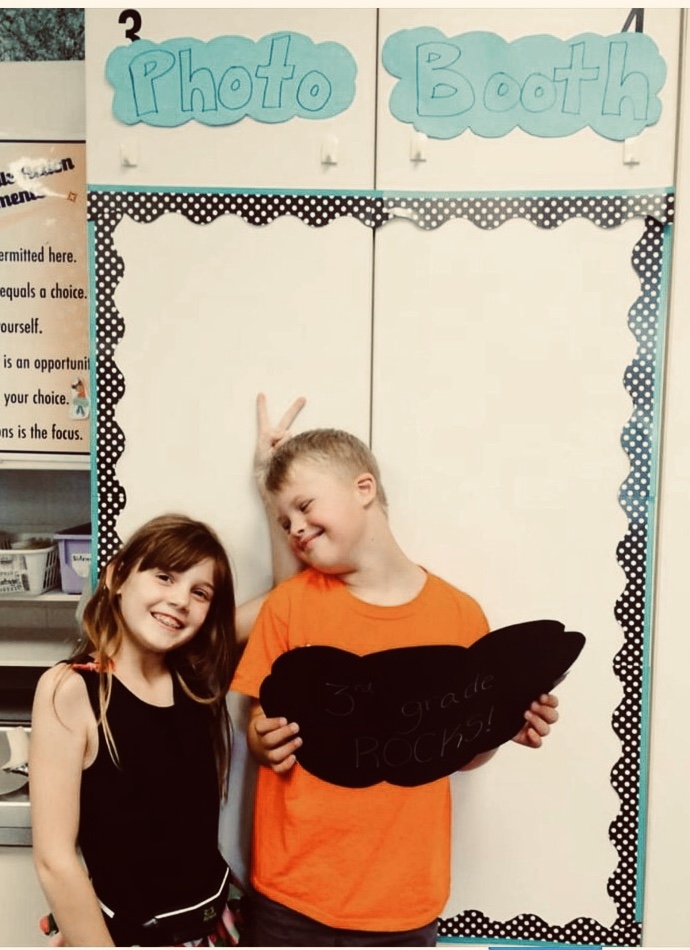
Sarah and Wil at their 3rd grade open house

Simpler Times

Wil has a karaoke machine in the basement. He flips the “on” switch, dials up the flashing lights, but the microphone remains in its clip. He cannot be tethered by such things.

Every single day, be it a weekend morning or a weekday after school, Wil inserts a Luke Bryan CD in the karaoke machine or cranks up country songs directly from his iPad — the use of the iPad does not exclude the need for karaoke lights. (Currently his favorite starter song is “Buy Dirt,” by Jordan Davis featuring Luke Bryan.) He’ll then grab the handrail of his mini-trampoline and drag it across the carpet. He lines it up directly in front of the karaoke machine and hits play. He then gets to jumping and singing full blast. This can go on for hours. 

If Wil comes across a song he likes but doesn’t know all the lyrics to, he’ll replay a verse over and over until he memorizes it. Then he’ll do the same with the next verse. And the next. Wil knows the full lyrics to over 100 country songs. Without Google. 

When he’s tired, he’ll say, “Phew!” Then stomp up the stairs and walk out to the back porch. He’ll take a seat on the slider and rock back and forth. A breeze will brush the side of his cheek. He’ll tilt his head up and say, “Ahhhh.” He may notice a looping bumble bee, the shrill of a hawk, or grazing deer in our back field. These are not new experiences where we live, but Wil expresses his excitement each time as if they were. “Listen, Mom.” “Mom, look!” “Deer, Mom!”  

Wil is frequently the last one at the dinner table. Katherine and Elizabeth typically set up their homework on the kitchen island. I’ll linger at the table with Wil or clean up in the kitchen. Last night after dinner, as I washed dishes, Elizabeth stayed at the table and talked to me about her AP Literature class. 

“We are reading ‘The Catcher in the Rye,’” Elizabeth said. “Do you want me to read you a chapter? You spent so many years reading to us. Now I’ll read to you, Mom.” 

I sat down next to Elizabeth as she read to me, and Wil finished his dinner. I was transported back to simpler times. 

When Wil was born I worried on all the challenges. The learning curve was high. Like Wil, I replayed new verses over and over again to absorb them. In that I also absorbed something you can’t know through Google. The soul within the verse. 

It is the challenges that shed a light on the soul of the simplicities. It’s like Wil flipped the “on” switch in my life, and the lights have never stopped flashing no matter what medium they illuminate. I’m reminded of the aerodynamic beauty of a bumblebee loop; how the shrill of a hawk cuts through the blue sky; I’m newly refreshed by a breeze across my cheek. Now I’m brought back to the joy of being read to — by my own daughter. I could listen for hours.

Complex Simplicities

She usually wears shoes to golf but in this heat, my guess is she wouldn’t leave the house without her flip-flops. She slipped off her flip-flops at the driving range and sliced the golf ball just as expertly as she did with shoes on.

She sat down to brush the dirt off her feet. Her bare feet were lifted to nearly chin level. Hypotonia (low muscle tone) allows our kids with Down syndrome great flexibility. The loose dirt fell off, but a dark stain remained on her heel. She wanted that to come off too, but wasn’t able to brush it off. She knows me as Wil’s mom, so I bent down and asked if I could help. She nodded. I poured water from my water bottle across her heel then scrubbed with my hand. She tilted her foot inward to get a better look, but never let her feet fall below chin-level. The dark stain had faded but she shook her head. Not good enough.

I poured more water on her heel and scrubbed again. She tilted her foot inward, took another look and shook her head. Another parent ran up to the golf course’s restaurant to get some napkins. But even those didn’t remove the dirt to her satisfaction. Her dad soon walked over, as he was volunteering on the putting green. By his expression I could tell he knew what was happening. He bent down and had a quiet conversation with her. She finally let her feet fall down to the ground then slid on her flip-flops. Victory! She took her dad’s hand, I waved good-bye and they headed toward the parking lot.  

The next day was equally as hot, but the evening had slightly cooled, so I sat on the back porch and Wil got his recumbent bike out. He expertly maneuvered the handles to make perfect cuts and turns across the grass. Sweat dripped down the side of his face but I don’t think he even noticed. Wil turned his head toward me and smiled every few seconds to be sure I was watching. 

When Wil was a baby he wore tiny lycra biker shorts with the inseam sown together. Otherwise his legs would flop out as Wil also has hypotonia. The idea of these shorts was to strengthen his hips and train his body to keep his legs in. Every time I watch Wil ride his bike, I’m brought back to those tiny biker shorts.  

Wil clomps heavily when he walks, and has a slight side-to-side swagger. Wil had speech therapy with his friend Teddy this summer. Teddy’s mom and I would always share a smile as Teddy and Wil clomp, clomp, clomped off to the classroom together. 

When Wil was born, I was told by parents who were ahead of me on this journey: “It may be hard to see now, but your life will be so much fuller with Wil in it.” 

That remained stuck in my head because it both struck a chord, and yet felt too abstract. I wanted more details. I wanted to know how my life would be fuller. What did that mean exactly? 

But how do you share with a new mom how endearing a flip-flop stand-off is when she is navigating the complexity of acceptance? How do you explain the depth of joy in watching your child ride his bike when she is navigating doctor appointments and therapies? How do you share the feeling of a deep-down connection in another mom’s smile when she is bewildered by a new journey full of new, unknown people. 

My answer to that now is no more detailed than the response I received over 14 years ago. I had to first embrace the complexities before I fully received the gifts of the simplicities.

True-Blue Happiness

As I waited in line at the pharmacy for Wil’s thyroid meds, I glanced at the magazine covers displayed below the check-out counter. A woman on one shiny cover sat cross-legged in a peaceful, meditative pose; mindfulness is the way to happiness. Another shiny cover had a full-page close up of a spotless country kitchen; simplifying your home is the way to happiness. Another shiny cover — this one in black-and-white – pictured a shirtless male weight-lifter; a sculpted body is a sure-fire way that happiness will find you.

Though nearly every magazine cover touted a way to happiness, I didn’t see a single one with a denim visor. 

At Wil’s Special Olympics golf last Thursday night, the golfers split into three groups: one at the driving range, one at the putting green and one chipping near the sand trap. Wil and I were at the driving range. As each group made the rotation, we crossed paths with one of Wil’s new friends. She is in her early 20s and also has Down syndrome. I admired her outfit and told her so. She wore a denim visor, and when I complimented her on it she said that a bus driver had given it to her. She then launched into the story behind it. 

I hung on her every word. Her words easily melded from one into the other. There were no pauses; there was no stuttering. It was a good story, and all the better that I could enjoy hearing it from her own perspective.  

Wil speaks in paragraphs, but not yet in stories. If you compliment Wil on his hat, he’s sure to say thank you. He may add that it’s from his grandpa, or his uncle, but that would be the extent of the detail. He has a lot of words to share, but tends to stutter in getting them all out. He’s working on remembering to take deep breaths to slow down his words.  

Every advancement in communication Wil makes, no matter how long it takes, is a thrill. Even the simplest requests that he’s been making for years, like what he wants for lunch, still gives me a smile. When you wait to hear someone’s very own thoughts, and their very own perceptions, it’s nearly impossible to take one word for granted; and I never want to.

A friend of mine in our golf group has a son in his mid-20s with Down syndrome. Her son has had a very recent shift in behavior. Though she has a few guesses as to why, she’s not sure. He’s not highly verbal, so she listens intently to anything he shares with her, be it physical, verbal or situational. Any type of communication from him could be the key that opens the door to what he is struggling with. It’s incredibly trying and frustrating to want to help your child when multiple communication barriers exist. 

As she communicates her situation to me, I feel her pain. I feel her angst. I know her frustration. It’s exhausting. But on this journey, you can’t get tired. You have to keep going. You have to keep navigating, deducting and assimulating. Even if you may never see the whole picture, one shared thought from your child is a beacon of light.  

These are not shiny, abbreviated forms of happiness. What we have is a connection and understanding created through inter-woven threads of time. What may appear simple from the outside — a story, a word, an emotion, a sign — is held up by solidarity and strength. Together we beam brighter under the sun and weather the storms through the test of time.

Just like a denim visor; with a good story behind it.