In this house we take no such statements for granted.
In middle school, Wil riding the bus proved unsuccessful. He was already having a hard time transitioning to a new school with new educators and hormones were in full effect. The middle school years are challenging; then add in communication barriers and cognitive delays that a body’s progression into puberty does not wait for, and you’ve got behaviors. Every day was a new experience, and we were rewriting the plan over and again. Finally, I called “Uncle” on the bus riding as it was adding stress to Wil amongst all the other areas we were navigating at the time. It’s challenging to do that, as you never know if you are giving up at the right time, or too soon. But what I have learned is no matter what the success — or lack there of — looks like from the outside, there is groundwork being laid on the inside.
Wil is now in 11th grade. He loves being 16 years old. And he is fond of reminding me he will be 17 years old on his birthday. He wants to go to college like his sisters. We will cross that bridge — in this house we are very used to crossing bridges as they come. As he is growing into his indepedence and his maturity has blossomed, he told me he wants to ride the bus home. I joyously concurred.
Last spring, he did ride the transfer bus from his high school to the elementary school where I work. This was very successful, so I think it was the perfect nudge to riding the bus the full way home.
All was going smoothly until 2 weeks ago. Wil walked to the bus like he always did, but then just kept on a-walking. His teacher ran after him and walked him back to the bus. Wil refused to get on. So Wil and his teacher walked to the office. His teacher called me and I picked him up. This happened every day for a week.
All I could get out of Wil was that the bus was too crowded. He refused to sit up front where it was quieter. But he is in 11th grade, so why would he want to do that? I suggested his noise-cancelling headphones. Wil is very aware of his looks, and doesn’t want to look different. I want to make clear that he is in no way ashamed of his disabilty, nor should he be. And noise sensitivity is part of his disability. But Wil puts great importance on his appearance, and you know by now his deep affection for baseball hats, so noise-cancelling headphones would throw off his style; and his hat. (Wil only wears his headphones now if he is at the movies or a concert, but he’ll only go to these loud places if he really wants to be there.)
So, here we were. Wil refused to ride up front where it was quieter. He wanted to sit in the back with his friends. But it was too crowded. So it makes total sense that he would attempt to walk up to the bus, get nervous and keep going.
Just being able to make sense of things is HUGE!! When Wil was in middle school, he was not able to express to me his reasons for being nervous on the bus. His educators and I had to do our best detective work, but with so many factors at play, our best guesses were only that — guesses.
As Wil could now tell me the reason for not riding the bus, we could have a discussion about it. Now Wil had true ownership in his decision as we could have a conversation about his options as I knew what the struggle was.
Whether what we come up with works for the long-term or not is to be seen. But what is most important is that Wil has a voice in this, and that is something he’s always deserved to have, and we’ve worked hard for him to share it.
With this knowledge, Wil’s teacher created a chart to hang in the classroom. Each day Wil rides the bus he will get a sticker. Wil thrives on recognition so was immediately into this idea. Every 3 stickers, I will take Wil to the market to pick out a handmade sandwich of his choice and a drink. He also loves this type of adventure.
Today is day one of this plan. I went up to the school and parked in the lot just in case Wil refused (I parked out of Wil’s sight so he wouldn’t backtrack.)
Wil’s teacher walked with him, and he successfully made it on the bus!
In this house, we celebrate successes!
Today is one day, tomorrow will be another. And so will the next. Every day we cross a new bridge. Every day I will feel a tightening in my stomach at 2:45 with one eye on my phone. And every day it doesn’t ring I’ll release the butterflies in my stomach to fly in celebration.
In this house, every day is a new day. We never take such things for granted.
Opening minds to acceptance need not be negative. My journey with Wil’s diagnosis is likened to a flower blossoming through a crack in the concrete, unfolding, stretching, growing, reaching, and opening fully to the sun. At first unbelievable, then freeing, and now a natural part of life.
Disability is a natural part of the human condition. Yes, you can argue I will get trampled again and again. Yes, I will be under the concrete again finding a new space to grow. But herein lies the difference. The concrete is real, but I don’t have to stare at it. I now know there is always a crack in the concrete somewhere because I have experienced it.
I’ve experienced bumping my head multiple times in search of the sun. I know that bumping my head — now in a progressive way — is simply part of the process in reaching a glorious opening to expand with the sun.
It hurts no less to continually bump my head. But I know, very deeply within me, that the more flowers I bloom, the more the natural human condition of people with disability will be recognized as a beautiful, natural part of life, and to be appreciated as such.
There is room for all of us to grow, but only when we open ourselves to fully supporting this growth that blossoms in its own natural way and time.
Should people without disabilties play parts in film of people with disabilties?
There have been some impressive performances of such cases. But then I thought, if Wil were an actor, would he be hired to play any part but of the person with Down syndrome? That would be summed up in two letters: NO. And if he were an actor, how would I feel about a person without Down syndrome playing his part? How would he feel? I would be appalled on many levels. No matter how much that actor studied, how would they really know? Who better to play the part, to raise true awareness, and to give a paying job to, than someone who lives it.
In today’s age, what does disability representation in film look like? There is definitely what coined by Stella Young as “inspiration porn.” As a society, are we as progressive as we claim to be? It’s definitely something to give thought to. So I did some research. Then I wrote about (see below) for my Special Education class (please feel free to comment, I’d love to hear thoughts):
Time to Share the Mic: Authenticating the Voice of Disability in Film Turner Classic Movies (TCM) played a double feature every Sunday this past July – a total of 10 movies for the month – showcasing people’s experiences with disabilities. The series, which coincided with Disability Pride Month, went as far back as the silent film Deliverance (1919) about Helen Keller and her teacher, Anne Sullivan. This early 20th-century film’s symbolism of ignorance and knowledge – one wore a white robe, the other black, and both urged Helen to follow them – was ahead of the times. The real Helen Keller and Anne Sullivan made an appearance in the film. The TCM series starter was The Best Years of Our Lives (1946), wherein three war veterans returned to their hometown “who are all in different states of physical and mental distress after the war” (Fields, 2023). One of the veterans is played by a real-life war veteran, Harold Russell. Russell lost both of his hands in a wartime incident, and having the choice between plastic prosthetic hands and steel hooks, he chose steel hooks. Russell became quite adept at using the steel hooks and eventually made a training film for soldiers who had lost both hands (Sevaro, 2002). Director William Wyler, a veteran himself with severe hearing loss due to his service, saw Russell’s training film and advocated hiring Russell. Russell had never had acting lessons, and Wyler stopped producer Samuel Goldwyn from arranging them. “This was a rare case of a person with an actual disability playing a character with a disability” (Fields, 2023).
Fast-forward the film reels of time to the present day and we will find that “significant depictions of disability on film and television shows have nearly tripled over the past decade compared with the previous 10 years”(Bahr, 2021). Per a Nielson study of among 3000 titles (from television and movies) from 1920 to 2021 nearly 70% of the content inclusive of disability was in film (Nielson, 2021).
So that is great news for the authentic voice of actors with disabilities to be heard, right? In film-speak, that would be called a long shot. Only 1.9% of all speaking characters in the top films of 2022 had a disability, according to an August 2023 report published by the University of Southern California (USC) Annenberg Inclusion Initiative (Heasley, 2023). The report states that “there has been no change in the representation of characters with disabilities since this community was included in our reporting across top films from 2015. Characters with disabilities are consistently missing in film.”(Smith, et al., 2023).
With an increase of disability portrayed in film, but with less than 2 percent of speaking characters with disabilities in recent top films, who is the voice of the disabled? Have we reverted back to the silent film days of Deliverance? The answer is, non-disabled actors are speaking for the disabled. Nearly 70 Academy Award nominations and 27 wins were given to non-disabled actors for playing disabled roles. Yet, only three actors with disabilities have won Oscars: The aforementioned Harold Russell, as Best Supporting Actor in 1947 for The Best Years of Our Lives, Marlee Matlin, who is deaf, as Best Actress in 1987 for Children of a Lesser God and most recently Troy Kotsur, as Best Supporting Actor in 2022 for CODA (Brownworth, 2023).
Non-disabled actors are clearly lauded, and applauded, for their portrayals of persons with an actual disability as is evidenced by the overwhelming number of nominations and Academy Awards given to non-disabled actors in relation to disabled actors. “Even though the number of disabled characters continues to increase, approximately 95 percent of those roles are still portrayed by actors who do not have disabilities,” said Lauren Applebaum, Senior Vice President of Communications at RespectAbility (Bahr, 2021).
And what of the content of the increased portrayals in film of people with disabilities? Consider what Stella Young, who spends her day in a wheelchair, coined as “inspiration porn” in her 2014 Tedx Talk:
The little girl with no hands drawing a picture with a pencil held in her mouth. You might have seen a child running on carbon fiber prosthetic legs. And these images, there are lots of them out there, they are what we call inspiration porn. (Laughter) And I use the term porn deliberately, because they objectify one group of people for the benefit of another group of people. So in this case, we’re objectifying disabled people for the benefit of nondisabled people. The purpose of these images is to inspire you, to motivate you, so that we can look at them and think, ‘Well, however bad my life is, it could be worse. I could be that person.’ But what if you are that person? I’ve lost count of the number of times that I’ve been approached by strangers wanting to tell me that they think I’m brave or inspirational, and this was long before my work had any kind of public profile. They were just kind of congratulating me for managing to get up in the morning and remember my own name. (Laughter) And it is objectifying. These images, those images objectify disabled people for the benefit of nondisabled people. They are there so that you can look at them and think that things aren’t so bad for you, to put your worries into perspective (Young, 2014).
If such inauthentic portrayals of disability have the power to shift human emotions, imagine how hard it is to unravel decades of film that have trained us to think about how disability should be portrayed. “When disability is a part of a character’s story, too often content can position people with disabilities as someone to pity or someone to cure, instead of portraying disabled individuals as full members of our society,” said Applebaum. (Bahr, 2021).
Rather than placing a non-disabled person’s bias on such portrayals, or portray people with disabilities as flawed or inspirations, a boost to authentic inclusion and diversity could be made by taking actions like Wyler in The BestYears of Our Lives; advocating for a person with an actual disability playing a character with a disability. Moreso, creating space for writers and directors behind the camera who have first-hand experience living with a disability. “The inclusion of disabled talent does not happen by accident. It is critical to have representation behind the scenes to ensure better and more authentic representation on screen,” said Appelbaum. “We need people with disabilities in a position to influence storylines and narratives, help make decisions about casting and talent, and represent the disability community throughout the creative process” (Nielson, 2022).
That’s exactly why some filmmakers and actors with disabilities are taking matters into their own hands by creating films such as CripCamp and Peanut Butter Falcon. Crip Camp is a “groundbreaking summer camp for teens with disabilities. Crip Camp is the story of one group of people and captures one moment in time. There are hundreds, if not thousands, of other equally important stories from the Disability Rights Movement that have not yet received adequate attention.” Crip Camp’s release in 2020 marked the start of a campaign “whose goal was to use the film as leverage to create change for people with disabilities.” Crip Camp stands “by the creed of nothing about us, without us. For too long, too many were excluded, and it is time to broaden the number of voices and share the mic”(CripCamp.com, 2020). The idea for PeanutButter Falcon began with a conversation between Zack Gottsagen, an actor who has Down syndrome, and his friends and screenwriters, Tyler Nilson and Michael Schwartz. Nilson shared with Gottsagen “that even though he was talented and had been studying acting for years, there just weren’t many roles written in Hollywood for actors with Down syndrome (or any disability) and that there was a very small chance that he’d ever get an opportunity to play a major role.” Gottsagen replied, “Well … you guys make movies, why don’t you write one and I can be in it?! We can do it together!” (Schwartz & Nilson, 2019).
There is reason to be hopeful that, as Gottsagen so aptly stated, “we can do it together!” More films with authentic disability representation have recently been released such as A Quiet Place, All the Beauty and The Bloodshed, CODA, Creed 111, and Netflix’s Rising Phoenix, Sex Education, and Special (Fraser, 2023).
Just maybe, we are realizing that “we need more relatable, middle ground, diverse disabled characters” (MediaTrust, 2019). Bobby Farrelly, director of Champions, a 2023 movie with a predominate cast of actors with disabilities, said, “We’ve become aware of how hard it is for disabled actors to get parts in movies because they don’t read for parts that aren’t disabled, so when the character is disabled, it should go to a disabled actor” (Heasley, 2023).
When non-disabled actors are applauded and awarded for their roles as the disabled, and when audiences applaud themselves with feel-good cheers of inspiration porn, or when the emotional wheels of pity are churned in scenes of people with disabilities marginalized as flawed, broken, or lesser versions of themselves – these are the reels of superficial progress. “We’re so busy believing we are being progressive…that we’re stuck in a rut, having lost sight of the fact that to progress means to move forward” (Zacharek, 2023). It’s time to shine a light on where the cast, crew, and audience have long followed a dark cloak of ignorance and celebrated it as knowledge. It’s time to shed light on the bigger picture. It’s time to share the mic.
Matt and I went out on the paddle boards and took Wil in the kayak. Wil was very proficient at paddling backwards, but didn’t quite catch on to paddling forward. Wil found himself deep in the lily pads— he got frustrated, so Matt went back to get a bungee out of the truck, and bungeed his paddle board to the kayak and towed Wil to the sandbar. We played and hung out in the water at the sandbar, then made our way back, Matt towing Wil.
A few more tries, and Wil will have kayaking figured out. But right now, without help, he’s stuck in the weeds.
It’s a great metaphor raising a child with a disability. A lot of people see our lives as being stuck in the weeds, as paddling backwards. But we enjoy the sandbar too, with a little help along the way.
And even better; when Wil learns how to paddle himself to the sandbar, people will wonder why we seem to be the happiest ones there. We will be because it’s not about the sandbar—It’s that we know not to take a single step, or directional paddle, for granted.
Individuals with disabilities are not more or less special — they are not put on this planet to teach us. All of us are born of the same place; all of us are born of our own ways. All of us are here just as we all are—meant to live and breathe and express our greatness the best we know how, in any way we know how.
But we do not see individuals with disabilities born of the same place we are. To make sense of it all we paint pretty pictures of angelic qualities, or dismissive pictures of lacking abilities, or tuck away the pictures in our minds, recoiling in fear and resistance to understanding.
Wil has undoubtably changed my life. But not because he’s special, or angelic, or here to teach me, or less than. He changed my life when I stopped painting pictures to make my mind more comfortable about his disability. He changed my life when I saw his greatness the same as mine, in his own individual way. That he was born of the same place as we all are, expressing his greatness in the best way he knows how, in any way he knows how.
When we see all of ourselves as born perfectly, in our own ways, then this thing called “acceptance” will no longer hold weight, because acceptance will simply—and beautifully complicatedly—be.
“It’s hard raising a child with disabilities.” If I had a quarter for every time I heard or read that statement. Bear with me while I flip the coin for a moment. No story is ever one-sided.
When I watched Wil walk off to his cabin for his first overnight camp, without even a glance back at me, my chest literally felt like it would burst open. Every part of my being begged to melt into an all-out uninhibited sob and fully feel all the emotions flow through and over me.
It felt like I had a million birds fluttering in my chest, crying to burst out. Each bird a story built upon another story that brought Wil and me to this very spot; stories of backward steps that said we’d never make it, stories of forward steps giving hope that we just might. Stories of angels on earth that took my hand and walked me through hardships; stories of those that withdrew emotional support and left me to walk on my own. Stories of my own inner growth; my own inner strength, my own education and devotion to this life. All of these stories now bound together begging to fly high together and exclaim in one unanimously strong and beautiful Hallelujah!
But I couldn’t let the birds free. I couldn’t give way to my sobs. I’d embarrass Wil. So I allowed tears to stream quietly down my cheeks. And that’s how almost every success Wil’s had has been. We work for it and work for it, and when it appears he’s like, “Yeah, what’s the big deal? We’re here now. Moving on.” We are like ducks paddling in the water—I know the destination, but I’m working under water. Coaching him how to paddle his legs. Sometimes he listens, sometimes we speed ahead, and sometimes we go backwards, sideways or float for a while. Sometimes I have to change course; sometimes I need to be patient with the course we are on. But we always arrive somewhere, and when we hit land, I surface and take a big breath in of the fresh air. The joy of the destination we worked for overtakes me. Wil looks around proud himself but with an inner knowing, like yeah, I knew we’d get here. You do know by now this is on my time and not yours. So here we are, right on time. Get control of yourself, lady!”
To Wil, I’m just his mom. I support him, I annoy him, I push him, and I spoil him. He’s moving forward in the way he intends to do. To him, this camp was right on time. To me, I knew what it took behind the scenes to get here.
We parents raising our kids are often called saints. That often puts me off because it puts us on a pedestal, rather than walking the earth right beside them.
I’m no saint, I’m just a mom that does what she does because she loves her child. But I have touched heaven being Wil’s mom; many times. Most recently I was standing on a little patch of grass at a summer camp, watching my son walk independently away. So maybe the saint-callers do have a point, because I would never have known that level of joy if I didn’t know the depth of the flip side.
To the moms who supported me in those early years and beyond…
Instead of sighing, we laughed. Instead of crying, we laughed. Instead of our differences, we laughed. Laughter did not make light of. Laughter did not negate the challenge of. Instead, laughter is depth of connection. Instead, laughter is inner understanding. Instead, laughter is unity. Instead, laughter is fortitude to navigate the challenge of. Instead, laughter is kinship.
There is no magic formula to acceptance of our friends with disabilities.
Acceptance, in its essence, is very simple.
You don’t need to be a special person. You don’t need to be born kind or compassionate or patient. You don’t need to be energetic or inspirational.
You don’t need to be anything other than willing to open your mind to acceptance.
That’s it. You don’t need anything else. It’s simply to be or not to be.
Once you truly open your mind to acceptance, the rest will come. The new ways of thought. The adventures you never considered. The new friends you wouldn’t have known otherwise. It’s the experience, once accepted, that delivers the specialness, the kindness, the compassion, the inspiration, the energy and the patience.
But if you keep your mind closed, then you’ll never know the amazing you are missing.
Acceptance is not a natural-born talent or a skill; it’s a choice. And that choice is up to you.
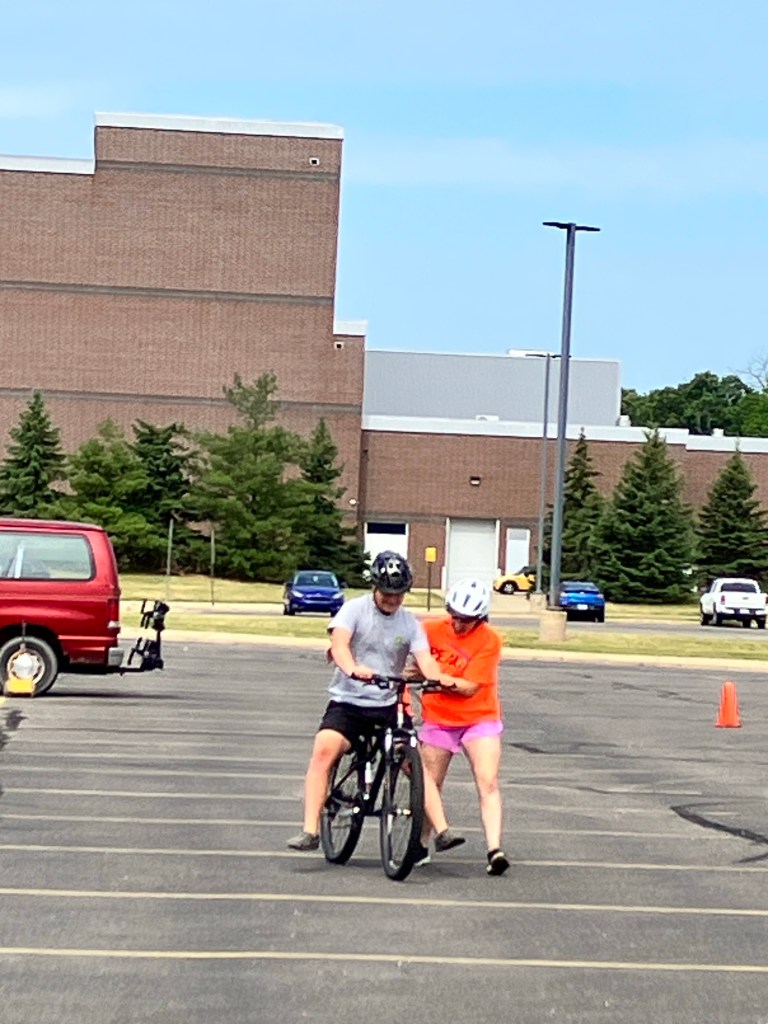
I walked into the parking lot area where Wil was to take his PEAC bike camp. I was overcome with a positive, uplifting feeling — thankfully this type of feeling is not unfamiliar. I’ve grown accustomed to this shift from breathing dense air into a higher atmosphere in only one step.
This atmosphere is one of people helping people. It is beyond a good deed. It is true unity. We innately know the difference as it’s the way we are supposed to be — together.
This is one of the many gifts individuals with special needs offer us. We only need to rise beyond ourselves to accept this handed gift.
The past fall, I struggled with the thought of never truly being an empty nester. My thoughts were a twisted, tangled jumble of yarn – strands of prickly burlap wound tight around strands of brilliant, transparent glitter.
The brilliant strands of glitter represent Wil’s near constant song. Nearly every event calls for a song — when he’s playing, in the shower, in the car, or outside for a walk; anything and everything is inspiration for music. The brilliant strands of glitter also represent Wil’s ever-creative and impromptu silliness. Just yesterday Wil grabbed a branch, held it up and said, “Look Mom! I’m Tree Wil.” And we both broke up into giggles. I can count thousands of such impromptu acts over the years. There is nothing too small for Wil to make big of. He could make a brown paper bag fun—and has, many times! The brilliant strands of glitter also represent Wil’s ever-expanding growth, independence and self-advocacy. Each year he reveals to us more and more of what his true abilities are.
And yet, even at Wil’s highest levels of self-advocacy and independence, he will always be vulnerable. He will always need some level of care beyond his own. When thoughts of Wil’s vulnerability overwhelm me, the prickly strands of burlap sprout and wrap themselves tightly around the brilliant glittery strands, shrouding their luminescence and razzle-dazzle, weighing them down like a heavy, clingy, weedy vine.
It is the burlap strands I’m stuck in when I envy my empty-nesting friends their freedoms. Don’t get me wrong, I am happy for them – I thrill at listening to their planned or dreamed of future adventures. It is the sense of freedom that lay before them that I envy. I envy that for them this is the natural order of things – that this type of freedom is expected.
For our family, a lot more is to be considered — Wil’s care must always be considered. He can’t be left alone for extended periods so we are always aligning schedules. Vacations must be made that suit his needs. If a situation is loud and very crowded, Wil may refuse to go in. If Matt and I chose to go out on our own, who would care for Wil while we were gone?
I also felt the same when people talked about not wanting to live past a certain age. One night after a sporting event, Matt and I went out to dinner with only 2 friends that I knew and the rest were acquaintences of Matt’s. We were all spread out down a long, rectangular table. A man about my age and his girlfriend were seated directly across from me. During the course of conversation the man said, “Well, I don’t want to live past 80.” I then asked him why that was so. His reasoning, as you would expect, concerned his own abilities. I then asked him, “What if you had a child with a disability that relied on you? Would that change your mind?” He stared blankly at me.
We only see what we know. But there is so much more to see than what we know.
This past fall, I was seeing things just as that man across the dinner table. A tightly woven, blocked perspective.
If my mind stays stuck on certain freedoms that I don’t have, how will I open my mind to see all the freedoms that I do have? And all the freedoms available that I don’t yet see.
Wil continues to grow and expand in his maturity because he sees beyond a finish line to growth that many of us draw for ourselves. Wil’s creativity and spontaneity knows no bounds for the same reason. At one point, we stopped seeing branches that could be created to form Tree Wil. In fact, now many of us walk past branches that we don’t see at all.
There are so many things that I do not see! And Wil reveals that to me every day, many times a day. So why can I not unravel the heavy, clingy prickly parts of my own life and instead view them in a new light? Why not let the brilliant, glittery strands elevate my perspective?
Why, because my life may look different than another’s, can I not shine light on a whole new natural order of things? Why must my natural order match another’s?
What I see – and more importantly what I don’t allow myself to see – are the only blocks to my very own freedom no matter where I go, or don’t go.






 'WIL'ingness = Willing to Embrace Extra in Life