Turning the Tide: A Story of Growth and Inclusion

Growing up, Wil has loved boat rides with his Grandma and Grandpa. So when his sisters were invited on an impromptu trip around the lake with some of the neighbor’s kids, they jumped on — and Wil stayed back with his grandparents.

My dad noticed a shift in Wil’s demeanor. He didn’t say anything, but my dad could feel it — that quiet pause, the internal processing. He turned to my mom and said, “Wil wanted to go too.” They decided they’d take Wil out for his own boat ride to lift his spirits. So off they went, stopping at his favorite swim spots along the way. Wil jumped in the water as he always does, with my parents jumping in with him. It worked — his mood lifted (there’s good reason Wil adores his grandparents!).

But the moment they returned to the dock, Wil spotted his sisters and the neighbors hanging out in the yard. My mom said he couldn’t get off the boat fast enough to join them.

Whenever Wil turns a corner in maturity, I feel a sudden wave of sadness for him — and then, not long after, I’m chuckling at his light-hearted ingenuity.

This summer in speech, Wil is working on initiating conversations. He struggles with finding ways to insert himself — to say things like, “Hey! I want to go too!” It seems so simple, but that’s just not in his current arsenal. He wanted to go, but didn’t know how to insert himself. But eventually, he found his way.

Processing time may be slower for Wil, but that does not mean his ways are not effective.

I share this story because no one intentionally left Wil out. In the past, he’s always chosen boat rides with his grandparents — that’s been his comfort zone. If he had said he wanted to go, he would’ve been welcomed. So sometimes, inclusion isn’t about purposeful exclusion. It’s about learning how to speak up — and that’s exactly what Wil is learning to do now.

I’m curious now to see if Wil does start to speak up more. He’s entering a new season — he’s graduated high school, and he’ll be around new people who don’t know him as well. They won’t read his cues the way longtime friends have. That shift will come with challenges, but maybe also with opportunities.

Because often, inclusion really just begins with getting to know someone. And showing up — or speaking up — in a way that you can be known.

Steps in Time

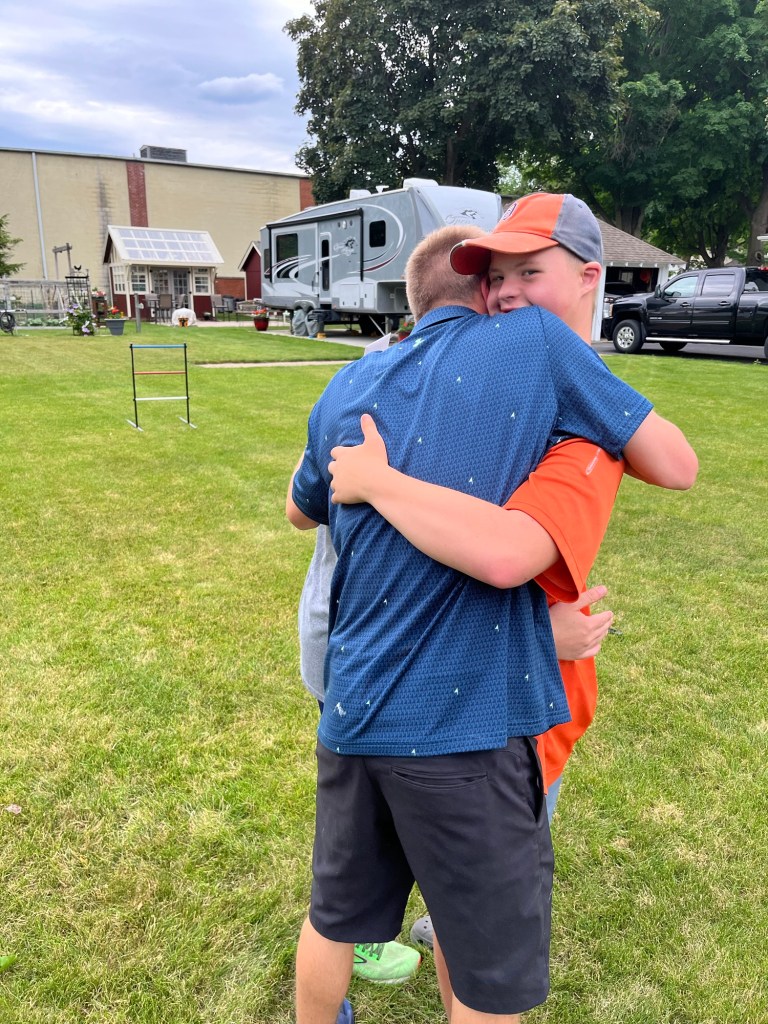
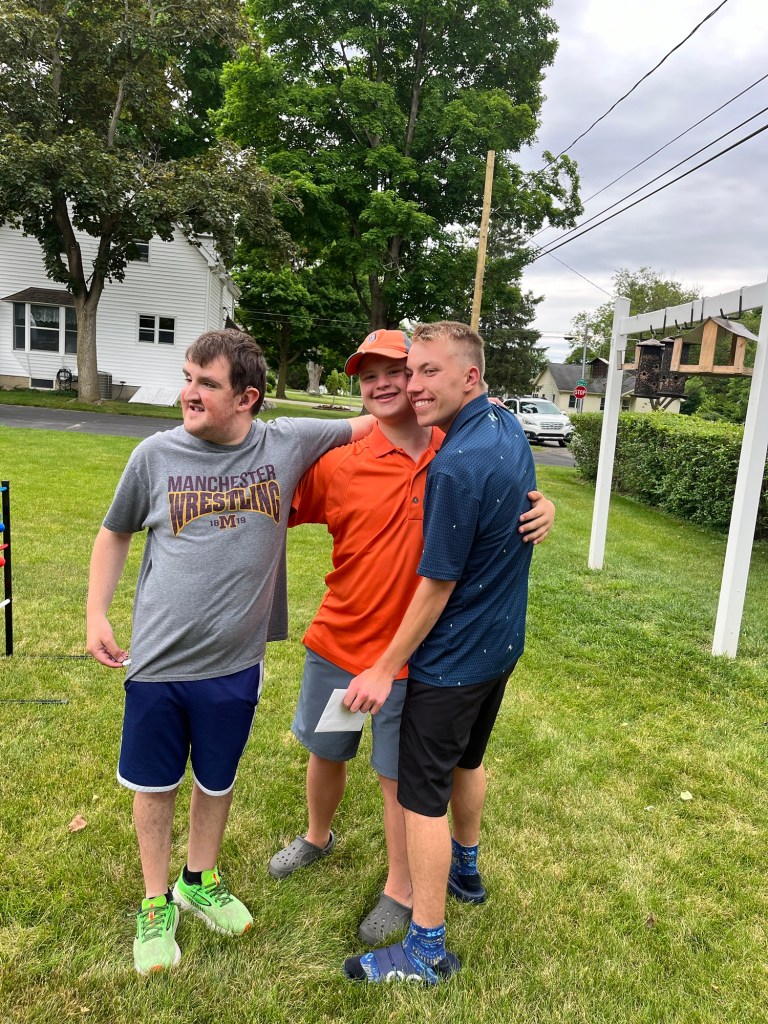
Just 2 years ago during graduation party time I needed an eagle eye on Wil. At one party he fled the party and would not leave the front porch. At another he ran to a side street and sat in the middle of it. Yesterday, at each grad party he hung with his buddies. And made new buddies. He played cornhole with known and new friends. He joined a basketball game with upper classmen from MSU. At each party, I only went to check on him here and there. A stark contrast from two short years ago.

He’ll be a senior next year, and then likely on to a young adult program. When he’s 20 he may have a whole new level of independence from what he has now. Time, opportunities, supports and his own will will tell.

Every individual is their own, no matter their disability. We cannot define nor predict their growth, but we can observe, we can open doors, and we can learn where to step in and offer supports, and as I’m currently learning, when to step back.

I Wonder, Wonder, Wonder

Wil talks all the time. He talks to me, he talks to friends, he talks to himself. I wonder at the time, listening to him today, how one hesitant word was cause to drop everything and celebrate. His verbalization today was once a distant, fuzzy dream. Like reaching for a cloud that my hands couldn’t quite grasp.

Wil does have a tendancy to stutter when he’s excited — his emotions overtake his ability to choose his words and his words get jumbled up. I get it; even the most poetic words could never fully describe an emotion.

When Wil sings, however, there is no stuttering. His emotions, paired with the words, are set free in song.

When Wil talks to himself, there is no hesitation in his words either.

“Lunch?” He’ll ask himself.

“Yeah, yeah, lunch.” Is his reply.

“What do you want? Hot dogs?” He prods.

“Mmm, hot dogs? Yeah, hot dogs.” He answers himself.

“With mustard and peppers. And relish. Mom! Lunch!”

When his self-talk first emerged, I worried. I remember when I first heard it. He was sitting on the floor of his bedroom in front of his closet. He had a back-and-forth conversation with himself on what toys to play with. It was also at this time that the gap in abilities with his peers was becoming very clear. So this timing had me wondering if he had created an imaginary friend because he felt lonely.

Wil has had the same peer group since kindergarten and they exemplify what inclusion is. Even so, I wondered how this gap in abilities that I saw expanding was affecting Wil emotionally. He didn’t act sad about it. He still talked about his friends in the same way. But there was this self-talk emerging and I didn’t know where it was coming from – other than Wil, of course.

I googled “self-talk Down syndrome.” I found this phenomenon is very common amongst individuals with Down syndrome. It’s simply a way to process thoughts. As Wil grew older and we spent more time with teens in our Down syndrome support group, I realized how typical this is. Now it’s just what Wil does. It’s just what is.

As Wil grows on the outside, I grow on the inside. The stigma of the outside disappears when I find understanding on the inside. I frequently look back and wonder at what I once wondered at. It’s an emotion beyond words.

<younger Wil and his longtime friend, Lila>

With a little help from my friends

Wil had a very hard morning. He would not get out of bed. Would not budge. Usually I tickle his feet. He laughs, sits up and says, “Hug Mom!”

He loves high school so even if he’s tired he is typically happy to get up and go. This morning was a throw back from the middle school years when hormones were running high and he had feelings he could not process or communicate at the time which lead to many new behaviors. But we emerged from that time; even if he has a slow start now, he can talk to me and work through it on school mornings.

I racked my brain as to the causes of his demeanor. My guess is a cold is brewing within him as I’m sick, plus he had Social Group Wed night and Music Therapy last night; he’s probably just plain tired.

As he laid in bed, he grew increasingly upset with himself for not moving, which ironically kept him in the “feeling stuck” loop. A wise special education teacher, Mrs. Hancock, shared with me that on these situations it’s about responding not compliance. I thought Matt, being a fresh person in the scenario, would help break him of this stuck loop.

I called my husband Matt at work on speaker phone. Wil shared with Matt that he was “upset.” I felt my heart jump up and cut through my stress with elation. For Wil to share his emotions in his current emotional state was a very important advance. After talking to Matt, Wil was able to unwind whatever was wound inside him and turn it around.

Wil started to get dressed but was still teary. I asked if he needed a hug. He gave me a tight one then I felt him loosen up. I knew then that he would be okay. I texted his teacher to let him know the situation and Wil may needed a calmer start to his day. I’m thankful he begins each school day in the life skills room rather than gen ed so he can go his pace to start and then gain momentum for choir, PE and art.

Our friend, Kate, had previously offered to drive Wil to school that morning, so again a fresh person always helps Wil’s demeanor and he adores Kate. When she walked in the door, she said she had his favorite songs ready to go in the car. Music to his ears (and mine)!

I was very rushed at that point — I hadn’t even brushed my teeth yet as I’d been trying to motivate and give Wil the time and space he needed for the last 30 minutes. I quickly made him his breakfast request to go — 2 turkey dogs with peppers, mustard and relish.

After he’d been in school for about 2 hours, I received a text from Jessica, whom I work with as a paraprofessional, forwarded a picture taken by Ashley who is working in his classroom. Seeing Wil smile big with his classmate buddies made me 🥹🥹🥹.

This morning was very hard, but as Mr. Rogers wisely said, “Look for the helpers. You will always find people who are helping.” ❤️

Tree Wil and Glitter Christie

The past fall, I struggled with the thought of never truly being an empty nester. My thoughts were a twisted, tangled jumble of yarn – strands of prickly burlap wound tight around strands of brilliant, transparent glitter.

The brilliant strands of glitter represent Wil’s near constant song. Nearly every event calls for a song — when he’s playing, in the shower, in the car, or outside for a walk; anything and everything is inspiration for music. The brilliant strands of glitter also represent Wil’s ever-creative and impromptu silliness. Just yesterday Wil grabbed a branch, held it up and said, “Look Mom! I’m Tree Wil.” And we both broke up into giggles. I can count thousands of such impromptu acts over the years. There is nothing too small for Wil to make big of. He could make a brown paper bag fun—and has, many times! The brilliant strands of glitter also represent Wil’s ever-expanding growth, independence and self-advocacy. Each year he reveals to us more and more of what his true abilities are.

And yet, even at Wil’s highest levels of self-advocacy and independence, he will always be vulnerable. He will always need some level of care beyond his own. When thoughts of Wil’s vulnerability overwhelm me, the prickly strands of burlap sprout and wrap themselves tightly around the brilliant glittery strands, shrouding their luminescence and razzle-dazzle, weighing them down like a heavy, clingy, weedy vine.

It is the burlap strands I’m stuck in when I envy my empty-nesting friends their freedoms. Don’t get me wrong, I am happy for them – I thrill at listening to their planned or dreamed of future adventures. It is the sense of freedom that lay before them that I envy. I envy that for them this is the natural order of things – that this type of freedom is expected.

For our family, a lot more is to be considered — Wil’s care must always be considered. He can’t be left alone for extended periods so we are always aligning schedules. Vacations must be made that suit his needs. If a situation is loud and very crowded, Wil may refuse to go in. If Matt and I chose to go out on our own, who would care for Wil while we were gone?

I also felt the same when people talked about not wanting to live past a certain age. One night after a sporting event, Matt and I went out to dinner with only 2 friends that I knew and the rest were acquaintences of Matt’s. We were all spread out down a long, rectangular table. A man about my age and his girlfriend were seated directly across from me. During the course of conversation the man said, “Well, I don’t want to live past 80.” I then asked him why that was so. His reasoning, as you would expect, concerned his own abilities. I then asked him, “What if you had a child with a disability that relied on you? Would that change your mind?” He stared blankly at me.

We only see what we know. But there is so much more to see than what we know.

This past fall, I was seeing things just as that man across the dinner table. A tightly woven, blocked perspective.

If my mind stays stuck on certain freedoms that I don’t have, how will I open my mind to see all the freedoms that I do have? And all the freedoms available that I don’t yet see.

Wil continues to grow and expand in his maturity because he sees beyond a finish line to growth that many of us draw for ourselves. Wil’s creativity and spontaneity knows no bounds for the same reason. At one point, we stopped seeing branches that could be created to form Tree Wil. In fact, now many of us walk past branches that we don’t see at all.

There are so many things that I do not see! And Wil reveals that to me every day, many times a day. So why can I not unravel the heavy, clingy prickly parts of my own life and instead view them in a new light? Why not let the brilliant, glittery strands elevate my perspective?

Why, because my life may look different than another’s, can I not shine light on a whole new natural order of things? Why must my natural order match another’s?

What I see – and more importantly what I don’t allow myself to see – are the only blocks to my very own freedom no matter where I go, or don’t go.

Signed,

Tree Wil and Glitter Christie

HOW WE BEND

Today Wil and Manny went bowling. Both are teens with Down syndrome. Manny’s mom, Laura, and I share frequently about our plans, thoughts and concerns for the future. Thoughts about our boys as they age out of the school system; after friends have moved on to college, to jobs, to get married. How will our boys adapt to the change? What programs are available now and in the works for the future? And of the programs available, are they a good fit for our boys?

Last night my friend, Cheri, who’s son CJ (who you may know from his weather reports—WCJR weather) called me. CJ is graduating high school this year and also has Ds. Cheri and I shared our thoughts and plans for our boys’ futures. Cheri is always a step ahead of me in raising CJ, and I learn greatly from her experiences.

Not everyone has a teen child with Ds. We must actively seek one another out, actively seek out programs, and discern if what’s available is the appropriate fit for our soon-to-be adults. In fact, just today, Wil had an interview with a summer camp I’ve tried for years to get him into. Wil is ready for an overnight camp, but not without an aide. Just going to a typical summer camp is not an option for him. And that is the case for many people with disabilities; thus the long waiting list. The interviewer said Wil’s a really good fit, but spaces are very limited. She was wonderful, we connected immediately, and said she’d do what she can for him to get in.

Recently talking with my friend, Vanessa, who has a teen daughter w Ds said to me, “You bend for the ones you love.” That statement delivered great clarity to me. It makes sense of what connects me to a camp counselor I just met on a 30 minute Zoom meeting, but knew her innate understanding immediately; and also what connects me, on a deeper level, with my friends. We bend to create understanding and opportunities for people with disabilities. We bend together for the ones we love.

As Vanessa spoke those words, I visualized trees that stay closed in, protecting the roots they know, refusing to bend. Then I visualized trees firmly rooted in love, but with branches reaching, stretching, bending, some almost impossibly yet never breaking, open to receive the sun along with the rain — both of which serve to strengthen them.

If you were a tree, what kind of tree would you be? 😉

I Feel Good!

I remember, when Wil was a brand new baby, I walked into my first Down Syndrome Support Team (DSST) meeting. Young kids with Down syndrome were running around playing like young kids do. Everything was so normal, and yet it wasn’t to me, because all these kids had Down syndrome. I went home, though very supported by the parents, crying my eyes out. My mother-in-law, who was at our house watching the twins (who were not even 2 years old yet), asked how it went. I broke down crying again. My emotions felt too big to process.

Yeaterday, at a DSST teen event, our kids acted like…you guessed it, total teenagers. They went between competitive games of pool, foosball, and Apples to Apples, to being cool and aloof. We finished the event with a dance party, and our teens got down like James Brown! I went home floating on a cloud.

What was the difference between then and now, other than age? Its the same, but also not. And in the process of learning the “not” I fell in love with the whole.

And when you can embrace the whole, there is an elation with a depth to it. Kind of like a James Brown charasmatic scream 🙂

I feel good!! Oww!!

A Good Morning!

Wil set the alarm on his iPad last night for school (I showed him how after asking the twins if they had an old alarm clock Wil could use. Elizabeth said, “Mom, just use his iPad” 🙄).

On mornings I work, Katherine or Elizabeth typically wake Wil. He is very independent now, and it’s getting rarer for him to have sluggish mornings. Even if he does get stuck at times, he recovers much quicker.

As getting Wil out of bed does not require the patient encouragement it used to, I suggested he try getting himself up. He was all about it.

Just last year, setting his own alarm would not have been an option. He would have felt abandoned. He required our encouragement and our consistency to start his day right. If there was even one chink in the chain, it could throw the whole day off.

Many of Wil’s behaviors have been associated with challenges in communication. But with his desire for independence, his communication skills continue to expand.

He has the maturity now to see how communication gets him where he wants to go. His ability to ask for help when he needs it, and to more clearly identify and express his emotions, has helped him make forward strides. He still runs off when he is overwhelmed or frustrated, and likely will for some time. But again, he recovers more quickly than in times past. The more exposure he has with these situations, such as his recent choir experience I wrote about, the more confidence he’ll build.

This morning Wil woke to his alarm, dressed in the outfit he picked out the night before, ate breakfast, filled his water bottle and put it in his backpack. When I got home from work, he was rocking in the rocking chair watching Wild Kratts.

“Mom! I’m all dressed!” He said as he popped out of the rocking chair with both arms raised.

Whenever Wil hits a growth spurt like this my head spins in wonder. Only a year ago, this leap wasn’t possible. Whenever I force time on Wil, he forces back. But when the foundation is laid, and we progress the best way we know how, the time reveals itself.

Sunday Live-Stream

I don’t listen to special needs podcasts.

It’s not that I don’t enjoy them, or learn from them, or feel a connection with them. I do. I have a few of my favorites saved in my library for quick access when I need extra help. But mostly, I enjoy the running podcast of my own life.

Like when Wil goes to Challenger baseball, I look forward to it just as much as he does. It’s as much of a supportive environment for him as it is for me.

There is both structure and freedom in the Challenger games: 3 innings, player placement in the outfield, a batting line-up, and everyone makes it to home plate. But beyond that, and sometimes within that, anything goes. It’s really the perfect parallel to raising a child with disabilities. The parents, coaches and players get it, because they live it. Every day.

Tim stepped up to bat, and Coach H. announced it was Tim’s birthday. Everyone cheered. Coach H. joked that his son, who has autism and scripts (repeats sayings), only told him 55 times that morning. After Tim hit the ball, Tim’s mom quietly told Coach H. that she’s not sure where his son heard it was Tim’s birthday; it’s really in January. But who couldn’t use an extra cheer?

Sandi was next up to bat. She hit the ball and ran to 1st base. But she didn’t stop there. Sandi ran on to join her friend on 2nd base to give him a hug. There Sandi stayed; two players on 2nd base and no one on 1st base.

James enjoys music; the same music, over and over. James’ dad’s cell phone is on a near constant repeat of animated show tunes in his pocket. But James’ dad instilled a rule: music while in the outfield, but no music while waiting to bat.

“I swear I can’t listen to that song one more time!” James’ dad said to me. James, in turn, scripted about the music the entire time he waited to bat. So, by the time James and his dad went back to the outfield, his dad was just as relieved as his son was to play music again!

I jokingly said to James’ dad, “No music on the pitching mound.” He replied, “Oh, there is going to be music on the pitching mound!”

Just before Challenger baseball, Wil, with his strong left-handed throw, tossed Elizabeth’s book into his pool. He wasn’t mad it her. Nothing precipitated his actions. He saw her book sitting on the back-porch table, and his pool was in perfect throwing distance.

He lost his iPad privileges, which means no Luke Bryan. So, he grabbed his Luke Bryan CDs, which I also said no to.

“DVD’s mom?” Wil asked.

“No,” I replied.

At the Challenger baseball game, I shared this incident with my friend, Eleanor. Her son also has Down syndrome and is Wil’s age. I knew she would understand, and sure enough, she laughed and said her son had committed similar acts with his sister’s possessions for no apparent reason. We shared other stories and how our sons always tell the truth, or remain silent, about such incidents. We’ve never heard either tell a lie. Then we watched her son crack an impressive grounder and take on the bases.

Entertainment, sports, connection, support, humor and education; no streaming required, all on a Sunday afternoon.

CREATING SPACE

“Mom, I saw Ashley in gym today!”

Wil did not share this fact after school. Nor at the dinner table.

Wil was lying on the couch, shortly before bedtime, watching a Netflix show with Elizabeth and me. He popped up in the middle of a scene— that had nothing to do with gym class, or long-time friends — and made his declaration.

When Wil was younger — and his friends, cousins and sisters were younger — the main goal was play. Though some kids ran and talked faster than Wil, the running and talking didn’t last long. They were all about the play, and that’s what they did.

But now, the play has transitioned to conversations. And these conversations move fast and take lots of tangents. And Wil, though he speaks quite well, simply can’t keep pace with most teenagers and adults when it comes to conversation. Thus activities in gym, and seeing long-time friends like Ashley, are highlights of Wil’s day.

I’ve recently noticed Wil’s increasing silence at large gatherings such as weddings and holiday dinners. Ironically, Wil’s conversational skills have increased, and yet, he still cannot keep up with the pace of group conversation. He joins in where he can; and for Wil, that is in laughter. Unless Wil is addressed or given the space to talk, he sits quietly, staring at his plate, until laughter spontaneously and contagiously catches everyone at the table, and he heartily joins in.

Fortunately most large events come with dancing and games, and this is where Wil knows exactly how to make space for himself. At my nephew’s wedding, he literally did just that. Wil created his own space on the dance floor, got down with his own moves, and his energy was so contagious that no other dancer could resist joining him. He was again at play, everyone around him was about the play, and that’s exactly what they did.

When space isn’t created for Wil, and he is not able to create space for himself, it is when the night grows quiet that he thinks on his day and processes events. It is his time to filter through images without all the tangents and interruptions. And though some of his declarations may seem out of the blue to us, he is creating that space for himself. And as his mom, I can’t help but cheer when he decides to take the floor!