Nothing about disability should make one uncomfortable. The discomfort within is simply a block in the desire to understand.
A desire to understand is hard work. It requires a shift in perspective. A vulnerable openness.
But even when a small fissure in that block opens within us, the sliver of light is absolute glory. I know this personally. This is when we begin to see a much wider world that has always been right in front of us.
But we will never see beyond the block until we have a desire to do so. Until we create an openness within us.
It pains my heart to know how accessible this joy is, but so many minds remain blocked to it out of the discomfort to understand.
Wil had a very hard morning. He would not get out of bed. Would not budge. Usually I tickle his feet. He laughs, sits up and says, “Hug Mom!”
He loves high school so even if he’s tired he is typically happy to get up and go. This morning was a throw back from the middle school years when hormones were running high and he had feelings he could not process or communicate at the time which lead to many new behaviors. But we emerged from that time; even if he has a slow start now, he can talk to me and work through it on school mornings.
I racked my brain as to the causes of his demeanor. My guess is a cold is brewing within him as I’m sick, plus he had Social Group Wed night and Music Therapy last night; he’s probably just plain tired.
As he laid in bed, he grew increasingly upset with himself for not moving, which ironically kept him in the “feeling stuck” loop. A wise special education teacher, Mrs. Hancock, shared with me that on these situations it’s about responding not compliance. I thought Matt, being a fresh person in the scenario, would help break him of this stuck loop.
I called my husband Matt at work on speaker phone. Wil shared with Matt that he was “upset.” I felt my heart jump up and cut through my stress with elation. For Wil to share his emotions in his current emotional state was a very important advance. After talking to Matt, Wil was able to unwind whatever was wound inside him and turn it around.
Wil started to get dressed but was still teary. I asked if he needed a hug. He gave me a tight one then I felt him loosen up. I knew then that he would be okay. I texted his teacher to let him know the situation and Wil may needed a calmer start to his day. I’m thankful he begins each school day in the life skills room rather than gen ed so he can go his pace to start and then gain momentum for choir, PE and art.
Our friend, Kate, had previously offered to drive Wil to school that morning, so again a fresh person always helps Wil’s demeanor and he adores Kate. When she walked in the door, she said she had his favorite songs ready to go in the car. Music to his ears (and mine)!
I was very rushed at that point — I hadn’t even brushed my teeth yet as I’d been trying to motivate and give Wil the time and space he needed for the last 30 minutes. I quickly made him his breakfast request to go — 2 turkey dogs with peppers, mustard and relish.
After he’d been in school for about 2 hours, I received a text from Jessica, whom I work with as a paraprofessional, forwarded a picture taken by Ashley who is working in his classroom. Seeing Wil smile big with his classmate buddies made me 🥹🥹🥹.
This morning was very hard, but as Mr. Rogers wisely said, “Look for the helpers. You will always find people who are helping.” ❤️
I am enmeshed in the world of people helping people; of making inclusion work. Personally and professionally. I am on a high learning curve, always, with both Wil and the children I work with. Down syndrome looks much different than other disabilities, and of course, no matter the disability, each individual is their very own person. There is always more to learn, to know, to understand, and new research and new ways of navigating situations. This world I’ve enmeshed myself in is both a challenging and beautiful place to be.
I recently heard an anti-inclusion comment. It hit me emotionally, like a pierce through the heart. It wasn’t about my son, but I felt it deeply personally. I was so saddened and I couldn’t shake it. I kept rolling it over in my mind. Though I know there are still people out there with these beliefs, it’s so outside the realm of where I am. The feelings were hard, but I didn’t want them to harden me. And thankfully, I had the perfect experience that very evening to put my perspective back in place.
Wil had his first music therapy. He was very excited and packed his acoustic guitar. As we walked into the building where Wil was to have music therapy, a mother and her daughter — her daughter had a disability — were walking out. We quickly assessed one another and shared smiles. An instant feel-good chemistry fills the atmosphere in such meetings of strangers. No matter how unique our paths are, we share a strong bond in the pursuit of unity. We know the path can be arduous, but we have chosen to walk it fully, and in that, we are conjoined warriors in the cause for the good of our children. We don’t slam doors, we open them. That’s what we do in any and every way we know how.
The music therapist welcomed us. As it was evening, her eyeliner was slightly smeared from a long day (as I’m sure mine was) and she had a pleasant, welcoming demeanor. Wil entered her room while I sat outside of it in a cushy black vinyl chair, happy for the rest. Wil and his music therapist instantly started a jam session. On the other side of the door, I heard her beautiful voice rise; I felt my whole body relax and rise in energy at the same time. She gave Wil gentle instructions on notes with his guitar. He sang his favorites, and then she sang hers.
When Wil and his music therapist emerged 45 minutes later, she had a glowing smile on her face. He is such a joy, she said, and by the way she said it, I knew she meant it. Both were high on joyous shared music and energy. And by proximity, so was I.
While I’m not thankful for the door slammer, I’m thankful for the eye-opener that the door slammer brought. To feel the sadness but not allow myself to be hardened by them; rather to rise higher with the good that surrounds us. I was reminded, right on time, of my deep gratitude for the high energy and joy of the door openers. No matter how high our learning curves, how many times things may change, or how exhausted we all may be at the end of the day, we always know, deep in our souls, that what we are doing matters. And it matters big. We are opening doors and creating shared atmospheres of inclusion no matter how unique each of our lives may look.
When I was a very young child I remember asking my dad, “What IF this happens? And what IF that happens? Then what IF this happens?” He looked at me and replied, “There are no ‘what if’s.’ You just do.”
I don’t remember much else other than we were in the car on our way somewhere, and the tone in which my dad said those words, and the way he turned his head and attention from me in the backseat to back on the road, I knew there was to be no further discussion. My mouth hung open with a million more “What IF” questions stuck in my throat. I was terrified at the prospect of having to “just do.” What was I to do, if I didn’t know what to do?
Little did I know, that many years later, this advice would serve me very well.
When Wil was a baby I asked his physical therapist when he would walk. She replied that she didn’t know. He had very low muscle tone so it would be up to him. She said it would depend on his level of motivation.
Though I didn’t know when Katherine and Elizabeth would walk as infants, I never questioned IF they would.
What IF Wil doesn’t walk? What IF he doesn’t crawl? What IF he doesn’t talk? What IF I wasn’t doing enough? What IF I messed something up and he fell behind. Then what IF this happens? And what IF that happens? What IF…
I placed a big, bold stamp of “What IF” all over Wil. It’s incredibly detrimental. Yet, at this point in my life, I was riding along in the backseat with no idea where we were going or what I would do when we got there.
I was terrified of such an open-ended, ambiguous prospect. What were the parameters?
Wil’s physical therapist showed me exercises to do with Wil. We incorporated these exericises into his play. Katherine and Elizabaeth, just over 2 years old at the time, always wanted to be involved and did Wil’s exercises with him too. “What IF” turned into “we just do.”
In this new way of doing things, though we still worked toward the goal of walking, the purpose changed. It changed into ‘look what Wil can do’, rather than measuring what he can do against a time stick.
Every advance was celebrated. As “we just did” — though I still worked purposefully with Wil –I let the timelines go. Timelines weren’t as important anymore. It was all about watching Wil grow, get stronger, and develop in his own way and in his own time. And as time went on, we adjusted with his growth. We just did.
Funny, I don’t even remember exactly when Wil started walking when it was once a monumental part of my life. Not that it wasn’t important. But what I remember most vividly is working with Wil and with Katherine and Elizabeth. How Katherine and Elizabeth loved to encourage him, and play with him, and how we all worked together to help him achieve his goal of walking when he was ready to walk. We just did.
I accepted Wil’s diagnosis long before he started to walk. But I learned to accept the value of what disability means the day I quit asking “what if” and focused on just doing.
That’s when we see the value of the individual person. Not stamped with a big, bold “What If” stamp dividing abled or disabled. But by seeing who we all are by lifting each other up, supporting one another, so we all rise in our own space and time.
What IF we can be a society that sees individuals as valuable without holding up a measuring stick of parameters?
In this house we take no such statements for granted.
In middle school, Wil riding the bus proved unsuccessful. He was already having a hard time transitioning to a new school with new educators and hormones were in full effect. The middle school years are challenging; then add in communication barriers and cognitive delays that a body’s progression into puberty does not wait for, and you’ve got behaviors. Every day was a new experience, and we were rewriting the plan over and again. Finally, I called “Uncle” on the bus riding as it was adding stress to Wil amongst all the other areas we were navigating at the time. It’s challenging to do that, as you never know if you are giving up at the right time, or too soon. But what I have learned is no matter what the success — or lack there of — looks like from the outside, there is groundwork being laid on the inside.
Wil is now in 11th grade. He loves being 16 years old. And he is fond of reminding me he will be 17 years old on his birthday. He wants to go to college like his sisters. We will cross that bridge — in this house we are very used to crossing bridges as they come. As he is growing into his indepedence and his maturity has blossomed, he told me he wants to ride the bus home. I joyously concurred.
Last spring, he did ride the transfer bus from his high school to the elementary school where I work. This was very successful, so I think it was the perfect nudge to riding the bus the full way home.
All was going smoothly until 2 weeks ago. Wil walked to the bus like he always did, but then just kept on a-walking. His teacher ran after him and walked him back to the bus. Wil refused to get on. So Wil and his teacher walked to the office. His teacher called me and I picked him up. This happened every day for a week.
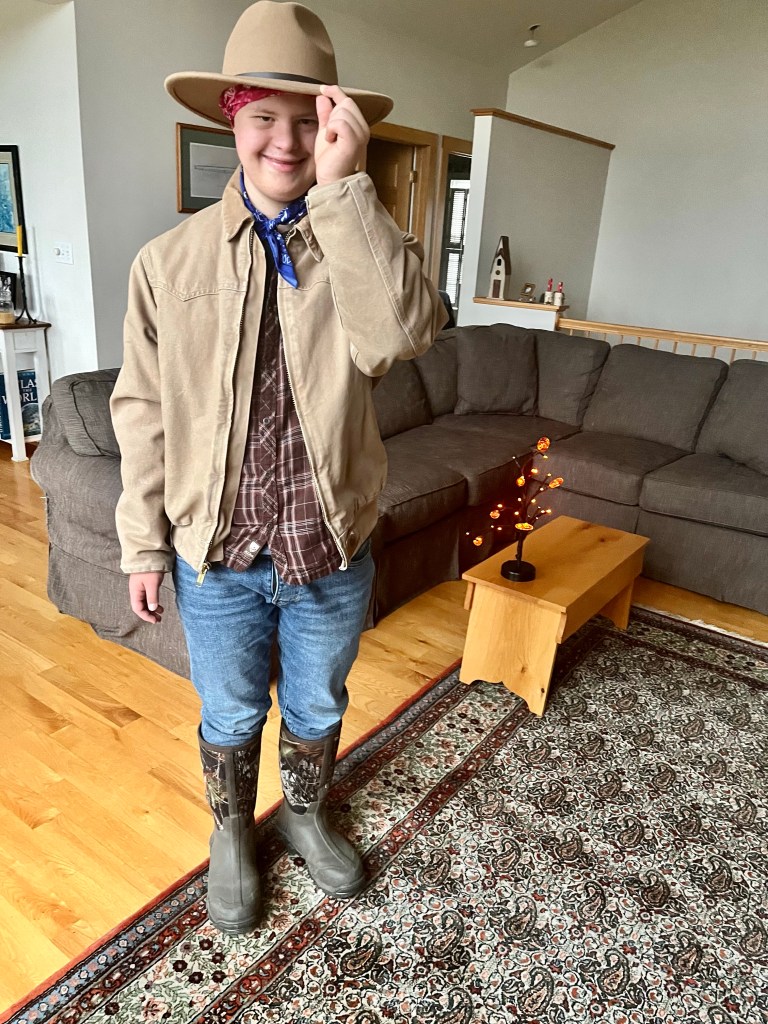
All I could get out of Wil was that the bus was too crowded. He refused to sit up front where it was quieter. But he is in 11th grade, so why would he want to do that? I suggested his noise-cancelling headphones. Wil is very aware of his looks, and doesn’t want to look different. I want to make clear that he is in no way ashamed of his disabilty, nor should he be. And noise sensitivity is part of his disability. But Wil puts great importance on his appearance, and you know by now his deep affection for baseball hats, so noise-cancelling headphones would throw off his style; and his hat. (Wil only wears his headphones now if he is at the movies or a concert, but he’ll only go to these loud places if he really wants to be there.)
So, here we were. Wil refused to ride up front where it was quieter. He wanted to sit in the back with his friends. But it was too crowded. So it makes total sense that he would attempt to walk up to the bus, get nervous and keep going.
Just being able to make sense of things is HUGE!! When Wil was in middle school, he was not able to express to me his reasons for being nervous on the bus. His educators and I had to do our best detective work, but with so many factors at play, our best guesses were only that — guesses.
As Wil could now tell me the reason for not riding the bus, we could have a discussion about it. Now Wil had true ownership in his decision as we could have a conversation about his options as I knew what the struggle was.
Whether what we come up with works for the long-term or not is to be seen. But what is most important is that Wil has a voice in this, and that is something he’s always deserved to have, and we’ve worked hard for him to share it.
With this knowledge, Wil’s teacher created a chart to hang in the classroom. Each day Wil rides the bus he will get a sticker. Wil thrives on recognition so was immediately into this idea. Every 3 stickers, I will take Wil to the market to pick out a handmade sandwich of his choice and a drink. He also loves this type of adventure.
Today is day one of this plan. I went up to the school and parked in the lot just in case Wil refused (I parked out of Wil’s sight so he wouldn’t backtrack.)
Wil’s teacher walked with him, and he successfully made it on the bus!
In this house, we celebrate successes!
Today is one day, tomorrow will be another. And so will the next. Every day we cross a new bridge. Every day I will feel a tightening in my stomach at 2:45 with one eye on my phone. And every day it doesn’t ring I’ll release the butterflies in my stomach to fly in celebration.
In this house, every day is a new day. We never take such things for granted.
Opening minds to acceptance need not be negative. My journey with Wil’s diagnosis is likened to a flower blossoming through a crack in the concrete, unfolding, stretching, growing, reaching, and opening fully to the sun. At first unbelievable, then freeing, and now a natural part of life.
Disability is a natural part of the human condition. Yes, you can argue I will get trampled again and again. Yes, I will be under the concrete again finding a new space to grow. But herein lies the difference. The concrete is real, but I don’t have to stare at it. I now know there is always a crack in the concrete somewhere because I have experienced it.
I’ve experienced bumping my head multiple times in search of the sun. I know that bumping my head — now in a progressive way — is simply part of the process in reaching a glorious opening to expand with the sun.
It hurts no less to continually bump my head. But I know, very deeply within me, that the more flowers I bloom, the more the natural human condition of people with disability will be recognized as a beautiful, natural part of life, and to be appreciated as such.
There is room for all of us to grow, but only when we open ourselves to fully supporting this growth that blossoms in its own natural way and time.
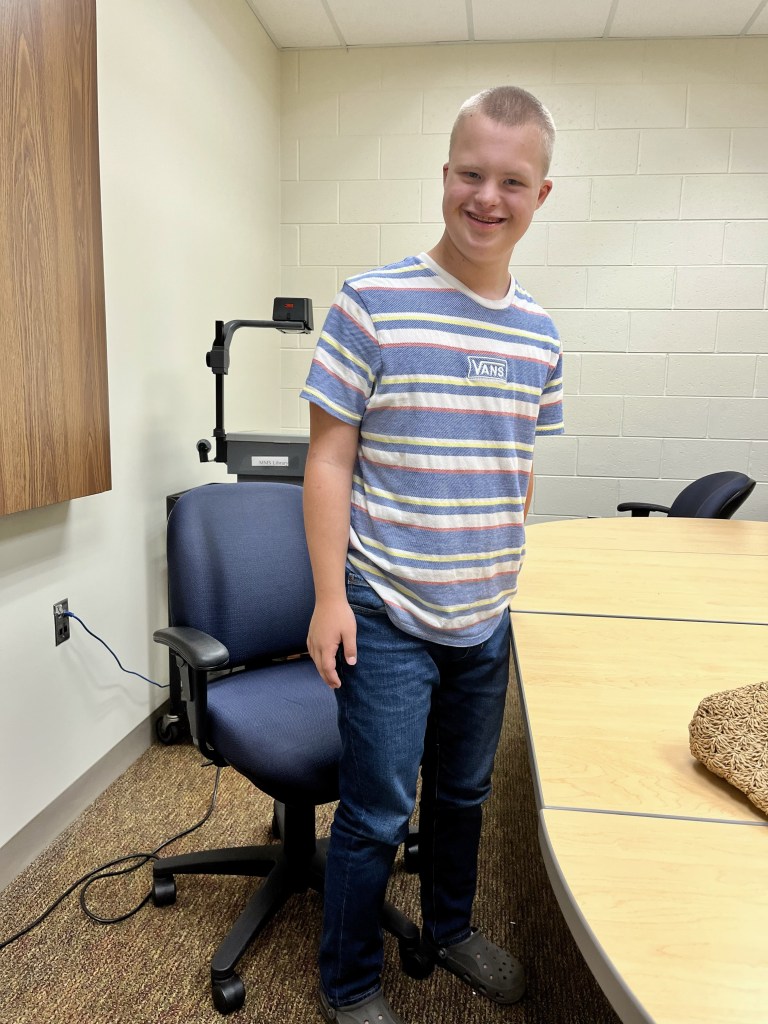
He’s a 16-year-old kid. He wants to be a 16-year-old kid the way he is, just like any 16-year-old kid wants to do things the way they do.
Why should a kid with prosthetic legs be an inspiration when he plays baseball? He just wants to play baseball, and that’s the way he does it. Yes, it’s more challenging than if he had two flesh and bone legs that ran when he told them to. But the way he plays is normal for him.
When I narrowly viewed how things should be, I unintentionally one-dimensionalized people. Then when I had reason to truly care, my heart cracked open to multiple ways of being. That is true joy once experienced; it’s very freeing. Challenges don’t disappear but my mind is no longer caught in what should be, because Wil is exactly as he should be. Boys playing baseball, no matter how they get to the bases, are how they should be.
Whenever I define what should be, the deep value of the many ways things can be is lost in my angst. The value of a multitude of joys is equal to the value of true inclusion. But a change in thinking doesn’t happen until we have a reason to care.
Someone once said to me about Wil, “ but don’t you want him to be the best he can be?” This was in relation to a claim certain supplements could help take some of his Down syndrome features away.
Of course, I want Wil to be the best he can be. But what I don’t want, with all the feeling I have within me, is for him ever to be ashamed of who he is. Down syndrome is part of who he is. Not a disease to be erased, or fixed to look more “normal.”
Why is it that we see people with disabilities as people to be fixed? Why is it so hard to see the value of an individual who does things in a way we hadn’t considered?
I saw a YouTube of a 12-year-old girl with CP who used an assistive technology device to talk. When she was asked what it was like to use that device to talk, her answer was, “normal.”
Do you know a great way to miss seeing someone as their best? Not seeing value in the person as a human being exactly as they are. Not seeing there are many versions of best, no matter how many legs, arms, chromosomes, etc. you have.
I mean, look at those almond-shaped eyes. Why would I want to fix anything he is? 💙
If I were to sum up my writing surrounding Wil in 7 steps it would be:
Wil wants and deserves to be treated as you’d treat anyone. As the individual he is.
But, 47 chromosomes has an impact on Wil.
To respect him for who he is, you cannot have an idealized view of what disability is. When you work closely with people with disabilities it is challenging. And here’s why…
You have to step back and try to understand what is driving the behavior. This is the single most challenging aspect. Whether we realize it or not, we impose our thoughts on others. To step back with an open mind and analyze the situation is incredibly challenging at times. Especially if it’s reoccurring, or you are in a hurry, or there is no answer you can discern due to communication barriers.
But here’s the glory—- when you do step back, when you do suspend your own thoughts and open your mind to what may be happening, it’s like a boulder blocking your heart was shifted. You are lighter but stronger. A view of life opens that you didn’t even know existed. It’s an awakening.
But this shift is so challenging, many of us — including me — need someone with a disability to personally impact their life. As much as it pains me to say that, it’s true.
Without the personal impact, views of individuals with disabilities are either seen with feel-good idealism or not thought of much at all.
Don’t idealize away the challenges. They are exactly what gives us strength to move boulders and see an elevated view of humanity that sadly many of us won’t do until we have to. I thank God every day that I “had to” because I love this elevated view I never knew existed. 💙
Picture day was today. Last night Wil took a shower in preparation, and spent extra time choosing a shampoo. I heard him talking to himself as he smelled each one.
“Ewww! Too strong. Hmmm, this is old. Mmmm, smells good.”
With his sisters gone to college, Wil can safely use what they’ve left behind without swift sibling reprimands. When his sisters were home, the slightest change in position of their shampoo, conditioner or body lotion bottles was expertly detected.
Wil eventually, and excitedly, exited the shower, put on his fluffy blue robe, and walked directly to me. He bent his wet head so I could smell his freshly showered hair, then lifted his arm for me to smell his fresh skin. Wil shared no words with these actions. This routine went back to the days of him refusing to bathe, and me adding positive reinforcement when he did. This same routine also remains with him blowing his minty fresh breath in my direction after he brushes his teeth.
“Oooo, fresh!” Is my expected, and routine reply. He’s 16 years old now, and we really don’t need this routine anymore, but it makes us both laugh, so we keep it up.
He combed his hair, played it into a Mohawk, “like this Mom?” We laughed again, he put on his pajamas, and he went to bed.
I’m not sure what happened overnight, but he was a different version of himself this morning. I had to coax him out of bed, then he wouldn’t get dressed. My guess would be overwhelm. He typically wears a favorite dressy shirt on picture day, but today he picked a black cotton Luke Bryan shirt that wasn’t exactly unwrinkled. He was muttering to himself, which meant he knew he picked this shirt to pick a fight. He wanted me to tell him to pick something else. And it would be him flat out refusing to do anything.
If he had simply picked out a shirt, without the muttering, I would have asked him to go back and take another look. I would help him if he wanted. And he’d do that, and come out saying, “This one, Mom?”
But I knew this muttering mood well. And it’s one where I give him space to work through what he needs to. And that’s what I did. Almost. His hair dried funny in the back. So I waited until he was eating breakfast (aka when he was happy and distracted) and put a wet comb through it.
“Mooooooom!”
“Wil, I know you’ll be disappointed if your hair is sticking up.” As he wears a baseball cap every day, I asked him to wait to put it on until after pictures. Well, in the mood he was in, you can guess what he did. Hat on.
“Wil, if that’s what you want to do, fine. But think about when you get your pictures and your hair is all sticking up. Is that what you want?” I asked. He pondered this.
“Gel, Mom.” He said. Vanity does have its perks!
Wil is a wild card, with a few wild hairs! I never quite know what will offset him, so I’m always reading his cues. I think that’s why I enjoy our predictable routines — oooo, fresh!—-even if he’s outgrown them. When we make it to the car every school morning, and he starts singing, it’s like I scored all aces, and we both turn up the volume on our voices and laugh, as we always do, at our ridiculousness.







 'WIL'ingness = Willing to Embrace Extra in Life