Take Another Think

We may believe our thinking is correct; or it is good—that we are good people.

Even those of us that call ourselves open-minded may find we have unwittingly closed off our minds when spending time with individuals with disabilities.

Why is this?

Because we have to see it their way first to understand. And many times — in some cases most of the time— their way is not easily readable. So we push our agenda on those with disabilities.

Individuals with disabilities’ way of communicating may be very different, or even non-existent in a verbal sense, so actions must be carefully observed. And even then we may remain clueless. It takes too much patience, and so we, even unconsciously, push our way on them, or we ignore them.

Our own belief system must be suspended to decipher theirs. We must let go of trying to be “good” or “helpful” because our version of what is good or helpful may not be for them. This very fact is likely the most challenging, and yet the most empowering process, in our very own lives.

When we suspend our own belief system in order to understand theirs, something shifts within us. Something bigger, something higher — spiritual even.

This process has no end. In fact, in 16 years I’m only just beginning. I’m stronger than I’ve ever been in trying to understand Wil, and understand the world’s reaction to him. I’m learning as a parapro to understand many differing abilities. It’s challenging and I need the expertise of those around me, because again what I think of as being helpful may not be helpful to them.

But it’s also so amazing to understand what in some ways may never be understandable. It wakes up something in me. Not because I’m trying to be a good person; it is because I truly want to understand what these kids are trying to say.

Those with disabilities are true gifts to us all—and yet this population is so very ignored and misunderstood. We must first forget ourselves, in full effort to understand another, and in that we find a stronger constitution of our own selves within.

To “Be” or not to “Be”

At 53 years old I am a student. At 89 years old I will be a student. When I say goodbye to this world, I will be a student.

Yesterday, I was trying to help a student who has autism. I was kind. I gave this student squeezes, I spoke calmly; soothingly. This student’s aggravation grew.

I see a lot of “Be Kind” bumper stickers. “Be Understanding,” in my opinion, is where we need to “Be,” but that’s too substantial for a bumper sticker.

I looked to the teacher for advice with this student. The teacher explained that this student was working through inner thoughts; likely about an event that happened earlier at home that we knew nothing about. This student needed space to verbally work through those emotions.

This explanation clicked immediately in my mind. It made sense in the way some times physical touch and calming words are needed; while others space is required. But without that explanation, I don’t believe I would have seen this difference on my own. But now that I did, it was set in place in my mind and I will now be better equipped to help this student when another such happening occurs.

Every day, in this way, I gain new understanding. I gain new confidence and strength in helping give these students what they need to move forward.

One of my friends, whose son has autism, said she wishes, just for a moment, she had a special key to unlock his brain, walk in, take a look around, say, “uh huh,” then close his brain back up and move on with life.

Full understanding is an unattainable goal, but when we shoot for the moon, we can reach the stars; even if it’s one star at a time.

I’ve been asked more times than I can count stars, “How do you have such patience?”

I’ve used the word “patience” regarding Wil in my stories about helping him through “stuck” patches. But now, after having the few months of experience in this work that I’ve had, my perspective on “patience” has shifted.

Now, when I consider that word, “patience” is exercised when I don’t want to take the time to understand. When time is urgent, and Wil won’t go. When I want Wil to cooperate and he won’t. So I wait him out. But when I truly learn to read his cues; when I anticipate what may happen, when I try to take the “key” so to speak and unlock what is happening in his mind, that’s not patience. That’s being a student; that is cultivating an understanding. And when you unlock even a piece of understanding, the elation is beyond words.

To truly fill up the well inside of you, don’t just “Be kind.” Be desirous to learn. Be desirous to understand. Be desirous to be a perpetual student. Reach for the moon, and even if you grab one star, you’ll “Be” substantiality beyond what any bumper sticker can preach.

The Perspective of Time

Wil has grown so much in his 10th grade year, and I can’t thank Kristi Campbell, Hope Schook and Heidi Drake enough for that! For this fact, it gives me space to snicker when I read about a day like this:

10:05 Refused to work
10:08 Turned it around
10:25 Refused to work
10:30 Turned it around
1:50 Refused to work
1:54 Turned it around

Just last week, I worked with a paraprofessional that subbed for Wil in 1st grade while his primary para was on maternity leave. We laughed that the main topic of daily conversation then was how to get Wil out from under the table most of the day. At the time, though, it was no laughing matter!

But with time, collaboration & communication with caring educators, we’ve come a long way, baby!

We are on to larger concerns, as Wil is an adventurous guy; without fear/recognition of danger which will likely be on our radar for years to come.

So seeing these little bursts of stubborness that he can resolve in minutes, is him showing his personality in full force and finding the self-desire within him to turn it around for a better day — while giving his teachers a run for their money! And we wouldn’t want him any other way!

Something New

Wil and I were at the orthodontist’s office. He has a top set of braces; this appointment was about a bottom set to correct his underbite.

“As many kids with Down syndrome have a smaller upper jaw, the underbite is common,” the orthodontist said.

The commonality of an underbite in people with Down syndrome, I knew— what I didn’t know was why! I sat on a blue swivel chair next to Wil marveling at my casual lack of knowledge!

Moments after Wil was born I learned about hypotonia, as the nurse said Wil was “floppy” which is an indicator of Down syndrome. After 3 excruciatingly long days for Wil’s genetics test to prove what we already knew, I met with a geneticist. I learned all about those squiggly, little chromosomes. I learned about his stubby fingers, the space between his toes, his small nasal passages that would later cause terrifying stridrous breathing with days and nights at the hospital. I met with a cardiologist for the first year of Wil’s life and learned with relief that the little hole in his heart closed on its own. I learned about the commonality of clogged tear ducts that unclogged on their own soon after Wil’s first birthday. I learned when Wil was 6 months old he had hypothyroidism, about Wil’s tiny ear canals causing multiple infections, about his mild astigmatism and the therapies he would need and why he would need them.

I learned and learned and learned.

I continue to learn and learn and learn. What will life look like after high school? What post-high school programs are available to Wil? What job training is available to Wil? What social opportunities? What about girls? What about independence? What about college? And most importantly, what will Wil think about adulthood and how will I navigate that with him?

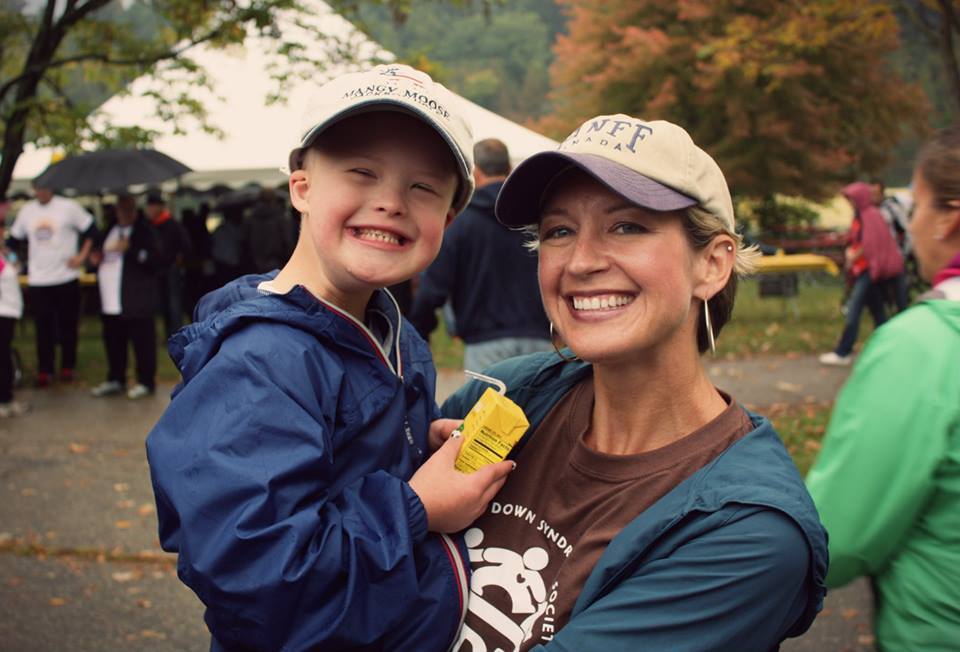
But on that blue swivel chair in the orthodontist’s office, I really didn’t even need to know why Wil had an underbite. I didn’t have to seek out any specialists, programs or community support. I didn’t need to create anything or join forces with others to create something. I just sat there and listened; and learned something casually new about my juice box-toting boy who is now turning into a man.

Inclusion Slam Dunk!

Wil’s paraprofessional, Kristi, told me how Wil — of his own will — went to the closet in gym class, pulled out two baskets and two balls. He proceeded to toss the balls in the baskets. His peers joined in his created game by cheering him on.

Today I picked up Elizabeth, Wil and their friend Kimmy from school today. Elizabeth had an NHS meeting, so Wil, Kimmy and I sat in the car waiting for her with the windows down. As kids poured out of the school, Wil yelled out his hellos, and peers called out and waved to Wil. One friend, Trent, walked up to our car and chatted w Wil. Trent has about every sport there is on his letter jacket. After their chat he fist bumped Wil and walked away.

Wil takes this all in stride, having no idea how this type of interaction is not commonplace. To him, it’s just another day at school with friends.

Kimmy, whose aunt and sister have special needs, said how embracing of Wil the students are at school. I responded that it fills my heart; its what inclusion is meant to be. Wil’s experience is as it should be but isn’t how it always is.

Kimmy agreed, saying she sometimes forgets how people don’t grow up under the same circumstances as she does, and don’t always understand certain reactions and behaviors of individuals with special needs.

I’m so thankful for this Community School experience. It’s enriched my life as much as Wil’s. It’s what inclusion is meant to be — a benefit for all. It’s about friends being friends; of all abilities.

Let Us Embrace Our Vulnerable Population

In embracing our vulnerable population we embrace our own vulnerabilities.

We crave Love. Love is the base of all things. Love is survival. We crave, live and breathe for Love.

In embracing individuals that we previously misconceived as having lesser value, we find in fact their value is greater than ours as theirs is the truth-pathway to LOVE. In embracing those we do not fully understand; we must find within ourselves a deep patience and seek to view life in new and fresh way. It is in this way we find Love — a love deeper than we knew existed. A love that touches and speaks of God. We feel God and His Presence even if we are not religious; even if we are non-believers. Whatever we believe, we cannot deny what we feel. We call it Love. And yet it matters not what we call it. It only matters that we FEEL it.

Once we are touched by that feeling, we crave more. This Love lifts us, lights a fire within us. We find it hard to believe it was something we closed ourselves to. But we did not know we were living behind a closed door until our child with a disability; or our experience with individuals with disabilities opened the door for us. The blast of fresh air is what alerts us once we open our minds. It blasts us with a gust, not unlike a hurricane; it forces us out of our closed mind so far that we can never go back. We never want to go back. In fact all we want to do now is pound on closed doors in our desire that those behind the closed doors know this Love.

We see the fear, and know the difficulty to get past that fear. But once you feel the blast of fresh air in your face you cannot but want more of it, and want more of it for others. And so you advocate for your child, but it is so much more than equal rights and acceptance. It is a Love, a Love for all that lays hidden. A Love that is locked away inside of us. We are scared of it’s immensity. But in the fight for your child you release it. You must, for their sake more than yours. And you find in this unlocking a Love greater than you ever knew existed but it does exist in immensity all around you. And when you breathe it in fully it grows and grows and grows. There is no end to it, and though it is bigger than you could ever conceive, even a small slice of it breathes new life into. You cry in the sheer love that you feel. And you know you can never run out of that love because it is always there, it is bigger than anything your mind can conceive.

You must re-open yourself to this Love every day. Recharge yourself with it. When the doors start to shut due to habit or other’s actions — your child opens the door for you with a kiss on the cheek, a simple gesture, or a silliness. And when you try to describe this type of grand simplicity that has the power to open a door, those behind closed doors see only the simplicity of the gesture, as they have not opened themselves to the grandness. They refuse to open the door to this Love, staying in a sheltered space they know. Fully unaware that the immensity of Love is available to them if they only unlock the door. But when we don’t know, and what we only know is behind the door there is great security in that. There is great control in that. And we think we are thriving when really we are not. We have created a life that feels good behind the closed door. Even when it doesn’t feel good, it is what we know — how terrifying to go outside of what we know.

When we spend time to truly know and understand our vulnerable population, oh, what LOVE. It is open, it is free. Our children never tire of opening the door; it is their nature. It is on us to open ourselves to them.

You will know when you feel the Love. This Love is yours, it is all of ours. It is in endless supply. Let us circulate it. Let us ventilate closed doors. Let us embrace our vulnerable population.

HOW WE BEND

Today Wil and Manny went bowling. Both are teens with Down syndrome. Manny’s mom, Laura, and I share frequently about our plans, thoughts and concerns for the future. Thoughts about our boys as they age out of the school system; after friends have moved on to college, to jobs, to get married. How will our boys adapt to the change? What programs are available now and in the works for the future? And of the programs available, are they a good fit for our boys?

Last night my friend, Cheri, who’s son CJ (who you may know from his weather reports—WCJR weather) called me. CJ is graduating high school this year and also has Ds. Cheri and I shared our thoughts and plans for our boys’ futures. Cheri is always a step ahead of me in raising CJ, and I learn greatly from her experiences.

Not everyone has a teen child with Ds. We must actively seek one another out, actively seek out programs, and discern if what’s available is the appropriate fit for our soon-to-be adults. In fact, just today, Wil had an interview with a summer camp I’ve tried for years to get him into. Wil is ready for an overnight camp, but not without an aide. Just going to a typical summer camp is not an option for him. And that is the case for many people with disabilities; thus the long waiting list. The interviewer said Wil’s a really good fit, but spaces are very limited. She was wonderful, we connected immediately, and said she’d do what she can for him to get in.

Recently talking with my friend, Vanessa, who has a teen daughter w Ds said to me, “You bend for the ones you love.” That statement delivered great clarity to me. It makes sense of what connects me to a camp counselor I just met on a 30 minute Zoom meeting, but knew her innate understanding immediately; and also what connects me, on a deeper level, with my friends. We bend to create understanding and opportunities for people with disabilities. We bend together for the ones we love.

As Vanessa spoke those words, I visualized trees that stay closed in, protecting the roots they know, refusing to bend. Then I visualized trees firmly rooted in love, but with branches reaching, stretching, bending, some almost impossibly yet never breaking, open to receive the sun along with the rain — both of which serve to strengthen them.

If you were a tree, what kind of tree would you be? 😉

House of Cards

Most of us don’t choose to be caregivers. Then next thing you know, you find yourself standing on a house of cards.

Last night a friend was at a neighboring table for dinner with her husband and another couple. After they had eaten dinner, the other couple left. As our friend tried to leave, her husband refused. As he’s endured multiple severe health issues, life circumstances now have our friend in the dual role of wife and caregiver. He wouldn’t leave because he’d forgotten he’d eaten dinner, and thought his wife was trying to make him leave before eating. Try as she might to convince him he’d already eaten, he sat steadfast.

Though the differences are many, I saw many parallels in Wil’s determination not to be swayed and our friend’s husband’s determination. I intimately knew the tears in her eyes. I felt her frustration not of just that moment, but of all the moments built as carefully, patiently, diligently and lovingly as a teetering stack of cards; that in just one moment, comes falling down.

After the cards collapse a number of times, you just feel so tired of it all. All of those cards, all over the floor, and one by one you must build them back again. Sometimes, it goes smoothly, and sometimes that one card keeps falling so as it’s impossible to build on it.

I knew this cycle with Wil. The only two solutions our friend had at this point were to wait him out until he decided for himself it was time to go (which could be hours) or a fresh voice to break the spell (as the caregiver’s voice is heard so many times, pleas can fall on deaf ears). It is a new face, or a new voice, that often breaks the spell.

My dad was the one who stepped in, and I looked at our friend, our eyes connecting in a knowingness. It’s hard, and no one asked this kind of hard, but there is so much love here, so much that we’d do for our loved ones, that makes the hard parts both more challenging, and yet strengthens us at the same time. And when friends step in to help, the wobbly card steadies and we can start building again.

Just before the holidays, a member at work shared with me that she was bringing her mother, who has dementia and lives in Florida, back to Michigan for a visit. She said, “Though Wil and my mom have many differences, I now know how you feel when you fly with him. You just don’t know if they will cooperate or not, so you prepare the best you can. Then you find out there is always something you didn’t think of, and things fall apart. And other times things go so smoothly that you wondered how you worried at all. You just don’t know.”

While visiting my parents in Florida, Katherine, Elizabeth, Wil and I went to the Naples Zoo. Wil gets hot easily, so we went on the coolest day. When he grew tired and too hot, I found an area by the zebras which was shady and he really enjoyed. Though Wil is very capable of walking the zoo for the day, its his building overstimulation with the heat, with the crowds and with the animal noises that eventually get to him.

Every year I find ways to keep him at the zoo longer. Every year I learn from the previous year. But I never let him sit it out. Because every year Wil learns how much more he can do. I’m fortunate that the twins can walk off to enjoy the zoo on their own, and circle back to Wil and me, instead of stopping every time Wil and I do. They know how this works. We build the house of cards together.

When Wil finally hits a wall after stops and starts, he still has to make his way back to the zoo entrance. As this zoo is near my parents’ home, they are fortunately available to pick Wil up when that “wall” is hit. I sit with Wil as long as he needs me to, as his will to walk to the entrance is his only way out.

We don’t choose our situations; they choose us. But we do choose how to utilize the time within our situation. We do choose whether to keep building, even after the cards have fallen. When times get hard, locking tearing eyes of understanding mean more than words could ever convey. They give us strength to build again and again; as many times as it takes.

Internal victories are what carry you and lift you through the hard times. Even 30 more minutes at the zoo on this visit delivered an internal joy with iron-clad strength—a strength and joy that will not fade with time or circumstances. I can build a million cards with the super-sonic strength of 30 extra zoo minutes many take for granted.

Caretaking is unpredictable and challenging, yet it brings out our best, and brings us all together if we allow it to. It’s what humanity is all about. (But if you challenge a caretaker to a house of card building game, they will mercilessly kick your ass.)

Unwrapped

Wil double-stepped down the broad concrete steps. He paused. Then he threw both arms back, hinged forward at the waist, and propelled himself over the last step. Mid-air he hollered, “Jump!”

He landed flat-footed and straight-legged.

Dang, when will he ever bend his knees?

“Mom, jump!” He yelled.

I exaggeratedly swung my left arm back, but kept my right elbow tucked in tight to protect a cup of lidded coffee. I jumped and landed softly with bent knees, then lifted my right arm in an effort to match the flow of my coffee. A deep brown dribble of coffee escaped the small hole in the lid and slid into the rim. I sipped it from the rim and raised my cup to Wil.

“Woohoo!” He yelled.

“Woohoo!” I yelled back.

“They are angels.” A woman said. I spun around. She sat on one of the ornate ice cream parlor chairs in front of the coffee shop. She was dressed in full-on Kelly green. I could barely discern where her shirt ended and her pants began.

“I’ve worked with many Down’s people. All angels.” She said.

I heard Elizabeth and Katherine, as clearly as if they were there, burst out in laughter. Then in my mind I heard Elizabeth say, “Does an angel throw your favorite comb down the heat vent?”

My mom-mind immediately targeted the woman’s lack of person-first language. But like Wil’s straight-legged landing, a correction would have stolen the meaning of the moment. The woman clearly cared about the person; she cared enough to reach out to a stranger and share the ultimate compliment.

So I smiled. I listened. Then Wil got antsy. I wished her a blessed day.

Still, her comment sat like a lead ball in the pit of my stomach. I needed to reach down deep, lift it up and roll it around until I could identify what the weight meant to me.

Then I saw it…she had put individuals with Down syndrome in a box. It was a beautiful white-feathered box placed on the very top shelf, with the utmost care and kindness; but it was still a box.

I realized I had put myself in a box too; labeled: to educate or not to educate. It’s a grown habit that becomes ingrained over the years of hearing stereotypes both well-meaning and not. Of watching your child reach milestones in micro-moments, so even the slightest bend in the knee does not go undetected.

But sometimes moments are meant to be moments. Moments to take a leap and land just the way you are. Moments to accept a stranger’s kindness by her intent rather than her words. Moments to unravel what sits heavy with you, unwrap it and let it go.

If there was an angel that day, it was one who whispered the vision of Katherine and Elizabeth in my mind; filled with laughter and words to match the moment and burst open the box.