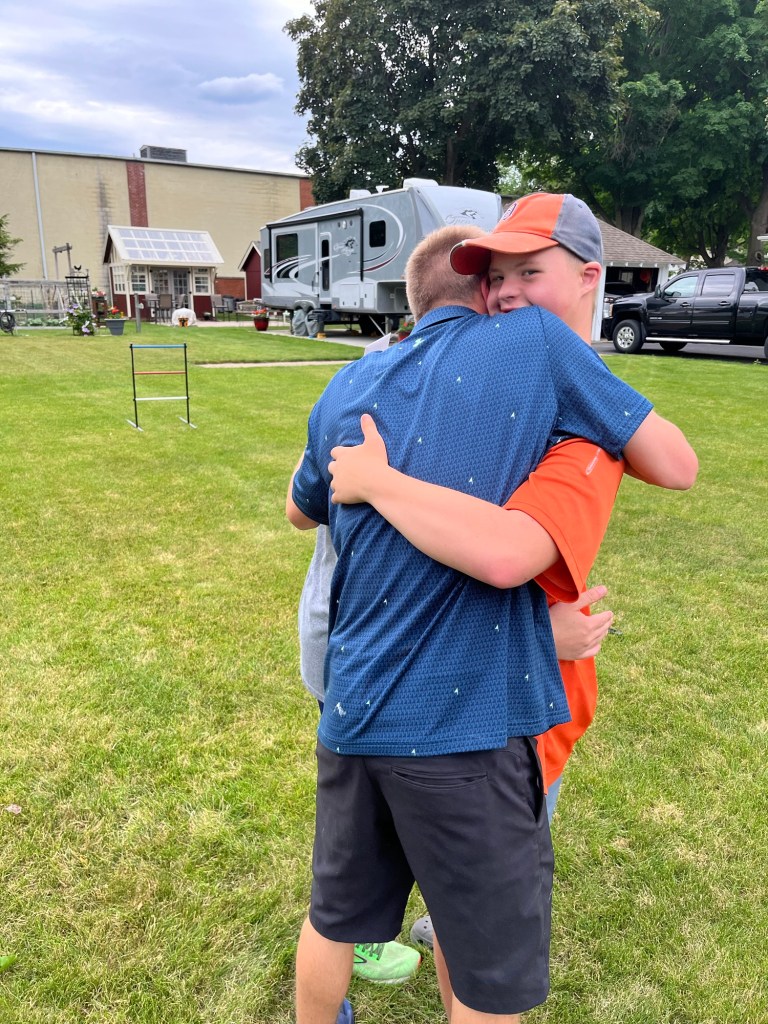
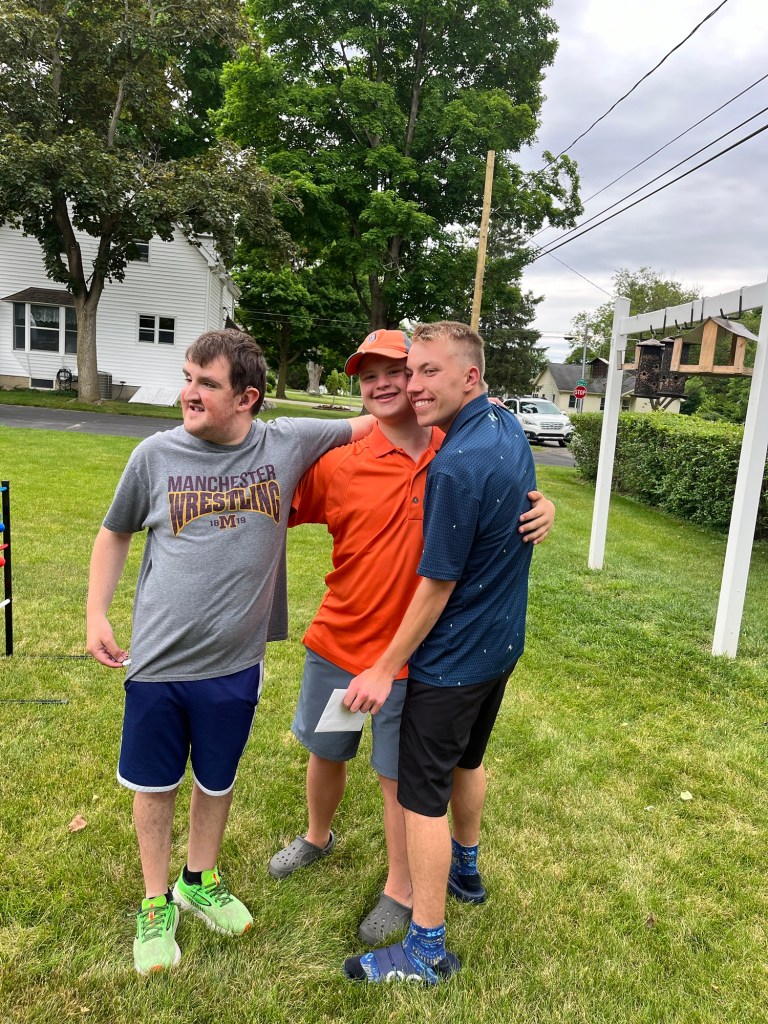
Just 2 years ago during graduation party time I needed an eagle eye on Wil. At one party he fled the party and would not leave the front porch. At another he ran to a side street and sat in the middle of it. Yesterday, at each grad party he hung with his buddies. And made new buddies. He played cornhole with known and new friends. He joined a basketball game with upper classmen from MSU. At each party, I only went to check on him here and there. A stark contrast from two short years ago.
He’ll be a senior next year, and then likely on to a young adult program. When he’s 20 he may have a whole new level of independence from what he has now. Time, opportunities, supports and his own will will tell.
Every individual is their own, no matter their disability. We cannot define nor predict their growth, but we can observe, we can open doors, and we can learn where to step in and offer supports, and as I’m currently learning, when to step back.
I’m not a patient person. But I’ve been called patient a lot since raising Wil. And I started to believe I grew in my patience. It’s possible I did.
Last weekend Wil got stuck, and we had a very important wedding to get to. As the clock ticked I grew very frustrated. I wasn’t feeling patient at all. You could say I lost my patience, but it was that very loss that a new realization within me occurred. Patience is not a driving force.
It is a desire to understand.
It’s that simple. And it’s that hard sometimes.
When I was pressed for time, I may have lost my patience, but more importantly is that I lost my desire to understand where Wil’s resistance was coming from. Standing there with the patience of Job wouldn’t have helped any of us without a desire to understand. I thought for a minute.
“Do you want to wear your new outfit in the car?”
Wil looked up at me and nodded.
“Ok, it’s a 2 hour drive and you’ll get all wrinkled. We are stopping at Grandma and Grandpas on the way. How about you change there?”
“Mmhmm,” he agreed. And that was that.
Sometimes it’s not that quick. But sometimes it is. Most importantly, who doesn’t want to feel heard, especially when they can’t find or process the words?
I may have to find patience within, but the desire to understand is what leads the way.
I’m no born-natural. I’m not made to raise a child with Down syndrome.
But here I am. And working as a paraprofessional, no less. I have a lot to offer, we all do. But I have a lot to learn; that’s exactly why am I where I am. Not because I was born with a special gift. I’m here because I have reason to care. And I do care; I care a lot.
The children I work with now have very different skill sets than Wil. Navigating these little humans’ ways of processing their world has been a great challenge and a great joy. I have good days and I have bad days. The bad days are hard. I beat myself up, and I’m working on that within myself. But I’m working with humans, and when I make a mistake it hits me personally. The upside is this is a high motivation for me to learn more – I’m always trying to figure out how to do things better the next time.
Raising a child with a disability I have come to learn one truth: life does not move in a straight line. When you think you’ve got one strategy down, you get thrown back 3 feet the next day. It reminds me of a game my Grandpa used to play with my sister and me as young kids. He’d sit on the back porch, leaning back in a cushioned chair blowing out smoke rings from a Viceroy cigarette. My sister and I would stand all the back at the end of the yard. He’d call out if we were to take small or giant steps forward and back. If we forgot to ask “Mother May I” we’d have to go all the way back to start.
Some days there is this invisible trigger within these children that I trip, and just like forgetting to say Mother May I, I get sent all the way back to start. But I get smarter, and I learn more and forget less. And finally, when I’m able to help one of these children through their emotional distress and they open up in communication, and they look up and smile at me, I float higher than one of my Grandpa’s smoke rings that I loved jumping up and catching on those long, summer days.
My work is hard. Raising Wil is hard. But so is just about everything else that we at first do not understand. Seek first to understand. Within those four wise words is enrichment in life. I’ve never lived so deeply as when I fully accepted my son. I still revert at times. I still go back to wanting the kids I work with to just do it my way. It’s easier that way – for me. But it’s not their way. It’s not the way their brains were made to work. And it’s also not all about everyone having their own way either. It’s about learning to work together.
Wil and I are recovering from Influenza A. He was all excited to get out of the house, but when it was time he got stuck. I sat down with him. I asked him what his upset was. Wil takes time to process and time to share. So I just sat there for 5 minutes. Not because I’m made for this, but over the years I made myself for this. And we unwound his wound-upness and we left the house without further issue. No one pushed anyone. We both had our say. It’s just time.
That’s what I am navigating now with the kids I work with. I’m learning again like I learned with Wil. I’m learning their way of doing things. Their way of thinking. And when I find that patience within myself, and I give these kids the space they need, it’s the most enriching experience ever. But sometimes it’s really, really hard to get there. Sometimes I’m just worn out from a 45-minute bout of emotional deregulation with still no progress and I walk away in tears. Because this is a human being and I’m disappointed in myself for not finding a way, and I’m tired and frustrated. Again, I’m not made for this but I’m finding my way because it’s so worth it. But like that game with my Grandfather, even though it can feel like it’s a setback, it’s really a setup for growth. A setup for being made for this. I get smarter, and I do better for these kids.
Inclusion is not easy, but it’s not evil either. On paper, it looks beautiful, and there are many proponents of inclusion that are more in love with the thought of inclusion than the reality of it. On the flip side of the paper, I still hear people say they “don’t want my kids with those kids.” Both stances are ignorant. Inclusion takes work. Inclusion takes listening and understanding what our kids with disabilities need just as we do for typically developing kids. It’s a game of Mother May I. When Wil had his first behavior plan in middle school, the first thing the educators told me was that it was a very fluid plan. We knew where we wanted to go, and we set parameters to get there, but the exact timeline and the exact steps would have to be navigated and adjusted along the way. What mattered most was that everyone at that table cared. We cared a lot. And that is what got us all through Wil’s puberty years to successful high school years.
No one is special and we all are special. We all belong together, no matter how pretty or messy it is and how many steps it takes and in how many directions we have to go.
The only requirement is to care. And that I know is natural within all of us. We just need reason to find it.
Wil talks all the time. He talks to me, he talks to friends, he talks to himself. I wonder at the time, listening to him today, how one hesitant word was cause to drop everything and celebrate. His verbalization today was once a distant, fuzzy dream. Like reaching for a cloud that my hands couldn’t quite grasp.
Wil does have a tendancy to stutter when he’s excited — his emotions overtake his ability to choose his words and his words get jumbled up. I get it; even the most poetic words could never fully describe an emotion.
When Wil sings, however, there is no stuttering. His emotions, paired with the words, are set free in song.
When Wil talks to himself, there is no hesitation in his words either.
“Lunch?” He’ll ask himself.
“Yeah, yeah, lunch.” Is his reply.
“What do you want? Hot dogs?” He prods.
“Mmm, hot dogs? Yeah, hot dogs.” He answers himself.
“With mustard and peppers. And relish. Mom! Lunch!”
When his self-talk first emerged, I worried. I remember when I first heard it. He was sitting on the floor of his bedroom in front of his closet. He had a back-and-forth conversation with himself on what toys to play with. It was also at this time that the gap in abilities with his peers was becoming very clear. So this timing had me wondering if he had created an imaginary friend because he felt lonely.
Wil has had the same peer group since kindergarten and they exemplify what inclusion is. Even so, I wondered how this gap in abilities that I saw expanding was affecting Wil emotionally. He didn’t act sad about it. He still talked about his friends in the same way. But there was this self-talk emerging and I didn’t know where it was coming from – other than Wil, of course.
I googled “self-talk Down syndrome.” I found this phenomenon is very common amongst individuals with Down syndrome. It’s simply a way to process thoughts. As Wil grew older and we spent more time with teens in our Down syndrome support group, I realized how typical this is. Now it’s just what Wil does. It’s just what is.
As Wil grows on the outside, I grow on the inside. The stigma of the outside disappears when I find understanding on the inside. I frequently look back and wonder at what I once wondered at. It’s an emotion beyond words.
Last night Wil’s music therapist recapped his session with me. She said, “I know how hard positioning his fingers and his wrist is for him . I can see his restraint from giving up. He has a lot of focus to keep going. That shows me he has been well supported.”
That last sentence 😭 All the years with his educators and therapists and at home. The long stretches of time with few signals of what is working, and what isn’t. Until one day, progress rises up like a submarine shining upon the horizon, revealing the quiet forward motion that had been motoring under the surface all along.
When you see it, you can’t help but feel your eyes sting from the brightness reflecting off the surface.
We historically do not like people who think differently than we do. We want things to work out the way we want them to and we surround ourselves the best way we can so things work out the way we want them to. When things don’t work out the way we want them to we get upset. We may blame ourselves, we may blame others, or we may blame God.
People with disabilities don’t work out the way we want them to. Think on how people with disabilities have been treated through the years. Disability is not seen as a part of the human condition. Disability has been explained away as a curse, a burden; shamed, hidden, tucked away. A therapist once asked me if I blamed myself for Wil’s birth. Hmmm, she didn’t ask me if I blamed myself for Katherine and Elizabeth’s birth.
Wil doesn’t fit into the definition of “things working out the way we want them to.” Sure, you could argue nothing really does, but did people celebrate your baby’s birth or tell you they were sorry? Wil lives outside of the above definition no matter how broad, wiggly or faint that line is.
There is a 5-year-old boy with autism that I work with. When we are out in the hallway transitioning from the classroom to a special, he likes to pretend he is a chameleon. He’ll push himself up against the wall and tell me he’s invisible; that I can’t see him. It’s a stall tactic, of course. I play along, asking where he went. I ask passerby’s in the hall if they can see him. The passerby’s smile, look back and forth down the hall and put their hands up. “I can’t see him anywhere.”
One day I thought of circling my fingers around to my thumb and placing my circled hands up to my eyes like glasses. I twisted my hands saying, “Click-click-click. I’m adjusting my invisibility goggles. Ahh, that’s better, now I can see. Hey, there you are!”
Raising Wil is like wearing invisibility goggles. I never knew this whole new way of seeing things was always available to me until I had a reason to care to see it.
I made my way through life, thinking the thoughts I did, defining things the way I did, without much further thought. I’d look up, I’d look down, and if things didn’t work out the way I wanted them to, I’d make them conform to my definition of what worked for me. My definition of “right.”
But what is right? What is normal? According to whom? Even if we don’t want to, we all have innate definitions of what these words mean to us.
Now I believe a better question is, What is? What is right in front of me? Am I seeing it for what it is?
Click-click-click.
My answers to these questions will forever be limited by my own vision; my own versions of right, my own versions of what works for me. My answers, though, as limited as they are, always have room for expansion. My view is no longer static, but fluid. There is always another level to view, another perspective to consider, another evolution to realize.
Raising Wil, I quickly realized I had to be fluid in my learning or I’d go crazy. The perspective I had at the time of his birth was not conducive to raising a child with Down syndrome. But here I was. It didn’t work for me, but I needed to make this work for me.
I realized then that I had a pair of invisibility goggles burning a hole in my pocket waiting for me to notice them. When I did, I never looked back. Invisibility goggles don’t work in reverse. The just look deeply inward, and expand outward.
Yesterday Wil and I were driving to get his hair cut. Wil always takes my phone, searches what he wants to play on Amazon music.
If he diverges from Luke Bryan he’ll say to himself, “how to spell Dierks Bentley” and type it out using phonics. Sometimes this works, and sometimes it leads to frustration and more tries. I listen as he figures it out, only helping when necessary.
Wil used to think Rodney Atkins’ name was Ronnie. He was adamant about this. But his searches lead to dead ends.
“Wil, it’s Rodney. Like a fishing rod, and your knee. Rod-knee.” I mimicked throwing a fishing line then pointed to Wil’s knee. Wil liked this explanation so gave up his strong adherence to Ronnie. Rodney became a joke between us, Wil throwing a line and hitting his knee.
There are two parts to nearly every story with Wil. As a parent, I always notice the learning happening. Always. It’s part of my every day with Wil and has been since day one. He needs extra in life, and the extra given gives back, without fail, in every experience, no matter how seemingly small.
The other part of each story is the joy. It’s pure. Because Wil is Wil. He’s all in to who he is, and that can not be faked. That’s why people are drawn to him.
There is a vulnerability to that which scares me. He can easily be taken advantage of. And yet, his vulnerability is the bravest way of being a human being without the effort to be brave. Wil is Wil.
When Wil listens to music he is all in. He rocks back and forth in his seat. As I’m driving, I sing and move my head but don’t rock at his level or I’d be off the road!
As is often the case, we will reach a destination and he wants to finish the song. I decided to match his back and forth rocking. It was a damn workout and I only matched his pace for just over a minute.
We’ve been at stop lights where people look over because he is moving so much. He never notices them looking but if he did, he’d look over and smile and keep on going without missing a beat. That’s authentic joy ~ freely sharing your inner joy outwardly with whomever wants to join in, and if they don’t he’s not bothered because he is all in.
As for me, I’m always learning too. The extra I give Wil always gives back more than I could ever give or have imagined to receive.
Wil loves putting ornaments on the Christmas tree. Using his fine motor skills has always been a challenge for him; especially pinching.
As you can imagine, placing ornaments with loops on top gets tiresome quickly for Wil — but Wil always finds a way. When his pinching fingers are worn out, he puts the ornament loop on the very edge of a branch, or just slides that ornament right into the tree and nestles it between branches. He has as much pride in this placement of ornaments as he is still participating in decorating the Christmas tree.
I’ll wake in the morning to multiple ornaments on the floor that slipped off their precarious perch over night. I then look up and browse the ornaments he’s tucked into the Christmas tree. As I stand there my entire being is consumed in a humorous joy that is from somewhere deep inside me. My joy is such it could elevate me directly to the ceiling like in a Mary Poppins floating tea party.
My deep joy is born of deep worries. Deep worries I had in Wil’s younger years when I learned of his low muscle tone. Of when I cried seeing his fine motor skills test scores report a 6-month-old’s ability level when he was 5 years old simply because he couldn’t string beads yet.
I’ve learned a lot about the values and deficiencies of tests over the years. I’ve learned what to take at face value and what to hit the delete button on. I’ve learned a lot about taking life day-by-day. I’ve found myself celebrating what I didn’t know would ever happen— I’ve found a patience in myself waiting for even a glimmer of it to happen. And I’ve found myself become someone who celebrates in vivid colors “what is,” while “what isn’t” quieted itself into a hazy, distant background I once knew.
What I once worried about does mean a lot. But not in the way I thought it would mean today.
This nestled ornament is not only made of paper, styrofoam, cotton balls and glue — it is a symbol of deeply nestled worries grown into a deep, uplifting joy.
Wil had a very hard morning. He would not get out of bed. Would not budge. Usually I tickle his feet. He laughs, sits up and says, “Hug Mom!”
He loves high school so even if he’s tired he is typically happy to get up and go. This morning was a throw back from the middle school years when hormones were running high and he had feelings he could not process or communicate at the time which lead to many new behaviors. But we emerged from that time; even if he has a slow start now, he can talk to me and work through it on school mornings.
I racked my brain as to the causes of his demeanor. My guess is a cold is brewing within him as I’m sick, plus he had Social Group Wed night and Music Therapy last night; he’s probably just plain tired.
As he laid in bed, he grew increasingly upset with himself for not moving, which ironically kept him in the “feeling stuck” loop. A wise special education teacher, Mrs. Hancock, shared with me that on these situations it’s about responding not compliance. I thought Matt, being a fresh person in the scenario, would help break him of this stuck loop.
I called my husband Matt at work on speaker phone. Wil shared with Matt that he was “upset.” I felt my heart jump up and cut through my stress with elation. For Wil to share his emotions in his current emotional state was a very important advance. After talking to Matt, Wil was able to unwind whatever was wound inside him and turn it around.
Wil started to get dressed but was still teary. I asked if he needed a hug. He gave me a tight one then I felt him loosen up. I knew then that he would be okay. I texted his teacher to let him know the situation and Wil may needed a calmer start to his day. I’m thankful he begins each school day in the life skills room rather than gen ed so he can go his pace to start and then gain momentum for choir, PE and art.
Our friend, Kate, had previously offered to drive Wil to school that morning, so again a fresh person always helps Wil’s demeanor and he adores Kate. When she walked in the door, she said she had his favorite songs ready to go in the car. Music to his ears (and mine)!
I was very rushed at that point — I hadn’t even brushed my teeth yet as I’d been trying to motivate and give Wil the time and space he needed for the last 30 minutes. I quickly made him his breakfast request to go — 2 turkey dogs with peppers, mustard and relish.
After he’d been in school for about 2 hours, I received a text from Jessica, whom I work with as a paraprofessional, forwarded a picture taken by Ashley who is working in his classroom. Seeing Wil smile big with his classmate buddies made me 🥹🥹🥹.
This morning was very hard, but as Mr. Rogers wisely said, “Look for the helpers. You will always find people who are helping.” ❤️
In this house we take no such statements for granted.
In middle school, Wil riding the bus proved unsuccessful. He was already having a hard time transitioning to a new school with new educators and hormones were in full effect. The middle school years are challenging; then add in communication barriers and cognitive delays that a body’s progression into puberty does not wait for, and you’ve got behaviors. Every day was a new experience, and we were rewriting the plan over and again. Finally, I called “Uncle” on the bus riding as it was adding stress to Wil amongst all the other areas we were navigating at the time. It’s challenging to do that, as you never know if you are giving up at the right time, or too soon. But what I have learned is no matter what the success — or lack there of — looks like from the outside, there is groundwork being laid on the inside.
Wil is now in 11th grade. He loves being 16 years old. And he is fond of reminding me he will be 17 years old on his birthday. He wants to go to college like his sisters. We will cross that bridge — in this house we are very used to crossing bridges as they come. As he is growing into his indepedence and his maturity has blossomed, he told me he wants to ride the bus home. I joyously concurred.
Last spring, he did ride the transfer bus from his high school to the elementary school where I work. This was very successful, so I think it was the perfect nudge to riding the bus the full way home.
All was going smoothly until 2 weeks ago. Wil walked to the bus like he always did, but then just kept on a-walking. His teacher ran after him and walked him back to the bus. Wil refused to get on. So Wil and his teacher walked to the office. His teacher called me and I picked him up. This happened every day for a week.
All I could get out of Wil was that the bus was too crowded. He refused to sit up front where it was quieter. But he is in 11th grade, so why would he want to do that? I suggested his noise-cancelling headphones. Wil is very aware of his looks, and doesn’t want to look different. I want to make clear that he is in no way ashamed of his disabilty, nor should he be. And noise sensitivity is part of his disability. But Wil puts great importance on his appearance, and you know by now his deep affection for baseball hats, so noise-cancelling headphones would throw off his style; and his hat. (Wil only wears his headphones now if he is at the movies or a concert, but he’ll only go to these loud places if he really wants to be there.)
So, here we were. Wil refused to ride up front where it was quieter. He wanted to sit in the back with his friends. But it was too crowded. So it makes total sense that he would attempt to walk up to the bus, get nervous and keep going.
Just being able to make sense of things is HUGE!! When Wil was in middle school, he was not able to express to me his reasons for being nervous on the bus. His educators and I had to do our best detective work, but with so many factors at play, our best guesses were only that — guesses.
As Wil could now tell me the reason for not riding the bus, we could have a discussion about it. Now Wil had true ownership in his decision as we could have a conversation about his options as I knew what the struggle was.
Whether what we come up with works for the long-term or not is to be seen. But what is most important is that Wil has a voice in this, and that is something he’s always deserved to have, and we’ve worked hard for him to share it.
With this knowledge, Wil’s teacher created a chart to hang in the classroom. Each day Wil rides the bus he will get a sticker. Wil thrives on recognition so was immediately into this idea. Every 3 stickers, I will take Wil to the market to pick out a handmade sandwich of his choice and a drink. He also loves this type of adventure.
Today is day one of this plan. I went up to the school and parked in the lot just in case Wil refused (I parked out of Wil’s sight so he wouldn’t backtrack.)
Wil’s teacher walked with him, and he successfully made it on the bus!
In this house, we celebrate successes!
Today is one day, tomorrow will be another. And so will the next. Every day we cross a new bridge. Every day I will feel a tightening in my stomach at 2:45 with one eye on my phone. And every day it doesn’t ring I’ll release the butterflies in my stomach to fly in celebration.
In this house, every day is a new day. We never take such things for granted.




 'WIL'ingness = Willing to Embrace Extra in Life