To the moms who supported me in those early years and beyond…
Instead of sighing, we laughed. Instead of crying, we laughed. Instead of our differences, we laughed. Laughter did not make light of. Laughter did not negate the challenge of. Instead, laughter is depth of connection. Instead, laughter is inner understanding. Instead, laughter is unity. Instead, laughter is fortitude to navigate the challenge of. Instead, laughter is kinship.
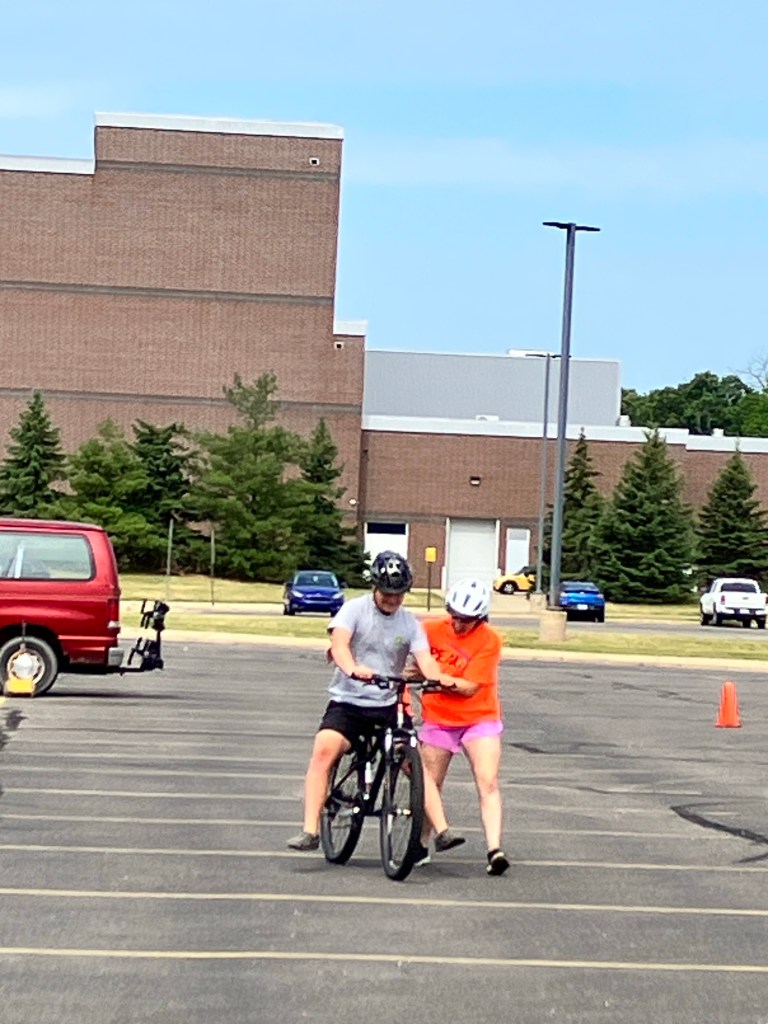
I just returned from Wil’s bike camp. And I’m really, really fortunate, you know? Because Wil can go to bike camp.
Bike camp is outside in a big, nondescript asphalt parking lot. The parking lot is in the middle of a neighborhood, so there are ample dog walkers, stroller-pushers, and an errant horn honk or construction noise.
That’s all very basic — except if you have a child who is sensitive to these things.
Depending on the child’s disability, a bark, a cry, or a loud noise puts their brains in immediate flight or fight mode. When their brains go in flight or fight mode, there is not the option to reason out of it. That mode sticks for a period of time. Their natural response is with behaviors that could endanger themselves and others. Even walking into such an open space without any other outside stimulus could be enough to trigger the flight or fight response.
Wil used to stay clear of dogs and babies because of their propensity for unpredictable bursts of noise. If we went to the grocery store and I forgot his noise-cancelling headphones, just the sight of a baby would send him running straight out of the store into the parking lot.
He doesn’t do that anymore. He’ll give dogs and babies the side-eye, but he can cope. Even when he went to summer camp the other week, a toddler was in our vicinity and she was fond of shrieking. Wil gave her nervous side-glances, muttered to himself, but continued with the camp check-in process. In the past, one shriek would have sent him running to the car never to return. Now, however, his desire to go to camp won over his fears.
His educators and I have worked very hard on this progression. To see him make it through experiences with outside stimulus that used to send him running gives me deep internal cheers each and every time. This knowledge of where we were to where we are now takes me to a higher plane of living. And yet, it also keeps me grounded because I know many parents who work tirelessly to find ways to navigate flight or fight responses. And no matter how herculean their efforts, standing in that parking lot is a freedom they and their child are not able to experience.
So friends, no matter where you stand, be grateful and be mindful. The nondescript space you take for granted could be a symbol of progression or a symbol of unaccessibility to another.
I signed Wil up for an online self-advocacy class. I logged him in, then left the room for a minute. In that minute he exited the meeting and closed the computer. Touché Wil 😂
There is no magic formula to acceptance of our friends with disabilities.
Acceptance, in its essence, is very simple.
You don’t need to be a special person. You don’t need to be born kind or compassionate or patient. You don’t need to be energetic or inspirational.
You don’t need to be anything other than willing to open your mind to acceptance.
That’s it. You don’t need anything else. It’s simply to be or not to be.
Once you truly open your mind to acceptance, the rest will come. The new ways of thought. The adventures you never considered. The new friends you wouldn’t have known otherwise. It’s the experience, once accepted, that delivers the specialness, the kindness, the compassion, the inspiration, the energy and the patience.
But if you keep your mind closed, then you’ll never know the amazing you are missing.
Acceptance is not a natural-born talent or a skill; it’s a choice. And that choice is up to you.
A sticky, filmy, wiggly smudge snaked across my computer screen. I’m not a fan of snakes, but I looked at this one endearingly.
Just a few days ago Wil was flipping through photos on my computer. They were photos of experiences at Camp Sunshine; the camp he’d be going to this very weekend. He smiled and called out to me to talk about each photo.
“Mom, a pool! Mom, a talent show! Mom, dancing! Mom, look a stage!” Wil’s finger followed the action of each photo. As he was on Camp Sunshine’s Facebook page, he went in deeper and deeper through the years. He didn’t want to stop looking, because he couldn’t contain his excitement about camp. He wanted the experience right here, right now.
It would be his first camp away from home; 3 nights, 4 days. Clearly, he was ready. I was ready for him. I’d been trying to get him into this camp for the last 4 years. When I finally was able to secure him a space, we then had an interview with Josie, his camp counselor. When we met Josie for the first time via Zoom she said, “The bad news is it’s hard to get in. The good news is for that same reason, once you are in, you are in.” Wil can go to this camp every year for as long as he lives.
When Wil and I entered the camp grounds, the camp was swimming in counselors with blue shirts on, and I’ll be darned if I could find one of them without a smile on their faces. The counselors were loaded to overflowing with just as much excitement as the incoming campers.
Many of the campers and the counselors had been coming back for years. As Wil and I waited in the line to hand medications to the nurse, we met Pete and his mom. Pete was 27 years old and this was his 6th year coming to the camp. At least 4 of the camp counselors approached Pete calling him by name as we waited in line.
“Hi!” A woman about my age with short, spiky gray hair in a blue camp shirt said to Wil. “My name is Kathy. What is yours?”
“Wil.” He smiled at her.
“Do you like fist bumps, high-fives or hugs?”
“Hugs!” Wil said. Kathy leaned in and the two embraced.
“And who is the beautiful woman you are with Wil?”
“That’s my mom!” Wil answered.
We were approached by many camp counselors just as friendly and effervescent as Kathy. Every counselor, without exception, addressed Wil directly. (You’d be amazed how many questions I get asked about Wil when he’s standing right there!) The counselors pointed every one of their questions to Wil as you would to any 16-year-old. As it should be.
After Wil was checked in and his medication handed over, it was time for Wil to go off on his own to camp. A young counselor named Conor placed a lanyard with Wil’s name badge over his head. As Wil bowed to receive his name badge, I felt the process almost knightly.
Next was the crossing-over ceremony. Multitudes of blue-shirted counselors lined each side of a walkway that lead to the cabins. Parents were not welcome on this walk. It was only for the campers and the counselors from here on.
“Do you want a loud or quiet send-off Wil?” Conor asked.
“Loud!” Wil answered without hesitation.
Cheers erupted as Wil marched forward through the walkway, pulling his suitcase behind him, never once looking back.
I stood on the sidelines trying my hardest not to fall into a body-shaking sob. My tears though, held no sadness. I cried feeling deep gratitude for the people that create a space such as this. A place that embraces my son for all of who he is. I cried seeing my son’s independence — it was an independence we had always worked toward but was never guaranteed. Many parents work this hard and certain levels are just not reached. So we celebrate every advance we work toward no matter where it lands us. And thus far, this is where we have landed and it is to be greatly celebrated.
It truly takes a village. Wil, our family, our friends, our educators, camp counselors and all of his supports. We all created this space together, in our own ways, and his independence means celebration for him, and also for the village.
I walked into the parking lot area where Wil was to take his PEAC bike camp. I was overcome with a positive, uplifting feeling — thankfully this type of feeling is not unfamiliar. I’ve grown accustomed to this shift from breathing dense air into a higher atmosphere in only one step.
This atmosphere is one of people helping people. It is beyond a good deed. It is true unity. We innately know the difference as it’s the way we are supposed to be — together.
This is one of the many gifts individuals with special needs offer us. We only need to rise beyond ourselves to accept this handed gift.
The past fall, I struggled with the thought of never truly being an empty nester. My thoughts were a twisted, tangled jumble of yarn – strands of prickly burlap wound tight around strands of brilliant, transparent glitter.
The brilliant strands of glitter represent Wil’s near constant song. Nearly every event calls for a song — when he’s playing, in the shower, in the car, or outside for a walk; anything and everything is inspiration for music. The brilliant strands of glitter also represent Wil’s ever-creative and impromptu silliness. Just yesterday Wil grabbed a branch, held it up and said, “Look Mom! I’m Tree Wil.” And we both broke up into giggles. I can count thousands of such impromptu acts over the years. There is nothing too small for Wil to make big of. He could make a brown paper bag fun—and has, many times! The brilliant strands of glitter also represent Wil’s ever-expanding growth, independence and self-advocacy. Each year he reveals to us more and more of what his true abilities are.
And yet, even at Wil’s highest levels of self-advocacy and independence, he will always be vulnerable. He will always need some level of care beyond his own. When thoughts of Wil’s vulnerability overwhelm me, the prickly strands of burlap sprout and wrap themselves tightly around the brilliant glittery strands, shrouding their luminescence and razzle-dazzle, weighing them down like a heavy, clingy, weedy vine.
It is the burlap strands I’m stuck in when I envy my empty-nesting friends their freedoms. Don’t get me wrong, I am happy for them – I thrill at listening to their planned or dreamed of future adventures. It is the sense of freedom that lay before them that I envy. I envy that for them this is the natural order of things – that this type of freedom is expected.
For our family, a lot more is to be considered — Wil’s care must always be considered. He can’t be left alone for extended periods so we are always aligning schedules. Vacations must be made that suit his needs. If a situation is loud and very crowded, Wil may refuse to go in. If Matt and I chose to go out on our own, who would care for Wil while we were gone?
I also felt the same when people talked about not wanting to live past a certain age. One night after a sporting event, Matt and I went out to dinner with only 2 friends that I knew and the rest were acquaintences of Matt’s. We were all spread out down a long, rectangular table. A man about my age and his girlfriend were seated directly across from me. During the course of conversation the man said, “Well, I don’t want to live past 80.” I then asked him why that was so. His reasoning, as you would expect, concerned his own abilities. I then asked him, “What if you had a child with a disability that relied on you? Would that change your mind?” He stared blankly at me.
We only see what we know. But there is so much more to see than what we know.
This past fall, I was seeing things just as that man across the dinner table. A tightly woven, blocked perspective.
If my mind stays stuck on certain freedoms that I don’t have, how will I open my mind to see all the freedoms that I do have? And all the freedoms available that I don’t yet see.
Wil continues to grow and expand in his maturity because he sees beyond a finish line to growth that many of us draw for ourselves. Wil’s creativity and spontaneity knows no bounds for the same reason. At one point, we stopped seeing branches that could be created to form Tree Wil. In fact, now many of us walk past branches that we don’t see at all.
There are so many things that I do not see! And Wil reveals that to me every day, many times a day. So why can I not unravel the heavy, clingy prickly parts of my own life and instead view them in a new light? Why not let the brilliant, glittery strands elevate my perspective?
Why, because my life may look different than another’s, can I not shine light on a whole new natural order of things? Why must my natural order match another’s?
What I see – and more importantly what I don’t allow myself to see – are the only blocks to my very own freedom no matter where I go, or don’t go.
We may believe our thinking is correct; or it is good—that we are good people.
Even those of us that call ourselves open-minded may find we have unwittingly closed off our minds when spending time with individuals with disabilities.
Why is this?
Because we have to see it their way first to understand. And many times — in some cases most of the time— their way is not easily readable. So we push our agenda on those with disabilities.
Individuals with disabilities’ way of communicating may be very different, or even non-existent in a verbal sense, so actions must be carefully observed. And even then we may remain clueless. It takes too much patience, and so we, even unconsciously, push our way on them, or we ignore them.
Our own belief system must be suspended to decipher theirs. We must let go of trying to be “good” or “helpful” because our version of what is good or helpful may not be for them. This very fact is likely the most challenging, and yet the most empowering process, in our very own lives.
When we suspend our own belief system in order to understand theirs, something shifts within us. Something bigger, something higher — spiritual even.
This process has no end. In fact, in 16 years I’m only just beginning. I’m stronger than I’ve ever been in trying to understand Wil, and understand the world’s reaction to him. I’m learning as a parapro to understand many differing abilities. It’s challenging and I need the expertise of those around me, because again what I think of as being helpful may not be helpful to them.
But it’s also so amazing to understand what in some ways may never be understandable. It wakes up something in me. Not because I’m trying to be a good person; it is because I truly want to understand what these kids are trying to say.
Those with disabilities are true gifts to us all—and yet this population is so very ignored and misunderstood. We must first forget ourselves, in full effort to understand another, and in that we find a stronger constitution of our own selves within.
These two young women have stepped up to the plate more than most realize; and they do it with love and grace.
That said, Katherine and Elizabeth treat Wil like any little brother — loving him, being annoyed with him, and standing up for him. Their life requires an extra level that is not easy to understand, unless you also have a sibling or loved one with a disability.
If you do, you are probably nodding right now. Here’s to you, and to the path you walk, and to what you give to this world.









 'WIL'ingness = Willing to Embrace Extra in Life